

BNS Section 318: Cheating Definition and Punishment Explained
BNS Section 318 defines cheating under the Bharatiya Nyaya Sanhita, 2023, and replaces Section 420 of the old Indian Penal Code. If someone deceives you into handing over property, money, or a valuable security, or induces you to do something you would not have done otherwise, that conduct falls squarely within this section. Lawyers, litigants, and law students searching for this provision usually want the same thing: a clear breakdown of what counts as cheating and what punishment follows a conviction.
This section is not a single offense with one penalty. It carries different punishment tiers depending on the nature of the deception, ranging from simple cheating to cheating that involves knowledge that the accused would default on a promise. Understanding which sub-clause applies to a given fact pattern often decides whether a complaint even survives scrutiny at the FIR stage.
In this article, I break down the legal definition of BNS Section 318, walk through its essential ingredients, explain how it differs from Section 420 IPC, and set out the punishment structure clause by clause. For drafting complaints or checking case citations quickly, tools like LeXi AI can pull verified judgments and cross-reference the corresponding IPC provisions in seconds.
Why BNS Section 318 matters for lawyers and businesses
Cheating cases rank among the most frequently filed criminal complaints in India, and BNS Section 318 sits at the center of nearly every commercial fraud dispute, from vendor scams to fake investment schemes. Businesses lose crores every year to deceptive dealings that never make it past a signed invoice or a forged purchase order, and knowing whether that conduct meets the legal threshold for cheating changes how a company responds, whether through a police complaint, a demand notice before filing a recovery suit, or both. Corporate counsel who understand this provision early can advise clients on risk exposure before a dispute escalates into litigation.
Cheating complaints carry real consequences for both sides
Getting the classification right under Section 318 matters because the punishment tiers differ sharply, and so does the cognizability of the offense under the criminal procedure code that replaced the CrPC. A simple cheating allegation under the base clause is treated differently from one involving knowledge of an intended default, which carries a steeper sentence and often triggers stricter bail conditions. Filing under the wrong sub-clause can result in a complaint being quashed at the threshold, wasting months of a client's time and money.
A cheating complaint that cites the wrong clause of Section 318 often collapses before it ever reaches trial.
Businesses face this provision more than they realize
Routinely, companies encounter fact patterns that touch Section 318 without recognizing it as a criminal matter at first glance. Consider these common scenarios where the provision becomes relevant:
- A supplier accepts advance payment and never delivers goods, with evidence suggesting the intent to deceive existed from the start.
- An employee submits fabricated expense claims backed by forged bills.
- A business partner induces investment by misrepresenting company financials.
- A buyer issues a check knowing the account lacks sufficient funds, coupled with false assurances of payment, which also makes cheque dishonour a criminal offense in its own right.
Each of these fits within the elements of cheating under Section 318, but only if the deception and the resulting harm can be proven with the right documentary trail.
Lawyers need this provision to advise clients accurately
Spotting a Section 318 case correctly protects lawyers from filing weak complaints and protects clients from defending against exaggerated ones. Practitioners who draft complaints, bail applications, or quashing petitions under this section need to move fast and rely on drafting habits that keep pleadings precise, since courts scrutinize the initial pleadings closely for whether the ingredients of cheating are even made out on the face of the complaint. AI-powered judgment search for cheating precedents saves the time many litigators do not have during a busy caseload, which is exactly where a tool like LeXi Agent helps by pulling relevant precedents and flagging gaps in a draft complaint before it goes on record. Understanding this provision thoroughly, rather than treating it as interchangeable with a breach of contract under the Indian Contract Act, 1872, is what separates a complaint that survives scrutiny from one that gets thrown out at the first hearing.
How to identify the elements of cheating under Section 318
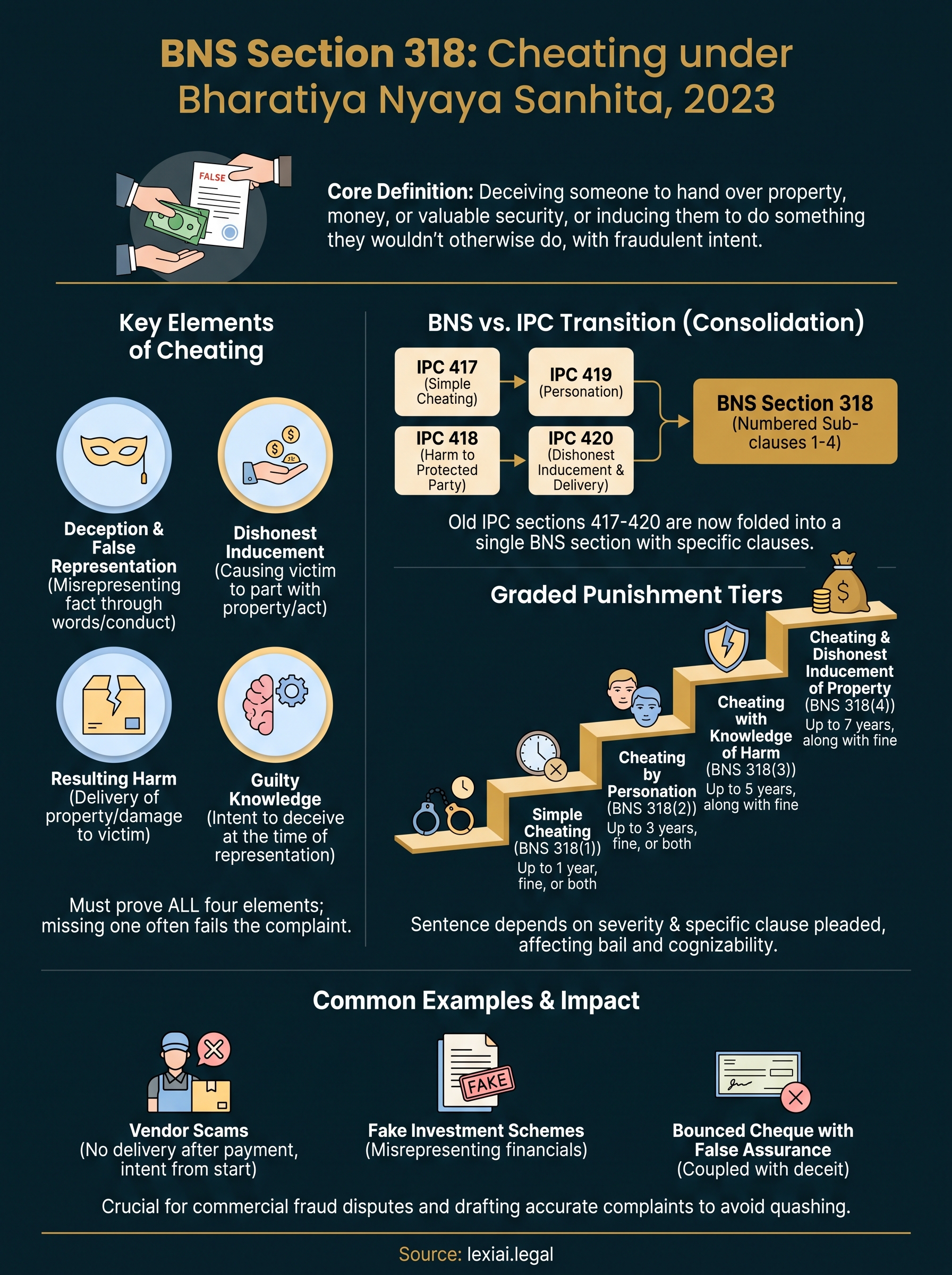
Establishing cheating under BNS Section 318 requires proof of specific ingredients, not just a vague sense that someone got a raw deal. Courts examine four things: deception, dishonest or fraudulent inducement, resulting delivery of property or damage, and the accused's state of mind at the time the representation was made. Missing even one ingredient usually means the complaint fails, regardless of how badly the complainant lost money.
Deception sits at the core of every cheating case, and it must be an act, not merely silence or a broken promise made in good faith. The accused must have made a false representation, whether through words, conduct, or a fabricated document, that induced the complainant to part with property or act against their own interest. Fraudulent intent at the time of the representation is what separates a criminal case from a civil dispute over a failed business deal.
A promise that turns sour later is a contract dispute; a promise made with no intention of keeping it from the start is cheating.
Breaking down the essential ingredients
Here is how the elements typically map onto a fact pattern that lawyers evaluate before drafting a complaint:
| Element | What it requires |
|---|---|
| False representation | A statement, document, or conduct that misrepresents fact |
| Dishonest inducement | The representation causes the victim to act or hand over property |
| Resulting harm | Delivery of property, valuable security, or damage to the victim |
| Guilty knowledge | Intent to deceive existed at the time of the representation, not afterward |
Guilty knowledge is the hardest element to prove and the one most litigated at trial. Investigators typically look at communications, financial records, and the timeline of events to determine whether the accused ever intended to honor the commitment. Documentary evidence, such as emails promising delivery dates the accused knew were impossible, often becomes the deciding factor in whether a case survives past the charge-framing stage, so it pays to know what counts as evidence in Indian courts today.
Punishment and sentencing for cheating under Section 318
Punishment under BNS Section 318 is not a flat sentence but a graded scale that tracks the severity of the deception. Simple cheating draws the lightest term, while cheating that involves personation or a calculated scheme to induce delivery of property draws the harshest. Courts decide the applicable clause based on the facts pleaded in the complaint, so the drafting stage directly shapes the sentencing exposure an accused faces later.

Graded punishment matters because it shapes bail strategy from day one. A complaint that pleads facts supporting the higher tiers, such as personation or knowledge of an intended default, faces a tougher road at the bail stage than one confined to the base offense. Defense counsel and prosecutors both need to map the facts against the correct sub-clause before the first hearing, not after.
The punishment tier under Section 318 depends entirely on how the facts are pleaded, not just on how much money changed hands.
The tiers at a glance
Here is a general breakdown of how the sentencing structure typically plays out under this provision:
| Nature of the offense | Typical punishment |
|---|---|
| Simple cheating | Imprisonment up to 1 year, fine, or both |
| Cheating by personation | Imprisonment up to 3 years, fine, or both |
| Cheating with knowledge of likely wrongful loss to a person whose interest the offender is bound to protect | Imprisonment up to 5 years, along with fine |
| Cheating and dishonestly inducing delivery of property or valuable security | Imprisonment up to 7 years, along with fine |
Sentencing outcomes also depend on aggravating factors that judges weigh at conviction, including the amount involved, whether the victim was particularly vulnerable, and whether the accused has prior convictions for similar conduct. Repeat offenders and cases involving large-scale financial fraud routinely receive sentences at the upper end of the applicable tier, and courts have shown little tolerance for cheating schemes that target elderly victims or small investors with limited legal recourse.
Section 318 compared to IPC's cheating provisions
Mapping BNS Section 318 onto the old Indian Penal Code shows more continuity than change, but the consolidation itself matters for anyone citing precedent. Section 420 IPC covered cheating and dishonestly inducing delivery of property, while Sections 417, 418, and 419 IPC handled simple cheating, cheating with knowledge of harm to a person the offender was bound to protect, and cheating by personation, respectively. BNS Section 318 folds all four provisions into a single section with numbered sub-clauses, which means lawyers no longer cite four separate sections to cover the full range of cheating conduct.
Quoting the wrong provision in a complaint or judgment citation is not a trivial slip anymore, since the numbering has shifted entirely. Judgments delivered before July 2024 will reference Section 420 IPC or its companion sections, and practitioners drafting fresh complaints under the new code need to translate those citations correctly rather than copying old templates verbatim.
Citing Section 420 IPC in a complaint filed under the BNS is the kind of drafting error that draws an immediate objection from opposing counsel.
A side-by-side view of the old and new provisions
| IPC provision | Covered conduct | BNS Section 318 equivalent |
|---|---|---|
| Section 417 | Simple cheating | Section 318(1) |
| Section 419 | Cheating by personation | Section 318(2) |
| Section 418 | Cheating with knowledge of harm to a protected party | Section 318(3) |
| Section 420 | Cheating and dishonest inducement of property delivery | Section 318(4) |
Notably, the substantive test for cheating remains unchanged, since the Bharatiya Nyaya Sanhita retained the same ingredients that Indian courts have interpreted for over a century under the IPC. Precedents decided under Section 420 IPC continue to guide how courts read Section 318, so the case law built up over decades has not been discarded, only relabeled under a new numbering scheme that every litigator now needs to keep straight.
Common examples that illustrate cheating under Section 318
Real fact patterns make the elements of BNS Section 318 far easier to apply than abstract definitions. Courts across India have convicted or acquitted accused persons based on specific conduct, and reviewing these patterns helps you spot cheating quickly when a client walks in with a grievance.

Everyday scenarios lawyers encounter
Drafting a complaint becomes much simpler once you match the facts to a recognized pattern rather than starting from scratch. Common scenarios include:
- A jeweler accepts gold for repair and sells it instead, having planned the sale before the customer ever handed over the item.
- A matrimonial site profile uses fabricated income details to induce a marriage proposal, later exposed as false.
- A builder collects booking amounts for flats in a project that never received the required approvals, and evidence shows the builder knew this at the time of collection.
- A recruitment consultant charges placement fees for jobs that do not exist, using forged offer letters to convince applicants.
Each example satisfies the ingredients discussed earlier: a false representation, dishonest inducement, resulting harm, and guilty knowledge present from the outset.
Where cheating claims often fail
Factual disputes frequently expose the gap between a genuine cheating case and a failed business arrangement. If a supplier missed a delivery deadline because of a supply chain disruption, that failure alone does not establish cheating, since the intent to deceive must exist at the time the promise was made, not develop afterward.
A missed deadline caused by circumstance is not cheating; a promise made with no intention of honoring it from day one is.
Genuinely, the strongest complaints under Section 318 rest on documentary proof, such as emails, WhatsApp messages, or bank statements, showing the accused knew the representation was false before the victim relied on it. Practitioners reviewing these fact patterns often turn to platforms like LeXi Agent to cross-check similar precedents and confirm whether a given scenario has held up in reported judgments before filing.
Applying Section 318 correctly in practice
Getting BNS Section 318 right comes down to matching facts to the correct sub-clause before anything gets filed. A complaint that pleads guilty knowledge and dishonest inducement clearly will survive scrutiny far longer than one that gestures vaguely at a bad deal. Punishment tiers, IPC cross-references, and the four ingredients of cheating all matter, but only when applied to specific documents and timelines rather than general impressions.
Practicing this way takes discipline, and it also takes time that most lawyers do not have between hearings. Checking whether a fact pattern mirrors a reported judgment, or confirming which sub-clause a set of facts fits, is exactly the kind of work that slows down complaint drafting the most. If you want that verification done faster and backed by verified sources, see what the LeXi AI platform does for cheating and criminal complaints and how it fits into your existing practice.