

Legal Notice for Recovery of Money: Format and How to Draft One
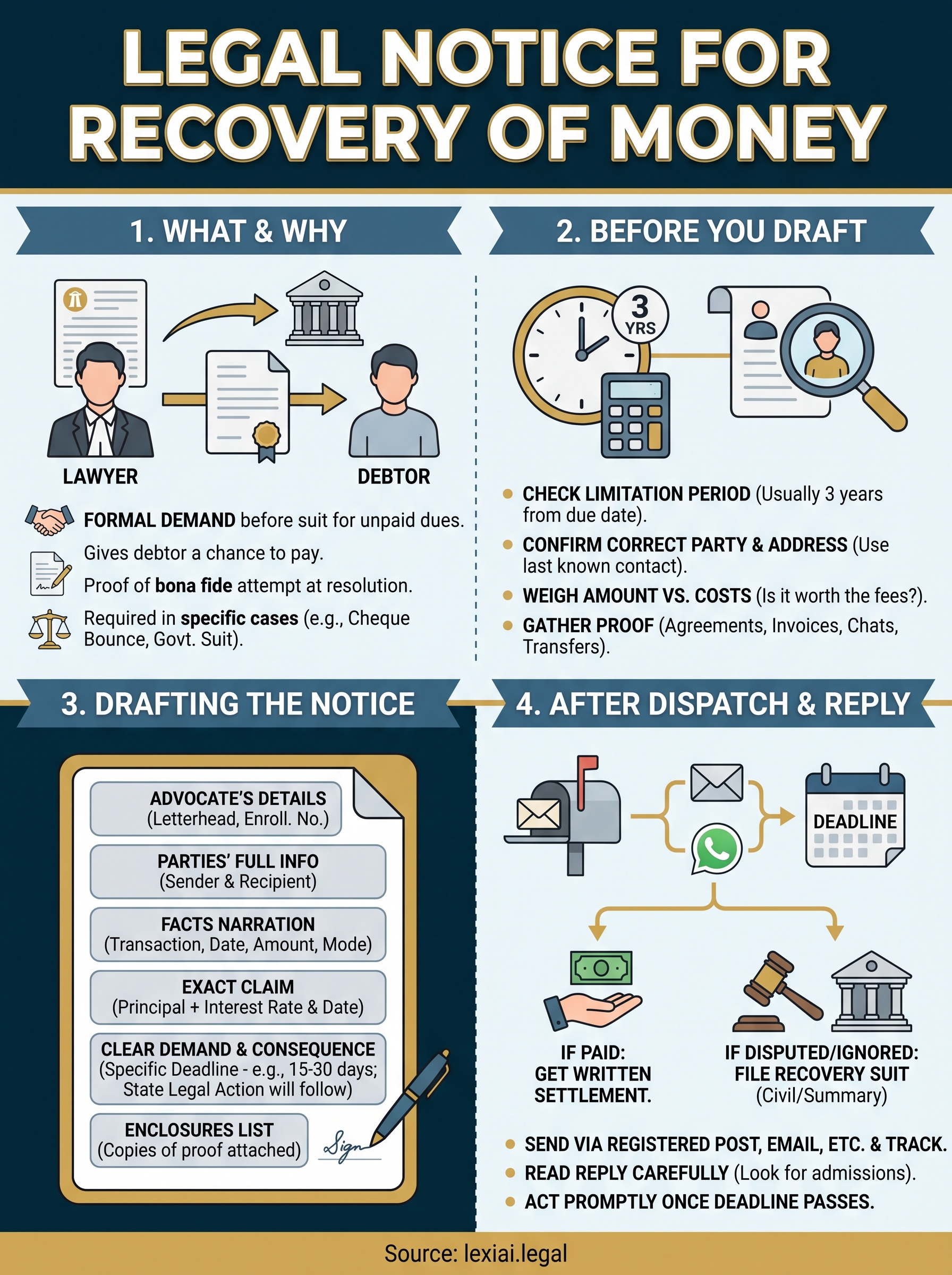
A legal notice for recovery of money is the formal letter you send before filing a suit to recover unpaid dues, whether from a client, a business partner, or a friend who has not returned a loan. It states the amount owed, the facts of the transaction, and a deadline, usually 15 to 30 days, for the other party to pay up before you approach the court under Order VII of the Code of Civil Procedure, 1908, or file a summary suit under Order XXXVII for a money claim based on a written agreement.
If you are searching for a legal notice format for recovery of money, you need one that names the parties correctly, states the exact principal and interest claimed, cites the relevant agreement or invoice, and closes with a clear demand and consequence for non-payment. This article gives you that structure in plain language, along with a sample you can adapt in Word or PDF.
Below, I walk through what to include, common mistakes that weaken a notice, how to send it so it holds up in court, and how to reply if you receive one. Where drafting speed matters, tools like LeXi AI can help generate a first draft quickly, though the legal accuracy still needs your review.
What is a legal notice for recovery of money
A legal notice for recovery of money is a formal written demand, typically drafted by an advocate on letterhead, that puts the debtor on record for owing you a specific sum. It is not a court filing itself; it is the step immediately before one, and it doubles as documentary proof that you tried to settle things without litigation. Courts across India, from district courts up to the High Courts, treat this notice as evidence of your bona fide attempt at resolution when you eventually file a suit for recovery.
Why lawyers recommend sending one before you sue
Sending a notice first gives the debtor a genuine chance to pay without a court case, which saves both sides court fees, advocate charges, and years of hearings. Beyond that practical benefit, a well-drafted notice often triggers payment on its own, because many debtors settle the moment they see a lawyer's letterhead and a hard deadline. Judges also expect to see this notice attached when you file your plaint, and its absence can raise avoidable questions about whether you acted in good faith before dragging someone to court.
A legal notice costs you a few thousand rupees and thirty days. A recovery suit can cost you years and lakhs.
Is a legal notice mandatory under Indian law
For most straightforward money claims, such as an unpaid loan to a friend or an unpaid invoice, the law does not require a legal notice before you sue. But specific statutes make it compulsory in specific situations. Section 80 of the Code of Civil Procedure, 1908, requires two months' notice before suing the government or a public officer. Section 138 of the Negotiable Instruments Act, 1881, requires a notice within 30 days of a cheque bounce, before you can prosecute for dishonor of the cheque. Section 8 of the Insolvency and Bankruptcy Code, 2016, requires an operational creditor to send a demand notice before initiating insolvency proceedings against a defaulting company.
What counts as a recovery of money case
- Unpaid loans given to a friend or relative without any registered agreement, recoverable through a simple demand letter citing the date and mode of transfer
- Outstanding invoices or professional fees owed by a client or business partner
- Security deposits withheld by a landlord after a tenant vacates
- Dishonored cheques falling under Section 138 of the Negotiable Instruments Act
- Breach of a loan agreement or promissory note carrying agreed interest
Often, if your matter involves a friend who has not returned money, the same format for a legal notice for recovery of money still applies. You simply describe the transaction plainly, since there is usually no written contract to cite.
Legal notice for money versus legal notice for property
Drafting a recovery of money notice demands a sum, while a legal notice for recovery of possession or title of immovable property follows a different structure, since it must describe the property, the nature of possession, and the eviction or title dispute involved. Anyone searching for a legal notice format for recovery of property should expect clauses on title documents and possession history instead of invoice numbers and payment dates. Do not reuse one template for the other. Courts read them as distinct causes of action, and mixing the two weakens both claims.
Step 1. Confirm a legal notice is the right move
Before you draft a single line, check whether the claim is even worth pursuing through a legal notice. Sending one on a debt that has gone stale, or against the wrong party, wastes your time and tips off the debtor to hide assets before you can act. Take a few minutes here, because this step decides whether the rest of your effort has any teeth.
Check the limitation period first
Under Article 22 of the Limitation Act, 1963, you generally have three years from the date the money became due to file a recovery suit, and sending a notice does not pause that clock. Calculate the due date carefully. For a loan repayable on demand, limitation typically starts from the date you first demanded repayment, not the date you lent the money. For an unpaid invoice, it usually runs from the invoice due date or the last part-payment received, whichever is later.
If your three years are almost up, do not wait on a notice, consult a lawyer about filing the suit first.
Identify the correct party and their address
Name the actual debtor, not a company they merely work for, unless the debt was contracted in the company's name. If you lent money to an individual who later formed a partnership or private limited company, the notice still goes to that individual personally unless the loan document names the entity. Verify the current address through the last known communication, WhatsApp chats, emails, or bank transfer records, since a notice returned undelivered weakens your later claim that you tried to resolve things amicably.
Weigh whether the amount justifies formal steps
A legal notice typically costs a few thousand rupees in advocate fees, so run a quick check before committing:
- Is the amount owed larger than the cost of a notice plus eventual court fees
- Do you have written proof, bank transfers, WhatsApp messages, invoices, or an agreement
- Is the debtor still traceable and likely to have assets worth recovering
- Has too much time passed under the Limitation Act, 1963
If you answer no to more than one of these, a notice may still be worth sending for the psychological pressure it creates, but temper your expectations about actually recovering the full sum through litigation. Many independent lawyers and law firms use platforms like LeXi AI at this stage to pull up similar precedents and confirm limitation calculations quickly, though you should still verify dates against the original transaction records before finalizing anything.
Step 2. Draft the notice in the correct legal format
Once you have confirmed the claim is worth pursuing, the actual drafting decides whether your notice reads as a serious legal document or a strongly worded email. A proper legal notice format for recovery of money follows a fixed structure that Indian courts recognize, and skipping any part of it gives the debtor an easy excuse to ignore you. Keep the tone formal and factual, never emotional, since courts weigh the notice on facts stated, not on how wronged you sound.
What every recovery notice must contain
Every notice needs these elements, in this order, regardless of whether you are recovering an invoice, a loan, or a security deposit:
- Advocate's letterhead with name, enrollment number, and address
- Full name and address of the sender (your client) and the recipient (the debtor)
- A clear narration of facts: date of the loan or invoice, amount, mode of payment, and any part-payment received
- The exact principal amount claimed, plus interest if agreed or claimed under Section 34 of the Code of Civil Procedure, 1908
- A specific deadline, usually 15 to 30 days, to clear the dues
- A clear statement that legal proceedings will follow if payment is not made within that period
- Date, signature of the advocate, and a list of enclosures
A notice missing even the deadline or the exact amount reads as a complaint, not a legal demand.
Sample clause language you can adapt
If you are building your own legal notice for recovery of money word format, use language close to this for the operative demand paragraph:
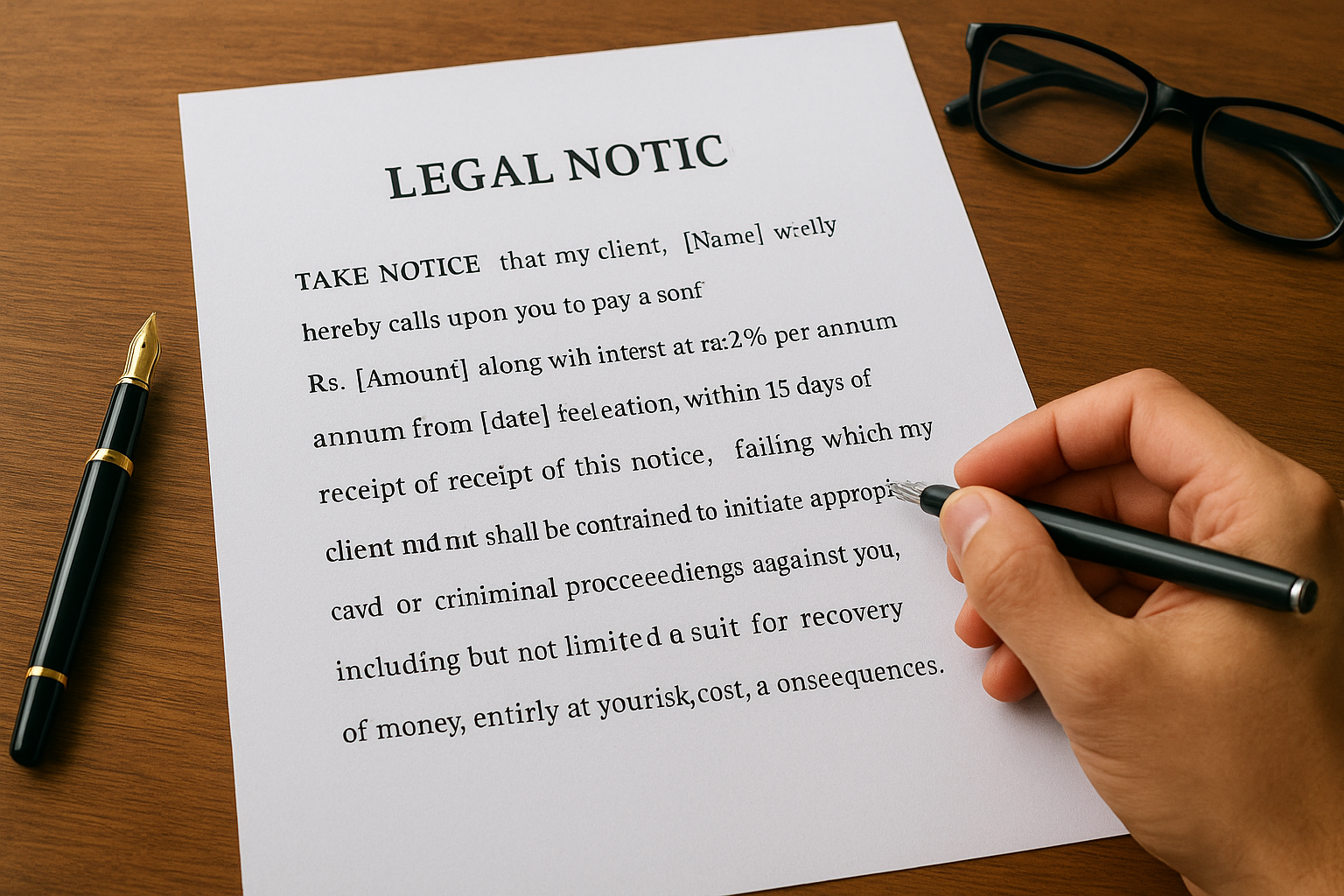
TAKE NOTICE that my client, [Name], hereby calls upon you to pay a sum of
Rs. [Amount] along with interest at [rate]% per annum from [date] till
realization, within 15 days of receipt of this notice, failing which my
client shall be constrained to initiate appropriate civil and/or criminal
proceedings against you, including but not limited to a suit for recovery
of money, entirely at your risk, cost, and consequences.
This single paragraph, placed near the end of the notice, is the part debtors actually read first, so get the amount and deadline exactly right.
Mistakes that weaken an otherwise good notice
Many drafters undermine a strong claim by rounding off figures, forgetting to mention the interest calculation method, or leaving out the specific date the cause of action arose. Vague phrases like "a large sum of money" instead of the exact figure give the debtor room to dispute the claim later in court. Watch for typos in the recipient's name or address too, since a returned notice due to a wrong address can later be argued as improper service.
Step 3. Attach proof and dispatch the notice correctly
A notice without supporting documents is just a claim on paper, so gather everything before you send it. Attach copies, never originals, of the loan agreement, invoices, bank statements, WhatsApp or email exchanges, and any promissory note or cheque involved. This step matters because courts later check whether the enclosures listed in the notice actually match what you produce as evidence during trial.
Which documents to prove your claim
Keep a clear enclosure list at the bottom of the notice itself, and match it exactly to what you post. A typical set looks like this:
- Copy of the loan agreement or promissory note, if one exists
- Bank transfer receipts or passbook entries showing the amount sent
- Invoices or purchase orders for a business debt
- WhatsApp chats or emails acknowledging the debt
- Copy of the bounced cheque and the bank's return memo, where relevant
Selectively including only favorable messages while hiding contradicting ones can backfire, since the debtor's reply may quote the missing context and damage your credibility.
How to send the notice so it holds up in court
Dispatch method decides whether you can later prove delivery to the debtor, so never rely on a single channel. Send the notice by registered post with acknowledgment due, and keep the postal receipt along with the AD card once it comes back. Simultaneously send a scanned copy by email and, where possible, WhatsApp, since courts increasingly accept these as supplementary proof of receipt when the postal notice is disputed or returned undelivered.
If the debtor cannot later claim they never received the notice, you have already won half the argument.
Sending an online legal notice for recovery of money
Many advocates now issue an online legal notice for recovery of money entirely through email and courier tracking portals, without a single physical visit to the post office. Platforms and law firm workflows built around tools like LeXi AI can generate the draft, attach enclosures, and log the dispatch timeline in one place, which helps later if you need to show a court exactly when and how the notice went out. Regardless of the channel, save every tracking number, delivery confirmation, and read receipt, because a recovery suit filed months later will need this trail to prove the notice actually reached the person you are suing.
Step 4. Track the response and plan your next legal step
Once the notice is dispatched, the waiting period is not a passive one. Mark the deadline on your calendar the day you send the notice, and follow up on delivery status every few days rather than waiting for the full 15 or 30 days to pass. What you do in this window, and immediately after, decides whether you settle quickly or end up filing a suit months later.
What to do if the debtor pays or offers a settlement
If the debtor responds with payment or a settlement offer, get everything in writing before you close the matter. Ask for the payment through a traceable mode, bank transfer or a demand draft, never cash for a disputed sum. If they propose a partial payment with a revised schedule, draft a simple settlement letter or consent terms signed by both sides, since an oral promise made after a legal notice carries almost no evidentiary value if they default again.
How to read a reply to the legal notice
Many debtors respond through their own advocate, and a proper reply to legal notice for recovery of money format usually either disputes the amount, claims the debt is time-barred, or denies the transaction altogether. Read this reply carefully against your own documents rather than reacting emotionally. Check specifically whether the reply admits the transaction but disputes the figure, since a partial admission actually strengthens your position in a future suit.
A reply that admits even part of the debt is evidence working in your favor, not against you.
When to escalate to a recovery suit
If the deadline passes with no response, or the reply is evasive without any real dispute of facts, your next step is a civil suit for recovery of money. For claims of large sums, this could still fall under Order XXXVII of the Code of Civil Procedure, 1908, as a summary suit, provided your claim rests on a written contract or a negotiable instrument. Where the money is owed against a corporate debtor and no dispute exists, a Section 8 demand under the Insolvency and Bankruptcy Code, 2016, sometimes moves faster than a civil court.
- Debtor pays in full: close the matter and obtain a signed receipt
- Debtor pays partially: record fresh terms in writing
- Debtor disputes the claim: prepare to file the suit within the limitation period
- No reply at all: treat silence as grounds to proceed to litigation without further delay
Sample legal notice format for recovery of money
Here is a complete legal notice format for recovery of money that you can adapt for most straightforward claims, whether the debt comes from a client, a business partner, or a friend who has not repaid a loan. Fill in the bracketed sections with your actual facts, and have an advocate review the final draft before it goes out on letterhead. This is the same structure discussed above, put together into one document so you can see how each piece fits.
Full sample notice you can copy
Use this as your starting point for a money recovery legal notice format, then adjust the facts paragraph to match your own transaction.
[ADVOCATE'S LETTERHEAD]
[Advocate Name, Enrollment No.]
[Address, Phone, Email]

Date: [DD/MM/YYYY]

To,
[Debtor's Full Name]
[Debtor's Complete Address]

SUBJECT: LEGAL NOTICE FOR RECOVERY OF MONEY

Sir/Madam,

Under instructions from and on behalf of my client, [Client Name], residing
at [Client Address], I hereby serve upon you the following legal notice:

1. That my client [describe the transaction: e.g., lent you a sum of
   Rs. [Amount] on [Date] via [bank transfer/cheque], as evidenced by
   [bank statement/promissory note], on the assurance of repayment within
   [period/on demand].

2. That despite repeated requests made by my client on [dates, if any],
   you have failed and neglected to repay the said amount.

3. That the total amount due and payable by you to my client, as on date,
   stands at Rs. [Amount] along with interest at [rate]% per annum from
   [date] till the date of actual realization.

TAKE NOTICE that my client hereby calls upon you to pay the aforesaid sum
of Rs. [Amount] with interest within 15 days of receipt of this notice,
failing which my client shall be constrained to initiate appropriate civil
and/or criminal proceedings against you, including a suit for recovery of
money, entirely at your risk, cost, and consequences.

A copy of this notice has been retained in my office for record and future
reference, if required.

Yours faithfully,
[Advocate's Signature]
[Name and Enrollment Number]

Enclosures:
1. [Bank statement/promissory note]
2. [WhatsApp or email correspondence]
Fill in every bracket before you send this, a blank field in a legal notice looks careless and gives the debtor an opening to dispute service.
Adapting the format for a loan to a friend
When you need a legal notice format for recovery of money from a friend, keep paragraph 1 simple and factual rather than formal, since there is usually no written agreement to cite. State the date, the amount, and the mode of transfer, and reference any WhatsApp message where the friend acknowledged the loan or promised repayment. The rest of the structure, the deadline and the consequence paragraph, stays exactly the same.
Saving it as Word or PDF
Once your advocate finalizes the wording, save the file in both formats: a Word document for further edits and a PDF for sending and for your own records. Keep a signed, scanned PDF copy alongside the postal receipt and AD card, since this combination becomes your proof bundle if the matter proceeds to a suit for recovery.
Getting your money back without unnecessary delay
A legal notice for recovery of money works best when you treat it as a serious first step, not a formality to rush through. Get the facts and figures exact, attach real proof, and send it through a channel you can prove in court later. Skip any of that, and you hand the debtor an easy excuse to stall you for months.
Most recovery cases settle right after the notice lands, provided the draft names the amount, the deadline, and the consequence clearly. If it does not settle, you still walk into the suit with a clean paper trail already in place, which counts for a lot before a judge. Speed matters here, and if you want a first draft ready in minutes rather than hours, sign up for LeXi AI and let your advocate review it before it goes out.