

5 Best Legal AI Tools in India for Research and Drafting (2026)
If you are searching for legal ai india tools that actually understand the Bharatiya Nyaya Sanhita, the Indian Contract Act, or a High Court judgment without hallucinating citations, this list is for you. Most general AI models were trained on American and European law, so they stumble on Indian statutory language, local precedent, and drafting conventions. This article covers five tools built or adapted specifically for Indian legal work.
Each tool below is evaluated on what practicing lawyers and law students actually need: accurate legal research with verified case citations, contract and clause drafting that follows Indian conventions, and case analysis that saves hours on a single brief. I have used or tested each of these directly, so the comparisons reflect real workflows, not marketing claims.
You will find where platforms like LeXi AI fit into this picture, particularly for litigation preparation and contract lifecycle management, alongside other tools built for research and drafting. By the end, you should know which tool fits your practice area, whether you draft contracts daily, prepare for courtroom arguments, or are a student trying to build practical legal skills before you start practicing, and how each stacks up in the broader legal ai india market.
1. LeXi AI
LeXi AI tops this list because it refuses to treat research, drafting, and litigation prep as separate problems that need separate apps. Built for Indian law by Astute Lex Servicado Private Limited, it connects contract lifecycle management, courtroom preparation, and legal research into a single platform, which is rare among tools claiming to serve the legal ai india market.

A legal AI tool that only drafts or only researches leaves you to stitch the rest of the workflow together by hand.
How it works
Underneath, LeXi AI runs models benchmarked against GPT 5.5, Gemini 3.1 Pro, Deepseek v3.2, and Claude Opus 4.8 on the AIBE 20 legal reasoning dataset, scoring 98.95% accuracy on statutory interpretation and case analysis tied to Indian commercial law. That benchmark matters because generic models often misquote sections of the Bharatiya Nyaya Sanhita or cite overturned judgments. LeXi Agent pulls precedent from verified judgment databases, while LeXi Desk flags clause-level risk, like an uncapped indemnity clause buried in a vendor contract.
Who it is for
Independent lawyers handling both litigation and transactional work get the most out of this setup, since LeXi LiTT covers case strategy and courtroom prep while LeXi Desk manages contracts. Firms and chambers running multiple matters at once use it to standardize drafting across associates, and law students turn to LeXi Academy to practice research and drafting before their first courtroom appearance. Among legal ai india options, LeXi AI remains the only platform benchmarked directly against global models on Indian statutory accuracy.
Key features
- LeXi LiTT: AI-assisted drafting and courtroom prep, claiming 90% faster case preparation
- LeXi Desk: contract drafting, clause risk analysis, translation, and document summarization, including condensing 400-page case files instantly
- LeXi Agent: legal research with verified case citations and precedent analysis
- LeXi Academy: guided research and drafting practice for law students
- Enterprise APIs to build custom legal AI systems
- Mobile access and 24/7 AI assistance for drafting queries
Pricing
Pricing scales by user type, with separate tiers for independent lawyers, law firms and chambers, and enterprise API access billed by seat count and usage. Exact rates change as new tiers roll out, so check the current plans directly on lexiai.legal before committing, or start a free trial to test it first.
2. Jhana AI
Jhana AI focuses on legal research and drafting assistance for Indian lawyers, built around a chat-style interface where you ask questions in plain English and get answers grounded in Indian statutes and case law. It positions itself as a research companion rather than a full litigation or contract management suite.
How it works
You type a legal question or paste a fact pattern, and Jhana AI searches its indexed database of Indian judgments and statutes to generate an answer with citations. It also supports drafting tasks like notices and pleadings, working off templates that you refine through follow-up prompts.
Who it is for
Solo practitioners and small firm lawyers who need quick research answers without a heavy onboarding process tend to use Jhana AI. It suits lawyers who want a conversational research tool rather than a full case or contract management platform.
Key features
- Conversational legal research with citations
- Drafting support for notices and basic pleadings
- Search across Indian case law databases
- Chat history for revisiting past research threads
Pricing
Jhana AI offers a free tier with limited queries, plus paid subscription plans for lawyers who need higher usage limits. Check current pricing on its website since plan structures change frequently.
3. NyayGuru
NyayGuru works as a question-and-answer legal assistant aimed at helping lawyers and students get quick clarity on statutory provisions and case outcomes without wading through PDFs. It leans on a simpler, more direct interface than the multi-module platforms above, which makes it approachable if you just want fast answers.
How it works
Ask NyayGuru a question about a section of the Indian Penal Code equivalents under the Bharatiya Nyaya Sanhita or a specific judgment, and it returns a plain-language summary with references. It works off a smaller indexed dataset than dedicated research platforms, so it handles common queries well but can miss niche or recent rulings.
A tool built for quick answers is not the same as a tool built for courtroom-ready research.
Who it is for
Law students and junior associates checking basic concepts or preparing for exams get the most value here. It also suits lawyers who want a fast reference check during a client call rather than deep litigation research.
Key features
- Plain-language answers to statutory and case law questions
- Basic citation references for judgments
- Simple chat interface with minimal setup
Pricing
NyayGuru offers free access with limited daily queries, and paid plans for students and professionals needing higher limits. Pricing details are best confirmed directly on its site.
4. Niyam
Niyam positions itself as a compliance-focused legal AI tool, built to help businesses and lawyers track regulatory obligations under Indian law rather than just researching case law. It works less like a research chatbot and more like a monitoring system that flags changes in statutes, rules, and notifications relevant to your practice or business.

How it works
Niyam indexes central and state-level regulatory updates, then matches them against a profile you set up for your business or client. Once configured, it sends alerts when a relevant notification, amendment, or circular affects your compliance obligations, so you are not manually checking government gazettes every week.
Missing a regulatory update by even a few days can turn a compliant contract into a liability.
Who it is for
Corporate legal teams and compliance officers managing multiple regulatory frameworks across sectors get the most out of Niyam. It also suits lawyers who advise businesses on ongoing compliance rather than one-off litigation or drafting work.
Key features
- Automated tracking of regulatory notifications and amendments
- Alerts customized to your business sector and jurisdiction
- Compliance calendar for recurring filing deadlines
- Basic search across regulatory texts
Pricing
Niyam runs on a subscription model priced by the number of compliance profiles you track, with enterprise plans for larger legal teams. Confirm current tiers directly with their sales team since compliance tools price differently than research or drafting platforms.
5. Prism AI by Indian Kanoon
Prism AI builds on Indian Kanoon's existing case law database, adding an AI research layer on top of what is already one of the largest free judgment repositories in the country. If you have used Indian Kanoon for plain-text search before, Prism AI feels like the natural next step rather than a new tool to learn.
How it works
You search using natural language instead of exact keywords, and Prism AI pulls relevant judgments from Indian Kanoon's indexed database, then summarizes them with links back to the full original text. Because it sits on top of an established case law index rather than a newly scraped dataset, citation accuracy tends to hold up well for reported judgments.
A research tool built on a database lawyers already trust has less room to hallucinate case names.
Who it is for
Lawyers and students already comfortable with Indian Kanoon who want faster summaries without switching platforms will find this the easiest upgrade on this list. It suits case law research more than drafting or contract work.
Key features
- Natural language search across Indian Kanoon's judgment database
- AI-generated summaries with direct links to source judgments
- Coverage across Supreme Court, High Courts, and tribunals
Pricing
Prism AI offers free access tied to Indian Kanoon's existing model, with paid tiers for higher search volume and priority features. Check current pricing on Indian Kanoon's site for specifics.
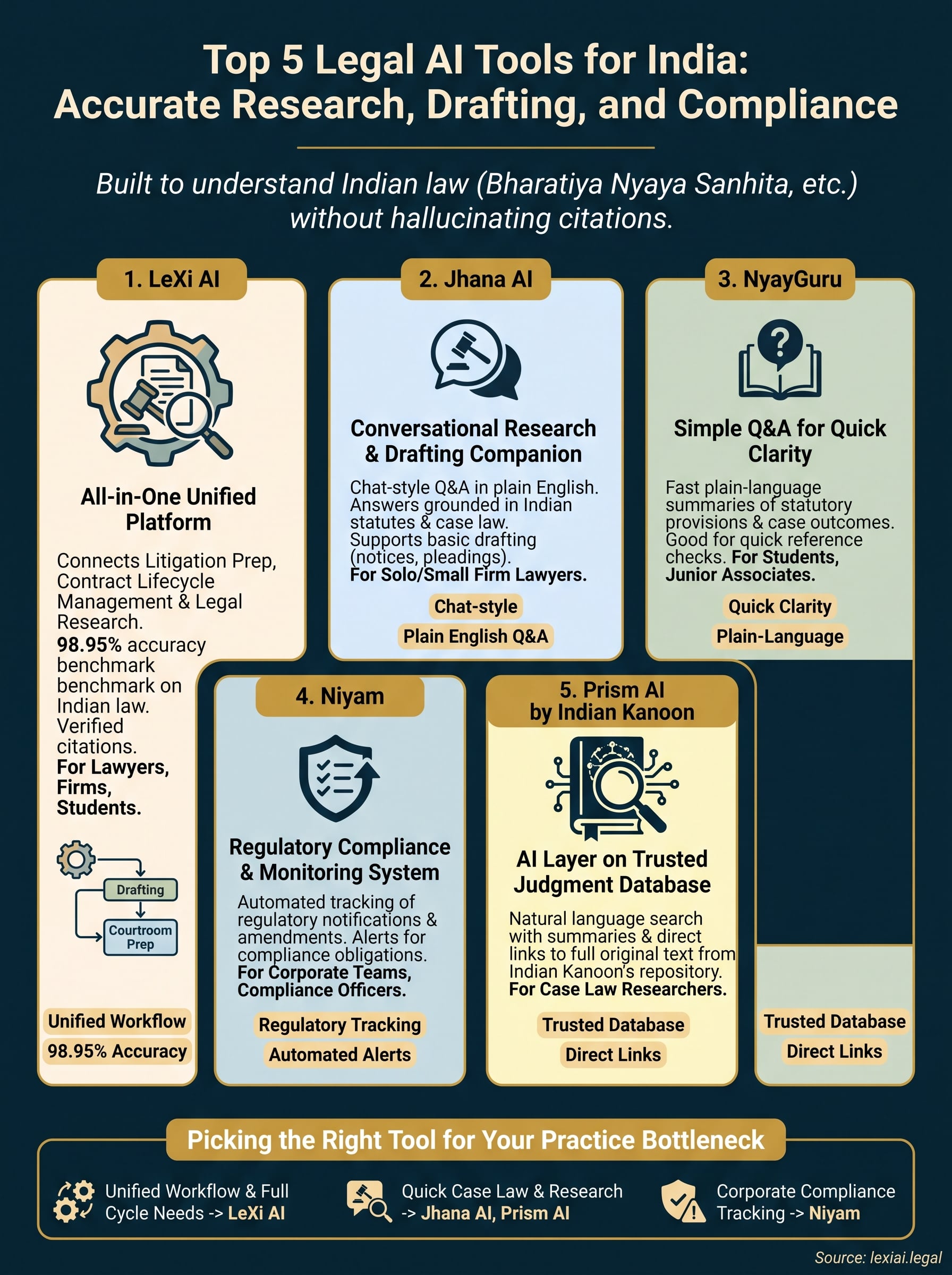
Picking the right tool for your practice
Match the tool to the actual bottleneck in your practice, not the one with the flashiest demo. If you draft contracts, prepare for hearings, and need research in one place, LeXi AI covers all three without forcing you to reconcile outputs from three different apps. If you only need quick case law lookups, Jhana AI or Prism AI by Indian Kanoon might be enough on their own. Whichever legal ai india tool you land on, verify its citations before trusting it in a filing.
Students building practical drafting skills before entering practice get more from a guided platform like LeXi Academy than a bare research chatbot. Corporate teams tracking regulatory filings should lean on Niyam instead of stretching a litigation tool to do compliance work it was not built for.
Whatever you choose, test it on a real brief or contract before committing to a paid plan. If you want to see how a unified workflow actually holds up under deadline pressure, try LeXi AI free or start a free trial and run it against your next matter.