

Format for Legal Notice: How to Draft One in India
A legal notice has a fixed structure for a reason. Courts and opposing parties expect specific sections in a specific order, and missing one, like the exact cause of action or the statutory period given to comply, can weaken your client's position later. If you are searching for the correct format for legal notice drafting in India, this guide gives you that structure directly, no need to piece it together from old templates.
A proper legal notice includes the sender's details, the recipient's details, a clear statement of facts, the specific relief or demand sought, a reasonable compliance period (typically 15 to 30 days), and the advocate's signature with registration details. The exact wording changes depending on the case, whether it is a cheque dishonour notice under Section 138 of the Negotiable Instruments Act, 1881, or a money recovery notice under general civil law, but the skeleton stays consistent.
This article walks through each mandatory section, explains what makes a notice legally sound versus one that gets challenged on technical grounds, and gives you sample formats for the two situations lawyers draft most often, cheque dishonour and money recovery. Tools like LeXi AI can help generate a first draft quickly, but you still need to understand why each clause exists before you send it out.
What is a legal notice and when do you need one
A legal notice is a formal written communication sent by one party to another, through an advocate or on one's own behalf, stating a grievance and asking for it to be resolved before anyone approaches a court. It puts the other side on record that you intend to pursue legal remedies if the issue is not fixed within a stated period. Think of it as the last formal warning before litigation starts, and courts often look at how this warning was drafted when deciding costs or even the merits of a case.
Understanding when a notice becomes mandatory matters more than most drafters realize, because sending one in the wrong situation, or skipping one where the law requires it, can get your entire case thrown out on a technicality. Section 80 of the Code of Civil Procedure, 1908, is the clearest example: you cannot sue the government or a public officer in their official capacity without first giving two months' written notice, and courts have dismissed suits filed without this step. Section 138 of the Negotiable Instruments Act, 1881, works the same way for cheque bounce cases, you must issue a notice within 30 days of receiving the bank's dishonor memo before you can file a criminal complaint. The India Code portal carries the full text of both statutes if you want to check the exact wording before you draft.
Skip a mandatory notice under Section 80 CPC or Section 138 of the NI Act, and your case can be dismissed before it is even heard on merits.
Beyond these two well-known statutes, several other situations call for a notice either by law or by long-standing practice:
- Cheque dishonor complaints under Section 138, NI Act, within 30 days of the return memo
- Suits against the government or public officers under Section 80, CPC
- Arbitration references under Section 21 of the Arbitration and Conciliation Act, 1996, where the notice invoking arbitration fixes the date the arbitration is deemed to commence
- Termination or eviction disputes under most state rent control laws, where a quit notice precedes any eviction suit
- Money recovery and breach of contract claims, where a notice is not legally required but almost always sent as good practice
Going further, even where no statute demands it, most litigators still send a notice because it creates a paper trail that helps in front of a judge later. In a recovery suit, for instance, a notice sent well before filing shows the court that you gave the other side a genuine chance to pay before dragging them into litigation. Insurance claims, employment disputes, and landlord-tenant disagreements over deposits fall into this category too, where the compliance period you set in the notice often becomes the timeline the other side actually follows, sometimes ending the dispute without a single court date.
Knowing this distinction changes how you approach the format for legal notice drafting itself. A notice under a mandatory provision needs precise statutory language, the exact section number, and dates that match the limitation period set by that law. A discretionary notice, sent purely as a negotiating tool, gives you more room to frame facts persuasively, though the core structure covered in the next sections stays largely the same either way. Get this classification right at the outset, and every choice you make afterward, from the subject line to the deadline you set, follows logically from it.
Step 1. Add the letterhead, date, and party details
Every legal notice starts with the sender's identification block, and this is not a formality you can skip. If an advocate is drafting the notice, it goes on the advocate's letterhead, showing the advocate's name, enrollment number with the State Bar Council, office address, phone number, and email. If the sender is drafting it personally, without an advocate, the same details appear for the sender instead, minus the bar enrollment number. Skipping this block makes the notice look unofficial, and opposing counsel will use that against you.
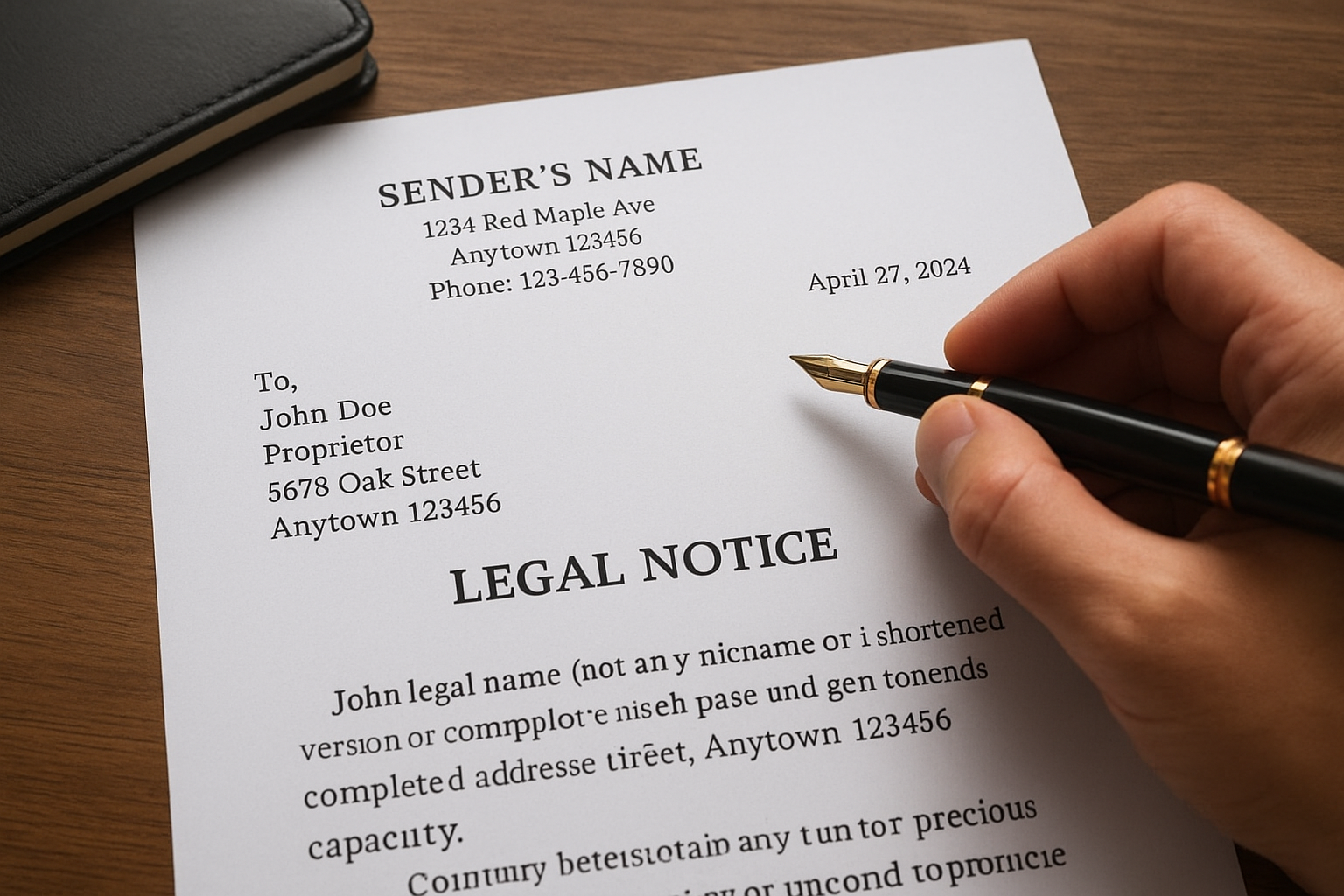
Date placement comes right after the letterhead, usually aligned to the right margin, and it matters more than most drafters realize. The date on the notice is what courts use to calculate whether you complied with statutory timelines, like the 30-day window under Section 138 of the Negotiable Instruments Act, 1881, or the two-month notice period under Section 80, CPC. Get this date wrong, or leave it blank and fill it in later, and you create a factual dispute the other side can exploit.
After the date, list the recipient's details in full: full legal name (not a nickname or shortened version), complete postal address including PIN code, and, where relevant, the designation or capacity in which they are being addressed (director, proprietor, karta of a joint family, government officer in official capacity). If there are multiple recipients, list each one separately with their own address rather than clubbing them into one line. Mismatched or incomplete addresses are one of the most common reasons a notice gets challenged as improperly served.
A notice sent to the wrong address or an incomplete name can be challenged as never having been served at all, no matter how strong the facts inside it are.
Here is a simple structure to follow for this opening block:
[Advocate's Letterhead / Sender's Name and Address]

Date: [DD/MM/YYYY]

To,
[Recipient's full name]
[Designation, if applicable]
[Complete address with PIN code]

[Repeat for each additional recipient]
Finally, decide how you will send the notice, because this affects what you write in the party details section. If you are sending it by registered post with acknowledgment due, note the intended dispatch mode at the top so the file record is clear from day one. Some drafters also add a line stating the notice is being sent "by registered post, speed post, and email" to cover all bases, which helps later if the recipient claims they never received it. Tools like LeXi AI can auto-populate this block from your case file, but always cross-check the spelling of names and addresses against the original documents before the notice goes out.
Step 2. Write the subject line and statement of facts
Draft a subject line that names the cause of action
Right below the recipient's address, add a one-line subject line starting with "Subject:" that names the exact dispute in plain terms. A vague heading like "Legal Notice" tells the reader nothing and wastes the one line where you can frame the entire dispute. Instead, write something specific: "Subject: Legal Notice for Dishonor of Cheque No. 123456 dated 05/03/2026 under Section 138 of the Negotiable Instruments Act, 1881" or "Subject: Legal Notice for Recovery of Rs. 4,50,000 towards Unpaid Invoices." Naming the cause of action here, rather than burying it in paragraph three, helps the recipient's advocate immediately understand the stakes and helps you later if you need to prove the notice covered this exact claim.
A subject line that names the cause of action in the first line does more work than three paragraphs of vague grievance later in the notice.
Lay out the statement of facts in chronological order
After the subject line, open the body with "Under instructions from and on behalf of my client, [name], I address you as follows:" and move straight into the statement of facts. List every material fact in chronological order, one numbered paragraph per fact, so the timeline reads cleanly from the first transaction to the current breach. Skip opinions, skip emotional language, and stick to dates, amounts, document references, and what each party actually did or failed to do.
A typical facts section for a money recovery notice looks like this:
1. That my client supplied goods worth Rs. 3,00,000 to you vide Invoice No. 445 dated 12/01/2026.
2. That payment was due within 30 days of delivery, i.e., by 11/02/2026, as per the agreed terms.
3. That despite repeated reminders on 15/02/2026 and 28/02/2026, you have failed to make payment.
4. That the outstanding amount as of the date of this notice stands at Rs. 3,00,000, excluding interest.
Keep the facts objective and verifiable
Every fact you state should trace back to a document you can produce later, an invoice, an email, a delivery receipt, a bank statement. Courts and opposing lawyers scrutinize a notice under challenge far more closely than most drafters expect, and an unsupported claim in the facts section gives the other side an easy line of attack. Numbering each fact separately, rather than writing one long paragraph, also makes it far easier for you to reference "paragraph 3 of the notice dated [date]" if the matter goes to trial months later.
Step 3. Cite the legal provisions that apply
Once the facts are laid out, the notice needs to tell the recipient exactly which law entitles your client to relief. This is where many self-drafted notices fall apart, because a grievance without a statutory or contractual hook reads like a complaint letter, not a legal document. State the specific provision by name and section number, not a general reference like "under the law," and explain in one or two lines why that provision applies to the facts you just listed.
Match the provision to the cause of action
For a cheque dishonor notice, the citation is straightforward: "The said cheque was dishonored for insufficient funds, and you are liable to pay the amount under Section 138 of the Negotiable Instruments Act, 1881, having failed to make payment within 15 days of receipt of this notice." For a money recovery notice arising from a contract, cite the specific clause of the agreement alongside Section 73 of the Indian Contract Act, 1872, which governs compensation for breach. For an eviction notice, cite the relevant state rent control act and the specific ground for eviction, whether it is default in rent or the landlord's bona fide requirement.
A demand with no statute or contract clause behind it is just a strongly worded letter, not a legal notice.
Keep the citation precise and current
Double-check the section number and the year of the act before you finalize the notice, since amendments can renumber or repeal provisions over time. A notice citing an outdated section, or one that was renumbered after a 2021 or 2023 amendment, gives opposing counsel a technical point to raise even when the underlying grievance is valid. The India Code portal keeps consolidated, updated text of central acts, and cross-checking there before you send the notice takes a few minutes but avoids an easy challenge later.
A short table helps when you are drafting across multiple notice types and need to keep the citations straight:
| Cause of Action | Primary Provision to Cite |
|---|---|
| Cheque dishonor | Section 138, Negotiable Instruments Act, 1881 |
| Breach of contract, money recovery | Section 73, Indian Contract Act, 1872 |
| Suit against government or officer | Section 80, Code of Civil Procedure, 1908 |
| Invoking arbitration | Section 21, Arbitration and Conciliation Act, 1996 |
| Tenant eviction | Applicable state Rent Control Act, specific ground clause |
Once the citation is in place, connect it directly back to the facts with one closing line, something like "In view of the above, you are liable under the aforesaid provision to pay the sum demanded below." This sentence bridges the facts and the citation into the demand section that follows, and it is the line most drafters skip, leaving the notice feeling disjointed rather than building toward one clear conclusion.
Step 4. State your demand, deadline, and consequences
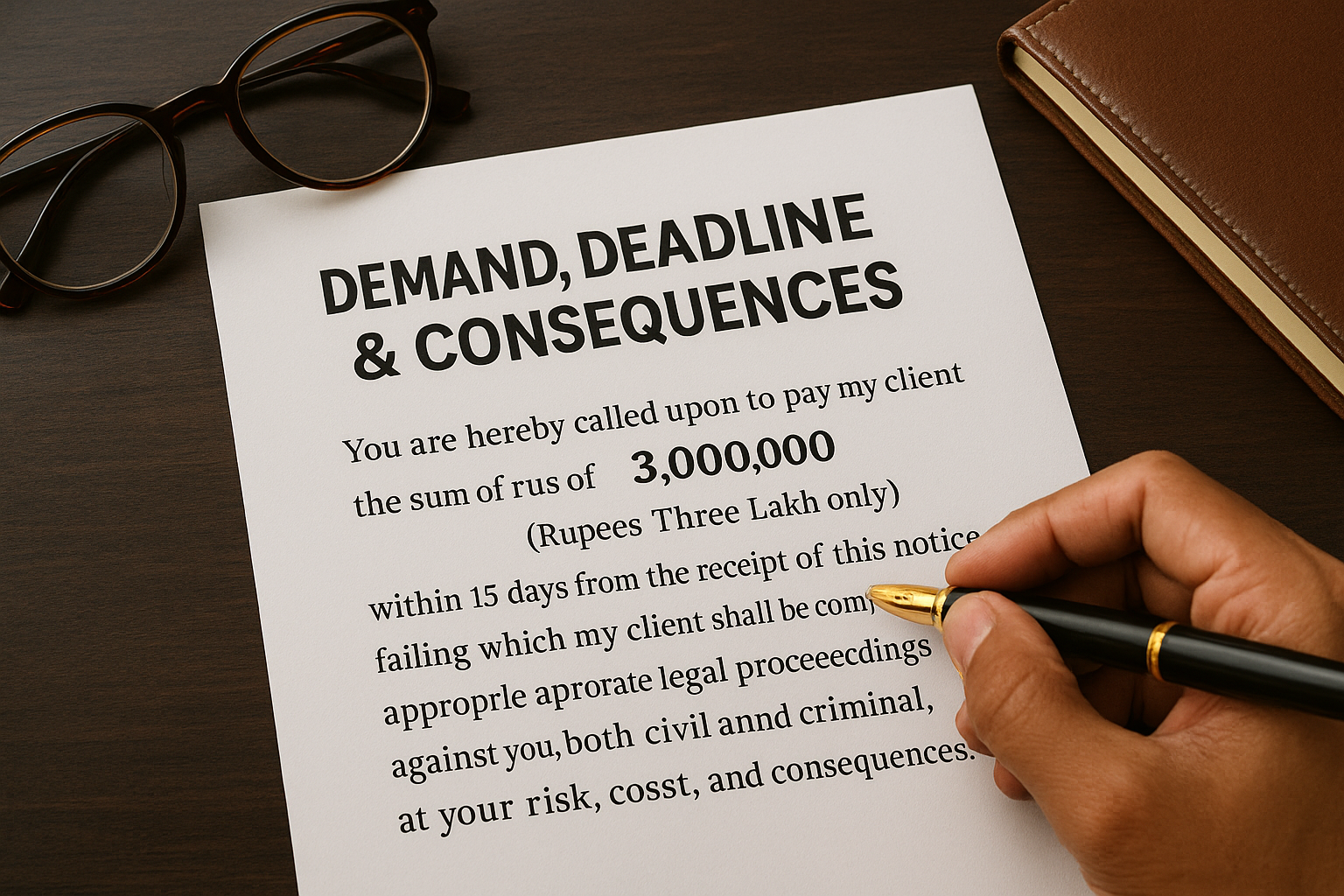
After the citation, the notice needs one clear paragraph that tells the recipient exactly what to do and by when. This is the operative part of the entire document, and vague demands are the single biggest reason a notice fails to achieve anything before litigation starts. State the exact amount or relief you want, not a range, not an approximation, and tie it back to the facts and provision you already laid out.
State the exact relief you want
Write the demand as a standalone paragraph so it cannot be missed on a quick read. If money is owed, give the precise figure, including interest if you are claiming it, and state the rate and the period it covers. If the relief is not monetary, such as vacating a property or specific performance of a contract clause, describe the action in one sentence, with no ambiguity about what compliance looks like.
You are hereby called upon to pay my client the sum of Rs. 3,00,000
(Rupees Three Lakh only), together with interest at 12% per annum
from 12/02/2026 till the date of realization, within 15 days from
the receipt of this notice, failing which my client shall be
compelled to initiate appropriate legal proceedings against you,
both civil and criminal, at your risk, cost, and consequences.
Fix a reasonable deadline
Give the recipient a specific compliance period, counted in days from receipt of the notice, not from the date printed on it. Fifteen days works for most commercial disputes, thirty days is standard where a statute prescribes it, such as the notice period under Section 80 of the Code of Civil Procedure, 1908. Setting the deadline correctly matters for the format for legal notice you are drafting, because courts check whether the recipient actually had the full period to respond before you filed suit, and a short or ambiguous deadline invites a challenge on that ground alone.
A notice without a fixed deadline gives the recipient no reason to act, and gives a court no way to test whether you gave fair time to comply.
Spell out the consequences of non-compliance
Close the demand paragraph by naming what happens if the deadline passes without action. Mention the specific remedy you intend to pursue, whether that is a civil suit for recovery, a criminal complaint under Section 138 of the Negotiable Instruments Act, 1881, or an application before a consumer forum or tribunal. Avoid generic threats like "legal action will be taken," since naming the actual forum and provision signals to the recipient's advocate that you have already worked out the litigation strategy, which often pushes settlement before the deadline even arrives.
Step 5. Sign, attach enclosures, and send the notice
Once the demand paragraph is in place, close the notice with a formal signature block. If an advocate is signing on the client's behalf, the block should read "For [Client Name], through [Advocate's Name], Advocate," followed by the advocate's signature, enrollment number, and the date if it differs from the letterhead date. A signed but unenrolled signature, or one missing the advocate's registration details, gives opposing counsel an easy technical objection even when the underlying claim is sound.
List every enclosure by name
Below the signature, add a short list titled "Enclosures" or "Copies enclosed" naming each document you are attaching, not just "as above" or "relevant documents." Courts and the recipient's advocate need to know exactly what supporting material traveled with the notice, since a missing enclosure later becomes an argument that the notice never properly informed the recipient of the claim.
Enclosures:
1. Copy of Invoice No. 445 dated 12/01/2026
2. Copy of dishonored cheque No. 123456
3. Bank return memo dated 10/03/2026
4. Copy of reminder emails dated 15/02/2026 and 28/02/2026
Choose a dispatch mode that proves delivery
How you send the notice matters as much as what it says, because the entire notice is worthless if you cannot later prove it reached the recipient. Registered post with acknowledgment due remains the standard, since the postal receipt and the returned acknowledgment card become evidence in themselves. Speed post works the same way and is faster, but always keep the tracking receipt and print the online delivery status once it updates.
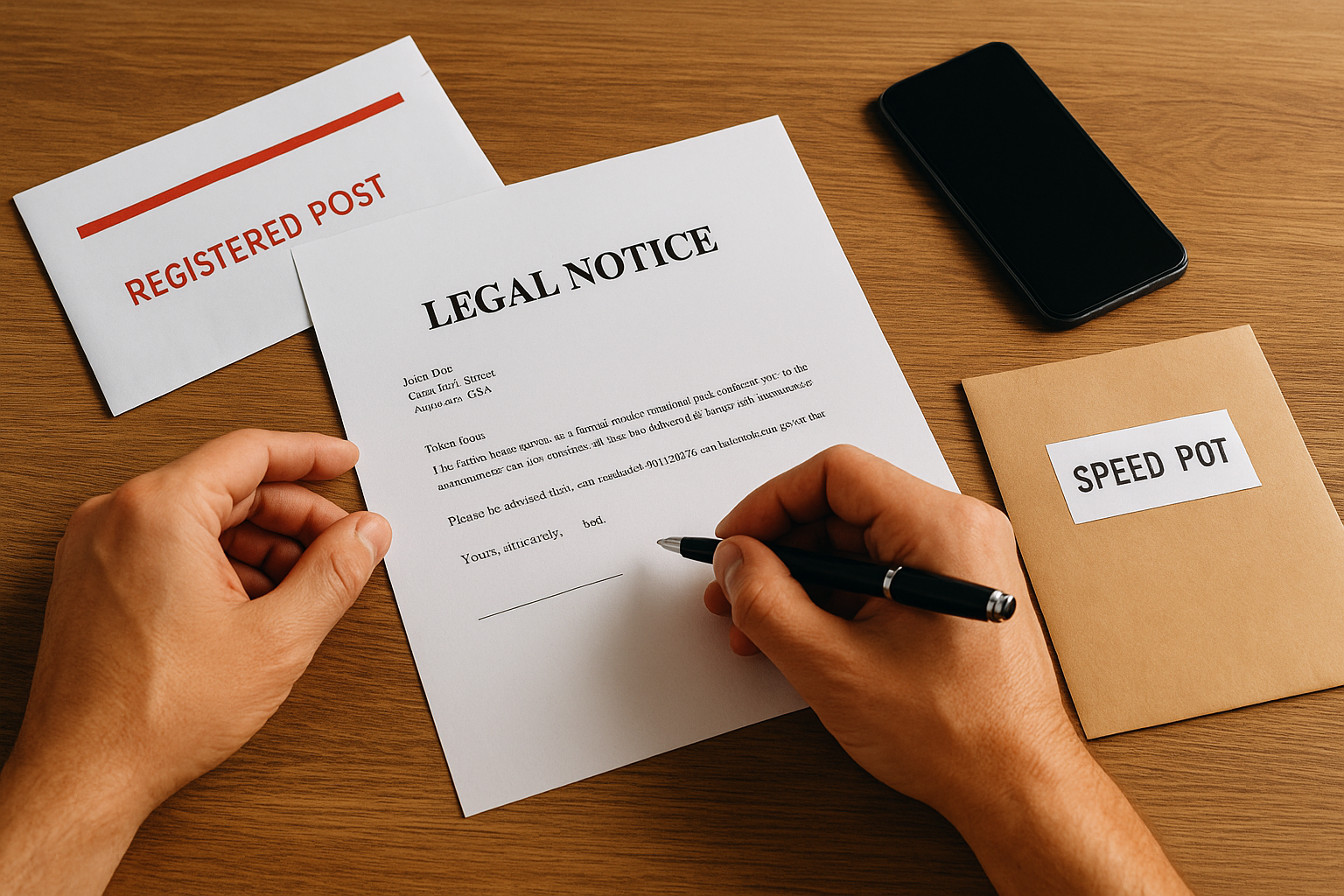
| Dispatch Mode | Proof It Generates | Best Used For |
|---|---|---|
| Registered post (AD) | Signed acknowledgment card | Statutory notices, Section 138, Section 80 CPC |
| Speed post | Online tracking and delivery status | Time-sensitive commercial notices |
| Sent and delivery timestamps | Supplementary, alongside physical post | |
| Courier | Signed delivery slip | Local or urgent delivery |
A notice that never reaches the recipient, or one you cannot prove reached them, has no legal weight, no matter how well it is drafted.
Many drafters send the notice through two or three channels at once, physical post plus email, precisely so that a claim of non-receipt does not derail the case later. Retain a complete file copy of the notice, the postal receipts, the tracking printouts, and any bounce-back or refusal report, since you will need all of it if the matter proceeds to litigation. This closing discipline, more than any clever phrasing in the body, is what separates a notice that holds up in court from one that gets picked apart on procedure.
Sample formats for common types of legal notices
Putting the five steps together makes more sense once you see a complete notice, so here are two full templates you can adapt directly. Both follow the same format for legal notice drafting covered above, just with the facts, citation, and demand swapped to fit the cause of action.
Sample notice for cheque dishonor under Section 138
Use this template when a cheque has bounced and you are within the 30-day window from the bank's return memo.
[Advocate's Letterhead]
Date: [DD/MM/YYYY]

To,
[Recipient's full name and address]

Subject: Legal Notice for Dishonor of Cheque No. [XXXXXX] dated [DD/MM/YYYY]
under Section 138 of the Negotiable Instruments Act, 1881

Under instructions from and on behalf of my client, [Client Name], I address
you as follows:

1. That you issued Cheque No. [XXXXXX] dated [DD/MM/YYYY] for Rs.
[Amount] drawn on [Bank Name] towards [purpose].
2. That the cheque was presented for payment and returned unpaid vide
return memo dated [DD/MM/YYYY] with the reason "insufficient funds."
3. That you are liable under Section 138 of the Negotiable Instruments
Act, 1881, to pay the said amount within 15 days of receipt of this notice.

You are hereby called upon to pay my client Rs. [Amount] within 15 days
from receipt of this notice, failing which my client shall initiate
criminal proceedings against you under Section 138 of the Negotiable
Instruments Act, 1881, at your risk, cost, and consequences.

Enclosures: Copy of cheque, bank return memo

For [Client Name], through Advocate
[Signature, Name, Enrollment No.]
The 15-day compliance period inside a Section 138 notice is not optional wording, it is a condition the courts check before allowing your complaint to proceed.
Sample notice for money recovery
Money recovery notices follow the same skeleton but cite Section 73 of the Indian Contract Act, 1872, instead of a criminal provision.
[Advocate's Letterhead]
Date: [DD/MM/YYYY]

To,
[Recipient's full name and address]

Subject: Legal Notice for Recovery of Rs. [Amount] towards [Invoice/Contract]

Under instructions from my client, [Client Name], I state as follows:

1. That my client supplied [goods/services] worth Rs. [Amount] vide
Invoice No. [XXX] dated [DD/MM/YYYY].
2. That despite reminders dated [DD/MM/YYYY] and [DD/MM/YYYY], payment
remains outstanding.
3. That you are liable under Section 73 of the Indian Contract Act,
1872, to compensate my client for this breach.

You are called upon to pay Rs. [Amount] with interest at 12% per annum
within 15 days, failing which civil proceedings for recovery shall be
instituted against you.

For [Client Name], through Advocate
[Signature, Name, Enrollment No.]
Notice how little actually changes between the two, the facts, the cited provision, and the consequence shift, while the letterhead, subject line placement, and signature block stay identical. Once you have drafted a handful of these, adapting the same skeleton to a new cause of action takes minutes rather than hours.
Getting the notice right before it leaves your desk
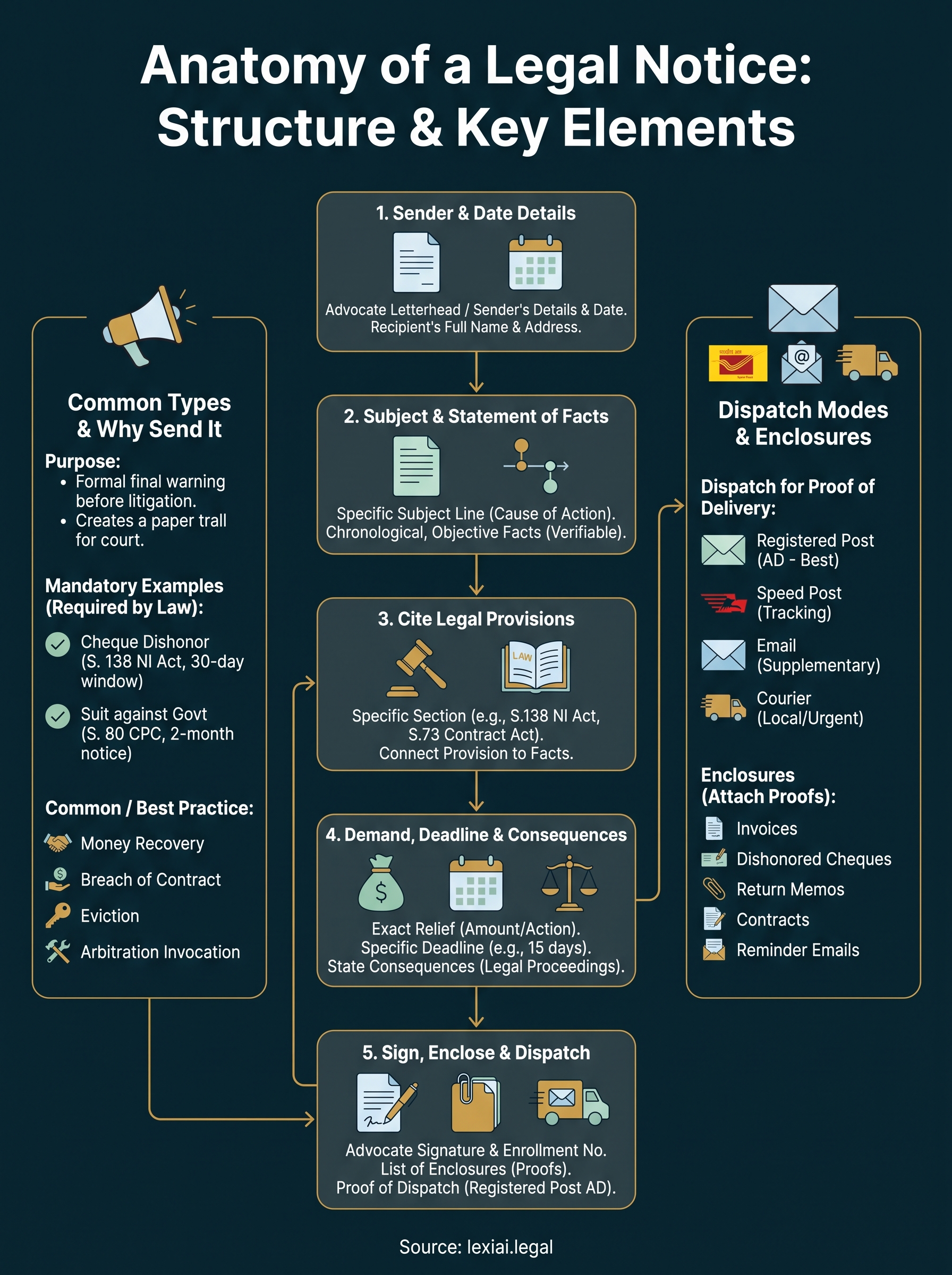
A legal notice earns its weight only when every section does its job: correct party details, facts that trace back to documents, the right provision cited by name, a firm deadline, and proof of dispatch you can produce months later. Miss any one of these, and you hand the other side a technical objection instead of a settlement. The format for legal notice drafting covered here is not a formality to rush through, it is the foundation the entire dispute rests on if it ever reaches a courtroom.
Before you send the next notice off your desk, run it against the five steps above one more time. Check the citation, check the deadline, check the enclosures list against what you actually attached. If you want a faster way to build that first draft and cross-check the statutory language, see how LeXi AI drafts and reviews legal notices before you finalize the one sitting in front of you.