

Bharatiya Sakshya Adhiniyam: What It Is and How It Replaces the Evidence Act
The Bharatiya Sakshya Adhiniyam, 2023 (BSA) is the law that governs what counts as evidence in Indian courts today. It replaced the Indian Evidence Act, 1872, on July 1, 2024, the same day the Bharatiya Nyaya Sanhita replaced the IPC, and it applies to every trial, civil or criminal, running in India right now. If you learned evidence law from the 1872 Act, you need to know what changed and what stayed the same before you walk into court.
This article gives you the direct answer: what the BSA actually says, section by section, and how each major provision maps back to its predecessor. You will see where the numbering shifted, where the substance changed (electronic evidence, confessions, secondary evidence), and where Parliament simply renamed old provisions without altering their effect.
We cover the structure of the Act, the definitions that matter for practice, and a working comparison table against the Evidence Act so you are not flipping between two bare acts. Tools like LeXi AI, a legal AI platform built for Indian statutes, can pull up the exact cross-referenced section and relevant case law in seconds, but this piece is written to work as a standalone reference even without one.
Why the Bharatiya Sakshya Adhiniyam matters for lawyers
Every lawyer who examines a witness, marks a document as an exhibit, or objects to a piece of testimony is working under the Bharatiya Sakshya Adhiniyam whether they realize it or not. The Act is not a housekeeping update, it changes how you prove your case in front of a judge. Missing one of its shifts, such as the revised treatment of electronic records under Section 63, can cost you an admission you were counting on. For litigators, this is not academic law, it is the rulebook for the courtroom you walk into tomorrow.
Fewer sections, but not less law
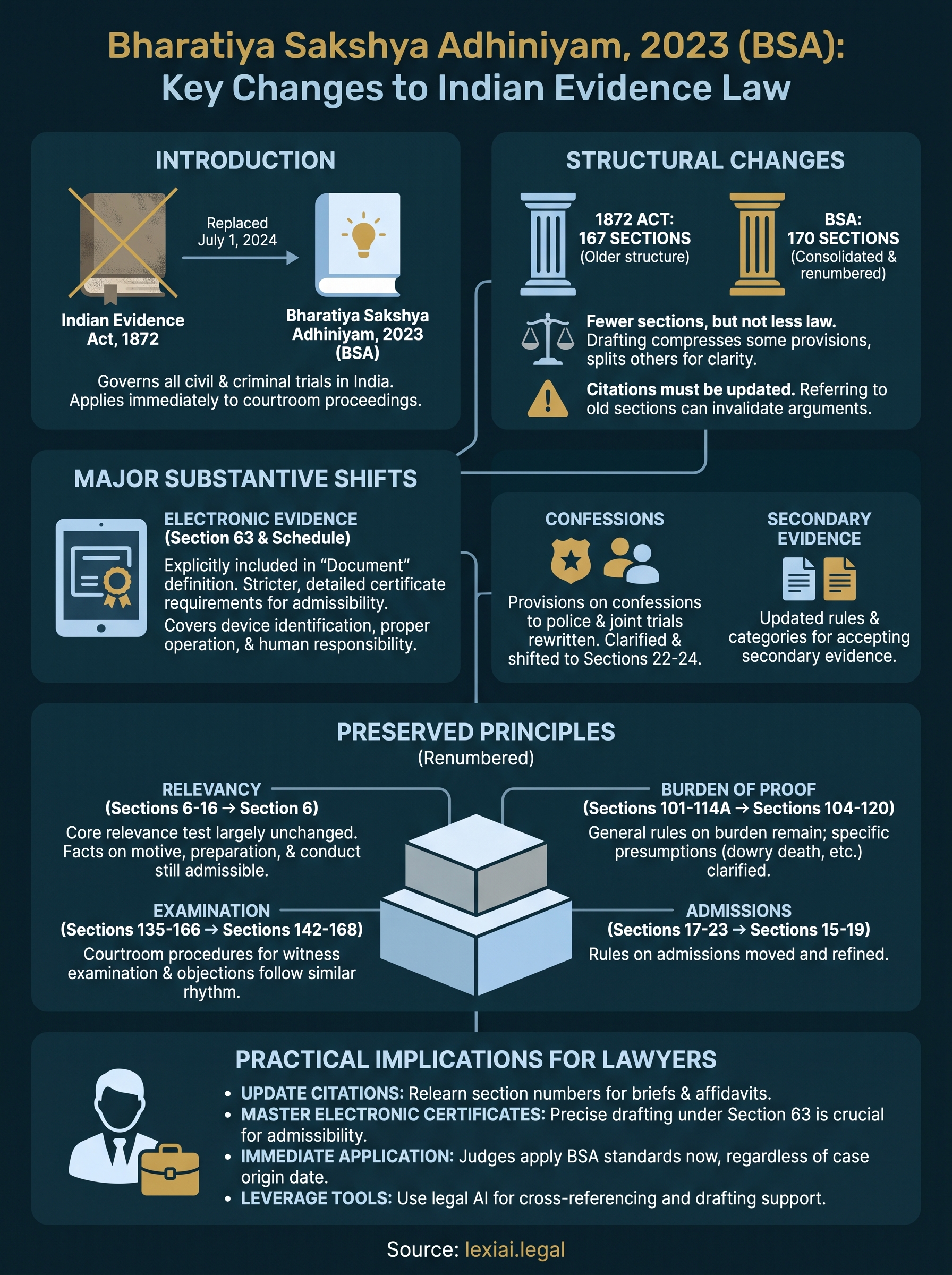
Numbers matter to lawyers because citations matter. The BSA runs to 170 sections against the Evidence Act's 167, but the drafting compresses several old provisions into single, cleaner sections while splitting others out for clarity. Section 22 of the old Act on facts showing motive, preparation, and conduct now sits inside Section 6 of the BSA, folded together with several adjoining provisions. If you cite Section 65B out of habit in a 2026 hearing, opposing counsel or the bench will likely flag it immediately, because that provision on electronic evidence now carries a different number entirely.
A citation to a repealed section is not a small slip, it can sink an otherwise strong argument on admissibility.
Why citing the wrong Act can hurt your case
Judges and registries have started rejecting pleadings that reference the old Act's section numbers without a cross-reference, especially in fresh filings after July 2024. Courts are not obligated to translate your citation for you, and a wrongly numbered provision weakens the credibility of your entire submission. Litigators drafting evidence affidavits, framing issues, or preparing cross-examination notes need the BSA's actual text in front of them, not a memorized version of the 1872 Act with a mental note to adjust the numbers later.
What this means for your daily practice
Practically, this changes four things you deal with constantly: how you authenticate electronic evidence, how you handle confessions to police, how you treat secondary evidence of documents, and how you address the burden of proof in specific fact patterns. Each area got either a substantive tweak or a full renumbering, and getting it wrong in a written submission signals to the bench that your practice has not caught up.
- Renumbering affects every citation: old section numbers in your templates, briefs, and precedent notes need updating before you file anything new.
- Electronic evidence rules tightened: the BSA now governs admissibility of electronic and digital records with a more detailed certification requirement than the old Section 65B.
- New categories of evidence recognized: the BSA explicitly names electronic and digital records as documents, removing ambiguity litigators argued over for years.
- Confession provisions were rewritten: sections on confessions to police and joint trials shifted position and picked up clarifying language.
Saving yourself from a bench correction mid-argument is worth the upfront work of relearning the numbering. Firms that update their precedent banks and drafting tools, including AI legal assistants for Indian lawyers like LeXi Agent, cut down this transition risk considerably, since cross-referencing old and new provisions by hand across hundreds of sections is exactly where errors creep in.
How the Bharatiya Sakshya Adhiniyam applies in court
Walk into any courtroom today and the judge is running relevance and admissibility calls under the Bharatiya Sakshya Adhiniyam, not the old Act, regardless of when the dispute arose. Procedural evidence law applies from the date of the hearing, not the date of the cause of action, so a 2019 contract dispute heard in 2026 still gets tested against BSA standards, while the conduct of the suit itself follows the Civil Procedure Code's structure and key provisions. Understanding this distinction early saves you from framing objections around a statute the bench has already retired.
Relevance and admissibility standards in the courtroom
Sections 3 through 8 of the BSA carry forward the core relevance test from the 1872 Act almost untouched, so facts connected to the issue, motive, preparation, and conduct remain admissible in largely familiar form. Where the BSA sharpens things is in admissibility of electronic records, expert opinion, and the standard for secondary evidence, all of which now demand more specific certification before a judge lets the document in.
If a fact would have been relevant under the old Act, it almost certainly still is under the BSA, but how you prove it may have changed.
Burden of proof and presumptions
The BSA keeps the general rule that whoever asserts a fact must prove it, but it tightens language around presumptions in specific situations, including dowry death, abetment of suicide, and certain documents produced from proper custody. Practically, this affects how you structure your evidence in a few recurring scenarios:
- Presumption as to certain documents: registered documents and certified copies carry the same presumption of genuineness they did before, now positioned under renumbered sections.
- Presumption in criminal cases involving specific offenses: statutory presumptions against the accused in cases like dowry death retain their earlier force, with clarified drafting.
- Burden on the party in possession: where facts lie especially within a party's knowledge, that party still carries the burden of explaining them.
Documentary and witness evidence procedure
Marking exhibits, examining witnesses, and objecting to inadmissible testimony follow the same courtroom rhythm lawyers already know, but the underlying statutory basis for objections has shifted section numbers throughout. Preparing your cross-examination notes or evidence affidavits now means checking the BSA's actual text rather than relying on muscle memory from the 1872 Act, especially for objections around hearsay, opinion evidence, and document proof. Tools such as LeXi LiTT are built for exactly this, searching Supreme Court and High Court judgments in seconds and pulling the current section alongside relevant precedent while you draft your courtroom strategy, so you are not cross-checking two statutes by hand during a live hearing.
Bharatiya Sakshya Adhiniyam vs the Indian Evidence Act
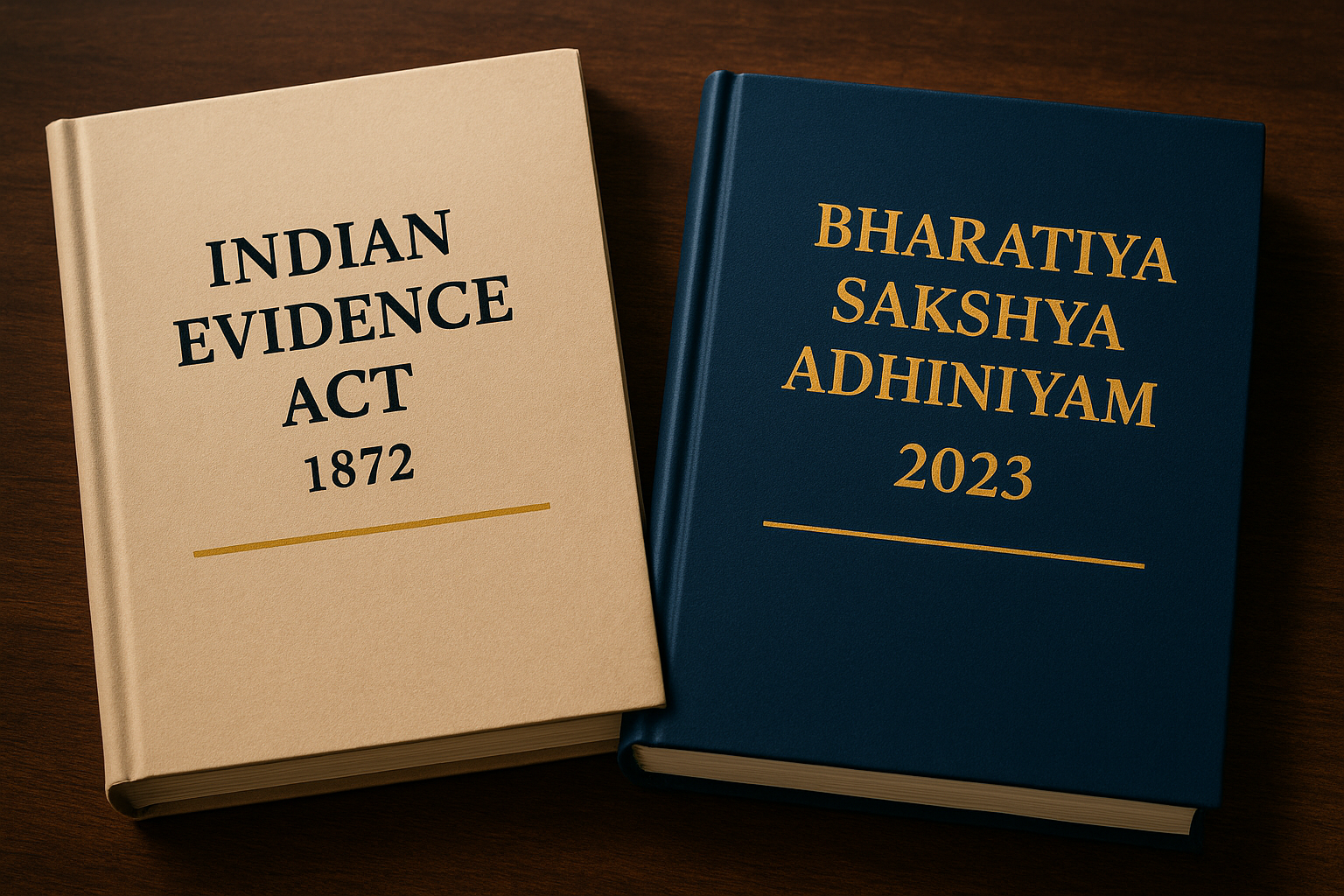
Comparing the two statutes side by side is the fastest way to see what actually moved and what merely got a new number. The Indian Evidence Act, 1872 ran on a colonial-era structure that had accumulated over 150 years of amendments and judicial gloss, while the BSA consolidates that same body of law into a tighter, renumbered framework. Below is a working reference for the provisions litigators cite most often.
| Subject | Indian Evidence Act, 1872 | Bharatiya Sakshya Adhiniyam, 2023 |
|---|---|---|
| Relevancy of facts | Sections 6 to 16 | Section 6 |
| Admissions | Sections 17 to 23 | Sections 15 to 19 |
| Confessions to police | Sections 25 to 27 | Sections 22 to 24 |
| Electronic records as documents | Section 65B | Section 63 with the Schedule |
| Presumption as to documents | Section 79 to 90A | Sections 78 to 93 |
| Burden of proof | Sections 101 to 114A | Sections 104 to 120 |
| Examination of witnesses | Sections 135 to 166 | Sections 142 to 168 |
The sections you cite may have new numbers, but the underlying evidentiary logic Indian courts built over a century mostly survives intact.
Substantively, the BSA makes its sharpest departure in three areas: electronic and digital evidence, confessions made to police officers, and the categories of secondary evidence a court will accept. The Act now explicitly includes electronic and digital records within the definition of "document" and "evidence" under Section 2, closing a gap that generated years of conflicting High Court rulings under the old Section 65B regime. Confession-related provisions also picked up clarifying language around joint trials and confessions made in police custody, tightening what previously required case law to settle.
Despite the renumbering, the BSA preserves nearly all of the 1872 Act's foundational doctrine on relevance, hearsay, and the hierarchy of primary versus secondary evidence. Repealed provisions were not deleted outright either, Section 170 of the BSA operates as a saving clause, so pending proceedings and past judicial interpretation built under the old Act remain relevant to how courts read the new one. Lawyers moving between the two statutes will find the drafting style modernized, with plain language replacing some archaic phrasing, but the tests a judge applies to decide whether a fact is relevant or a document is proved have not been reinvented from scratch. Knowing exactly which handful of provisions changed in substance, rather than assuming the whole Act is unfamiliar, is what separates efficient litigation prep from relearning evidence law from zero.
How electronic evidence is treated under the BSA
Digital evidence gets its most significant overhaul in the entire Bharatiya Sakshya Adhiniyam, and this is the area most litigators need to relearn carefully. The old Section 65B regime under the Indian Evidence Act generated more conflicting High Court rulings than almost any other provision, largely because the certificate requirement was vague and courts disagreed on when it could be waived. Section 63 of the BSA now governs this territory, and it comes with a detailed Schedule that spells out exactly what a certificate must contain before a court will even look at your electronic record.
What qualifies as electronic evidence now
Under the BSA, the definition of "document" in Section 2 expressly includes electronic and digital records, closing a gap lawyers used to argue over case by case. Emails, WhatsApp chats, CCTV footage, server logs, and electronically signed contracts all fall within this definition without needing a separate argument to bring them in. This removes an entire category of preliminary objections that used to eat up hearing time under the 1872 Act, where opposing counsel could stall proceedings simply by disputing whether a screenshot even counted as a document.
Electronic evidence is no longer a gray area under the BSA, it is a document like any other, provided the certificate requirements are met.
Certificate requirements under Section 63
Getting an electronic record admitted still depends on a valid certificate, and the Schedule to Section 63 lays out what that certificate needs to cover:
- Identification of the device or system that produced the record, including its regular use for the relevant activity
- Confirmation that the information was fed into the device in the ordinary course of that activity
- Statement that the device was operating properly during the period the record was generated
- Details of the person responsible for managing the device, along with their signature and designation
Missing any one of these elements gives opposing counsel a clean admissibility objection, so applying precise drafting skills to the certificate the first time saves you a return trip to the witness who signed it.
Practical impact for litigators
Filing electronic evidence without a properly drafted certificate remains the single most common mistake lawyers make post-transition, and judges have shown little patience for curing it mid-trial. Handling case files that run into hundreds of pages of chat logs or transaction records by hand is slow, and this is where a tool like LeXi Desk helps by flagging missing certification language and summarizing digital exhibits before you file them. Preparing electronic evidence correctly under Section 63, rather than treating it as a formality, is what keeps your strongest exhibits from getting thrown out on a technicality.
Staying prepared as the BSA takes effect
The Bharatiya Sakshya Adhiniyam is not a rebrand of the Indian Evidence Act, it is a renumbered, partly rewritten statute that governs every relevance and admissibility call in Indian courts today. Most of the 1872 Act's foundational doctrine survives, but the sections on electronic evidence, confessions, and secondary evidence demand fresh attention before you file or argue anything under them. Getting the citations right, drafting Section 63 certificates properly, and framing objections against the correct provision are no longer optional housekeeping, they decide whether your evidence gets admitted.
Waiting until a bench correction forces the issue is the expensive way to learn the new numbering. A faster path is building the BSA into your daily workflow now, from drafting templates to cross-examination notes. If you want cross-referenced sections, case law, and drafting support in one place instead of juggling two bare acts, see what the LeXi AI platform does for evidence work and how it fits into your practice.