

Bharatiya Nyaya Sanhita: What It Is and How It Replaces the IPC
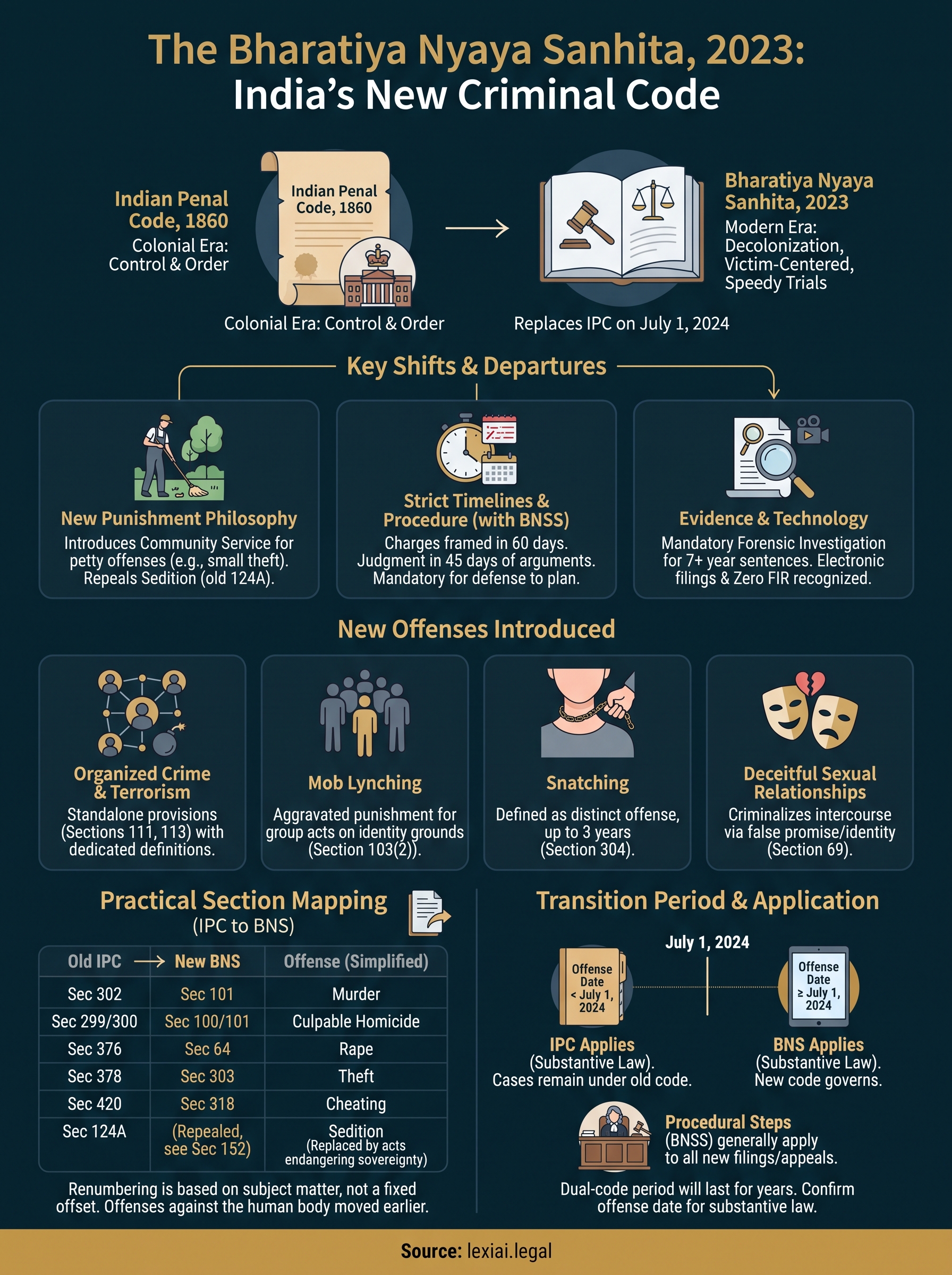
The Bharatiya Nyaya Sanhita, 2023 is the new criminal code that replaced the Indian Penal Code, 1860 on July 1, 2024. It is not a minor amendment. Parliament restructured offenses, renumbered sections, and added new categories of crime such as organized crime and terrorist acts, which had no dedicated provisions under the IPC.
If you are searching for what changed, here is the direct answer. The BNS retains most core offenses from the IPC but reorganizes them under 358 sections instead of 511, introduces community service as punishment, and repeals colonial-era provisions like sedition in its old form. Cross-referencing old IPC sections against their new BNS numbers is now a daily task for practicing lawyers.
This article walks through the structure of the BNS, its major departures from the IPC, and a practical section mapping you can use in filings and arguments. Legal AI tools that actually understand the Bharatiya Nyaya Sanhita can speed up this cross-referencing work, but understanding the underlying changes yourself remains essential for any litigation practice in India today.
Why the Bharatiya Nyaya Sanhita replaces the Indian Penal Code
A code built for another era
The Indian Penal Code, 1860 was drafted by Lord Macaulay for a colonized population, not a constitutional democracy. Its language, structure, and punishment philosophy reflected the priorities of the British administration: control and order, not victim rights or rehabilitation. Sections like sedition (old Section 124A) existed to protect the colonial government from dissent, not to serve citizens of an independent country. That mismatch sat unresolved for over 160 years, through countless amendments that patched the code without ever rebuilding it.
The official reasons Parliament gave
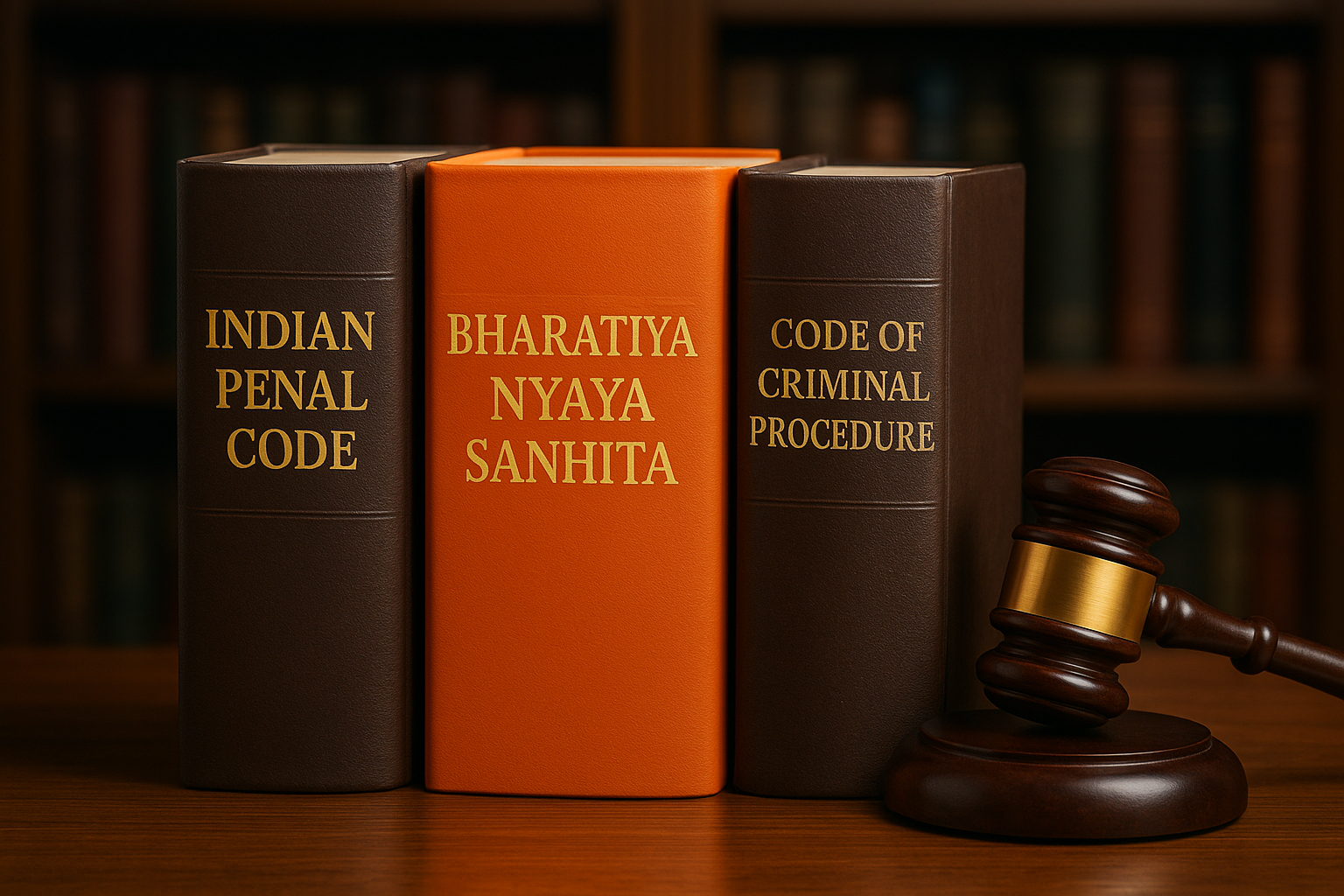
Home Minister Amit Shah introduced the Bharatiya Nyaya Sanhita bill in August 2023, framing it around three goals: decolonization, victim-centered justice, and speedy trials. Parliament passed it in December 2023, and it came into force on July 1, 2024, alongside two companion statutes that replaced the Code of Criminal Procedure and the Indian Evidence Act. Together, these three laws form the new criminal justice framework in India.
| Old Law | New Law | Governs |
|---|---|---|
| Indian Penal Code, 1860 | Bharatiya Nyaya Sanhita, 2023 | Substantive offenses and punishments |
| Code of Criminal Procedure, 1973 | Bharatiya Nagarik Suraksha Sanhita, 2023 | Investigation, trial, and procedure |
| Indian Evidence Act, 1872 | Bharatiya Sakshya Adhiniyam, 2023 | Rules of evidence |
From punishment to deterrence and timelines
The government's stated case for replacing the IPC rests heavily on trial delays. India's courts carry a backlog running into tens of millions of cases, and the government argued that a colonial code with no built-in timelines contributed to that pileup. The Bharatiya Nyaya Sanhita works alongside procedural mandates in the BNSS, such as requiring judgment within 45 days of the conclusion of arguments and charges to be framed within 60 days of the first hearing. Forensic investigation is now mandatory for any offense carrying a sentence of seven years or more, a shift meant to strengthen evidence quality rather than rely on confessions or witness memory alone.
The Indian Penal Code punished; the Bharatiya Nyaya Sanhita is built to also deter, and to finish cases faster.
Community service also enters Indian criminal law for the first time as a formal punishment, available for petty offenses like small-value theft, public intoxication, and certain defamation cases. This single change reflects the government's argument that the IPC's punishment menu, largely fines or imprisonment, did not fit low-harm offenses well.
Filling gaps the IPC never addressed
Organized crime and terrorism never had dedicated provisions in the IPC. Prosecutors relied on special statutes like the Maharashtra Control of Organised Crime Act or the Unlawful Activities (Prevention) Act, which apply only in specific states or specific circumstances. Section 111 of the BNS now defines organized crime as a standalone offense, and Section 113 defines terrorist acts, giving every state a baseline provision without needing separate legislation. Mob lynching, absent from the IPC entirely despite years of documented incidents, now carries its own aggravated punishment provision tied to murder and grievous hurt when committed by a group acting on identity-based grounds.
Gender-neutral language appears in several sections where the IPC used outdated or narrow terms, and provisions dealing with acts against women and children were consolidated into their own chapter rather than scattered across the code. None of this means the BNS is a wholesale rewrite of Indian criminal principles. Most of the conduct that was a crime under the IPC remains a crime under the Bharatiya Nyaya Sanhita. What changed is the numbering, the framing, and the addition of categories the drafters of 1860 never had reason to imagine.
How the Bharatiya Nyaya Sanhita changes criminal law in practice
New timelines change how you plan a case
Getting a first information report filed is no longer the only clock running. Under the linked procedural code, police must complete investigation within fixed periods for many offenses, and courts must frame charges within 60 days of the first hearing. Judgment must follow within 45 days of the conclusion of arguments. If you are appearing regularly in trial courts, build these deadlines into your case diary from day one, because missed timelines now carry consequences that did not exist under the old framework.
A case strategy that ignores the new statutory timelines is already behind schedule.
Forensic evidence becomes mandatory, not optional
Section 176(3) of the Bharatiya Nagarik Suraksha Sanhita requires forensic investigation for any offense punishable with seven years or more imprisonment. That single line reshapes how prosecutors build a case and how defense lawyers challenge one. Expect more reliance on physical evidence, forensic reports, and video documentation of crime scenes, and correspondingly less weight given to confessions obtained without corroboration. States without adequate forensic infrastructure have a grace period to scale up, but the direction is clear: evidence quality now matters more than it did under IPC-era practice.
Electronic filings and hearings get formal recognition
Zero FIR provisions, meaning you can file a first information report at any police station regardless of jurisdiction, now sit on statutory footing rather than departmental circulars. Electronic filing of complaints and statements recorded through video conferencing also gained explicit legal recognition. For practicing lawyers, this means clients in another city or state are no longer stuck waiting for a transfer application before an FIR gets registered, and witness statements can move faster when travel is not feasible.
Sentencing options widen for minor offenses
Community service, introduced for the first time under the Bharatiya Nyaya Sanhita, changes how you advise clients facing petty charges. Theft of property under a certain value, public nuisance, and minor defamation cases can now end in community service rather than a criminal record built entirely around fines or jail time. This matters most for first-time offenders and for clients where a conviction under the old regime would have carried disproportionate long-term consequences for employment or reputation.
What this means for daily practice
Drafting habits need to catch up with all of this. Petitions, bail applications, and charge sheets referencing old IPC numbers without cross-checking the corresponding BNS section risk confusing a judge or, worse, citing a provision that no longer exists in the form you remember. Lawyers who built years of muscle memory around IPC section numbers are relearning citation practice from scratch, and firms are updating templates, precedent banks, and internal checklists to reflect the new numbering and the new procedural deadlines running alongside it.
New offences introduced under the Bharatiya Nyaya Sanhita
Several crimes that had no independent existence under the IPC now stand on their own in the Bharatiya Nyaya Sanhita. Drafters did not just relabel old sections; they identified conduct that courts and police had been forcing into ill-fitting provisions for years and gave it a proper legal home. Snatching, deceptive sexual relationships, and acts threatening the sovereignty of India all fall into this category, alongside the organized crime and terrorism provisions covered earlier.
Snatching finally gets its own section
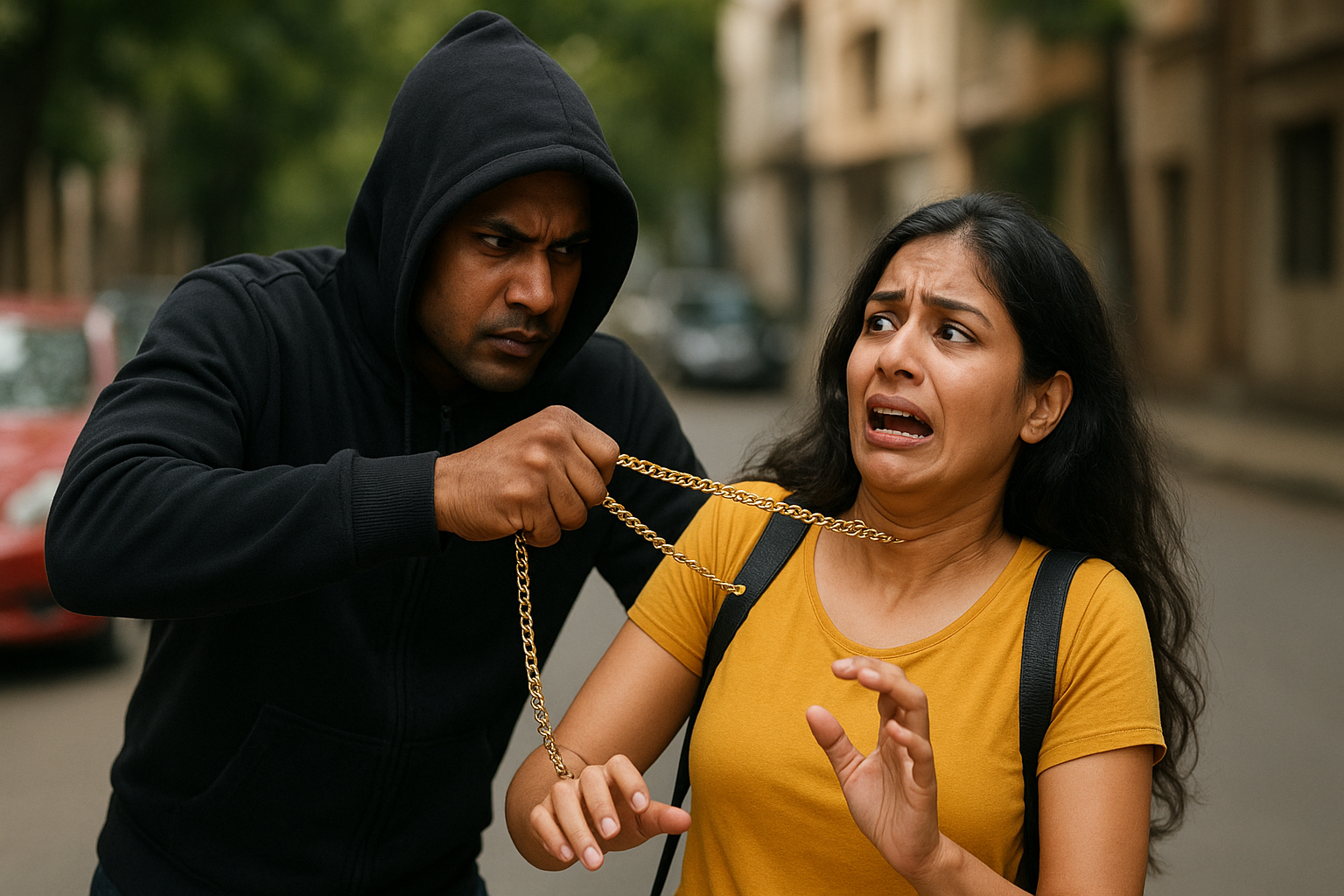
Before July 2024, a snatched chain or phone got prosecuted as simple theft or robbery, neither of which captured the sudden, forceful grab that defines street snatching. Section 304 of the BNS now defines snatching as a distinct offense, punishable with up to three years imprisonment. Police departments in cities like Delhi and Bengaluru, where snatching cases run into the thousands annually, finally have a section that matches the crime pattern their FIR registers actually show.
Deceptive means to establish sexual relationships
Courts had struggled for years with cases where a man obtained sexual consent through a false promise of marriage or by concealing his identity. Section 69 of the Bharatiya Nyaya Sanhita now criminalizes sexual intercourse obtained through deceitful means, including false promise of marriage, false identity, or inducement through fraud, with punishment extending up to ten years. This closes a gap that previously forced prosecutors to stretch rape provisions or cheating provisions to cover conduct that fit neither cleanly.
A crime pattern without a matching section either goes unprosecuted or gets forced into the wrong one; the BNS was built to close exactly that gap.
Acts endangering sovereignty, unity, and integrity of India
Replacing the old sedition provision, Section 152 targets acts that endanger the sovereignty, unity, and integrity of India through subversive activities, secessionist acts, or armed rebellion against lawful authority. Unlike old Section 124A, this provision is drafted around acts and conduct rather than words that merely bring the government into disrepute, at least on paper. How courts interpret that distinction over the coming years will decide whether this change is substantive or cosmetic.
A quick reference to the new categories
| New offense | BNS section | What it covers |
|---|---|---|
| Organized crime | Section 111 | Syndicate-based crime, extortion, contract killing |
| Terrorist acts | Section 113 | Acts intended to threaten unity, security, or sovereignty |
| Mob lynching | Section 103(2) | Murder by five or more persons on identity grounds |
| Snatching | Section 304 | Sudden, forceful theft of property from a person |
| Sexual relationship by deceit | Section 69 | Consent obtained through false promise or identity fraud |
| Acts against sovereignty | Section 152 | Subversive or secessionist acts against the state |
Together, these additions show a code responding to crime patterns that Indian courts and police had been documenting for decades without a matching statutory provision.
Offences removed or renamed under the Bharatiya Nyaya Sanhita
Not every change under the Bharatiya Nyaya Sanhita added something new. Parliament also used this rewrite to drop provisions the courts had already hollowed out and to rename offenses whose old labels no longer matched how judges and lawyers actually used them. If you learned criminal law under the IPC, this is the part most likely to trip you up in a live hearing.
Sedition loses its old section, not just its old name
Old Section 124A, the sedition provision that jailed independence-era leaders and later drew repeated constitutional challenges, stands formally repealed. It cannot be invoked for any act occurring after July 1, 2024, no matter how the prosecution frames the conduct. Section 152 of the BNS covers acts endangering the sovereignty, unity, and integrity of India, but it is drafted around subversive conduct and armed rebellion rather than words that merely embarrass the government, at least in its text.
Sedition as a word disappeared from the statute book; whether the conduct it punished disappeared with it is a question courts will answer case by case.
Adultery and Section 377 were already gone before the BNS arrived
Two removals get credited to the BNS that actually happened years earlier through the courts. Section 497 of the IPC, which criminalized adultery, was struck down by the Supreme Court in Joseph Shine v. Union of India (2018) for treating women as property. Old Section 377, covering unnatural offenses between consenting adults, was read down in Navtej Singh Johar v. Union of India (2018). The Bharatiya Nyaya Sanhita simply confirms both removals by leaving no equivalent provision, rather than reviving what the courts had already discarded.
Renamed offences you will trip over first in filings
Several offenses kept their substance but changed their label or numbering enough to catch you off guard mid-argument. Culpable homicide and murder shifted from Sections 299 and 300 to Sections 100 and 101. Rioting and unlawful assembly moved out of the 140s range entirely. Drafting habits built around citing "Section 302 for murder" need conscious correction, because that number now sits somewhere else in the code.
| Old provision | Status under BNS | Notes |
|---|---|---|
| Section 124A (Sedition) | Repealed, replaced in substance | New Section 152, narrower drafting |
| Section 497 (Adultery) | No equivalent provision | Struck down by Supreme Court in 2018 |
| Section 377 (Unnatural offenses, consensual) | No equivalent provision | Read down by Supreme Court in 2018 |
| Section 302 (Murder) | Renamed and renumbered | Now Section 101 |
| Section 299/300 (Culpable homicide/Murder) | Renumbered | Now Sections 100 and 101 |
Check every citation against a current mapping table before you file, especially in appeals referencing older judgments that still use IPC numbers throughout their reasoning.
How IPC sections map to Bharatiya Nyaya Sanhita sections
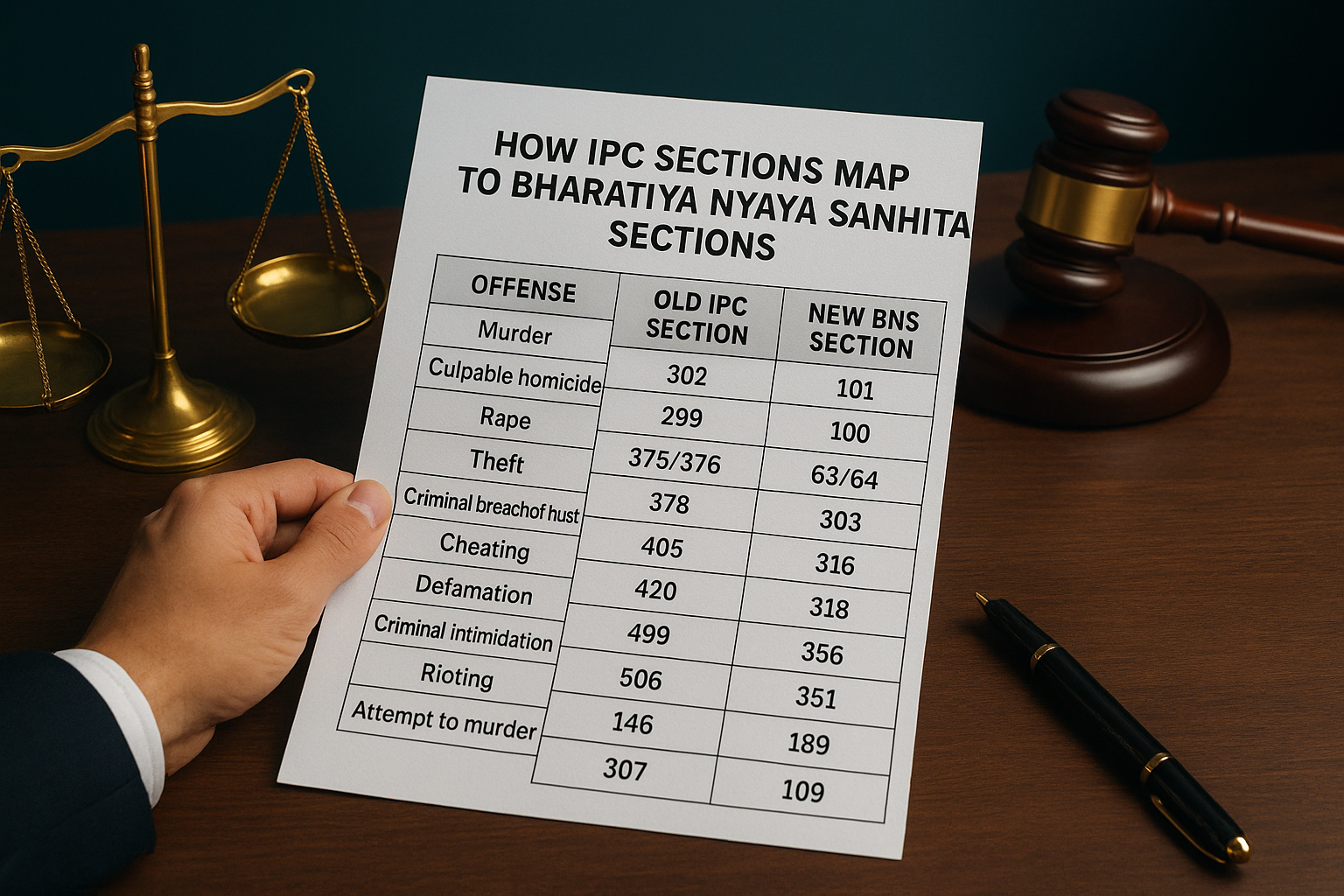
Mapping tables became the single most searched resource among Indian lawyers in the months after July 1, 2024, and for good reason. Every petition, bail application, and cross-examination built on IPC citations needs a BNS equivalent before it can go anywhere near a courtroom today. A wrong section number does more than look sloppy; it can get an application returned or, worse, invite an objection from opposing counsel that stalls a hearing you had scheduled weeks in advance.
Why renumbering was not a simple shift
Understanding why the numbers do not follow a predictable pattern helps you stop guessing. The BNS did not renumber sections by adding a fixed offset to each IPC number, the way some early rumors suggested. Drafters regrouped offenses by subject matter first, which means murder, previously Section 300, now sits at Section 101, while theft moved from Section 378 to Section 303. Sections dealing with the human body come earlier in the new code, and offenses against property and the state follow in a different order than the IPC used.
Guessing at a BNS section number from memory is a habit worth breaking on day one.
Frequently used sections lawyers cite daily
Building a quick personal reference for the sections you cite most often saves real time in a busy practice. The table below covers the provisions that come up constantly in trial court filings and bail hearings.
| Offense | Old IPC Section | New BNS Section |
|---|---|---|
| Murder | Section 302 | Section 101 |
| Culpable homicide | Section 299 | Section 100 |
| Rape | Section 375/376 | Section 63/64 |
| Theft | Section 378 | Section 303 |
| Criminal breach of trust | Section 405 | Section 316 |
| Cheating | Section 420 | Section 318 |
| Defamation | Section 499 | Section 356 |
| Criminal intimidation | Section 506 | Section 351 |
| Rioting | Section 146 | Section 189 |
| Attempt to murder | Section 307 | Section 109 |
Double check every entry against the current government notification before relying on it in a filing, since amendments and clarifications have already adjusted a handful of numbers since the code came into force.
Building a reliable cross-referencing habit
Relying on memory alone is where most citation errors creep into otherwise solid drafting. A few habits keep your filings accurate:
- Keep a printed or digital section-mapping chart open beside every draft that references criminal provisions.
- Cross-check any judgment predating July 2024 against the current BNS number before quoting it as precedent.
- Flag templates and precedent banks in your firm that still carry unrevised IPC numbers.
- Use AI legal research built for Indian judgments that updates citations automatically rather than a static PDF that goes stale.
Tools like LeXi Agent handle this cross-referencing automatically when you search a judgment or draft a filing, pulling the current BNS section alongside the historical IPC citation so you are not manually checking two codes side by side for every clause you write.
Structure and chapters of the Bharatiya Nyaya Sanhita
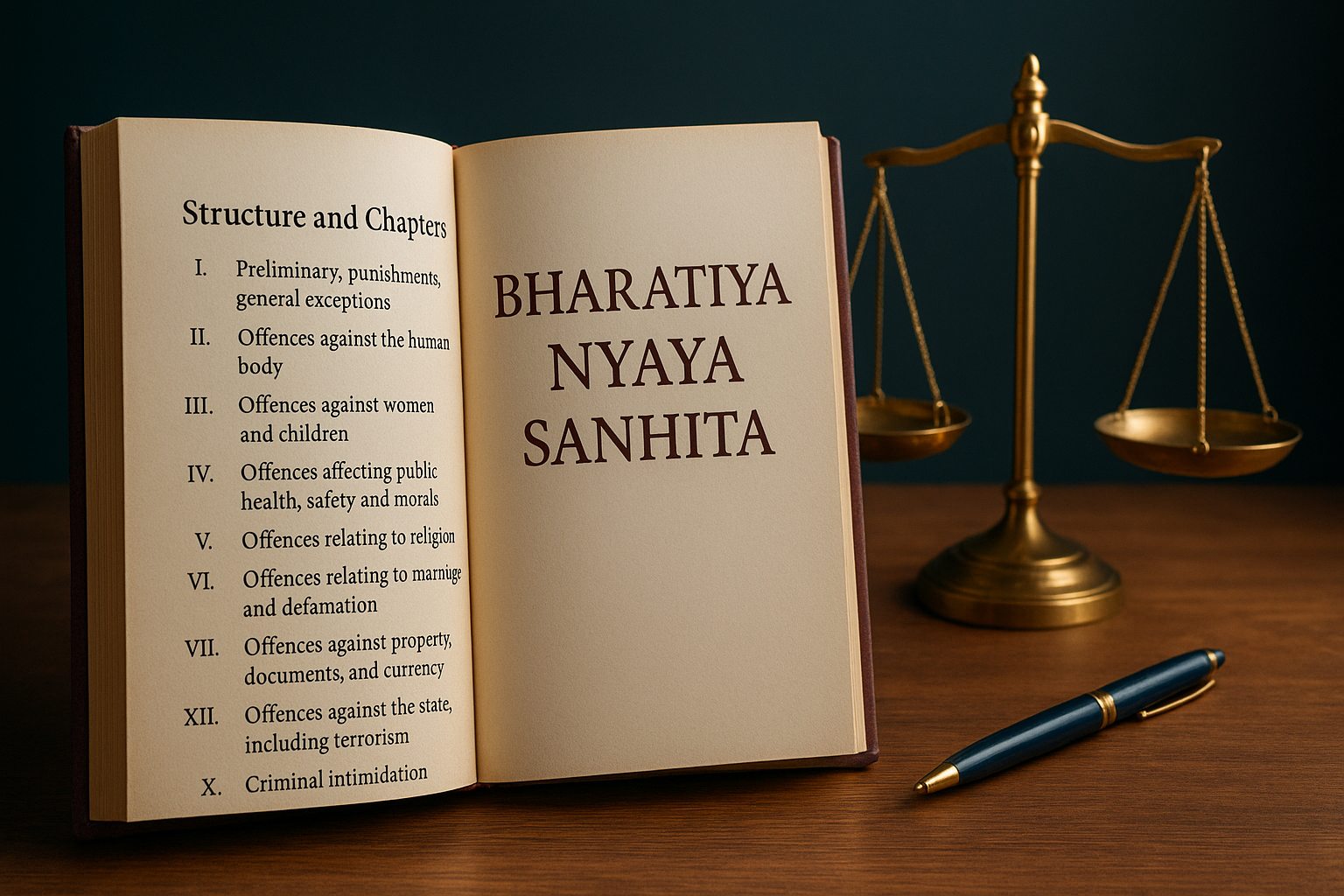
The Bharatiya Nyaya Sanhita compresses the code into 20 chapters and 358 sections, down from the Indian Penal Code's 23 chapters and 511 sections. Drafters achieved that reduction by folding overlapping provisions together and dropping obsolete colonial offenses, not by deleting substantive crimes wholesale. Anyone flipping through the bare act for the first time will notice the chapter order itself has changed, and that change is not cosmetic. It reflects a deliberate decision to move offenses against the human body ahead of offenses against property and the state, a reversal of the IPC's original sequence.
Why the chapter order moved
Understanding this reordering matters more than memorizing it. Chapters V and VI of the BNS deal with offenses affecting the human body, covering culpable homicide, murder, hurt, and sexual offenses, and they now sit near the front of the code rather than buried in the middle as under the IPC. Sexual offenses against women and children, previously scattered across different chapters, now sit consolidated under one heading. This grouping logic makes the code easier to navigate once you learn it, even though the transition period means constantly checking whether a section you remember from law school still lives in the same neighborhood.
A code organized around the harm caused, rather than colonial priorities, changes how you search for the right section, not just where you find it.
A quick map of where things live
Running down the chapter list once is enough to fix the broad geography in your head for daily filings.
| Chapter | Subject matter |
|---|---|
| I to III | Preliminary, punishments, general exceptions |
| IV | Abetment, criminal conspiracy, attempt |
| V and VI | Offenses against the human body (homicide, hurt, kidnapping) |
| VII | Offenses against women and children |
| VIII | Offenses affecting public health, safety, and morals |
| IX to XI | Offenses relating to religion, marriage, and defamation |
| XII to XVII | Offenses against property, documents, and currency |
| XVIII | Offenses against the state, including terrorism |
| XIX and XX | Criminal intimidation, and repeal and savings provisions |
What the reorganization means for research and drafting
Searching by chapter, rather than by a remembered section number, often gets you to the right provision faster during the transition. Lawyers preparing charge sheets or bail applications benefit from treating the chapter headings as a first filter before diving into section text, especially when a client's case involves conduct that spans multiple old IPC chapters now folded into one BNS chapter. Students studying the Bharatiya Nyaya Sanhita for the first time have something of an advantage here, since they can learn the new structure directly without unlearning IPC habits first. Practicing lawyers do not have that luxury, and rebuilding a mental map of where offenses now sit is simply part of adapting to this code.
How the Bharatiya Nyaya Sanhita applies to pending cases
Here is the short version: the Bharatiya Nyaya Sanhita does not reach backward to punish conduct that happened before July 1, 2024. Section 358 of the BNS, its repeal and savings clause, keeps the Indian Penal Code alive for every offense committed before that date. If your client is accused of theft committed in March 2024, the FIR, the chargesheet, and the trial all run on Section 378 of the IPC, not Section 303 of the BNS, regardless of when the case actually reaches trial.
The date of the offense decides the code, not the date of trial
Going by the offense date rather than the filing date or hearing date is the rule courts have consistently applied since July 2024. This follows directly from Article 20(1) of the Constitution, which bars retrospective criminal punishment, meaning nobody can be convicted under a law that did not exist when they committed the act. A pending case where the alleged offense occurred in 2023 stays an IPC case through appeal, revision, and even a Supreme Court hearing years from now. Lawyers who assume every hearing after July 2024 automatically uses BNS numbers are setting themselves up for an avoidable correction from the bench.
The law that applies is the law that existed on the day the offense happened, not the law on the day the judge reads the order.
Procedural law works differently from substantive law
Separating the two codes in your head matters here, because the Bharatiya Nagarik Suraksha Sanhita does not follow the exact same freeze-in-time rule as the BNS. Procedural steps that had not yet occurred as of July 1, 2024, such as an appeal filed after that date or a bail application moved for the first time in 2025, generally follow the new procedural code even when the underlying offense sits under the old IPC. Several High Courts issued practice directions in mid-2024 clarifying this split, since trial courts initially disagreed on whether pending matters should shift procedural tracks midway.
What this means for a case running through 2026 and beyond
Expect this dual-code period to last for years, not months, given how long serious trials and appeals take to conclude in India. A single case file may cite IPC Section 302 for the charge while referencing BNSS timelines for the trial schedule, and both citations are correct in that file. Practical habits worth building into every pending matter:
- Confirm the offense date before assuming which substantive code applies, never the FIR date alone.
- Check whether the procedural step you are filing falls before or after July 1, 2024, since that decides CrPC versus BNSS.
- Flag appeals and revisions from older judgments so the bench knows which code governed the original conviction.
- Keep both IPC and BNS section numbers in your notes for any matter that straddles the transition.
Getting this distinction wrong in a filing invites exactly the kind of procedural objection that delays a hearing you cannot afford to lose time on.
How lawyers and law students can adapt to the new code
Relearning citation practice from scratch
Adapting starts with accepting that muscle memory built over years of practice is now a liability, not an asset. Senior lawyers who could cite "Section 302" or "Section 420" without opening a bare act have to consciously pause and verify before they speak in court, because that same number now points somewhere else entirely under the Bharatiya Nyaya Sanhita. Treat every citation as unverified until you check it, even ones you have used a hundred times.
The lawyers who adapt fastest are the ones who stop trusting their own memory for section numbers.
Building a personal cross-reference system
Creating your own quick-reference habit beats relying on whatever chart happens to be open in another tab during a hearing. A few practices worth adopting immediately:
- Keep a printed BNS-IPC mapping table taped inside your case diary, not buried in a folder you rarely open.
- Rebuild your precedent bank so every saved judgment carries both the old IPC citation and its current BNS equivalent.
- Run a firm-wide audit of templates, from bail applications to charge sheet formats, and flag anything still citing unrevised IPC numbers.
- Set a recurring calendar reminder to recheck your reference table against government notifications, since a handful of section numbers have already seen clarificatory amendments since July 2024.
Skipping this groundwork shows up fast, usually in the form of a judge pointing out a wrong section number mid-argument.
What law students should do differently
Students entering the profession now have an advantage that practicing lawyers do not get to enjoy: no old numbering to unlearn. Rather than memorizing the Bharatiya Nyaya Sanhita as a translated version of the IPC, learn it as the primary code it now is, and treat IPC numbers as historical references you will need only when reading older judgments. Moot court practice, internships, and case studies should all run on BNS section numbers by default, with IPC cross-references added as a secondary layer for research purposes. Law schools that still teach primarily from IPC-era textbooks are doing their students a disservice, and it is worth pushing faculty to update reading lists accordingly.
Where AI tools fit into this transition
Speeding up this adjustment period is exactly where an AI legal assistant for Indian lawyers earns its place in a modern practice. A tool like LeXi Agent can pull the current BNS section alongside its historical IPC citation the moment you search a judgment, which removes the manual lookup step that eats time during drafting. Students working through LeXi Academy get guided practice on BNS provisions directly, without picking up outdated habits first. None of this replaces actually understanding why a section moved or what conduct it now covers, but it does cut down the hours spent flipping between two codes while you build that understanding.
Where Indian criminal law goes from here
The Bharatiya Nyaya Sanhita is not a rebranding exercise. It changes section numbers, adds offenses the IPC never addressed, and ties substantive law to procedural deadlines that did not exist before July 2024. Both codes will sit side by side in Indian courtrooms for years, since the IPC still governs every offense committed before that date, and getting that distinction right matters more than getting comfortable with new numbers.
Expect further clarificatory amendments as courts interpret provisions like Section 152 and Section 69 for the first time. Treat every citation as something to verify, not something to remember, and build that habit now rather than after a judge corrects you mid-argument.
If you want that cross-referencing done for you automatically, across BNS, BNSS, and BSA, see what the LeXi AI platform does for criminal practice and how it fits into your daily filing routine.