

Legal Drafting Techniques: Core Skills for Precise Documents
Every contract dispute or dismissed petition you've seen usually traces back to one thing: sloppy drafting. A misplaced comma, an undefined term, or a vague clause can undo months of negotiation or weaken a strong case. Learning proper legal drafting techniques isn't optional anymore, it's the skill that separates documents that hold up in court from those that get picked apart by opposing counsel.
This article gives you the practical drafting principles working lawyers actually use, not textbook theory. You'll learn how to structure clauses so they can't be misread, how to choose precise language over legal-sounding filler, and how to spot the ambiguity risks that create loopholes or litigation down the line. Whether you're drafting a commercial contract, a pleading, or a legal notice, these techniques apply across document types.
We'll walk through sentence construction, defined terms, consistency checks, and review habits that catch errors before they cost you. We also cover where AI drafting tools like LeXi Desk fit into this process, helping you flag risky clauses and cut drafting time without sacrificing the precision your practice depends on.
Why legal drafting techniques matter for your practice
Lawyers often treat drafting as clerical work, something you delegate to a junior or knock out between hearings. That mindset costs money and cases. Poor drafting is the single most preventable source of contract disputes, and courts routinely interpret ambiguous clauses against the party who drafted them. If you want documents that protect your client rather than expose them, you need to treat legal drafting techniques as a core competency, not an afterthought.
The real cost of imprecise language
A single undefined term can unravel an otherwise solid agreement. Say a supply contract uses "reasonable time" for delivery without defining it. One side thinks that means a week, the other assumes a month, and you end up arbitrating a dispute that a single defined-terms clause would have prevented. Vague drafting doesn't just create friction, it creates litigation, and litigation is expensive for everyone except opposing counsel.
A contract that needs a judge to explain what it meant has already failed at its job.
Here's what weak drafting typically triggers, based on patterns you'll recognize from practice:
- Renegotiation delays when parties discover a clause means different things to each side
- Indemnity gaps where undefined "loss" or "damages" leave one party exposed
- Jurisdiction fights when dispute resolution clauses are drafted loosely
- Termination disputes when notice periods or cure periods aren't precisely stated
How drafting quality shapes litigation outcomes
Judges and opposing counsel read your pleadings and contracts looking for weak points. Sloppy structure, inconsistent defined terms, or clauses that contradict each other elsewhere in the document give the other side an opening. Precise drafting, on the other hand, closes those gaps before they become arguments in court. The Indian Contract Act, 1872 still governs how courts interpret contractual intent, and courts consistently lean on the plain text of an agreement when disputes arise, which means the words you choose today decide how a judge rules years later. You can review how Indian courts approach statutory interpretation through resources published by the Department of Justice, Government of India (https://doj.gov.in/), which underscores why textual precision carries so much weight in Indian legal proceedings.
Good drafting also speeds up negotiation. When your clauses are unambiguous, the other side's lawyers spend less time flagging concerns and more time signing off, which shortens deal timelines and reduces the back-and-forth that eats into billable hours.
Drafting as a business skill, not just a legal one
Think of drafting quality as a direct input into client outcomes, not a stylistic preference. Firms that produce tighter contracts see fewer disputes reach litigation, and litigators who write cleaner pleadings tend to see faster admissions and fewer procedural objections. This connects directly to the efficiency gains legal teams chase today: faster case preparation, lower legal costs, and stronger win rates all trace back to how well documents are drafted at the outset.
Consider the comparison below, which reflects what typically separates a well-drafted document from a rushed one:
| Factor | Weak Drafting | Strong Drafting |
|---|---|---|
| Clause interpretation | Open to multiple readings | Single, clear meaning |
| Negotiation cycles | Multiple rounds of clarification | Fewer rounds, faster signing |
| Litigation risk | Higher exposure to disputes | Reduced ambiguity-based claims |
| Client trust | Erodes after disputes surface | Builds with consistent clarity |
Mastering these techniques isn't about sounding more "legal." It's about producing documents that do exactly what you intended, every time, regardless of who reads them next.
How to apply core legal drafting techniques step by step
Good drafting follows a repeatable process, not a burst of inspiration. Skilled drafters move through the same sequence every time, whether they're building a shareholder agreement or a writ petition. Treating legal drafting techniques as a workflow rather than a talent means junior associates can learn the process and senior lawyers can review faster, because everyone knows what stage a document should be at.
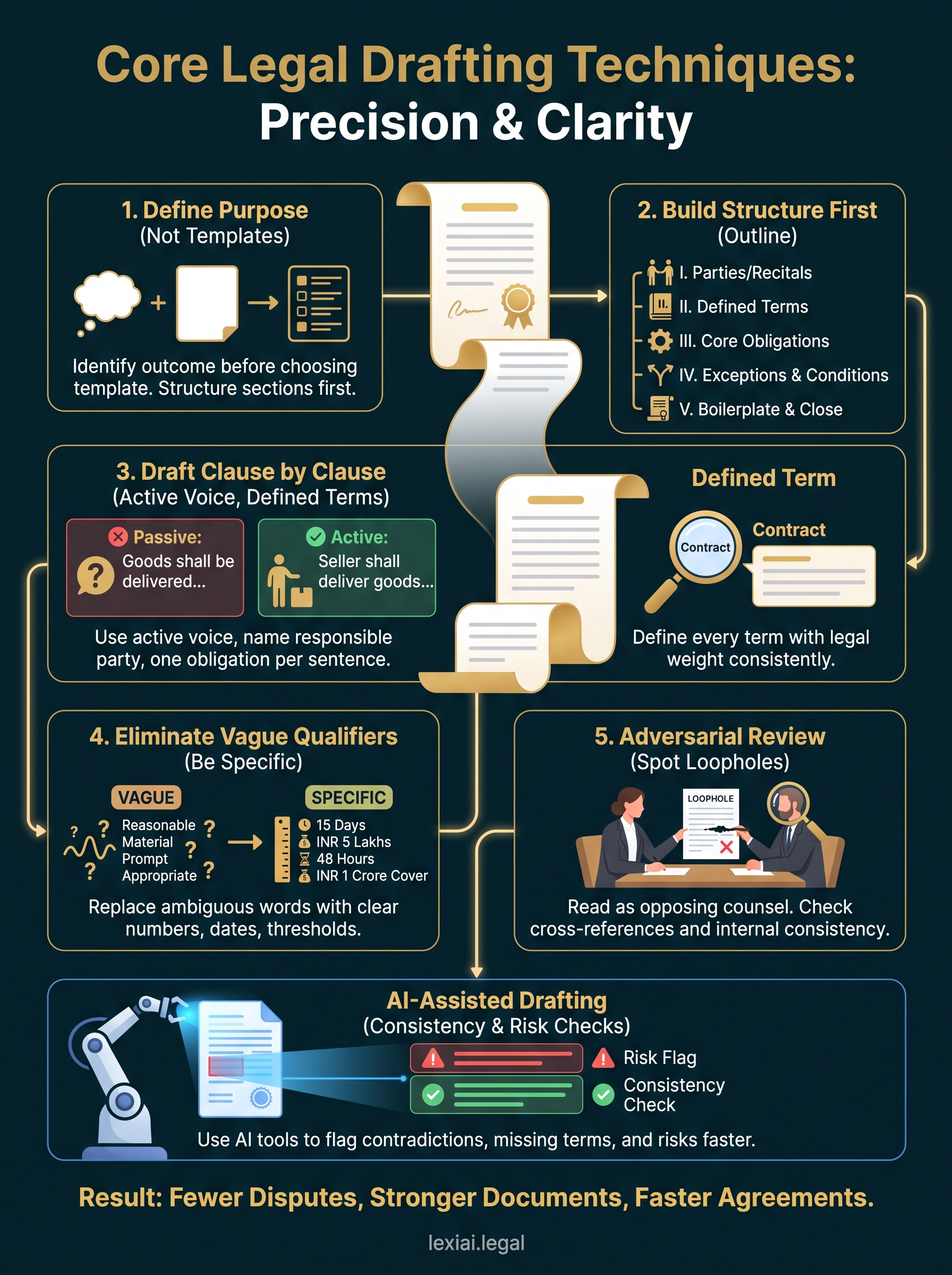
Start with the purpose, not the template
Before you open a template, write down what the document needs to achieve and for whom. A termination clause in a vendor contract serves a different purpose than one in an employment agreement, even if the language looks similar. Skipping this step is why lawyers end up recycling clauses that don't fit the deal, then patching problems later during negotiation.
Draft with the outcome in mind first; the clauses will follow logically once you know what you're protecting.
Build structure before you write sentences
Outline the document's sections and their logical order before drafting a single clause. Document structure determines whether a reader can find the obligation, exception, and remedy without hunting across pages. Follow this sequence for most commercial contracts:
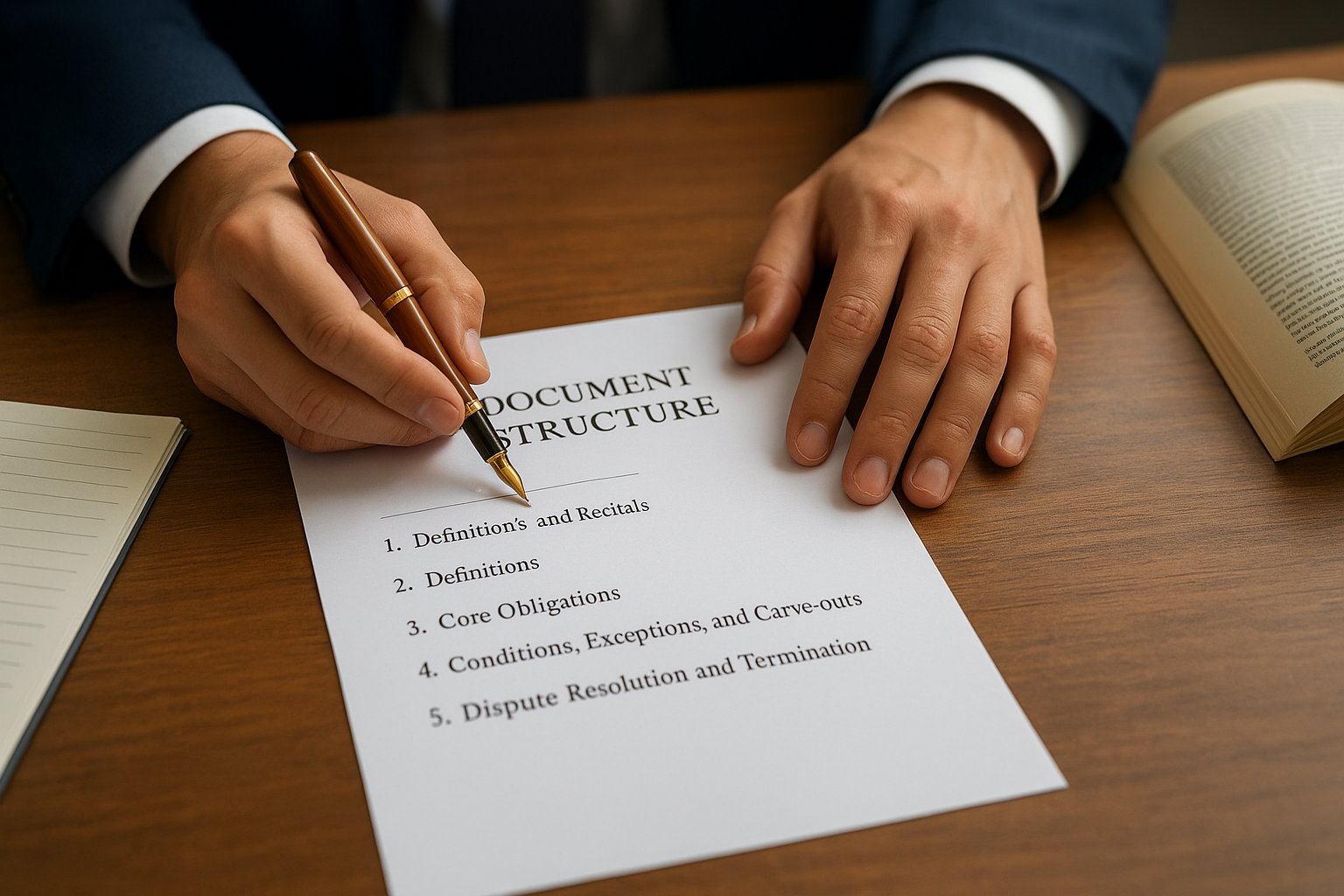
- Define the parties and recitals clearly
- List all defined terms in one place
- State the core obligations first
- Add conditions, exceptions, and carve-outs after the main obligation
- Close with dispute resolution, termination, and boilerplate clauses
Draft clause by clause, not document by document
Drafting one clause at a time, checking it against the defined terms list, and confirming it doesn't contradict an earlier section keeps errors from compounding. Clause-level review catches problems while they're small, instead of after the whole document is written and inconsistencies are buried across twenty pages. This is where most drafting time actually goes, not in writing the first draft, but in reconciling clauses against each other.
Review against the opposing party's interest
Finally, reread every clause as if you were opposing counsel looking for a weakness. Adversarial review is the single most underused step in drafting, because it forces you to spot the ambiguity you introduced without noticing. If a clause can be misread in a way that hurts your client, rewrite it before it reaches the other side's desk. This step alone prevents most of the disputes that later end up in arbitration or court, and it costs you nothing but a second, more critical read.
Essential techniques for clarity and precision in drafting
Certain habits separate drafters who write clean, enforceable text from those who produce documents that invite disputes. These legal drafting techniques aren't complicated, but they require discipline applied consistently across every clause, not just the ones that feel important at the time.
Define every term that carries legal weight
Anything that could mean two different things to two different readers needs a definition. Defined terms should sit in one clearly labeled section, use consistent capitalization throughout, and never be redefined halfway through a document. If you use "Confidential Information" in clause 4, don't switch to "Confidential Data" in clause 12 and expect a court to treat them as the same thing.
If a term isn't defined, assume a judge will define it for you, and probably not in your client's favor.
Write short sentences with one obligation each
Long, compound sentences packed with multiple obligations, exceptions, and conditions are where ambiguity hides. Break each sentence down to a single actor, a single action, and a single condition. Sentence structure this simple is harder to misread, and it's far easier for opposing counsel or a judge to apply cleanly to the facts.
Use active voice and name the responsible party
Passive voice buries who's actually responsible for an obligation. "The goods shall be delivered" doesn't tell you who delivers them. "The Seller shall deliver the goods" does. Active voice forces you to name a party every time, which closes the exact gap that lets one side later claim the obligation wasn't theirs.
Eliminate vague qualifiers
Words like "reasonable," "appropriate," "timely," and "material" feel safe because they sound flexible, but flexibility in a contract usually becomes a fight later. Replace them with numbers, dates, and thresholds wherever possible:
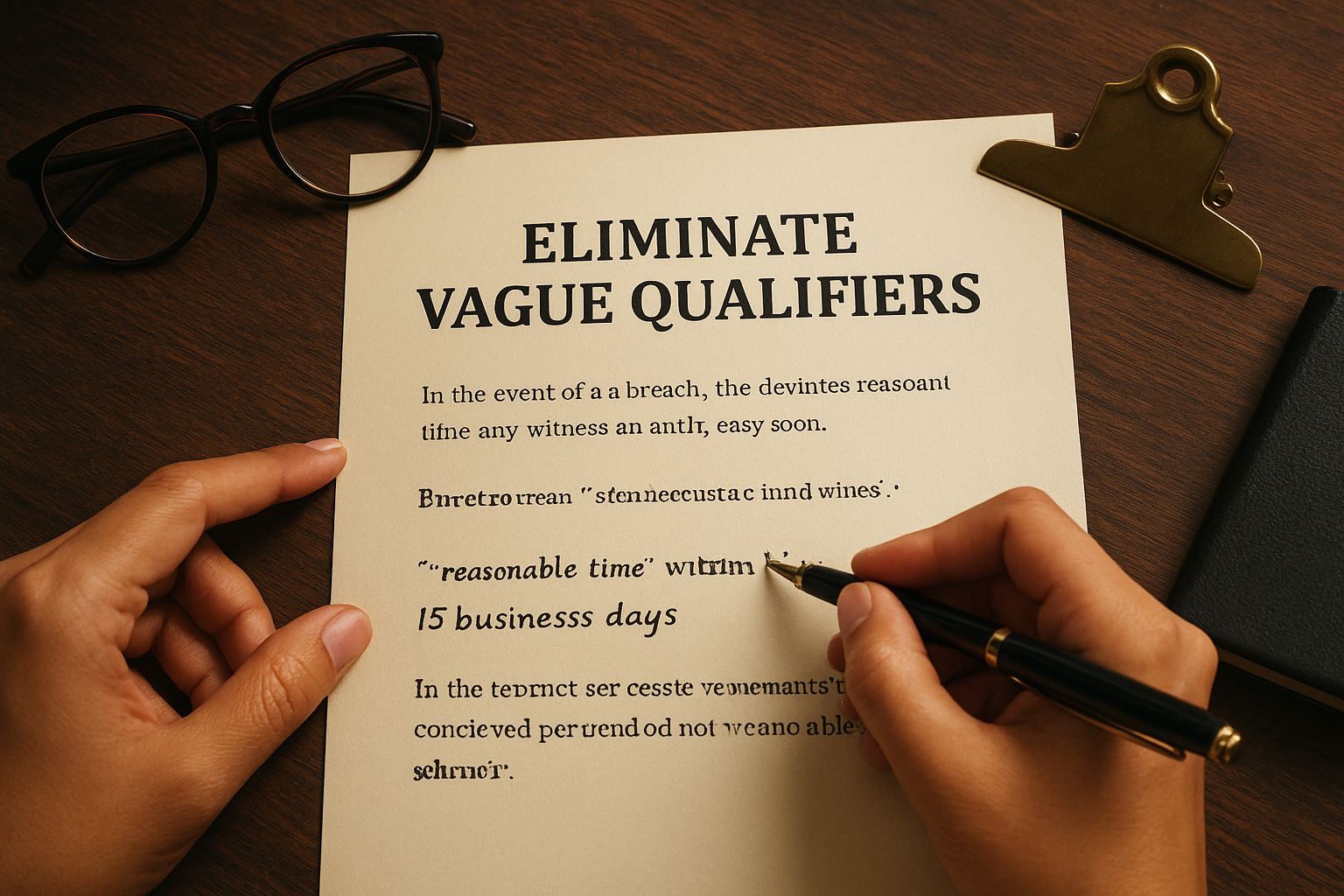
- "Reasonable time" becomes "within 15 business days"
- "Material breach" becomes "breach exceeding INR 5,00,000 in damages"
- "Prompt notice" becomes "notice within 48 hours of discovery"
- "Appropriate insurance" becomes "insurance coverage of at least INR 1 crore"
Check cross-references before finalizing
Documents grow through revisions, and clause numbers shift while cross-references don't always get updated. Cross-reference accuracy matters more than it seems, because a clause pointing to the wrong section can void the protection it was meant to provide. Run a final pass specifically to confirm every internal reference still points where it should before the document goes out for signature.
Common drafting mistakes and how to avoid them
Most drafting errors aren't exotic, they're the same handful of habits repeated across thousands of documents every year. Recognizing these patterns is half the fix, because once you know where drafting mistakes tend to hide, you can build a checklist that catches them before a document goes out for signature. The techniques below aren't advanced, they're the basics most lawyers skip when they're rushing.
Copying clauses without adapting them
Pulling a clause from an old contract and dropping it into a new one without checking whether it fits is one of the most common template errors in practice. A limitation of liability clause written for a services agreement often doesn't translate cleanly to a supply contract, and the mismatch only surfaces once a dispute forces someone to read the clause closely. Treat every reused clause as a draft, not a finished product, and rewrite the parts that don't match the new deal.
Letting boilerplate replace judgment
Standard clauses on jurisdiction, force majeure, and severability exist for good reason, but copying them wholesale without adjusting for the specific transaction creates gaps. Boilerplate language that doesn't reference the correct governing law or dispute forum for this particular deal is worse than no clause at all, because it gives false confidence.
A clause that looks complete but doesn't fit the deal is more dangerous than a clause everyone knows is missing.
Overlooking internal consistency
Defined terms, numbering, and cross-references drift as documents go through multiple rounds of edits. Internal consistency breaks down quietly, one small edit at a time, until a term defined in clause 3 no longer matches how it's used in clause 15. Run a dedicated consistency pass on every document before it leaves your desk, separate from your substantive review.
Here's a quick list of mistakes worth checking for on every draft:
- Mismatched defined terms across sections
- Clauses that contradict an earlier obligation
- Missing effective dates or signature blocks
- Cross-references pointing to the wrong clause number
- Undefined thresholds left as vague qualifiers
Skipping the adversarial read
Rushing a document to signature without a final adversarial read is where most avoidable disputes start. Final review should always include one pass where you actively look for how the other side could misread or exploit a clause, not just whether the language sounds correct on first glance.
How AI tools are changing legal drafting techniques
Drafting used to mean hours spent hunting through old files for the right clause, then manually checking it against every other section of the document. AI-assisted drafting has changed that math. Tools built specifically for legal work can now scan a full contract for inconsistent defined terms, flag clauses that contradict each other, and highlight risk before a document ever reaches a partner's desk. This isn't about replacing the lawyer's judgment, it's about clearing the mechanical work so you spend your time on the calls that actually need a legal mind.
Where AI catches what manual review misses
Human reviewers get tired after the tenth cross-reference check on a fifty-page contract. Software doesn't. Clause risk detection tools trained on legal language can flag an indemnity clause with no cap, a termination provision missing a cure period, or a jurisdiction clause that contradicts the governing law section elsewhere in the same document. LeXi Desk, for example, runs this kind of clause-level risk analysis as part of contract lifecycle management, catching the gaps that a rushed adversarial read might skip on a Friday afternoon before signing.
The value of AI in drafting isn't speed alone, it's catching the inconsistency a tired reviewer would miss.
Speed without losing precision
The biggest objection lawyers raise about AI drafting is that speed comes at the cost of accuracy. That trade-off matters less when the underlying model is trained specifically on legal reasoning rather than general text. Legal-specific AI models built for statutory interpretation and case analysis, rather than general-purpose chat models, produce drafting suggestions that actually reflect how Indian courts read contractual language, not just how the sentence reads grammatically. This distinction is why benchmarking on legal reasoning tasks matters more than benchmarking on general writing quality.
What this means for your daily workflow
Practically, this shows up in a few concrete ways:
- Faster first drafts built from clause libraries instead of blank templates
- Automated risk flags on indemnity, termination, and liability clauses
- Consistency checks across defined terms and cross-references, run instantly rather than manually
- Document summarization that condenses long case files or contracts into reviewable extracts
None of this removes the need for a lawyer to make the final call. What it does is move you from spending hours on mechanical checks to spending minutes reviewing flagged risks, which leaves more time for the judgment calls that actually decide whether a clause protects your client.
Sharpening your drafting skills going forward
Good drafting isn't a one-time skill you master and forget. Legal drafting techniques improve the same way trial skills do, through repetition, review, and a willingness to catch your own mistakes before opposing counsel does. Define your terms, write short sentences with one obligation each, kill vague qualifiers, and always finish with an adversarial read. Do this consistently and your documents stop inviting disputes and start closing them off before they start.
Holding yourself to this standard on every contract, notice, or pleading takes discipline, but it's the difference between documents that protect your client and ones that get picked apart in court. Consistent practice paired with the right tools closes that gap faster than working alone ever will. If you want to see how AI-assisted drafting and clause risk analysis fit into this workflow, sign up for LeXi AI and start drafting with more precision from your next document onward.