

Indian Contract Act 1872 Bare Act: Full Text and Sections
If you are searching for the indian contract act 1872 bare act, you want the actual statutory text, not a summary. This law, enacted on April 25, 1872, and in force since September 1, 1872, remains the foundation of contract law in India, covering offer, acceptance, consideration, capacity, free consent, and breach of contract across its 266 sections and ten chapters.
This article gives you direct access to the structure of the Act, section by section, from Section 1 on the short title to Section 238 on agency and beyond, so you can read the exact wording lawyers and judges rely on. You will find the original provisions, key definitions under Section 2, and the sections courts cite most often in commercial disputes.
We also flag the parts later amended or omitted, such as the sale of goods and partnership provisions, so you are not confused by outdated commentary. If you need faster case law lookups alongside the bare act, tools like LeXi AI search verified Indian judgments by section interpreting these very provisions.
Why the Indian Contract Act 1872 still governs Indian contracts
Most Indian statutes from the 1870s have either been repealed or rewritten beyond recognition. The Indian Contract Act, 1872 has survived largely intact because it codified principles that do not age: an offer needs acceptance, a promise needs consideration, and consent must be free of coercion or fraud. Courts still quote Section 10 word for word when deciding whether an agreement qualifies as a contract, and that single section has decided thousands of commercial disputes over the past 150 years.
A colonial-era law built on common law logic
The drafters borrowed heavily from English common law, but they did something the English never did: they wrote it into a single, numbered code that any advocate could cite by section number in front of a judge. This is why Indian courts rarely need to reach for old English case law when a contract dispute arises. Section 2(h) defines a contract as an agreement enforceable by law, and that definition alone has shaped how Indian judges test every commercial arrangement, from a one-page vendor agreement to a multi-crore joint venture deed.
A statute that still gets cited section by section after 150 years is not outdated law, it is settled law.
What later legislation carved out, and what stayed
Parliament has trimmed the Act twice in major ways. The sale of goods provisions, originally Sections 76 to 123, were repealed in 1930 and replaced by the Sale of Goods Act, 1930. The partnership provisions, Sections 239 to 266, were pulled out in 1932 to form the Indian Partnership Act, 1932. Both moves left the core of the Act, Sections 1 to 75 and 124 to 238, exactly where they were, which is why most bare act editions you buy today still print the higher section numbers as
How to use the bare act text in daily legal practice
Reading the indian contract act 1872 bare act in a browser tab is fine for quick checks, but daily practice demands something sturdier. Keep a searchable PDF or a physical bare act copy at your desk, because you will reference specific sections dozens of times a week when drafting notices, replies to a legal notice, or pleadings. Cite the section number directly in your draft rather than paraphrasing the rule, since judges expect precision when you argue that a clause falls under Section 23 or that damages flow from Section 73.
Reading sections together, not one at a time
No section in this Act stands alone. Section 10 tells you what makes an agreement a contract, but you cannot apply it without checking Section 2 for the definitions of proposal, promise, and consideration first. Similarly, Section 73 on compensation for breach only makes sense alongside Section 74, which caps penalty clauses. Lawyers who skim a single section in isolation often miss the qualifying language sitting two sections earlier or later.
Cite the section, then read its neighbors, because Indian contract law is built in clusters, not isolated rules.
A working shortlist for everyday drafting
Most transactional and litigation work returns to the same handful of provisions. Bookmark these before you need them mid-hearing:
- Section 10: what agreements qualify as contracts
- Section 23: lawful consideration and object
- Section 56: agreements void by impossibility
- Sections 73 and 74: compensation and penalty clauses
- Sections 124 and 125: contracts of indemnity
- Section 148: bailment definitions
- Sections 182 to 238: agency, still fully in force
Having this sections list open alongside your draft, together with sound clause-by-clause drafting method, cuts down the time spent flipping between chapters looking for the exact wording a client's clause needs to match.
Where AI tools help without replacing the statute
AI research assistants speed up the search step, not the judgment step. When you need the exact text of Section 56 alongside three recent judgments interpreting frustration of contract, a tool like LeXi Agent pulls both in seconds instead of the twenty minutes a manual search across databases usually takes. You still read the section yourself and decide how it applies to your facts, but you stop wasting billable hours hunting for text you already know exists somewhere in the Act. That distinction matters because the bare act remains the primary source; AI tools only shorten the path to it.
How the act is structured across its chapters
The Indian Contract Act, 1872 was originally drafted in ten chapters, though the last two now exist only in name after the 1930 and 1932 carve outs. When you open the indian contract act 1872 bare act, you are really reading a document built in layers, general principles first, then specific contract types, then remedies. Knowing which chapter you are in tells you whether you are dealing with a rule that applies to every contract or one that applies only to a narrow category like bailment or agency.
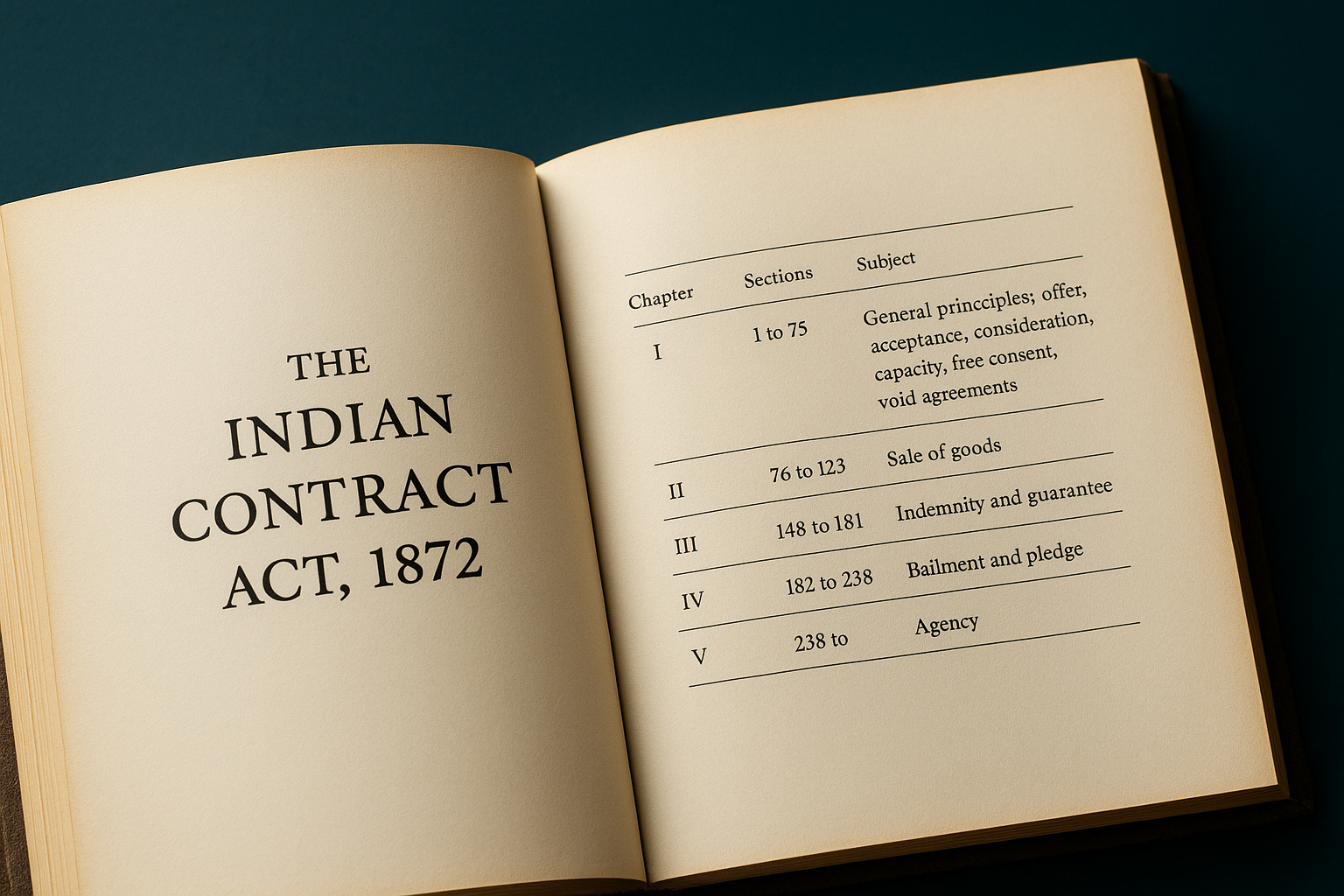
The ten chapters at a glance
Here is how the chapters break down, including which parts still carry legal force:
| Chapter | Sections | Subject | Status |
|---|---|---|---|
| I | 1 to 75 | General principles: offer, acceptance, consideration, capacity, free consent, void agreements | In force |
| II | 76 to 123 | Sale of goods | Repealed, replaced by the Sale of Goods Act, 1930 |
| III | 124 to 147 | Indemnity and guarantee | In force |
| IV | 148 to 181 | Bailment and pledge | In force |
| V | 182 to 238 | Agency | In force |
| VI | 239 to 266 | Partnership | Repealed, replaced by the Indian Partnership Act, 1932 |
This layout explains why a bare act you buy today looks lopsided, dense chapters at the start and end, a gap in the middle where the sale of goods provisions used to sit.
Why the numbering jumps where it does
Publishers keep the original numbering rather than renumbering the whole Act, because every judgment, textbook, and cross reference written since 1872 relies on those exact numbers. Renumbering would break a century and a half of citation. So when you see Section 124 following straight after Section 75 with nothing printed in between, that gap is not a printing error, it marks where Chapter II used to run before Parliament pulled it out in 1930.
The gaps in the section numbers are not missing law, they are a paper trail showing what Parliament removed and when.
How chapters map to real practice
Most transactional lawyers live in Chapter I and Chapter III, drafting clauses around consideration, free consent, and indemnity. Litigators spend more time in Chapter I's void agreement provisions and the compensation sections that follow. Corporate teams handling distribution or franchise relationships lean on Chapter V for agency questions, since that chapter never got carved out and still governs every principal-agent relationship formed under Indian law today.
What makes an agreement a valid contract under the act
Section 10 of the indian contract act 1872 bare act answers this question directly: an agreement becomes a contract when it is made by free consent of parties competent to contract, for a lawful consideration and with a lawful object, and is not expressly declared void. Every clause you draft, whether a vendor agreement or a shareholder deed, gets tested against this single sentence sooner or later. Skip any one requirement and the agreement risks being unenforceable, no matter how detailed the drafting looks on paper.

The five conditions courts actually check
Judges rarely quote the whole of Section 10 in a judgment. They break it down into the same five checks, one after another:
- Offer and acceptance: a definite proposal accepted without variation, per Sections 2(a) and 2(b)
- Free consent: agreement not caused by coercion, undue influence, fraud, misrepresentation, or mistake, under Sections 14 to 22
- Competent parties: parties of the age of majority, of sound mind, and not disqualified by law, under Sections 11 and 12
- Lawful consideration and object: value flowing both ways that is not forbidden, fraudulent, or against public policy, under Section 23
- Not declared void: the agreement does not fall into any category the Act itself voids, such as those under Sections 26 to 30
If any single check on this list fails, you no longer have a contract, you have an agreement that a court will refuse to enforce.
Why capacity gets overlooked in drafting
Lawyers spend most of their drafting time on consideration clauses and dispute resolution boilerplate, yet capacity trips up more agreements than people expect. Section 11 disqualifies minors, persons of unsound mind, and anyone disqualified by a law they are subject to, which matters when you draft agreements involving trusts, insolvent parties, or foreign entities with restricted contracting powers under their own law. Confirming signatory authority before execution takes five minutes and avoids a void agreement fight years later.
Consideration does not need to be fair, just lawful
Many first-year associates assume consideration must be adequate, meaning roughly equal in value between the parties. Section 25 explains that inadequate consideration does not itself make an agreement void, though it can serve as evidence of coercion or fraud if a dispute arises. Consideration only needs to be lawful under Section 23, real, and moving at the desire of the promisor. Once you separate adequacy from lawfulness, several clauses that seemed suspicious on first read start making sense, and you stop flagging commercially normal arrangements as legally defective.
Void agreements and voidable contracts explained
Section 2(g) of the indian contract act 1872 bare act defines a void agreement as one not enforceable by law, while Section 2(i) defines a voidable contract as one enforceable at the option of one party but not the other. That single-line distinction decides whether a client can walk away from a deal or must first take active steps to cancel it. Getting this wrong in a legal notice can cost a client months of avoidable litigation over a point the statute already settles.
Agreements the Act declares void from the start
Certain agreements never acquire legal force, no matter how willingly both sides sign them. Section 20 voids agreements made under a bilateral mistake of fact, Section 23 voids agreements with unlawful consideration or object, Section 26 voids agreements in restraint of marriage, Section 27 voids agreements in restraint of trade, and Section 56 voids agreements to do an impossible act. None of these need a court order to fail; they are unenforceable the moment they are made.
A void agreement was never a contract to begin with, while a voidable contract stays valid until the aggrieved party chooses to end it.
Voidable contracts and the right to rescind
Unlike void agreements, voidable contracts remain binding unless the party wronged takes steps to cancel them. Section 19 makes a contract voidable when consent was caused by coercion, fraud, or misrepresentation, and Section 19A extends the same rule to undue influence. The wronged party can affirm the contract and keep it running, or rescind it under Section 64, which also obliges them to restore any benefit received under the agreement once they choose to cancel.
| Feature | Void Agreement | Voidable Contract |
|---|---|---|
| Enforceability | Never enforceable | Enforceable until rescinded |
| Relevant sections | 20, 23, 26, 27, 56 | 19, 19A, 64 |
| Who can act | Neither party | Only the wronged party |
| Effect of inaction | No action needed, agreement fails automatically | Contract stays valid if not rescinded |
Why the distinction changes your drafting advice
Correct classification also changes how you advise a client on refunds and restitution. Under Section 65, a void agreement (or a contract later discovered to be void) requires any party who received an advantage to restore it or make compensation, while a voidable contract rescinded under Section 64 triggers a similar restitution duty only from the point of rescission onward. Treating a voidable contract as automatically void, or the reverse, leads to notices that ask for the wrong remedy, and courts notice that mistake quickly.
Rules on performance and discharge of contracts
Section 37 of the indian contract act 1872 bare act states the core rule plainly: parties to a contract must either perform their promise or offer to perform it, unless performance is dispensed with or excused under the Act or any other law. Everything else in this part of the statute, timing, method, and who may perform, builds on that single obligation. A drafting lawyer who ignores this section often writes conditions precedent that conflict with what Section 37 already assumes.
What Section 37 requires from every party
Beyond stating the duty to perform, Section 37 also covers what happens after one party dies or becomes incapable, extending the obligation to legal representatives unless the contract shows a contrary intention. Section 40 adds that a promisee can insist on personal performance where the contract intends this, based on the nature of the promise or the circumstances, but otherwise allows performance by an agent or representative. Reading these two sections together tells you whether a personal service clause needs to say "personally" at all, or whether the Act already implies it.
A promise to perform is not optional once made; the Act only excuses it where the statute itself says so.
Time, place, and manner of performance
Sections 46 to 50 fill the practical gaps that most contracts leave open. Where no time is fixed, Section 46 requires performance within a reasonable time, and Section 47 sets rules for performance on a specified day. Contracts silent on venue fall back on Section 49, which lets the promisor ask the promisee to appoint a reasonable place. Precision on these points during drafting avoids arguments later about whether a party actually defaulted or merely performed a day late without objection.
The four ways a contract legally ends
Discharge under the Act happens in one of a few recognized ways, and knowing which one applies changes the remedy a client can claim:
- Performance: both sides complete their promises, closing the contract under Sections 37 to 39
- Agreement: parties novate, rescind, or alter the contract under Section 62, replacing old obligations with new ones
- Impossibility: performance becomes unlawful or physically impossible after formation, discharging the contract under Section 56
- Breach: one party fails to perform, giving the other a right to treat the contract as discharged and claim compensation
Each route triggers different consequences for restitution and damages, which is exactly the ground the next section covers in detail.
Remedies for breach of contract under the act
When one party defaults, the indian contract act 1872 bare act does not leave the wronged party without a remedy. Section 73 gives the injured party the right to claim compensation for loss or damage naturally arising from the breach, or loss the parties knew was likely when they made the contract. Section 74 then governs cases where the parties already fixed a sum as damages or a penalty, letting courts award reasonable compensation not exceeding that named amount, whether or not actual loss is proved. Together these two sections decide almost every damages argument you will make in a commercial dispute.
How Section 73 measures actual loss
Section 73 does not hand out punitive damages. It restricts recovery to loss that flows naturally from the breach in the usual course of things, or loss both parties contemplated as probable when they signed the contract. Remote or indirect loss, the section says plainly, is not to be regarded in estimating damages, which is why speculative future profits rarely survive scrutiny at trial. A claimant who cannot connect the loss to the breach through this two-part test walks away with nothing, however genuine the financial hit.
Damages under Section 73 compensate real loss connected to the breach, not every consequence a party can imagine.
Section 74 and the cap on penalty clauses
Most commercial contracts include a liquidated damages clause, and Section 74 is the provision that decides whether courts will enforce it at face value. Indian courts do not automatically award the stated sum; they award reasonable compensation up to that ceiling, which means a party still needs to show some loss occurred, even if not its exact quantum. This differs from English law, where genuine pre-estimates of loss get enforced more readily, so drafters working across jurisdictions should not assume the clause behaves the same way in an Indian court.
Rescission, restitution, and other remedies available
Beyond damages, the Act gives injured parties other tools:
- Rescission under Section 39: when one party refuses to perform, or disables itself from performing, the other may treat the contract as ended
- Compensation for loss on rescission under Section 75: a party who rightfully rescinds is entitled to compensation for any damage suffered through the non-fulfillment
- Restitution under Sections 64 and 65: a party who rescinds must return benefits already received, and vice versa
Specific performance and injunctions, once mentioned in Chapter II of the original Act, now sit entirely in the Specific Relief Act, 1963, so do not expect to find them in the current bare act text. Pulling up Section 73 alongside recent judgments on quantum of damages is exactly the kind of research LeXi Agent shortens, letting you confirm the current judicial trend before you draft the compensation claim.
Repealed chapters and amendments worth knowing
Anyone comparing an old law school textbook against the current indian contract act 1872 bare act notices gaps that were not there in 1975. Parliament removed entire chapters twice, and it made a smaller but important change to Section 28 in 1996. None of this happened quietly; each change replaced settled provisions with a standalone act, which is why a modern bare act edition looks thinner in the middle than the version your professor may have used decades ago.
The two chapters Parliament carved out
Sections 76 to 123, which governed the sale of goods, stopped applying the day the Sale of Goods Act, 1930 came into force. Sections 239 to 266, covering partnership, met the same fate in 1932 when the Indian Partnership Act, 1932 took over, and that is the statute you work from today when drafting a partnership deed. Both replacement statutes kept the underlying contract principles intact; they simply gave sale transactions and partnership firms their own dedicated code instead of sharing space with general contract law. If you are reading a pre-1930 judgment that cites Section 90 or Section 100, you are reading law that no longer exists in this Act and now sits in the Sale of Goods Act instead.
A repealed section is not deleted history, it is law that moved house to a statute built specifically for it.
The 1996 amendment to Section 28
Section 28 originally voided any agreement that restricted a party's right to enforce their rights through ordinary legal proceedings. The Indian Contract (Amendment) Act, 1996 added an exception carving out arbitration agreements from this restriction, bringing Section 28 in line with the newly enacted Arbitration and Conciliation Act, 1996. That single change matters every time you draft a dispute resolution clause, since it confirms that requiring parties to arbitrate first, rather than approach a court directly, does not fall foul of Section 28.
| Year | Change | Sections Affected | Resulting Law |
|---|---|---|---|
| 1930 | Sale of goods provisions repealed | 76 to 123 | Sale of Goods Act, 1930 |
| 1932 | Partnership provisions repealed | 239 to 266 | Indian Partnership Act, 1932 |
| 1996 | Section 28 amended to exempt arbitration clauses | 28 | Arbitration and Conciliation Act, 1996 |
Since 1996, no major restructuring has touched the Act, which means the current text you read today is largely the same one lawyers argued from through most of the twentieth century, minus the two carve outs above.
How AI research tools speed up work with the bare act
Searching a PDF for a section number is easy. Building the fuller picture around that section, meaning amendments, repealed cross-references, and current judicial interpretation, is where most lawyers lose an afternoon. AI research tools built for Indian law close that gap by pulling the indian contract act 1872 bare act text together with the case law interpreting it, in one search instead of five.
Finding the right section without flipping pages
Instead of scrolling through a PDF looking for where Chapter III starts, you can ask a tool like LeXi Agent for the exact text of Section 124 and get it back with the surrounding sections attached, since indemnity and guarantee rarely get argued in isolation. Typing a plain-language question, such as what happens when a bilateral mistake voids an agreement, returns Section 20 along with the judgments that have applied it in Indian courts. That saves the ten minutes you would otherwise spend guessing which section covers your fact pattern before you even start reading.
The bare act tells you what the law says; verified case law tells you how a court applied it, and finding both together is where AI tools save the most time.
Cross-referencing amendments and repealed provisions automatically
Older commentary and law school notes still reference sections that no longer apply, like the sale of goods provisions under old Sections 76 to 123. A research assistant trained on the current statute flags that a section has been repealed and points you straight to its replacement act, so you do not build an argument on a provision that stopped existing in 1930. This matters most for junior associates working from inherited precedent files that were drafted decades before the last amendment.
Verified judgments attached to the section you are reading
Quoting a section correctly is only half the job in a hearing; you also need recent authority showing how a bench has read it. LeXi Agent's judgment search pulls rulings tied to a specific section, so a search on Section 74 penalty clauses returns recent Supreme Court and High Court decisions on liquidated damages rather than a generic keyword match, which is how research tools ranked for Indian lawyers are meant to work. Case file summarization tools in the same platform condense a lengthy judgment down to the paragraph that actually interprets your section, cutting the reading time before a hearing significantly.
Where the lawyer's judgment still matters
None of this replaces reading the section yourself or deciding how it fits your client's facts. AI tools shorten the search step, not the reasoning step, which stays with you. Treat the output as a faster route to the same primary sources you would have found manually, verify the citation, and then argue the section the way you always have.
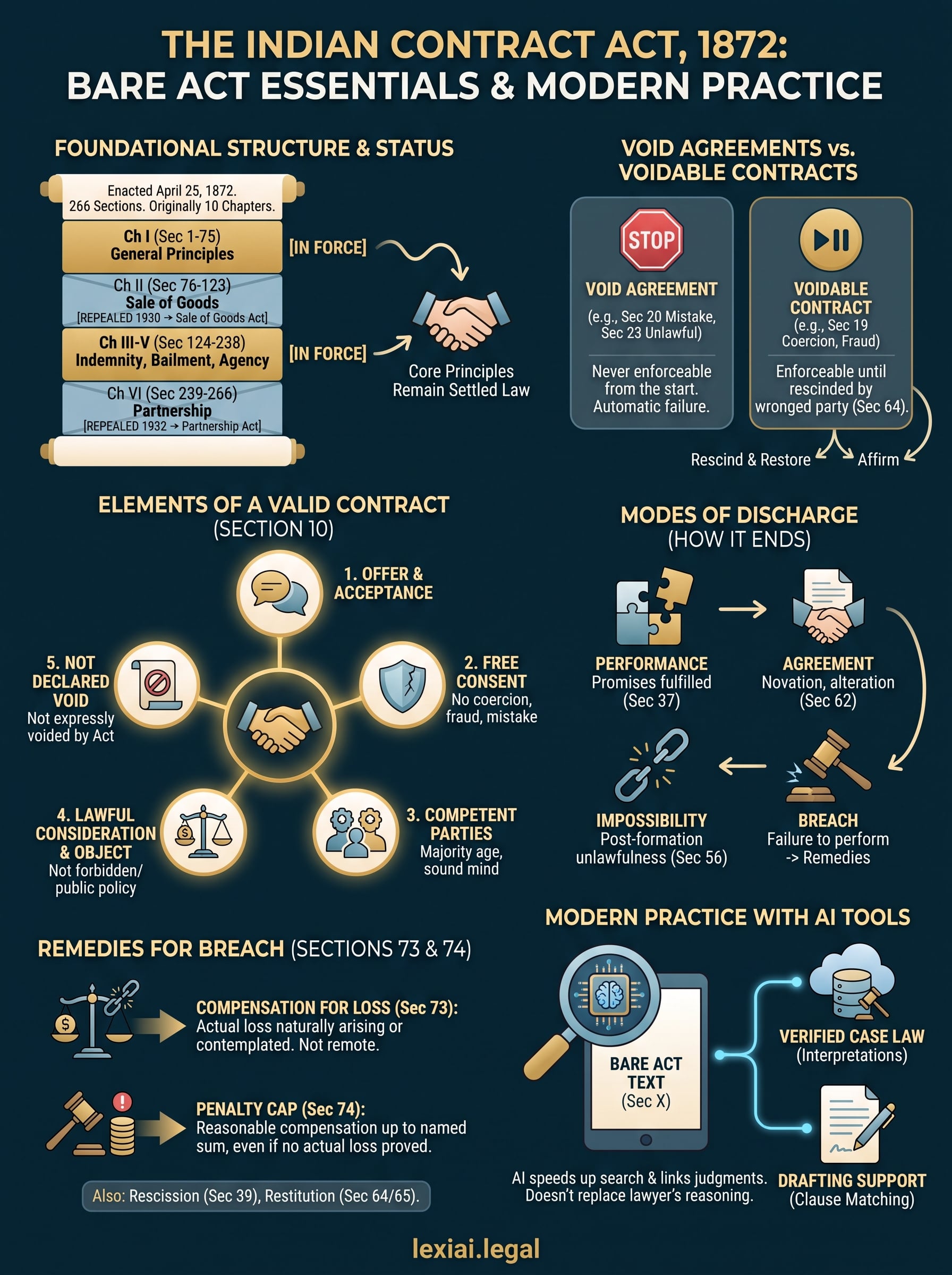
Keeping the bare act within easy reach
The indian contract act 1872 bare act still decides the outcome of contract disputes the same way it did a century ago, because its core sections on offer, consideration, free consent, and breach never needed rewriting. Knowing the exact section number, not just the general rule, is what separates a persuasive submission from a vague one. Every chapter you have read here, from Section 10's contract test to Section 74's cap on penalty clauses, stays relevant whether you are drafting a vendor agreement or arguing a breach claim in court.
Keep the text close, but pair it with verified case law so you know how courts are reading these sections right now, not just what they said in 1872. That is the gap tools built for Indian legal research are meant to close. If you want the bare act, current judgments, and drafting support in one place, see how one platform built for Indian contract practice fits into your daily work.