

Partnership Deed Format: Sample and How to Draft One
A partnership deed format is not something you should copy blindly from the first Google result. Two partners running a trading firm in Ahmedabad need different clauses than three professionals setting up a consultancy in Bangalore, yet most templates online treat every partnership the same way. Get the format wrong, and you risk disputes over profit sharing, capital contribution, or exit terms that could have been settled on paper in the first place.
This article gives you a working sample partnership deed along with the exact clauses required under the Indian Partnership Act, 1932, including provisions on capital, profit and loss ratio, admission or retirement of partners, and dispute resolution. You will also see where firms commonly go wrong, such as skipping the arbitration clause or leaving bank operation authority undefined.
We walk through each section of the deed, explain why it matters, and show how to adapt the format for your specific business, whether that is a two-person partnership or a larger firm with multiple working and sleeping partners. For lawyers drafting these regularly, tools like LeXi Desk and other AI drafting software built for Indian legal practice can speed up clause generation and flag risk in existing drafts, though the fundamentals covered here apply regardless of what you use to draft.
Why your partnership needs a proper deed
Many partners start a business on a handshake and a WhatsApp group, planning to "formalize it later." That delay costs money. Under the Indian Partnership Act, 1932, a partnership exists the moment two or more people agree to share profits from a business run by all or any of them, deed or no deed. But without a written partnership deed format, you are stuck with the Act's default rules, and those defaults rarely match what partners actually intended.
What happens without a written deed
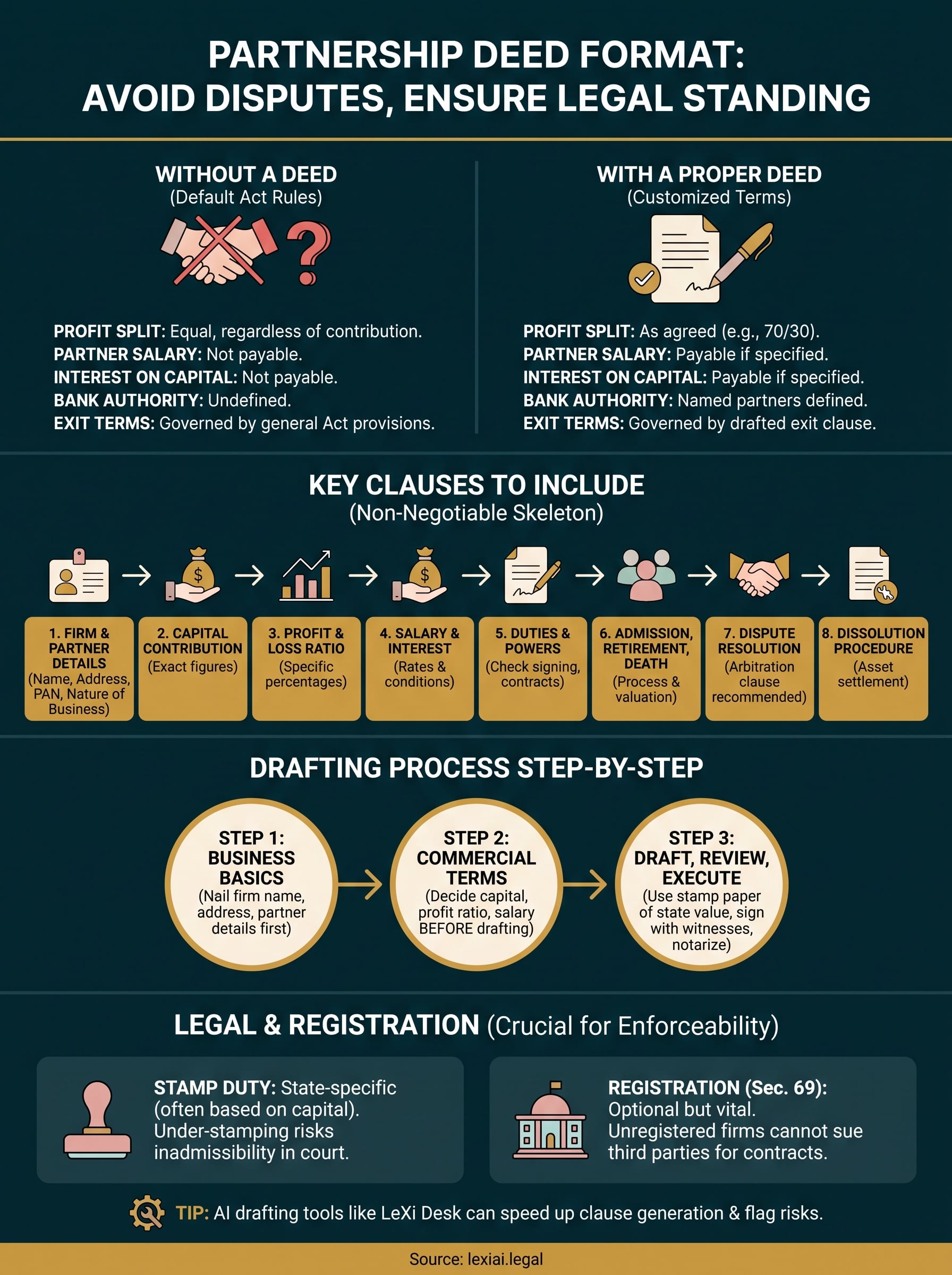
Section 13 of the Act says partners share profits and losses equally, no matter how much capital each person put in. If you contributed 70% of the capital and your partner contributed 30%, you still split profits fifty-fifty unless a deed says otherwise. The same section denies partners any right to interest on capital or to a salary for working in the business, again unless the deed states it. Oral agreements about unequal shares or partner salaries carry little weight in court once a dispute lands there.
A deed is not paperwork for its own sake, it is the only document that overrides the Act's default terms in your favor.
Where disputes actually start
Most partnership disputes I have seen do not start with fraud. They start with silence on ordinary questions: who can sign checks, what happens if a partner wants out, how to value the business on retirement or death. Without clauses covering these, partners end up in court applying general provisions of the Act, which are built for the average case, not your business.
| Situation | Without a deed | With a proper deed |
|---|---|---|
| Profit split | Equal, regardless of contribution | As agreed, in writing |
| Partner salary | Not payable | Payable if specified |
| Bank signing authority | Undefined, often disputed | Named partners specified |
| Exit or death of a partner | Governed by default Act rules | Governed by exit clause you drafted |
| Filing an income tax return | Deed often required by the assessing officer | Deed available on demand |
Registration and legal standing matter too
Section 69 of the Act bars an unregistered partnership firm from suing a third party to enforce a contract right. If a client refuses to pay an invoice, an unregistered firm cannot drag them to court over it, though the client can still sue the firm. That asymmetry alone should push most partnerships toward registering their partnership agreement with the Registrar of Firms, which requires a properly executed deed as the founding document. Banks, GST authorities, and the Income Tax Department also routinely ask for the deed before opening accounts or processing registrations, so having one drafted correctly from day one saves repeated back-and-forth later.

How to draft a partnership deed step by step
Drafting a partnership deed format is not a one-sitting task. Get the sequence wrong and you end up rewriting clauses after the deed is already signed and stamped, which costs both time and stamp duty. Follow a fixed order instead of jumping straight to clause language, applying the same drafting discipline that keeps legal documents precise.
Start with the business basics before touching clauses
Begin by nailing down the firm name, principal place of business, and nature of business in plain terms. Partners often skip this and go straight to profit sharing, then realize the firm name they picked is already registered elsewhere or does not match what is on the GST application. List every partner's full name, address, and PAN details next, since the Registrar of Firms and the Income Tax Department both cross-check these.
Get the business basics locked down first, because a clause built on a wrong firm name or missing PAN detail has to be redrafted anyway.
Decide the commercial terms before you draft
Decide capital contribution, profit and loss ratio, and whether any partner draws a salary or interest on capital before you write a single clause. These are commercial decisions between partners, not legal boilerplate, and rushing them into a template invites disputes later. Once decided, put them in numbers, not vague percentages that shift depending on who you ask.
Draft, review, then execute
Write the deed on stamp paper of the value applicable in your state, since stamp duty for a partnership agreement varies by state government notification. Have every partner sign in the presence of witnesses, then get it notarized if your state requires it, following the same execution care a power of attorney format demands. Firms drafting several deeds a year often use a tool like LeXi Desk to generate a first draft and flag missing clauses before manual review, one of several tools that cut drafting and research hours lawyers usually spend on repetitive work.
Partnership deed format: key clauses to include
Every partnership deed format needs certain clauses regardless of business size, and skipping any of them is what creates the disputes we covered earlier. Think of these as the non-negotiable skeleton, with commercial terms filled in to match your specific partnership.
The clauses that must appear
A properly drafted deed should cover the following, in roughly this order:
- Name, address, and nature of business of the firm, along with the date the partnership commences
- Names and details of all partners, including PAN and residential address
- Capital contribution by each partner, stated in exact figures, not percentages alone
- Profit and loss sharing ratio, since Section 13 defaults to equal shares unless you specify otherwise
- Interest on capital and partner salary, if any, along with the applicable rate
- Duties and powers of each partner, including who can sign checks or bind the firm in contracts
- Admission, retirement, or expulsion of a partner, with the process each requires
- Death of a partner and how the firm continues or dissolves
- Dispute resolution, ideally an arbitration clause under the Arbitration and Conciliation Act, 1996
- Dissolution procedure, including how assets and liabilities get settled
Leave out the arbitration clause and you push every future disagreement straight into civil court, which is slower and costlier for everyone involved.
Clauses firms add based on their business
Professional firms, such as consultancies or chartered accountancy practices, often add a non-compete clause restricting a retiring partner from soliciting clients for a fixed period. Trading and manufacturing firms tend to focus more on capital withdrawal limits and loan or borrowing authority, since cash flow disputes surface faster in those businesses. If your partnership plans to bring in new partners as it grows, build an admission clause now rather than amending the deed later, since amendments also require fresh stamp duty in most states.
Stamp duty and registration for partnership deeds in India
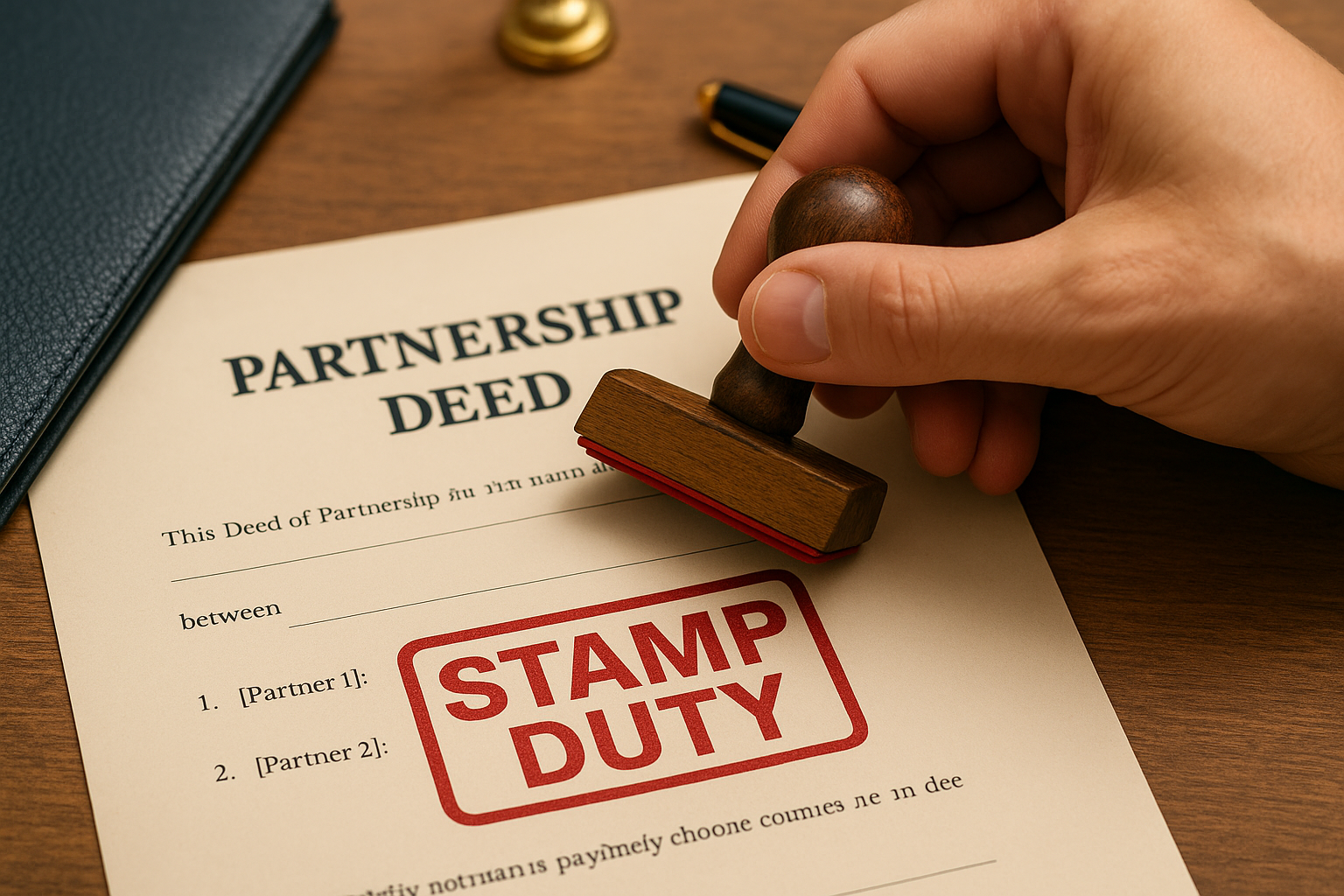
Stamp duty on a partnership deed format is a state subject, not a central one, much like the duty payable on a sale deed for property transfer, so the amount you pay in Maharashtra will differ from what you pay in Delhi or Tamil Nadu. Most states calculate duty based on the capital contribution mentioned in the deed, while a few states charge a flat fee regardless of capital size. Skipping this step or under-stamping the deed can make it inadmissible as evidence in court until the deficient duty is paid along with a penalty.
How stamp duty varies by state
Check the applicable rate with your state's stamp act before drafting, since the figures change periodically through government notifications.
| State | Typical stamp duty basis |
|---|---|
| Maharashtra | Percentage of capital, subject to a cap |
| Delhi | Slab based on capital contribution |
| Karnataka | Flat fee plus capital-linked component |
| Tamil Nadu | Percentage of capital, state-notified rate |
Under-stamp the deed and you risk having it thrown out as evidence the day you need it most.
Registering with the Registrar of Firms
Registration under Section 58 of the Indian Partnership Act, 1932 is technically optional, but Section 69 makes that choice costly if you skip it. To register, submit Form 1 along with the original partnership agreement, an affidavit, and proof of the principal place of business to the Registrar of Firms in your state. Processing timelines vary, but most states issue a Certificate of Registration within a few weeks once documents are in order.
Why timing matters
Execute and stamp the deed before the firm starts operating wherever possible, since backdating stamp duty payment invites scrutiny from the assessing officer during income tax filing. Firms that register early also find it easier to open a current bank account and apply for a GST number, since both processes typically ask for the registered deed as supporting proof.
Drafting a deed that holds up in practice
A partnership deed format only works if it matches how your partners actually plan to run the business, not a template pulled off the internet. Get the commercial terms right, include every clause the Indian Partnership Act, 1932 expects you to address, and stamp the document according to your state's rules before the firm starts operating. Skip any of these steps and you are relying on default provisions that rarely favor the partner who contributed more capital or did more work.
Going forward, treat the deed as a living document. Revisit it whenever a partner joins, exits, or the profit sharing ratio changes, since an outdated deed causes as many disputes as no deed at all. If you draft partnership agreements regularly and want to cut down on repetitive clause work, see how LeXi AI handles drafting, research, and contract review for Indian legal practice.