

Power of Attorney Format: Sample and How to Draft One
You need a power of attorney format that a sub-registrar or bank will actually accept, not just a generic template pulled from a random website. Most disputes over a POA come down to missing execution details such as stamp duty, notarization, or clear description of powers granted. This article gives you a working sample and shows you exactly how to draft one that holds up.
A power of attorney is a document executed under the Powers of Attorney Act, 1882, where the principal authorizes an agent to act on their behalf in specific or general matters. The format changes depending on whether you need a general power of attorney format covering broad powers like property management and banking, or a special POA limited to one transaction, such as registering a single sale deed and how to draft one. Getting the clauses, stamp duty, and attestation right matters as much as the wording itself.
Below, you will find a sample format you can adapt, a clause-by-clause breakdown of what each section must contain, and the state-specific stamp duty and registration steps that make the document enforceable. If you are drafting under time pressure, AI drafting built for Indian law like LeXi Desk can generate a first draft from your inputs, which you then review and customize before execution.
Why the power of attorney format matters legally
A sloppy power of attorney format does not just look unprofessional, it can render the entire document void in the eyes of a sub-registrar, bank, or court. Section 1A of the Powers of Attorney Act, 1882, defines who qualifies as an agent, but the Act itself does not prescribe a rigid template. That gap is exactly why so many POAs get rejected: the drafter assumes any wording works, when in fact courts and registering authorities expect specific recitals, witness attestation, and a precise description of powers.
The statutes that govern a POA
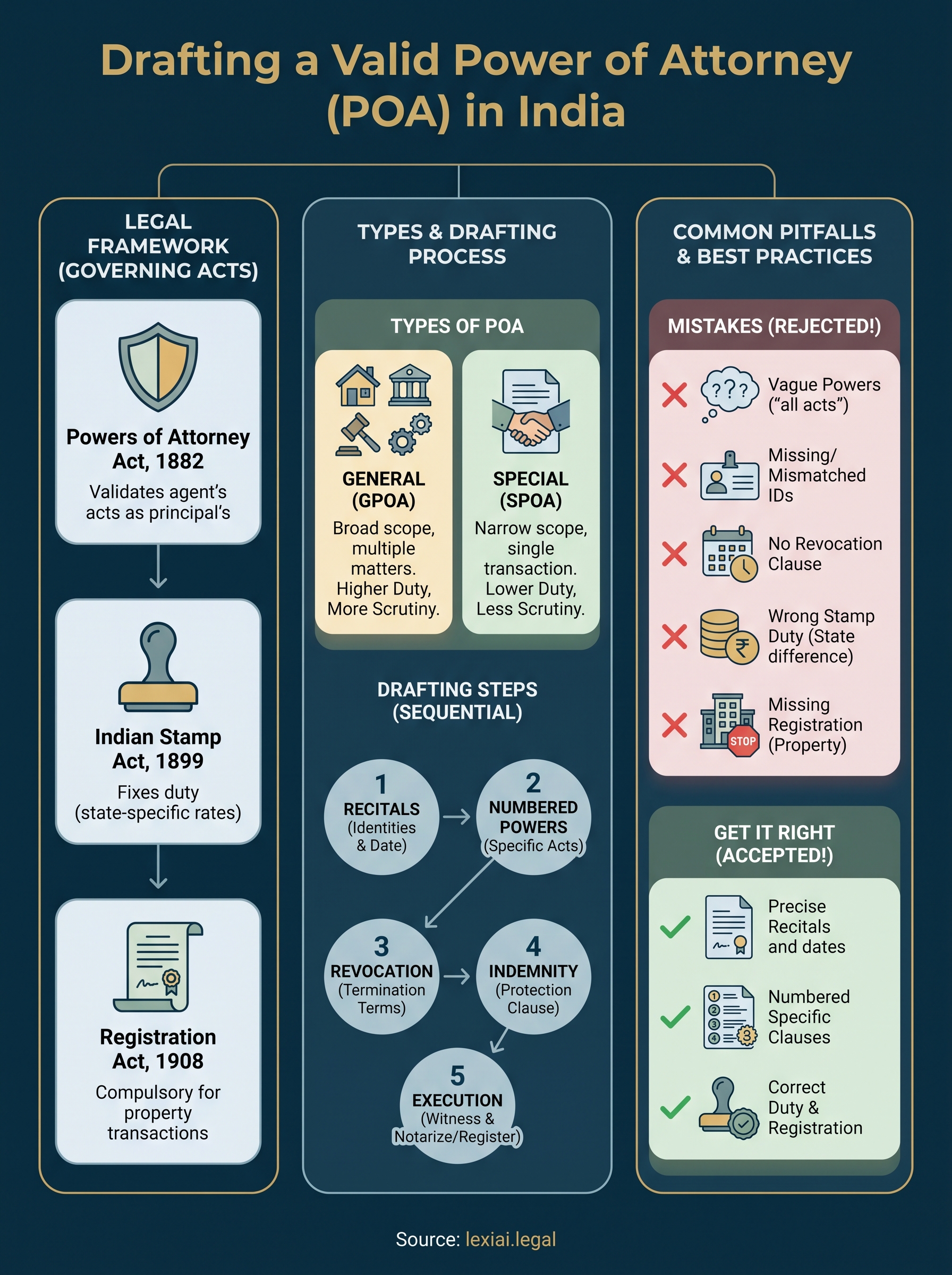
Three laws work together here. The Powers of Attorney Act, 1882 validates acts done by an agent as if done by the principal. The Indian Stamp Act, 1899 (and state amendments) fixes duty based on whether the POA involves immovable property. The Registration Act, 1908 makes registration compulsory when the POA authorizes the agent to present documents for registration or transfer an interest in immovable property, under Section 17.
What happens when the format fails
When a POA skips a required clause, such as revocation terms or a clear statement of authority, banks freeze transactions and sub-registrars return the document unregistered. Courts have repeatedly held that an unregistered POA covering immovable property transactions cannot be acted upon for registration purposes.
A power of attorney is only as strong as its weakest clause.
This is why the execution format matters as much as the intent behind it. A properly drafted general power of attorney format protects the principal from disputes over the scope of authority granted, while a defective one invites litigation over whether the agent ever had valid power at all.
How to draft a power of attorney step by step
Start with the recitals, the opening paragraph that names the principal, the agent, and the date. Get this wrong and every clause after it becomes ambiguous about who is granting authority to whom. Follow the recitals with a clear statement of the powers granted, written as specific acts rather than vague phrases like "all necessary powers."
The drafting sequence that works
Work through these steps in order, since skipping one usually means redoing the whole draft later:
- Draft the recitals with full names, addresses, and identification details of both parties.
- List each power granted as a numbered clause, not a single paragraph.
- Add a revocation clause stating when and how the POA ends.
- Insert an indemnity clause protecting the principal from the agent's unauthorized acts.
- Attach witness signature blocks and space for notarization or registration stamps.
Once the draft is complete, read it aloud against the transaction you actually need done, applying the same core drafting skills for precise documents you would use on any deed. Many lawyers use LeXi Desk to generate this first pass and then tighten the clause language before printing on stamp paper.
General power of attorney format vs special power of attorney
Choosing between a general power of attorney format and a special POA depends entirely on scope, not on which document sounds more formal. A general POA authorizes the agent to act across a wide range of matters, property management, banking, litigation, and business operations, often for an indefinite period until revoked. A special POA restricts the agent to one defined act, such as registering a single sale deed or representing the principal in one court case.

Misreading this distinction causes real problems. Banks often reject a special power of attorney presented for a transaction it was never drafted to cover, and registrars scrutinize general POAs more closely because the powers are broader and riskier to misuse.
The scope you grant is the scope you are stuck defending.
Here is how the two compare:
| Factor | General POA | Special POA |
|---|---|---|
| Scope of powers | Broad, multiple matters | Narrow, one transaction |
| Duration | Until revoked | Ends after the act is done |
| Stamp duty | Usually higher | Usually lower |
| Registration scrutiny | Higher | Lower |
Pick the format that matches your actual need, not the one that feels safer on paper.
Sample power of attorney format and key clauses
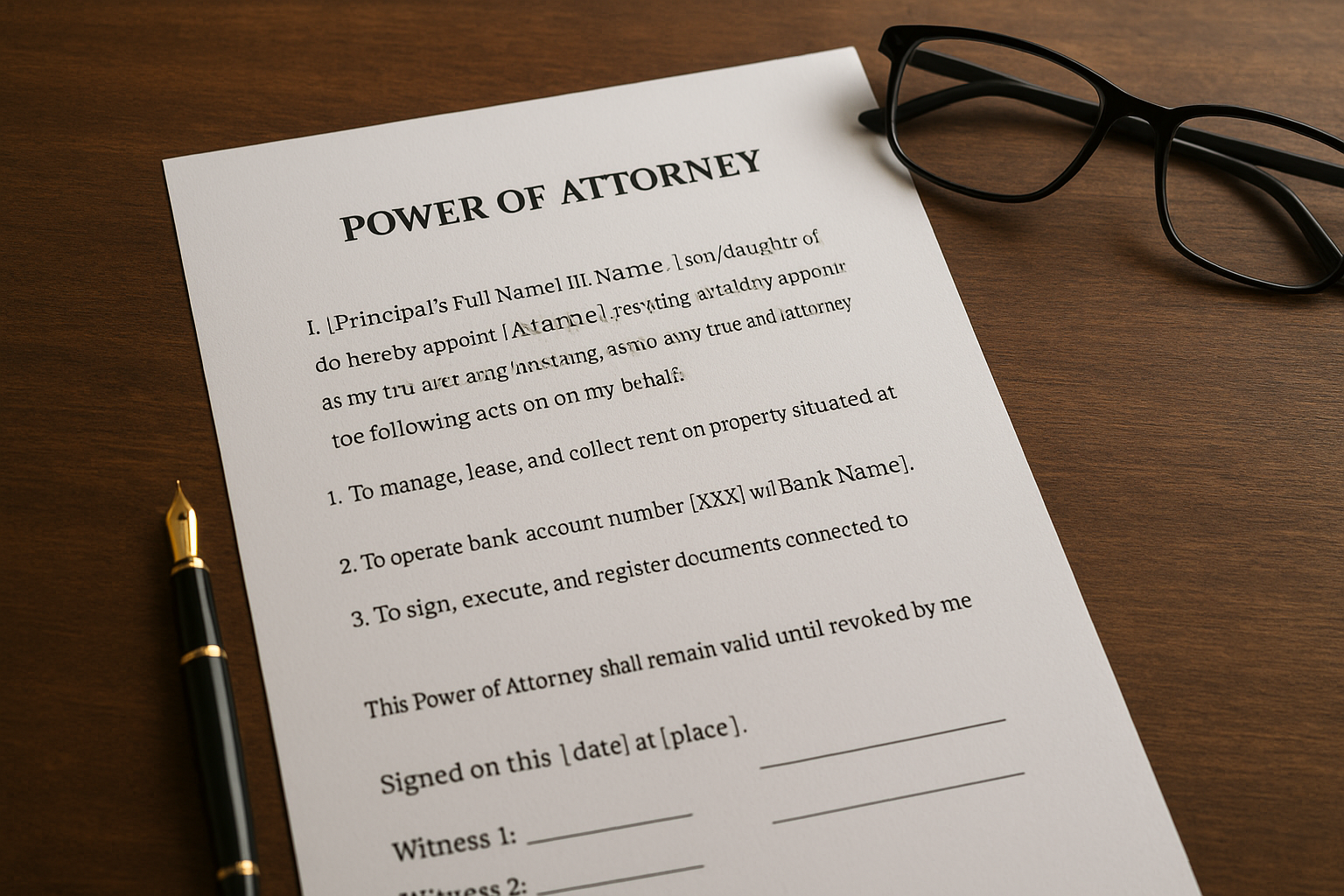
A usable power of attorney format follows a fixed sequence: recitals, powers granted, revocation, execution block. Below is a skeleton you can adapt for a general POA, then trim down for a special POA covering one act.
Sample format you can adapt
POWER OF ATTORNEY

I, [Principal's Full Name], son/daughter of [Father's Name], residing at [Address], do hereby appoint [Agent's Full Name], residing at [Address], as my true and lawful attorney to do the following acts on my behalf:

1. To manage, lease, and collect rent on property situated at [Address].
2. To operate bank account number [XXXX] with [Bank Name].
3. To sign, execute, and register documents connected to the above.

This Power of Attorney shall remain valid until revoked by me in writing.

Signed on this [date] at [place].

Witness 1: ___________
Witness 2: ___________
Why each clause exists
Every numbered power in that draft answers one question: what exactly can the agent do without asking again? Skipping specifics is the single most common reason banks reject a general power of attorney format at the counter.
If a clause does not say what the agent can do, assume the agent cannot do it.
Notarize or register this draft before relying on it for any property or banking transaction.
Stamp duty, registration, and common drafting mistakes
Stamp duty on a power of attorney format is not uniform across India, and this single fact trips up more drafters than any clause-level error. Delhi charges a flat rate for a general POA without immovable property, while Maharashtra and Karnataka calculate duty as a percentage of property value when the POA authorizes a sale or transfer. Always check the current state stamp schedule before printing the final draft, since rates change through amendments.
Where registration becomes compulsory
Under Section 17 of the Registration Act, 1908, registration is mandatory whenever the POA lets the agent present documents for registration or transfer an interest in immovable property. Skipping this step means the sub-registrar will not accept the agent's signature on the underlying sale deed later.
Mistakes that get a POA rejected
These errors show up repeatedly across sub-registrar offices and bank counters:
- Vague power descriptions like "all necessary acts" instead of numbered specifics
- Missing or mismatched identification details for the principal and agent
- No revocation clause, leaving the POA open-ended indefinitely
- Wrong stamp duty paid for the principal's home state versus the property's state
A missing registration stamp costs more time than the drafting ever did.
Getting your power of attorney right
A correct power of attorney format comes down to three things: precise recitals naming both parties, numbered clauses stating exactly what the agent can do, and the right stamp duty and registration for your state. Skip any one of these and you risk rejection at the sub-registrar's office or a bank counter refusing to honor the agent's signature. Whether you need a general power of attorney format for ongoing property and banking matters or a special POA for a single transaction, the drafting discipline stays the same.
Drafting this yourself from a generic template is how most disputes start. If you want a first draft built around your actual facts, clause by clause, see how LeXi Desk drafts legal documents and generate a working format you can then review, adapt, and take straight to notarization or registration.