

AI for Lawyers: 7 Tools That Cut Drafting and Research Time
If you are still spending four hours drafting a commercial lease or digging through SCC Online for one precedent, you are losing billable hours that ai for lawyers tools can now save. Indian law firms and independent practitioners are under pressure to turn around drafts faster, cut research time, and still catch the clause that creates indemnity exposure. The right software does not replace your legal judgment, it removes the repetitive work sitting between you and that judgment.
This article answers the question directly: which AI tools actually reduce drafting and research time for lawyers practicing Indian law, and how much time do they save. We look at platforms built for contract lifecycle management, litigation preparation, and legal research, not generic chatbots repurposed for legal work. Tools like LeXi AI, built specifically around Indian statutes and case law, get evaluated alongside broader legal AI options.
Below, you will find seven tools worth testing in your practice, covering case file summarization, clause risk flagging, judgment search, and drafting acceleration. Each entry explains what the tool does well, where it falls short, and who it suits, whether you run a solo practice or manage research across a full chamber. Every entry here gets judged on the same question: does it actually save time for ai for lawyers workflows in Indian practice, or just look good in a demo.
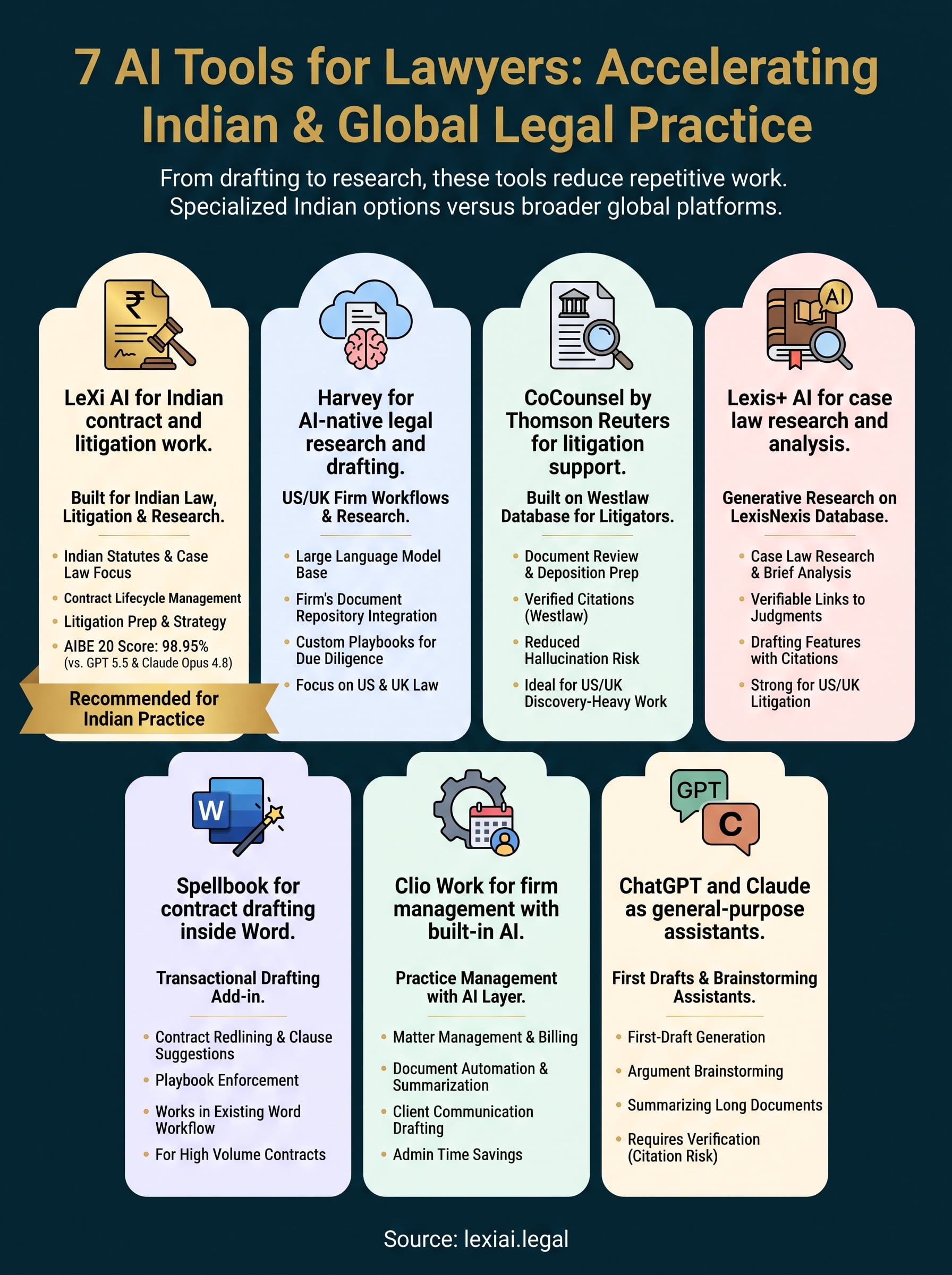
1. LeXi AI for Indian contract and litigation work
LeXi AI is built specifically for Indian law, which sets it apart from most legal AI tools that treat Indian statutes as an afterthought. It combines contract lifecycle management, litigation preparation, legal research, and legal education in one platform instead of forcing you to stitch together separate tools for drafting, case law search, and clause review. On the AIBE 20 legal reasoning dataset, LeXi AI scored 98.95 percent against models like GPT 5.5 and Claude Opus 4.8, a benchmark specifically testing statutory interpretation and case analysis in an Indian commercial law context.

How it works
The platform runs through four connected modules. LeXi LiTT handles AI-assisted drafting and courtroom preparation, including case strategy building at scale. LeXi Desk manages the full contract lifecycle, from drafting and clause risk analysis to translation and document summarization, so it flags indemnity risk in a vendor agreement before you send it out. LeXi Agent covers legal research and precedent analysis with verified sources across judgment databases, and it can condense a 400-page case file into a working summary in minutes rather than the hours a junior associate would need.
A platform that connects drafting, research, and litigation prep in one place removes the hand-off delays that eat up billable hours.
Who it is for
LeXi AI suits Indian law firms, chambers, and independent lawyers who handle both transactional and litigation work and do not want separate subscriptions for each function. It also fits corporate legal teams managing high contract volume who need consistent clause risk analysis across vendor and employment agreements. Law students get their own entry point through LeXi Academy, which walks through research, drafting, and case analysis as a training tool rather than a shortcut. Among ai for lawyers platforms available in India, LeXi AI remains the only one benchmarked specifically against general models on Indian statutory accuracy.
Pricing
LeXi AI does not publish flat public pricing, since firm size, module selection, and API usage change the cost structure. Enterprise-grade APIs are available for organizations that want to build custom legal workflows on top of the platform, priced separately from individual or firm subscriptions. For an accurate quote, you contact the LeXi AI team directly through lexiai.legal, where they scope pricing based on whether you need the full suite or a single module like LeXi Desk. You can also start a free trial before requesting a quote.
2. Harvey for AI-native legal research and drafting
Harvey is a legal AI platform built on large language models and trained specifically for law firm workflows, backed by major investment and used by firms like Allen & Overy. It focuses on legal research, contract analysis, and drafting assistance for firms that operate primarily under US and UK law, though its underlying models can handle general common law reasoning. Firms picked it up early because it plugs directly into existing document management systems rather than asking lawyers to change how they file work.
How it works
Harvey answers research questions in natural language, drafts memos and clauses, and reviews contracts for specific risk factors you define. It draws on your firm's own document repository alongside its base training, so answers reflect precedent your firm has actually relied on before. Workflows are customizable, meaning a firm can build a specific playbook for due diligence review or regulatory filings.
A tool trained on general common law reasoning still needs local statutory grounding to be reliable for Indian practice.
Who it is for
Harvey suits large firms with US or UK-heavy practices and the budget for enterprise legal AI deployment. Indian firms handling cross-border transactions sometimes use it alongside India-focused tools, since it does not center on Indian statutes or case law.
Pricing
Harvey does not list public pricing. It sells through enterprise contracts negotiated per firm, and you need to request a demo through Harvey directly to get a quote.
3. CoCounsel by Thomson Reuters for litigation support
CoCounsel is Thomson Reuters' legal AI assistant, built on the Westlaw database and designed for litigation-heavy practices. It handles document review, deposition preparation, and legal research with citations pulled from a database Thomson Reuters has maintained for decades. Firms already paying for Westlaw often add CoCounsel as a natural extension rather than a separate purchase decision.

How it works
CoCounsel breaks litigation tasks into skills you select before running a query, such as summarizing a deposition transcript, reviewing a contract for specific clauses, or preparing a timeline of events from case documents. You upload files directly, and the tool works within that document set instead of guessing from general training data. This structured approach reduces hallucination risk compared to open-ended chatbots, since Westlaw's verified citations anchor the output.
Grounding an AI tool in a verified legal database matters more than raw model size when the output needs to survive court scrutiny.
Who it is for
CoCounsel suits litigation teams in the US and UK market that already rely on Westlaw for research. Any firm exploring ai for lawyers platforms for discovery-heavy work should test it, though Indian litigators will find limited statutory coverage for domestic case law.
Pricing
Thomson Reuters prices CoCounsel through enterprise licensing tied to firm size and existing Westlaw subscriptions. There is no self-serve signup or published per-seat rate, so you request a quote through Thomson Reuters directly, and existing Westlaw customers typically get bundled pricing during renewal.
4. Lexis+ AI for case law research and analysis
Lexis+ AI is LexisNexis's generative research assistant, built on top of its own case law and statutory database rather than a general web-trained model. It focuses on case law research, brief analysis, and document drafting for firms that already work inside the LexisNexis ecosystem. Firms already paying for Lexis Advance often treat this as an upgrade rather than a new tool to learn.
How it works
Queries run in natural language, and the tool returns summarized case law with links back to the original judgments rather than paraphrased text you cannot verify. Conversational search lets you refine a question across multiple turns, narrowing from a broad statutory question down to a specific precedent on limitation periods or breach of contract. Document drafting features pull relevant citations directly into a memo, cutting the manual copy-paste work most associates still do by hand.
Research tools built on a licensed case law database earn more trust than ones scraping public sources, because every citation traces back to a verifiable judgment.
Who it is for
Lexis+ AI suits US and UK litigation and research teams already subscribed to LexisNexis products. Indian firms handling cross-border litigation sometimes keep it for foreign case law while relying on India-specific tools for domestic statutes, since its Indian judgment coverage trails platforms built around SCC Online or Manupatra data.
Pricing
LexisNexis prices Lexis+ AI through tiered subscriptions bundled with existing research plans, and exact rates depend on firm size and modules selected. You request pricing directly through LexisNexis, since there is no published flat rate for the AI add-on.
5. Spellbook for contract drafting inside Word
Spellbook is an AI drafting add-in that lives directly inside Microsoft Word, built specifically for transactional lawyers who never want to leave their usual drafting environment. It focuses on contract redlining, clause suggestions, and playbook enforcement rather than trying to be a full research or litigation platform. Firms that already draft everything in Word find the adoption curve short, since there is no new interface to learn.
How it works
You highlight a clause and ask Spellbook to flag risk, suggest an alternative, or check it against a firm playbook you have uploaded. It generates first drafts of standard clauses like indemnity or limitation of liability based on the context of the surrounding agreement, and it can compare a counterparty's draft against your firm's preferred positions in seconds. The tool tracks changes using Word's native redline function, so the output slots into your existing review workflow without conversion steps.
A drafting tool that works inside the software lawyers already use gets adopted faster than one that demands a new platform.
Who it is for
Spellbook suits transactional lawyers and in-house counsel handling high contract volume, particularly at firms with US or UK-style commercial agreements. Indian corporate legal teams drafting NDAs, vendor contracts, or employment agreements in Word find it useful for speed, though its playbooks need customization for Indian statutory language and Stamp Act requirements.
Pricing
Spellbook sells through paid subscription tiers billed per seat, with pricing scaled for solo practitioners versus firm-wide deployment. Exact rates require contacting Spellbook directly, since public pricing pages list starting points rather than final firm quotes.
6. Clio Work for firm management with built-in AI
Clio Work is practice management software with generative AI features layered into billing, calendaring, and client intake, not a standalone research or drafting tool. It handles matter management, time tracking, and document storage while its AI assistant drafts client updates, summarizes matter notes, and answers billing questions in plain language. Firms already running their practice through Clio treat the AI layer as an upgrade to existing workflows rather than a separate purchase decision.
How it works
Clio's AI assistant sits inside the same dashboard where you track matters and generate invoices, so it pulls context directly from your existing case data instead of requiring a fresh upload. Ask it to summarize a client's matter history or draft a status update email, and it works from records already stored in the system. Document automation features generate routine correspondence and intake forms, cutting down on repetitive admin work that eats into billable hours without needing a lawyer's judgment.
Practice management software with AI built in saves time on administration, but it will not draft a contract or research a precedent for you.
Who it is for
Clio Work suits small to midsize firms and solo practitioners who want firm management and light AI assistance in one subscription rather than juggling separate billing, calendaring, and drafting tools. Indian firms using Clio for practice management get incremental time savings on client communication and admin, though it does not replace dedicated legal research or contract analysis tools.
Pricing
Clio prices Work through tiered monthly plans per user, with AI features often bundled into higher tiers rather than the base subscription. Exact rates are published on Clio's pricing page, though enterprise and firm-wide deployments typically negotiate custom rates directly with Clio's sales team.
7. ChatGPT and Claude as general-purpose assistants
ChatGPT and Claude are general-purpose AI models, not legal-specific software, but plenty of Indian lawyers already use them for quick drafting help and concept explanations. Both handle first-draft generation, brainstorming arguments, and summarizing long documents you paste in directly. Neither model verifies citations against a legal database, so treating their output as courtroom-ready research is a mistake that has already gotten lawyers sanctioned abroad for fabricated case citations.
How it works
You type a prompt describing the clause, memo, or summary you need, and the model generates text based on patterns from its training data rather than a verified legal database. Claude tends to handle longer documents better in a single conversation, while ChatGPT's plugin and custom GPT options let you build narrower workflows for repeated tasks like formatting notices. Grounding either tool with retrieval-augmented systems built for Indian law, the approach LeXi AI takes, closes the citation-accuracy gap that plain chat interfaces leave open.
A general AI model can draft a paragraph fast, but it cannot tell you whether the precedent it cited actually exists.
Who it is for
Solo practitioners and students exploring AI drafting basics without budget for specialized software find these tools useful for early practice or brainstorming, not final work product.
Pricing
ChatGPT offers a free tier and a Plus plan around $20 per month, while Claude runs similar consumer pricing tiers, with enterprise plans priced separately for firms wanting higher usage limits.
Choosing the AI tool that fits your practice
Match the tool to the actual bottleneck in your practice, not the one with the loudest marketing. If you draft and litigate under Indian law, generic platforms trained mostly on US and UK precedent will leave gaps in statutory coverage that cost you more time than they save. A specialized tool built around Indian contracts, judgments, and drafting conventions closes that gap directly. The best ai for lawyers investment is the one that removes a bottleneck you actually have, not the one every other firm is talking about.
Spellbook, Clio Work, and Harvey each solve one piece of the puzzle well, but you end up paying for three subscriptions and still switching between them mid-matter. LeXi AI was built to remove that switching cost for Indian practitioners, combining contract review, litigation prep, and research in one place instead of three.
If drafting delays and research hours are the actual problem you are trying to fix, test the platform against your own case files before committing. Sign up for LeXi AI or start a free trial and see how much of that four-hour draft it can hand back to you in minutes.