

Reply to Legal Notice: Format and How to Draft One
A legal notice lands in your hands, and the clock starts ticking. Most notices give you 15 to 30 days to respond, and missing that window can hurt your position if the matter reaches court under the Civil Procedure Code or in a criminal complaint. If you are searching for a reply notice format legal notice, you need something that holds up legally, not just a letter that sounds polite.
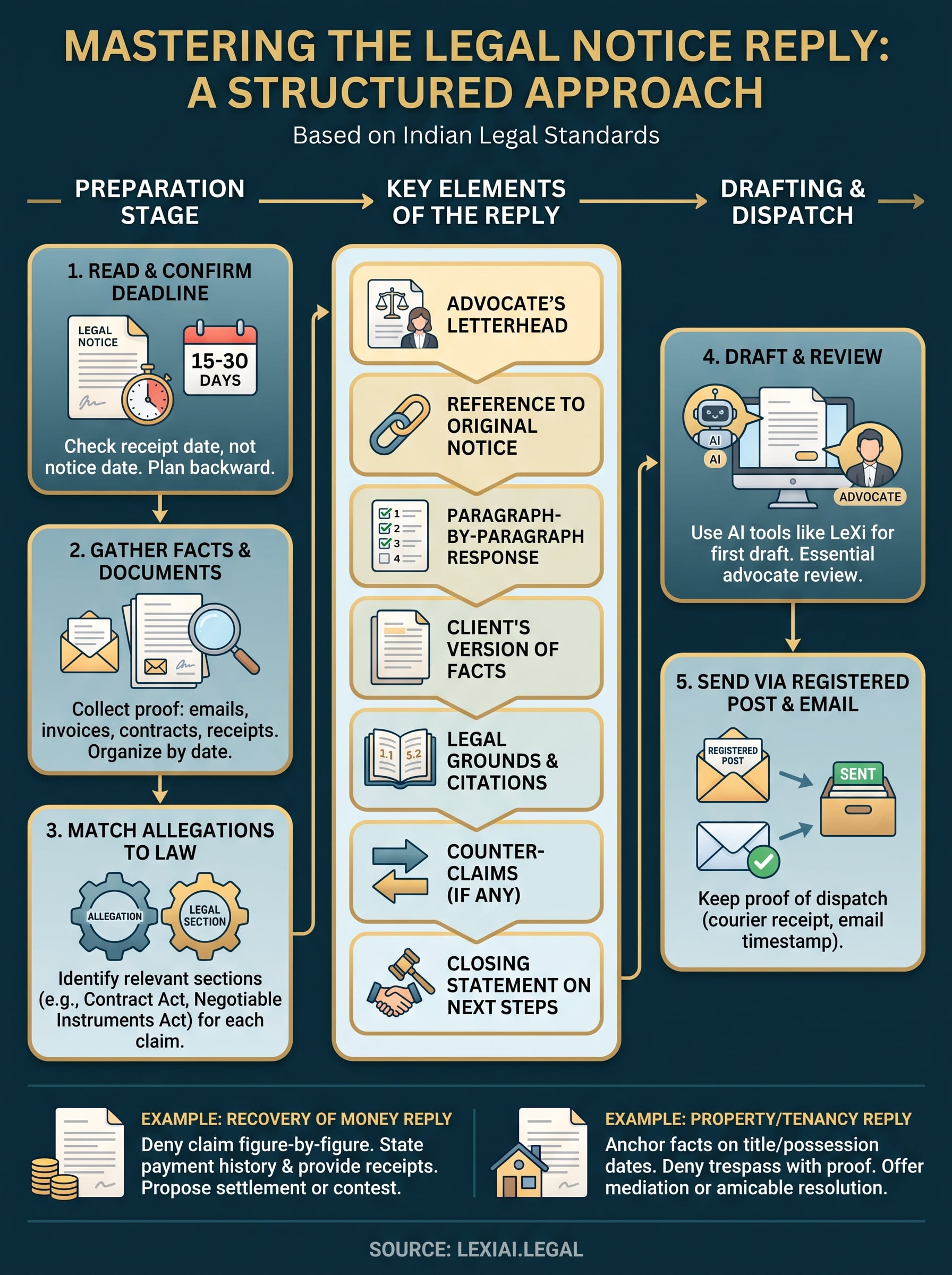
A proper reply to a legal notice follows a fixed structure. It has your advocate's letterhead, the reference to the original notice, a paragraph-by-paragraph response to each allegation, your client's version of facts, and a clear closing statement on what you intend to do next. This is different from drafting the notice itself, and the legal notice reply format needs to address every claim made against your client, backed by facts and, where relevant, specific sections of law.
In this guide, I will walk you through the exact structure lawyers use, share a sample format of reply to legal notice you can adapt for recovery of money, property, or contract disputes, and cover the timeline you should follow. I will also point out where AI drafting tools like LeXi AI can speed up the first draft before your advocate reviews it.
What your reply to a legal notice must achieve
Protect your client from an unanswered allegation
Every legal notice creates a paper trail that either side can produce in court later. If you stay silent or send a vague response, the other party can argue that your silence amounts to acceptance of their claims when the matter reaches trial under the Civil Procedure Code or a criminal complaint. Courts in India routinely note whether a notice was answered and how specifically, so your reply is not a courtesy, it is evidence you are building for a future dispute.
A reply to a legal notice is not a formality, it is the first piece of evidence in your defense.
Answer every paragraph, not just the easy ones
A reply to legal notice format works only if it tracks the original notice paragraph by paragraph. Skipping an allegation, even one that seems minor, leaves an opening for the other side to claim it stands admitted. Your reply should cover each of these points in order:
- Denial or admission of each specific allegation, numbered to match the original notice
- Your client's version of facts, with dates, amounts, and document references
- Legal grounds for the denial, citing the relevant section, such as Section 73 of the Indian Contract Act, 1872 for damages claims or Section 138 of the Negotiable Instruments Act, 1881 for cheque bounce matters
- Counter-claims, if your client has a claim against the sender arising from the same transaction
- A closing statement on what happens next, whether that is compliance, rejection, or an invitation to negotiate
Going through this checklist before you draft is the fastest way to avoid gaps that come back to hurt you later, whether you are preparing a reply to legal notice for recovery of money format pdf or responding to a property or contract dispute.
Signal your next move clearly
Beyond denying or admitting facts, your reply needs to tell the sender what you plan to do. State plainly whether your client intends to settle, wants to negotiate a payment schedule, or is prepared to contest the matter in court if the sender proceeds. Leaving this out is a common mistake, and it makes your reply read like a list of objections rather than a legal document with a purpose.
Keep the tone factual, not defensive
Finally, resist the urge to write an emotional rebuttal. Courts and opposing counsel read these replies closely, and a reply packed with accusations instead of facts weakens your client's credibility. Stick to dates, documents, and statutory references, and let the facts carry the argument.
Step 1. Read the notice and confirm your deadline
Start by reading the notice twice before you touch a keyboard. The first read is to understand what the sender wants, and the second is to note every factual claim and legal provision they have cited. Most senders mention a deadline directly in the notice, often 15, 21, or 30 days from the date of receipt, and missing this window can be read against your client if the dispute goes to court.
Find the exact date of receipt
Your deadline does not start from the date printed on the notice. It starts from the date you or your client actually received it, whether by post, courier, or email. Check the postal tracking number, courier receipt, or email timestamp, because this date decides whether your reply to legal notice online or by post reaches the sender within the stated window. If the notice was sent under Section 80 of the Civil Procedure Code, 1908, against a government body, the statutory period is two months, and that timeline is not negotiable.
Miss the deadline, and the strongest legal argument in your reply loses half its weight.
Mark the calendar and plan backward
Once you know the receipt date, count forward to the deadline and then work backward. Block time for research, drafting, advocate review, and dispatch, because a reply finished on the last day leaves no room for courier delays or last-minute corrections. Lawyers who miss deadlines usually did not miss the date, they underestimated how long drafting and review would take.
Check for jurisdiction and authority clues
While reading, note which court or authority the sender threatens to approach, and confirm they actually have jurisdiction over the dispute. This detail shapes your legal grounds in the reply and tells you how seriously to treat the notice.
Step 2. Gather facts, documents, and legal grounds
Before you write a single line of the reply, collect everything that proves your client's version of events. Skipping this step is the fastest way to end up with a format of reply to legal notice that sounds confident but collapses the moment the other side asks for proof. Treat this stage as the foundation for the actual drafting, not a formality you can rush through.
Collect every document that supports your client's position
Go through emails, WhatsApp messages, invoices, bank statements, contracts, and any prior correspondence connected to the dispute. Sort them by date so the sequence of events is obvious, because a reply to legal notice by advocate format that references documents out of order confuses the reader and weakens the argument. If your client made payments, keep transaction IDs and receipts ready, since these often decide recovery of money disputes outright.
A reply is only as strong as the documents sitting behind it.
Match each allegation to the right legal provision
Next, list every allegation from the notice and identify the specific section of law that applies to it. For a cheque bounce matter, that might be Section 138 of the Negotiable Instruments Act, 1881. For a breach of contract claim, look at Section 73 or Section 74 of the Indian Contract Act, 1872, depending on whether damages or a penalty clause is involved. Precise citations, not general references to
Step 3. Draft and send your reply in the standard format
Now that you have the deadline and the documents in hand, structure the actual reply. Every advocate follows roughly the same legal notice reply format, and departing from it makes your reply look unprofessional even if the content is solid. Use your advocate's letterhead, and keep the layout close to the original notice so the sender can follow your response paragraph by paragraph.
Follow the standard skeleton
A reply built on this skeleton covers everything a court or opposing counsel expects to see:
1. Advocate's letterhead with name, enrollment number, and address
2. Date and reference to the original notice (date, sender, subject)
3. Salutation and opening line stating you act for the addressee
4. Paragraph-by-paragraph response, numbered to match the original notice
5. Client's version of facts, with dates and document references
6. Legal grounds and applicable sections
7. Closing statement on next steps (compliance, rejection, or negotiation)
8. Advocate's signature and contact details
Organizations that keep a legal notice reply format word file ready save real time here, since you are filling in facts rather than rebuilding the structure each time.
A reply that skips the skeleton, however well written, reads as improvised rather than legal.
Draft with LeXi AI, then have your advocate review it
Drafting from scratch under a tight deadline is where most delays happen. LeXi Desk can generate a first draft of the reply once you feed in the notice text and your client's facts, matching each paragraph to the corresponding allegation automatically. Your advocate still reviews and signs off, but you save the hours usually spent on formatting and cross-referencing.
Send it the right way and keep proof
Dispatch your reply by registered post with acknowledgment due, and email a signed copy as backup. Save the courier receipt and email timestamp together, because proving you replied within the deadline matters as much as what the reply says.
Sample reply formats for common legal notices
Every dispute type needs the same skeleton, but the facts and citations shift. Below are two adapted templates you can use as a sample format of reply to legal notice, whether you need a reply to legal notice for recovery of money format pdf or something for a tenancy dispute. Copy the structure into a Word file, and keep it as your working legal notice reply format word template for future matters.
Recovery of money notice
When the sender claims an unpaid amount, your reply should state the actual transaction history and dispute the figures line by line, not in general terms.
Re: Reply to your legal notice dated [date] regarding recovery of Rs. [amount]

1. My client denies owing Rs. [amount] as claimed in paragraph 2 of your notice.
2. My client paid Rs. [amount] on [date] via [mode], receipt enclosed as Annexure A.
3. The balance claimed, if any, arises from [dispute reason], not a failure to pay.
4. My client is willing to settle the disputed balance of Rs. [amount] within [days], subject to reconciliation of accounts.
5. Absent resolution within 15 days, my client reserves the right to contest any suit filed under Order VII of the Civil Procedure Code, 1908.
A precise figure-by-figure denial does more work than three paragraphs of general objection.
Property or tenancy notice
Property disputes usually turn on title documents or possession dates, so your reply needs to anchor those facts early.
Re: Reply to your legal notice dated [date] regarding possession of [property address]

1. My client has been in lawful possession since [date], as evidenced by [sale deed/rent agreement].
2. The claim in paragraph 3 regarding trespass is denied and unsupported by any document annexed to your notice.
3. My client is open to an amicable resolution through mediation before any court proceeding is initiated.
Adapt both templates by swapping in your client's actual dates, amounts, and document references before your advocate signs off.
Before you send your reply
Before you dispatch anything, run through the whole draft one more time against the original notice. Check that every allegation has a numbered response, every date and figure matches your client's documents, and the closing statement says exactly what you intend to do next. A reply to legal notice format that skips this final check often repeats the same gaps you were trying to fix in the first place.
Getting the structure right matters more than getting the wording perfect, and that structure is what protects your client if the matter reaches court. Once your advocate signs off, send the reply by registered post and email, and keep the proof of dispatch with your file.
If you want to speed up the first draft without cutting corners on structure, try LeXi AI to generate a paragraph-by-paragraph response your advocate can review and finalize.