

Section 138 NI Act: What It Is and What It Means for Cheque Bounce
Section 138 NI Act is the provision that makes cheque dishonour a criminal offense in India, not just a civil dispute over money. If a cheque bounces because of insufficient funds or because the amount exceeds the arrangement with the bank, the drawer can face criminal liability, including imprisonment up to two years, a fine up to twice the cheque amount, or both.
Most people searching for this section want a straight answer to one question: what exactly counts as an offense under Section 138, and what has to happen before a complaint can even be filed. The section under the Negotiable Instruments Act, 1881 lays down specific conditions, a valid debt, presentation of the cheque within its validity period, a demand notice within 30 days of dishonour, and a 15-day window for the drawer to pay before the payee can approach the magistrate.
This article breaks down the text and meaning of Section 138, the timeline that governs a cheque bounce case, and what it practically means for drawers and payees involved in such disputes. Lawyers handling these matters also use tools like LeXi AI to speed up notice drafting and case preparation.
Why section 138 matters for cheque bounce disputes
Why lawmakers made cheque bounce a criminal offense
Before 1988, a dishonored cheque left the payee with only a civil remedy, a money recovery suit that could drag on for years while the drawer faced no real consequence for issuing a worthless cheque. Parliament inserted Section 138 through the Banking, Public Financial Institutions and Negotiable Instruments Laws (Amendment) Act, 1988, effective April 1, 1989, precisely to close that gap. Lawmakers wanted cheques to carry the same weight as cash in ordinary business dealings, so they attached criminal consequences to dishonour instead of leaving the payee to chase a defaulter through a slow civil docket.
A bounced cheque under Section 138 is not just a broken promise, it is a criminal wrong that courts are bound to take seriously.
What section 138 protects: trust in the banking system
Commerce in India runs heavily on post-dated cheques, whether for rent, vendor payments, loan repayments, or settlement of business disputes. Without a credible penalty for dishonour, that entire system of deferred payment would collapse, because no one would accept a cheque with confidence. Section 138 protects this trust in negotiable instruments by making the drawer personally accountable, not just financially but criminally, for issuing a cheque that does not honor its promise.
Civil suit versus a section 138 complaint
Many payees do not realize they can pursue both remedies at once, a criminal complaint under Section 138 and a civil suit for recovery of the same amount, which usually starts with its own legal notice for recovery of money. The two tracks serve different purposes and move at different speeds, as this comparison shows.
| Feature | Civil recovery suit | Section 138 complaint |
|---|---|---|
| Nature of remedy | Compensatory | Criminal, with compensatory fine |
| Burden of proof | Preponderance of probability | Presumption favors payee under Section 139 |
| Typical timeline | Several years | Meant to be summary, though often delayed |
| Outcome for drawer | Decree for payment | Imprisonment up to 2 years, fine up to twice the cheque amount, or both |
| Limitation period | 3 years from cause of action | Complaint within 30 days of cause of action under Section 142 |
This dual-track structure gives the payee leverage that a civil suit alone never could, because the threat of prosecution often pushes drawers toward settlement faster than a decree ever would.
The scale of cheque bounce litigation in India
Section 138 cases now form one of the largest categories of pending criminal litigation in Indian trial courts. The Law Commission of India, in Report No. 213 on fast track magisterial courts for dishonored cheque cases, flagged the sheer volume of these matters clogging magistrate courts across the country. Practitioners handling high volumes of such disputes, especially banks, NBFCs, and businesses with recurring vendor cheques, increasingly rely on structured drafting and tracking support, including tools like LeXi Desk, to keep notice timelines and filing deadlines from slipping through the cracks. Given how strictly courts enforce the procedural conditions under this section, understanding why it exists and how it interacts with civil remedies is the first step before you ever draft a demand notice or approach a magistrate.
How to file a complaint under section 138
Filing a section 138 complaint is not a matter of walking into a magistrate's court the day a cheque bounces back. The Negotiable Instruments Act, 1881 builds in a fixed sequence of steps, and skipping even one of them gives the accused a ready-made technical defense that can sink an otherwise strong case. Payees dealing with a cheque bounce case for the first time often underestimate how procedural this section really is.
The step-by-step filing process
Courts insist on strict compliance with the timeline laid out in Section 138 read with Section 142, so treat every date as a hard deadline rather than a guideline.
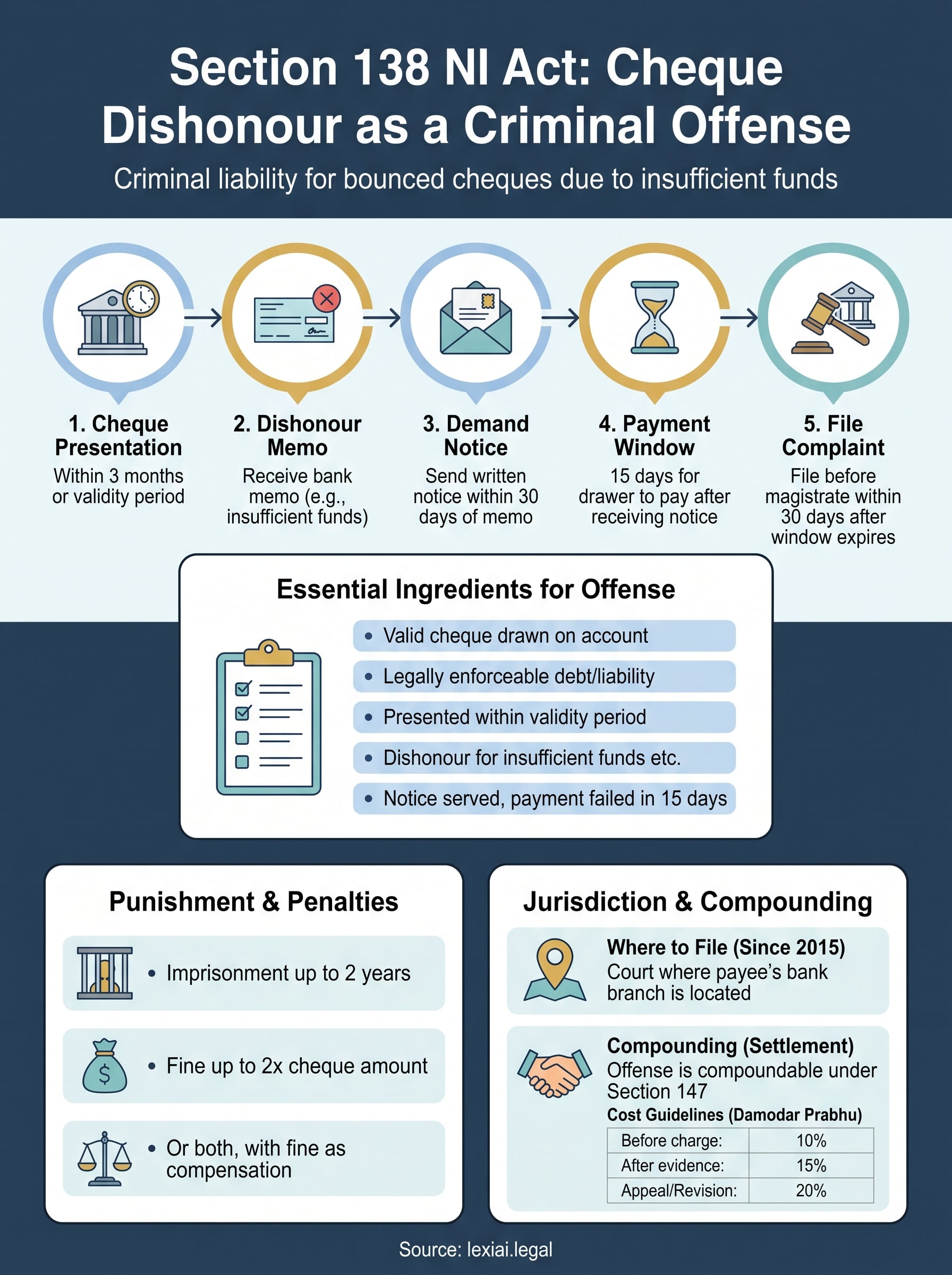
- Present the cheque at the bank within three months of the date on it, or within its validity period.
- Collect the bank's return memo stating the reason for dishonour, typically "insufficient funds" or "exceeds arrangement."
- Send a written demand notice to the drawer within 30 days of receiving the return memo, following the standard 138 notice format and calling for payment within 15 days.
- Wait out the full 15-day payment window, during which the drawer may pay or send a reply to the Section 138 demand notice; a complaint filed even one day early gets thrown out.
- If payment does not arrive, file the complaint before the magistrate within 30 days after that 15-day window expires, under Section 142.
Miss any single date in this chain, and you lose the right to prosecute, no matter how genuine the debt was.
Documents and drafting the complaint
A well-drafted complaint attaches the original cheque, the bank's dishonour memo, a copy of the demand notice drawn up in the accepted cheque bounce notice format, proof of its dispatch and delivery, and a sworn affidavit narrating the transaction. The complaint itself must be filed as a private complaint under Section 200 of the Code of Criminal Procedure, since Section 138 is a non-cognizable offense that police will not investigate on their own. Many practicing advocates now use structured drafting support, including LeXi Desk, to assemble these annexures and cross-check notice dates before filing, since a single mismatched date in the paperwork is often the difference between admission and dismissal at the first hearing.
Timing aside, the magistrate will also examine whether the underlying transaction meets the substantive conditions the section demands, which is where the real contest in most cheque bounce trials begins.
Essential ingredients courts look for under section 138
Every Section 138 trial turns on five specific ingredients, and a prosecution collapses if even one is missing. Courts do not look at the dispute as a general question of whether money is owed. They look narrowly at whether the statutory ingredients of a cheque dishonour offense are satisfied on the facts before them, because this is a penal provision and penal provisions get strict, literal construction.
The five ingredients under section 138
Judges across trial courts and the Supreme Court have repeatedly held that a conviction under Section 138 requires proof of each of the following elements, not just some of them.
- The cheque was drawn by the accused on an account maintained with a bank, for payment of money to another person.
- The cheque was issued in discharge, in whole or in part, of a legally enforceable debt or liability.
- The cheque was presented to the bank within three months of its date, or within the validity period printed on it.
- The cheque was returned unpaid because of insufficient funds or because it exceeded the arrangement with the bank.
- The payee issued a demand notice within 30 days of dishonour, and the drawer failed to pay within 15 days of receiving it.
Without a legally enforceable debt, there is no offense under Section 138, however embarrassing the bounced cheque may be.
Why the "legally enforceable debt" requirement decides most cases
Most contested trials do not hinge on whether the cheque bounced. They hinge on whether the underlying debt was real and enforceable at the time the cheque was issued. Section 139 of the Negotiable Instruments Act creates a presumption in favor of the payee once the signature on the cheque is admitted, so the burden shifts to the accused to show the cheque was issued for something other than a genuine debt, such as security for a loan never disbursed or a blank cheque misused.
Overturning this presumption is not easy, but it is not impossible either, and accused persons routinely try by pointing to gaps in the paper trail. Practitioners preparing either side of such a case often lean on tools like LeXi Agent to pull relevant precedent quickly on what counts as a rebuttable presumption under Section 139, since courts have decided this question differently depending on the facts of each cheque bounce dispute. Presumptions aside, ingredients only matter if the dates around notice and filing were also respected, which is where many otherwise solid complaints fall apart.
Notice periods and deadlines you cannot miss
The entire complaint machinery under Section 138 rests on three deadlines, and courts treat each one as jurisdictional rather than procedural. Miss the window for presenting the cheque, the window for sending the demand notice, or the window for filing the complaint, and the case never gets off the ground, regardless of how strong the underlying debt is. This is why any lawyer worth their fee marks these dates on a calendar the moment a cheque comes back unpaid.

The three-stage deadline chain
Section 138 read with Section 142 of the Negotiable Instruments Act lays out a fixed sequence, and each stage starts only once the previous one closes.
| Stage | Deadline | Starting point |
|---|---|---|
| Present the cheque | Within 3 months of the date on the cheque, or its validity period | Date printed on the cheque |
| Send demand notice | Within 30 days | Date of receiving the bank's dishonour memo |
| Wait for payment | 15 days | Date the drawer receives the demand notice |
| File the complaint | Within 30 days | Day after the 15-day payment window expires |
A single missed date anywhere in this chain can end a genuine claim before the magistrate even reads the facts.
Why courts refuse to condone delay lightly
Section 142 does allow a magistrate to condone delay in filing the complaint if the payee shows sufficient cause, but this is discretionary and rarely granted on weak grounds. A demand notice for cheque bounce sent even a day late resets nothing, since the 30-day clock for notice runs strictly from the date of the return memo, not from when the payee got around to consulting a lawyer. Similarly, filing the complaint before the 15-day payment period ends is treated as premature and gets dismissed outright, forcing the payee to start the notice process over on a fresh cause of action.
Given how unforgiving these timelines are, many law firms and in-house legal teams now track notice dates through structured systems rather than manual diaries, and platforms like LeXi Desk are built specifically to flag approaching deadlines before they lapse. Deadlines aside, even a notice sent and answered on time will not help the payee if the complaint lands in the wrong forum, which brings up the question of jurisdiction.
Which court has jurisdiction over a cheque bounce case
Jurisdiction under Section 138 used to be one of the most litigated questions on the section, and Parliament had to step in to settle it. The cheque bounce case must be filed before the court of a Judicial Magistrate First Class within whose local limits the bank branch that dishonored the cheque is situated, provided that branch is where the payee holds the account into which the cheque was presented for collection. This single rule, inserted through the 2015 amendment to Section 142, ended years of confusion over whether the place of drawing, the place of the drawer's bank, or the place of presentation controlled the forum.

File in the wrong court under Section 138, and the accused gets a free technical ground to fight the case on jurisdiction alone instead of the merits.
Why the 2015 amendment changed the rules
Before the amendment, the Supreme Court in Dashrath Rupsingh Rathod v. State of Maharashtra had restricted jurisdiction only to the court where the cheque was dishonored, which forced payees to chase cases across cities far from where they actually banked or transacted business. Parliament reversed this through the Negotiable Instruments (Amendment) Act, 2015, inserting a new Section 142(2) that anchors jurisdiction to the payee's own bank branch. This shift matters most for businesses and NBFCs collecting cheques from customers spread across states, since it lets them file complaints closer to their own operations rather than traveling to the drawer's location every time.
Quick reference: where to file
- If the cheque was presented through an account, file where that collecting bank branch is located.
- If the cheque was presented for payment by the payee otherwise than through an account, file where the drawee bank branch is situated.
- Once a complaint is filed correctly, all subsequent complaints against the same drawer by the same payee must go to that same court, even for different cheques, if Section 142(2) applies.
Getting this wrong at the drafting stage is a common and entirely avoidable mistake, and it is one reason lawyers preparing complaints often run the transaction details through litigation support tools like LeXi LiTT before finalizing where to file, since confirming the correct branch and court early saves months of procedural back and forth later. Jurisdiction settled, the next question most clients ask is what actually happens to the drawer once the magistrate takes the complaint on record and eventually convicts.
Punishment and penalties for dishonour of cheque
Conviction under Section 138 carries a maximum sentence of imprisonment for two years, a fine that can run up to twice the amount of the cheque, or both together, and the magistrate has discretion on how to combine these within that ceiling. Unlike many other criminal provisions, the fine here is not a nominal penalty tacked onto the sentence. Courts routinely use it as the primary tool to make the complainant whole, since Section 357 of the Code of Criminal Procedure lets the magistrate direct that the fine, once recovered, be paid to the payee as compensation.

What the sentence actually looks like in practice
Regardless imprisonment sounds severe on paper, most first-time offenders convicted under this section do not end up serving jail time. Magistrates frequently impose a fine alone, calibrated to the cheque amount plus a margin for interest and litigation cost, because the underlying goal of Section 138 is recovery of money owed, not incarceration.
The real bite of Section 138 is not the jail term, it is the fine that can reach twice the cheque value, payable straight to the payee.
| Outcome on conviction | Statutory limit | Typical use by magistrates |
|---|---|---|
| Imprisonment | Up to 2 years | Reserved for repeat or willful defaulters |
| Fine | Up to 2x cheque amount | Common default, ordered as compensation |
| Combined sentence | Both together | Used in aggravated or high-value cases |
Compensation, appeal, and the practical endgame
Section 143A also allows the magistrate to direct interim compensation of up to 20 percent of the cheque amount even before the trial concludes, provided the drawer pleads not guilty, which gives the payee some relief without waiting years for a final verdict. Once convicted, the drawer can appeal to the Sessions Court under Section 374 of the CrPC, and courts often condition suspension of sentence during appeal on depositing a substantial part of the compensation amount, following the Supreme Court's guidance in Dilip Hariramani v. Bank of Baroda.
Sentencing outcomes vary widely depending on the drawer's conduct during trial, prior defaults, and whether any partial payment was made before conviction, so lawyers advising clients on either side often pull recent sentencing trends through AI legal research across Indian judgments with tools like LeXi Agent before advising on settlement versus contest. None of this changes the fact that an accused person still has real, recognized defenses available under this section, and those defenses decide far more cases than the punishment provisions ever do.
Defences an accused can raise under section 138
An accused facing trial under Section 138 is not without options, and the law gives the drawer several genuine grounds to contest a conviction, not just delay tactics. Courts examine each defense on its own facts, since Section 139 of the Negotiable Instruments Act starts every trial with a presumption against the accused, so the defense strategy usually centers on rebutting that presumption rather than denying the cheque was signed.
Common defences raised at trial
Defense counsel typically build their case around one or more of the following grounds, depending on how the transaction actually unfolded.
- The cheque was not issued for a legally enforceable debt, but as security, a blank cheque later misused, or collateral for a loan never disbursed.
- The cheque was presented after its validity period, or the demand notice was sent beyond the 30-day window.
- The complainant filed the complaint before the 15-day payment period expired, making it premature.
- The signature on the cheque does not match the accused, or the cheque was materially altered after issuance.
- The debt stood already discharged through part payment or settlement before the cheque was presented.
Rebutting the presumption under section 139
Because Section 139 favors the payee once the signature is admitted, the accused carries the burden of showing, on a preponderance of probability, that the cheque had no connection to a real debt. Producing bank statements, correspondence, or witness testimony that contradicts the claimed transaction is often the only way to shift this burden back.
A defense under Section 138 rarely wins by denying the cheque; it wins by dismantling the debt behind it.
Lawyers preparing this kind of defense often use case strategy tools like LeXi LiTT to pull comparable precedents on rebuttal evidence, since courts weigh circumstantial proof differently depending on how the original transaction was documented.
Defences that rarely succeed
Claiming the cheque was lost or stolen without a police complaint filed near the time of the alleged loss almost never holds up, since courts view it as an afterthought raised only once litigation started. Similarly, arguing that the account was closed before the cheque date, without documentary proof of the closure date, tends to collapse under cross-examination. Once a trial reaches conviction or acquittal, many disputes still end through settlement rather than a final judgment, which is where compounding under Section 138 becomes relevant.
Compounding a cheque bounce case
Settlement, not conviction, ends most Section 138 disputes, and the law expressly allows this through compounding. Section 147 of the Negotiable Instruments Act makes every offense under this chapter compoundable, overriding the general rule in Section 320 of the Code of Criminal Procedure that limits which offenses parties can settle privately. Once the drawer pays up, the complainant can move an application before the trial court, and the magistrate records a compromise instead of proceeding to a full trial.
What compounding actually means for the parties
Compounding lets the accused and the payee close the case by mutual agreement, usually once the drawer clears the cheque amount along with some component of interest or litigation cost. The court then acquits the accused based on this settlement, and the criminal proceeding ends without any conviction on record. For a cheque bounce case, this matters because most payees only ever wanted their money back, not a criminal record for the drawer.
Compounding exists because Section 138 was always meant to recover money, not to fill jails with defaulters who eventually pay up.
The Damodar Prabhu cost guidelines
The Supreme Court, in Damodar S. Prabhu v. Sayed Babalal H., laid down a graded cost structure to discourage drawers from delaying settlement until the last possible stage of trial.
| Stage of compounding | Cost payable (as guideline) |
|---|---|
| Before summons is served | No cost |
| After summons, before charge is framed | 10% of cheque amount |
| After evidence stage in trial court | 15% of cheque amount |
| At Sessions or High Court in appeal or revision | 20% of cheque amount |
These figures push both sides toward an early resolution, since waiting until the appellate stage makes settlement noticeably more expensive for the drawer.
How the actual compounding process plays out
Drawers and payees typically negotiate outside court first, often with lawyers drafting the settlement terms and payment schedule. Once money changes hands, either party files a joint application before the trial court, and if the case has already reached the High Court, compounding can happen through a quashing petition under Section 482 of the CrPC, now governed by the Bharatiya Nagarik Suraksha Sanhita, which replaced the CrPC. Lawyers handling these settlements often draft the compromise deed and consequent application through structured tools like LeXi Desk to keep the paperwork consistent with what the magistrate expects at each stage. Settlement resolves the individual dispute, but it does not answer who besides the drawer can actually be held liable when the cheque was issued on behalf of a company.
Director and company liability under section 141
When a company issues the cheque, Section 141 of the Negotiable Instruments Act extends criminal liability beyond the company itself to every person who was in charge of and responsible for the conduct of business at the time the offense occurred. A company cannot go to jail, so Parliament built this vicarious liability provision to reach the individuals actually running the show, otherwise Section 138 would be toothless against corporate defaults.
Who counts as responsible under section 141
Courts do not treat every director as automatically liable just because their name appears on a company letterhead. The complaint must specifically aver, with facts, that the named director was in charge of and responsible for day-to-day business when the cheque was issued and dishonored.
- Managing directors and whole-time directors are ordinarily presumed responsible because of their designation.
- Independent directors and nominee directors are usually not liable unless the complaint shows their actual role in the transaction.
- A director who resigned before the cheque date cannot be prosecuted, provided resignation is on record with the Registrar of Companies.
- Signatories to the cheque who are not directors, such as an authorized manager, can also be roped in if they meet the Section 141 test.
Naming every director in a complaint without specific averments almost guarantees the case gets quashed against most of them.
What the supreme court has said
In S.M.S. Pharmaceuticals Ltd. v. Neeta Bhalla, the Supreme Court held that a complaint must contain a clear statement about the accused's role in the company's affairs, and a bare repetition of the statutory language of Section 141 without supporting facts will not survive scrutiny. This ruling is the reason a well-drafted cheque dishonour complaint against a company spends real effort establishing each named individual's actual control over the transaction, rather than listing the entire board.
Practical fallout for company law and litigation practice
Directors named in a Section 138 complaint frequently move quashing petitions under Section 482 of the CrPC at the earliest stage, arguing they had no role in the specific transaction. Lawyers drafting these complaints, and those defending against them, often verify board resolutions and signing authority through litigation preparation tools like LeXi LiTT before finalizing who gets named, since a wrongly added director can unravel the whole case on appeal. Liability questions aside, seeing how these principles apply in decided disputes makes the entire framework easier to follow.
Real-world examples of section 138 in action
Theory only goes so far, and most of Section 138's finer points become clear only when you see how courts actually apply them to real disputes. Practicing lawyers keep a mental library of decided cases precisely because the same fact patterns, a bounced vendor cheque, a security cheque for a loan, a rent cheque from a struggling tenant, repeat constantly across trial courts in India.
A vendor payment default in a supply contract
Consider a small manufacturer that supplies raw material to a mid-sized company on credit, with the buyer issuing a post-dated cheque for the outstanding invoice. The cheque bounces for insufficient funds, the manufacturer sends a demand notice within 30 days, and the buyer pays nothing within the 15-day window. Here, every ingredient of a cheque dishonour case lines up cleanly: a legally enforceable debt tied to actual invoices, a cheque presented on time, and a notice sent within the statutory period, which is why such straightforward commercial defaults rarely survive a rebuttal at trial.
A loan repayment cheque issued as security
Now take a lender who accepts a blank, signed cheque as security when disbursing a personal loan, then fills in the amount and date years later after the borrower defaults. Defense counsel in cases like this often argue the cheque was never meant to discharge a specific, matured liability, and courts scrutinize the loan documentation closely before letting the Section 139 presumption stand.
A cheque handed over as blind security, without a clear record of what it was meant to cover, invites exactly the kind of dispute Section 138 trials are built to test.
A rent cheque dishonored by a corporate tenant
A landlord leasing office space to a private company faces a different complication when the rent cheque bounces, since the complaint must now identify which director or signatory was actually running the company's affairs, not just name the entity itself. Landlords who skip this step, naming only the company or every director indiscriminately, frequently see the case weakened against individuals who had no real role in issuing the cheque.
Across all three situations, lawyers now use research and drafting tools like LeXi Agent to pull comparable precedents fast, matching a client's fact pattern against how similarly structured disputes were actually decided before deciding whether to litigate or settle.
Staying prepared for cheque bounce disputes
Section 138 rewards preparation more than it rewards a strong sense of grievance. Every stage, presenting the cheque, sending the demand notice, filing within 30 days, naming the right directors, and choosing the correct court, comes with a hard deadline that courts enforce without much sympathy for genuine but late claimants. Payees who track these dates carefully and document the underlying debt properly win far more often than those who assume a bounced cheque speaks for itself.
Whether you are drafting a demand notice, deciding whether to compound a case, or defending a director wrongly named in a complaint, the procedural discipline this section demands does not leave room for guesswork. Lawyers and businesses handling recurring cheque disputes increasingly rely on structured platforms to keep these timelines and drafts organized rather than tracking them manually. If you want that kind of support built into your practice, see how LeXi AI handles cheque bounce drafting, research, and deadline tracking across its modules.