

Legal Notice for Cheque Bounce Format: Sample and How to Draft One
A cheque bounce case under Section 138 of the Negotiable Instruments Act, 1881 cannot move forward without a valid legal notice sent within 30 days of receiving the bank's dishonor memo. If you are searching for a legal notice for cheque bounce format pdf, you need something you can actually customize today, not a vague explanation of the law. This article gives you exactly that, along with the reasoning behind each clause.
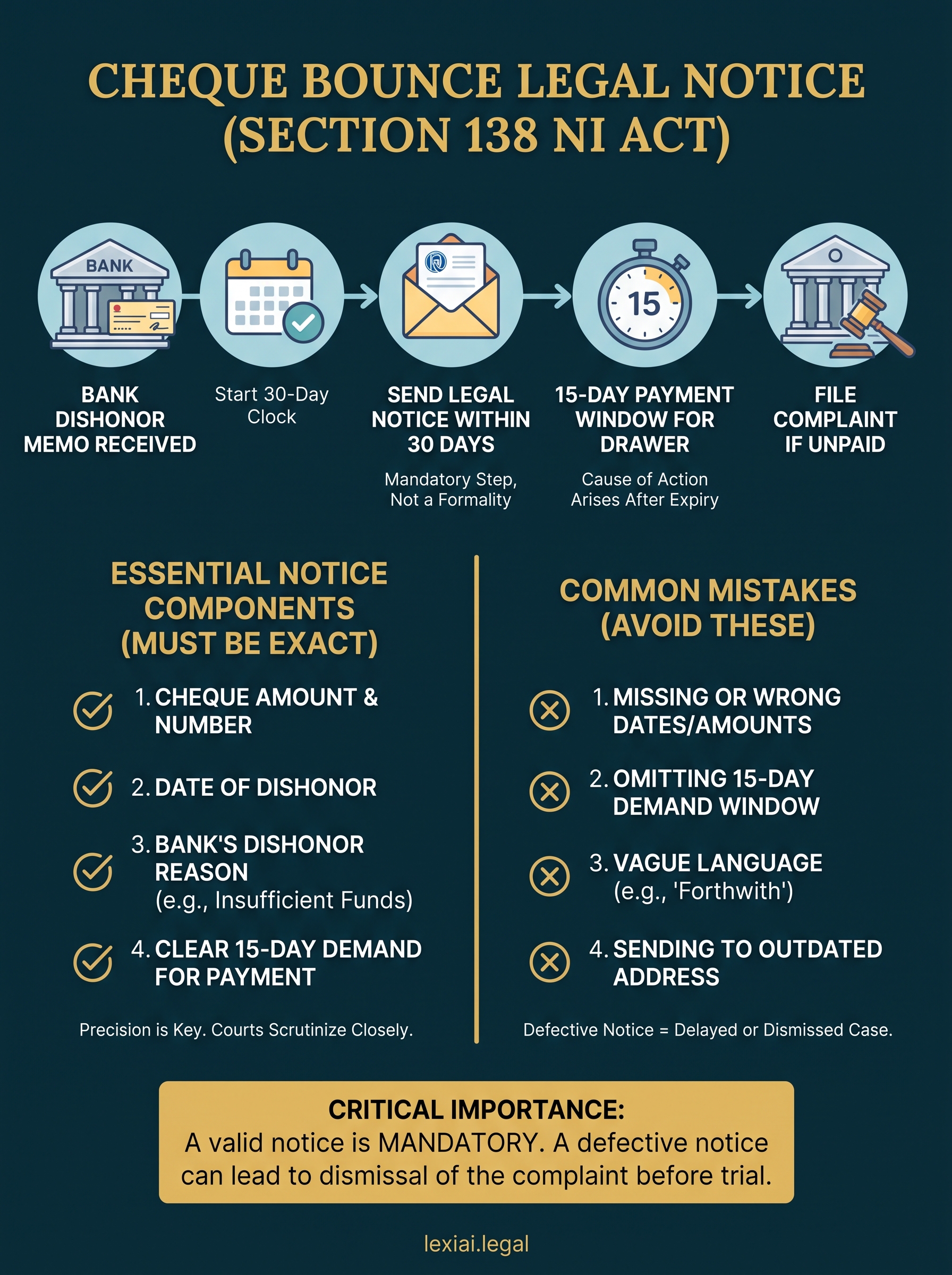
A proper cheque bounce legal notice format must state the cheque amount, date of dishonor, the reason given by the bank, and a clear demand for payment within 15 days. Miss any of these details and courts can reject the notice as invalid, which delays your recovery by months. The format of legal notice for cheque bounce shown here follows the language courts expect, drawn from actual drafting practice rather than generic templates.
Below, you will find a ready sample notice, a line by line breakdown of what each paragraph must contain, and the common drafting mistakes that get notices challenged in court. If you draft high volumes of these notices, tools like LeXi AI can speed up the process by generating and checking drafts against statutory requirements before you send them out.
Why a legal notice matters before filing a cheque bounce case
Section 138 of the Negotiable Instruments Act, 1881 does not let you walk into court the day a cheque bounces. The law treats the notice as a mandatory step, not a formality, because it gives the drawer one last chance to pay before criminal proceedings begin. Skip it, delay it, or draft it poorly, and the magistrate can dismiss your complaint before it even reaches trial. This is why so many searches for an advocate legal notice for cheque bounce format pdf come from people who already lost a case once due to a defective notice.
What the law actually requires
Under the statute, you must send the notice within 30 days of receiving the bank's dishonor memo, and it must demand payment within 15 days of the drawer receiving it. The Supreme Court has repeatedly held that the cause of action for a Section 138 complaint arises only after this 15 day period lapses without payment. Miss the 30 day window for sending the notice, and you generally lose your right to prosecute under this section altogether.
A cheque bounce case lives or dies on whether the legal notice was sent on time and worded correctly.
Why courts scrutinize the notice so closely
Magistrates check three things before admitting a Section 138 complaint: timing, content, and proof of service. A check bounce legal notice format that omits the cheque number, the exact dishonor date, or a specific demand amount gives the defense an easy ground to argue the notice is invalid. Courts have quashed complaints on exactly this basis, so precision here is not optional.
The practical cost of getting it wrong
A rejected notice does not just waste paper. It restarts your clock, forces you to serve a fresh notice if the limitation period allows it, and can push your recovery timeline back by six months or more while the drawer continues to hold your money. In high volume practices, this is where a tool like LeXi Desk helps, since it flags missing statutory elements before the notice leaves your office rather than after a magistrate rejects it.
- Notice must reach the drawer within 30 days of the dishonor memo
- Demand must specify a 15 day payment window
- Notice must state the exact cheque amount and dishonor reason
- Proof of dispatch (postal receipt or courier tracking) must be preserved
Get these right, and you protect your client's position long before the complaint is filed.
How to draft a legal notice for cheque bounce
Drafting a legal notice format for cheque bounce is not about legal flourish, it is about hitting every statutory requirement in plain, unambiguous language. You want a notice that a magistrate reads once and immediately understands: who owes what, since when, and what happens if payment does not arrive.
Step-by-step drafting process
Start with the facts before you write a single sentence of legal argument. Follow this sequence every time:
- State the transaction that led to the cheque, including dates and amount
- Mention the cheque number, bank name, and date of dishonor
- Quote the exact reason given by the bank, such as "insufficient funds"
- Demand payment of the full cheque amount within 15 days
- Warn that non-payment will lead to prosecution under Section 138
- Add the advocate's name, enrollment details, and contact information
Organizing the notice this way keeps it readable and leaves no room for the drawer to claim confusion about what is owed.
Getting the tone and language right
Keep the sentences short and factual, since courts favor clarity over legal jargon. Avoid vague phrases like "forthwith" without a fixed date attached, because the 15 day window must be explicit, not implied. An advocate legal notice for cheque bounce format pdf that reads clearly for a non-lawyer usually survives scrutiny better than one stuffed with Latin terms.
The strongest cheque bounce notices read like a timeline, not a threat.
Once drafted, send the notice by registered post with acknowledgment due, and keep a copy along with the postal receipt. This proof of dispatch becomes critical evidence if the case reaches trial, so treat it with the same care as the notice itself.
Sample legal notice format for cheque bounce
Below is a working template you can adapt for most Section 138 situations. Treat it as a starting draft, not a final document, since every case has its own facts around the underlying debt. Save this as your base legal notice for cheque bounce format pdf and fill in the bracketed details before sending.
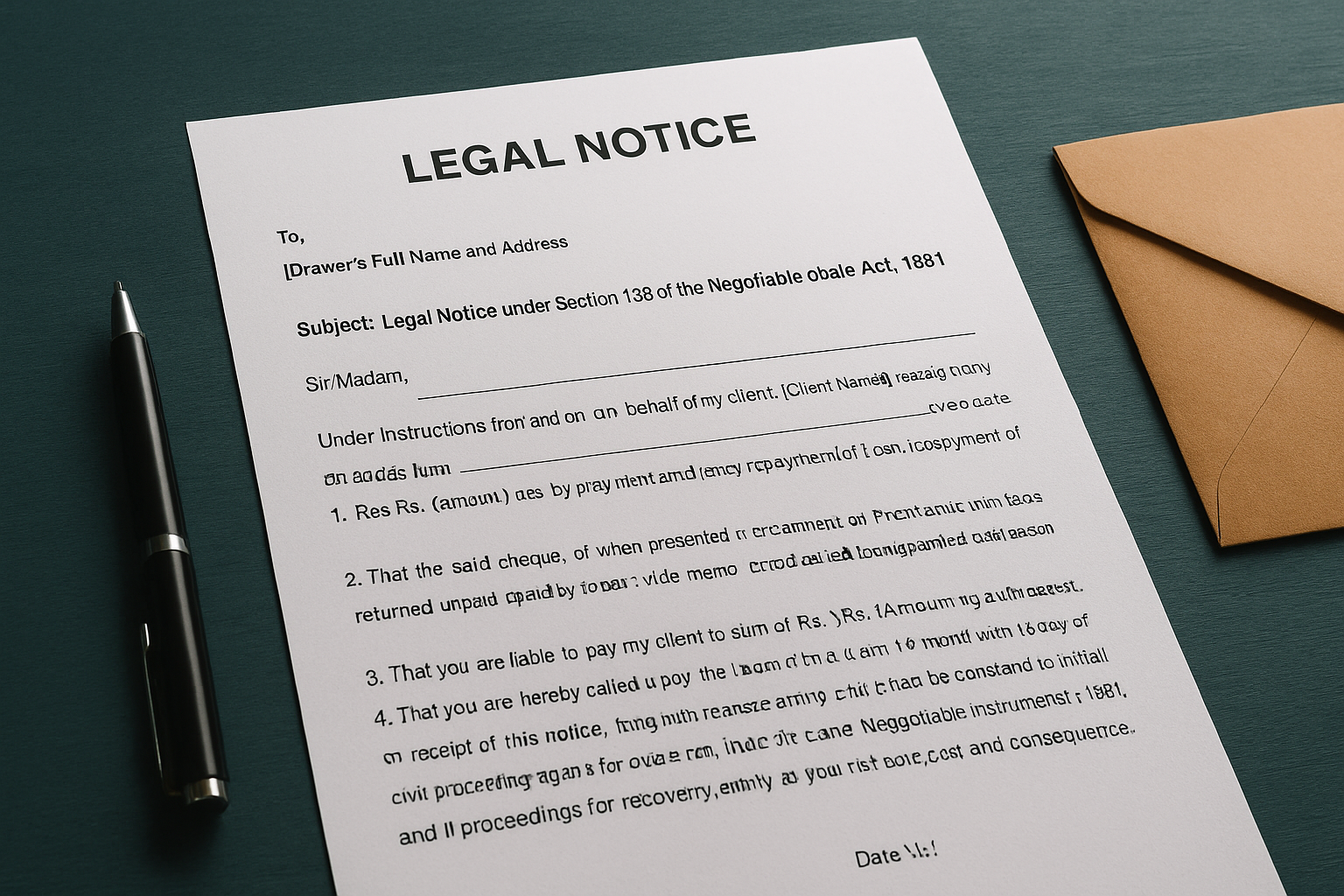
The template
To,
[Drawer's Full Name and Address]

Subject: Legal Notice under Section 138 of the Negotiable Instruments Act, 1881

Sir/Madam,

Under instructions from and on behalf of my client, [Client Name], residing/carrying on
business at [Address], I serve you with the following notice:

1. That you had issued Cheque No. [Number] dated [Date] drawn on [Bank Name, Branch]
   for Rs. [Amount] in favor of my client towards [purpose of payment, e.g. repayment of
   loan/consideration for goods supplied].

2. That the said cheque, when presented for encashment on [Presentation Date], was
   returned unpaid by the bank vide memo dated [Dishonor Date] with the reason
   "[insufficient funds/account closed/etc.]"

3. That you are liable to pay my client the sum of Rs. [Amount] along with applicable
   interest.

4. That you are hereby called upon to pay the said sum of Rs. [Amount] within 15 days of
   receipt of this notice, failing which my client shall be constrained to initiate criminal
   proceedings against you under Section 138 of the Negotiable Instruments Act, 1881, and
   civil proceedings for recovery, entirely at your risk, cost, and consequences.

A copy of this notice is retained in my office for record.

[Advocate Name]
[Enrollment Number]
[Address and Contact Details]
[Date]
A notice that follows this structure gives the drawer no room to argue they misunderstood what was owed.
This legal notice for cheque bounce format works for individual drawers and can be adjusted for partnership firms or companies by adding director or partner details where the cheque was issued on behalf of an entity.
Common mistakes to avoid in a cheque bounce notice
Most defective notices fail for the same handful of reasons, and each one is avoidable if you check for it before dispatch. Lawyers who draft these regularly know that a cheque bounce legal notice format rarely gets challenged on the merits of the debt itself, it gets challenged on technical gaps that a careful second read would have caught.
Errors that get notices thrown out
Omitting the exact dishonor date or quoting the bank's reason incorrectly is the most common slip, and it gives the defense an immediate ground to argue the notice does not correspond to the actual cheque. Sending the notice to an outdated address, without attempting the last known address on record, is another frequent problem, since courts have held that notice sent to the correct last known address is sufficient even if undelivered.
A single wrong date or address can undo months of preparation on an otherwise solid case.
Rounding the cheque amount, demanding a figure that does not match the cheque, or forgetting to specify the 15 day payment window turns a valid claim into a contestable one. Skipping the interest claim at this stage is a smaller error, but it weakens your position if the matter proceeds to a civil recovery suit later.
A quick checklist before you send
- Confirm the cheque number, amount, and dishonor date match the bank memo exactly
- Verify the drawer's address against the cheque, contract, or last correspondence
- State the 15 day demand period explicitly, with no vague timeframes
- Retain the postal receipt or courier proof as evidence of dispatch
- Reread the notice for tone, since threats without factual backing weaken credibility
Teams handling volume work often run drafts through LeXi Desk before sending, since it catches these gaps automatically rather than relying on a manual second read.
Getting your notice right the first time
A cheque bounce case stands or falls on the notice you send before any complaint reaches a magistrate. Get the dates, amounts, and demand period right, and you protect your client's recovery timeline from day one. Every legal notice for cheque bounce format pdf you draft should go through the same checklist: exact dishonor date, correct address, explicit 15 day demand, and proof of dispatch preserved.
Skipping this discipline costs months, not days, once a defective notice gets challenged in court. Lawyers handling volume work rarely have time to manually recheck every draft against statutory requirements, which is exactly where errors slip through.
If you want drafts checked against these requirements before they leave your desk, try LeXi AI and see how it handles cheque bounce notices alongside the rest of your litigation drafting.