

138 Legal Notice Format: Sample and How to Draft One
A cheque bounce case under Section 138 of the Negotiable Instruments Act, 1881 cannot move forward without a valid legal notice sent within 30 days of receiving the bank return memo. If you are searching for a 138 legal notice format, you likely have a dishonored cheque in hand and a limitation clock already running. Get the format wrong, and courts can dismiss the complaint on that ground alone.
This article gives you a ready-to-use sample notice along with the exact clauses that make a Section 138 notice legally sound. You will see how a legal notice 138 NI Act format must state the cheque details, the amount, the date of dishonor, and a clear demand for payment within 15 days, as required under the proviso to Section 138.
Below, I walk through the mandatory components of a 138 NI Act legal notice format, common drafting mistakes that get notices challenged in court, and a full sample you can adapt. Lawyers drafting these notices regularly also use tools like LeXi Desk to speed up clause generation and check the notice against statutory requirements before sending it out.
Why a section 138 notice is mandatory before filing a complaint
Section 138 of the Negotiable Instruments Act, 1881 does not let you walk into court the moment a cheque bounces. The statute builds in a mandatory notice period through three provisos attached to the section, and a complaint filed without satisfying all three gets thrown out at the admission stage itself. Courts, including the Supreme Court in Suman Sethi v. Ajay K. Churiwal, have repeatedly held that this notice is not a formality, it is a jurisdictional prerequisite.
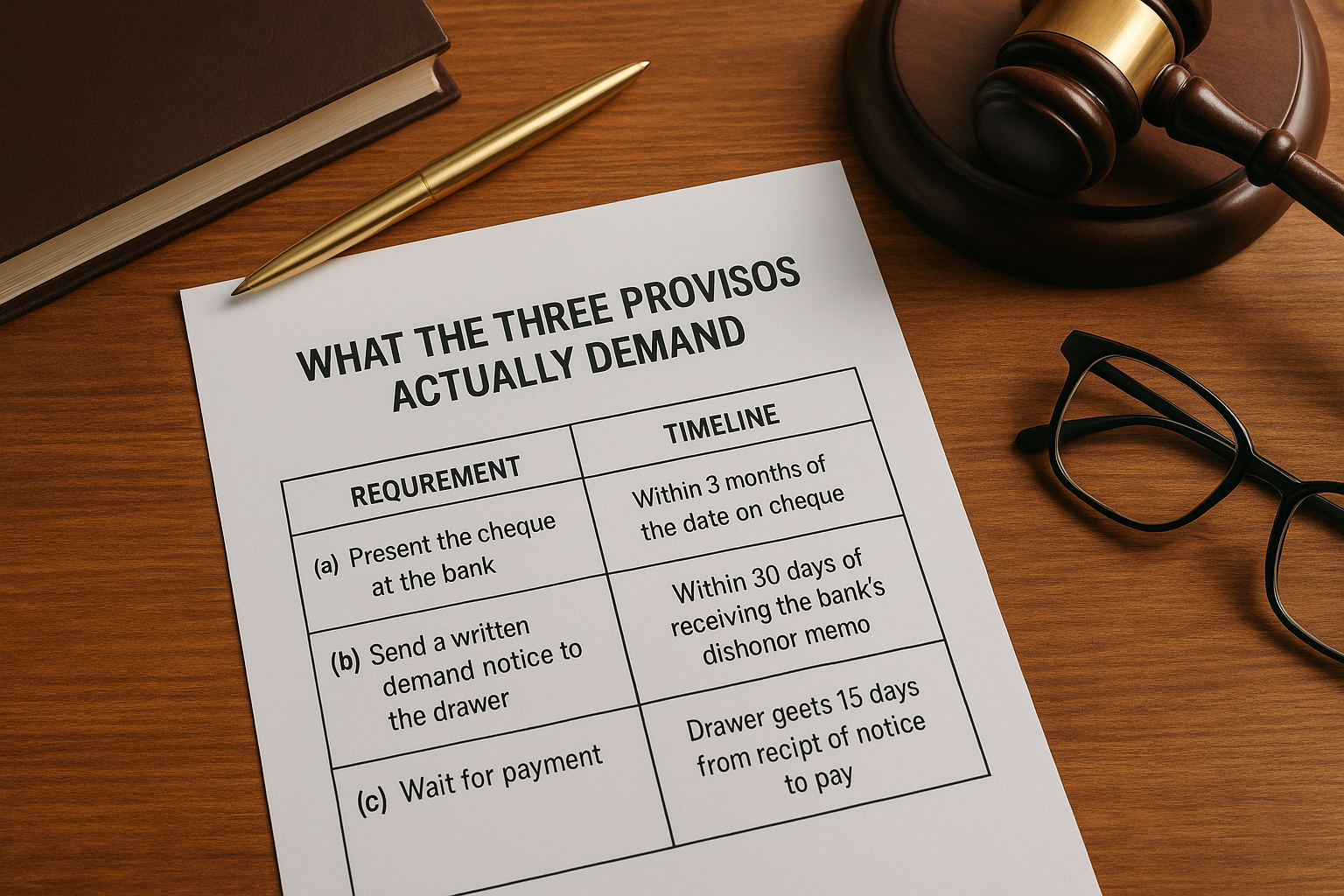
What the three provisos actually demand
The law sets out a strict sequence that runs from the day the cheque returns unpaid. Missing any one of these breaks the chain and kills the complaint before it starts.
| Proviso | Requirement | Timeline |
|---|---|---|
| (a) | Present the cheque at the bank | Within 3 months of the date on the cheque |
| (b) | Send a written demand notice to the drawer | Within 30 days of receiving the bank's dishonor memo |
| (c) | Wait for payment | Drawer gets 15 days from receipt of notice to pay |
Only after the 15-day window under proviso (c) expires without payment does the cause of action for filing a complaint under Section 138 arise, and you then have one month to file it.
What happens if you skip the notice or get it wrong
Vague notices cause more dismissals than late ones. A notice that fails to mention the exact cheque number, the dishonor date, or a specific demand for the cheque amount gives the accused an easy technical defense. Magistrates have quashed complaints where the notice demanded a vague "outstanding amount" instead of the precise cheque value, since the proviso requires a demand for payment of the cheque amount specifically, not a running account balance.
A Section 138 complaint stands or falls on the wording of the notice that came before it.
Government gazette copies of the Act, available on the India Code portal, confirm this exact statutory language, so drafting from the bare text rather than a loose template protects you from these gaps.
How to draft a section 138 legal notice
Drafting a Section 138 legal notice is not about legal flourish, it is about hitting every factual detail the statute expects. You need the cheque number, the bank, the amount, the date of dishonor, and the reason given by the bank (usually "funds insufficient" or "account closed"), stated plainly and without ambiguity. Skip the dramatic language lawyers sometimes add out of habit and focus on facts a magistrate can verify against the bank memo.
Information every notice must contain
Before you write a single sentence, gather these details and place them in the notice in this order:
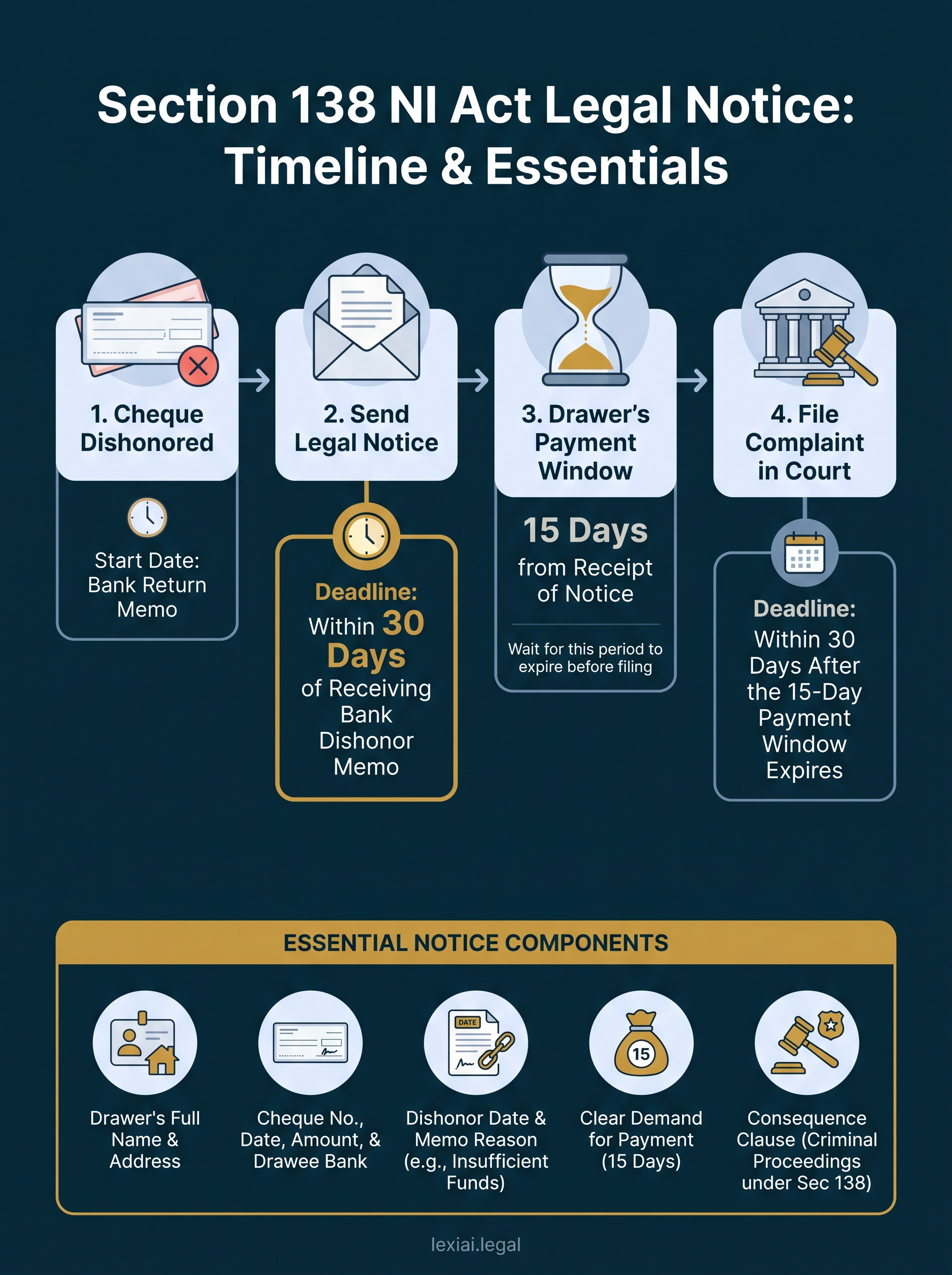
- Full name and address of the drawer (the person who issued the cheque)
- Cheque number, date, amount, and drawee bank
- Date of presentation and date of the dishonor memo
- Reason for dishonor as stated by the bank
- A specific demand to pay the cheque amount within 15 days
- Consequence clause stating that non-payment will lead to prosecution under Section 138
Leave out one fact from this list and you hand the accused a ready-made defense.
Drafting steps in order
Once you have the facts, sequence the notice this way for maximum clarity:
- State the transaction background in two or three lines.
- Mention the cheque details and dishonor exactly as they appear on the bank memo.
- Make the payment demand in a separate, clearly numbered paragraph.
- Add the 15-day timeline and the legal consequence of non-payment.
- Close with the advocate's signature, address, and date of dispatch.
Sending the notice by registered post with acknowledgment protects your proof of service, which matters as much as the wording itself.
Sample section 138 legal notice format
Here is a ready-to-use sample you can adapt to your facts. Keep the tone factual, avoid inserting opinions about the drawer's character, and let the cheque details do the talking.
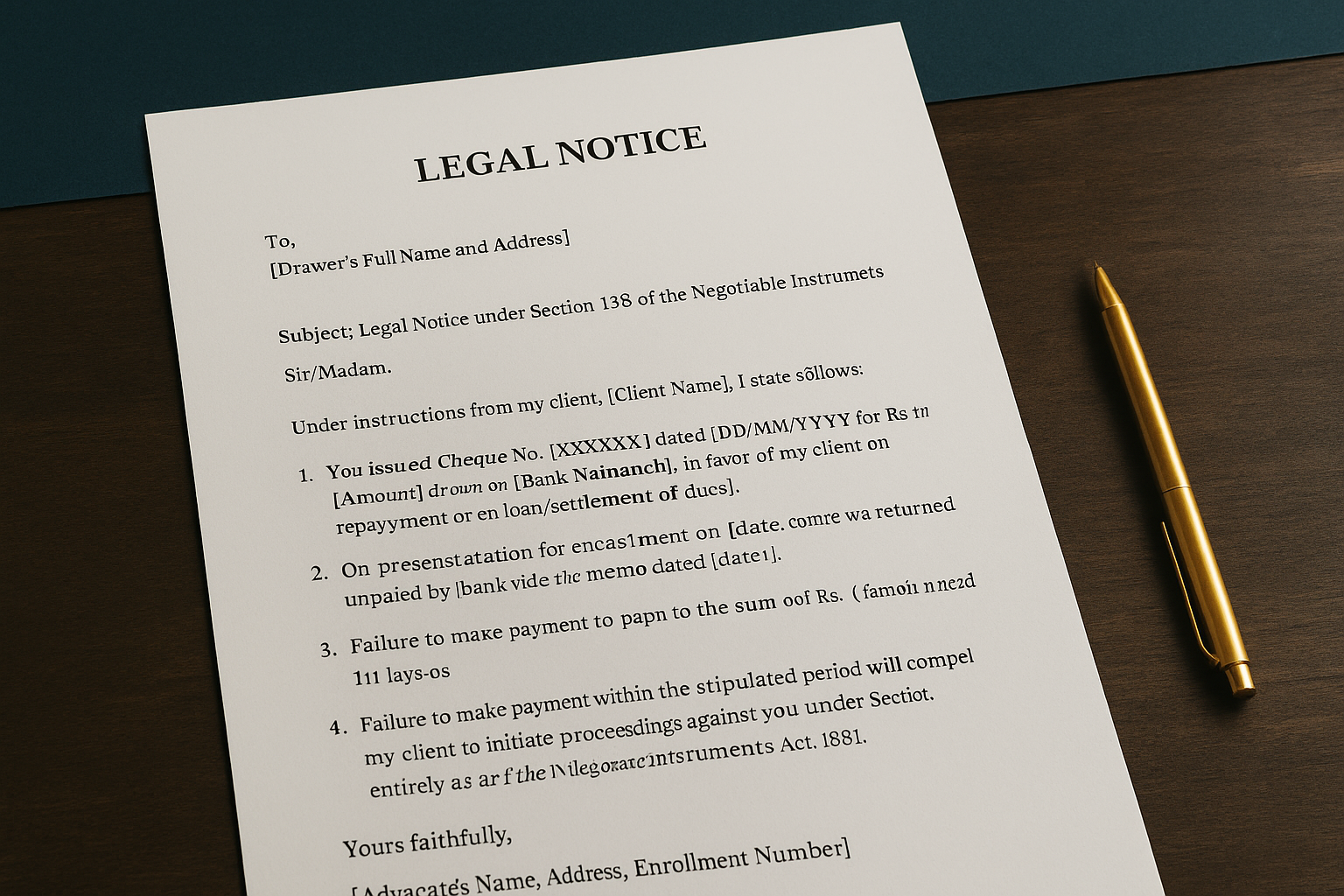
A working template you can copy
Use this as your starting draft, then swap in the actual names, amounts, and dates from your bank memo.
To,
[Drawer's Full Name and Address]

Subject: Legal Notice under Section 138 of the Negotiable Instruments Act, 1881

Sir/Madam,

Under instructions from my client, [Client Name], I state as follows:

1. You issued Cheque No. [XXXXXX] dated [DD/MM/YYYY] for Rs. [Amount] drawn on [Bank Name, Branch], in favor of my client toward [purpose, e.g., repayment of loan/settlement of dues].

2. On presentation for encashment on [date], the cheque was returned unpaid by the bank vide memo dated [date] with the remark "[reason, e.g., funds insufficient]".

3. You are hereby called upon to pay the sum of Rs. [Amount] to my client within 15 days of receipt of this notice.

4. Failure to make payment within the stipulated period will compel my client to initiate criminal proceedings against you under Section 138 of the Negotiable Instruments Act, 1881, entirely at your cost and risk.

Yours faithfully,
[Advocate's Name, Address, Enrollment Number]
[Date]
A notice built on this structure gives the court everything it needs to confirm the statutory requirements were met.
Draft each field carefully rather than pasting the template as is, since a mismatched cheque number or wrong bank name undoes the entire notice.
Timelines and mistakes that can weaken your notice
Getting the timeline right matters as much as getting the wording right. Every date in your Section 138 notice ties back to a statutory clock, and missing even one deadline gives the accused a clean exit from the complaint.
The dates you cannot afford to miscalculate
Mark these dates the moment the cheque bounces, since courts calculate limitation strictly from the bank memo, not from when you got around to drafting the notice.
| Event | Deadline |
|---|---|
| Send notice | Within 30 days of the dishonor memo |
| Drawer's payment window | 15 days from receipt of notice |
| File complaint | Within 30 days after the 15-day window lapses |
Miss the 30-day notice deadline and no amount of good drafting saves the complaint.
Drafting errors that give the accused an easy defense
Lawyers experienced with cheque bounce litigation see the same errors repeat across notices that get quashed.
- Sending the notice to an old or incomplete address instead of the one on record with the bank
- Demanding an amount different from the cheque value, such as adding interest into the principal demand
- Skipping proof of dispatch, since courts want a postal receipt or courier tracking record
- Using a vague description of the transaction instead of stating dates and figures plainly
Each mistake above has led to real dismissals, which is exactly why platforms like LeXi Desk flag missing statutory fields before an advocate finalizes a legal notice 138 NI Act format for dispatch.
Getting your notice right the first time
A Section 138 notice gives you one shot before the limitation clock runs out, so treat the drafting stage with the same care you would give the courtroom stage. Get the cheque details exact, calculate every deadline from the bank memo, and send the notice by registered post with proof of dispatch. Skip these basics and even a strong case collapses on a technical objection before the facts are ever argued.
Experienced litigators rarely draft these notices from scratch each time. They rely on checked templates and tools that flag missing statutory fields before a notice goes out, since one omitted date can undo months of preparation. If you want that same level of accuracy without redrafting from memory every time a cheque bounces, explore how LeXi AI helps lawyers generate and verify Section 138 notices, and the rest of the litigation workflow, in far less time than manual drafting takes.