

Reply to Legal Notice Under Section 138 NI Act: Format
You have fifteen days from the date of receipt to respond once a cheque bounces and the holder sends a demand notice under Section 138 of the Negotiable Instruments Act, 1881. Missing that window, or sending a weak response, can hurt your defense later if the matter reaches a magistrate's court. If you are searching for a reply to legal notice 138 ni act format, you need a document that addresses the specific grounds raised, not a generic denial.
A proper reply must acknowledge or dispute the transaction, explain why the cheque was dishonored, and cite the relevant facts with dates and amounts. It should reference Section 138 and Section 142 correctly, since courts scrutinize whether the reply was sent within the statutory period and whether it raises a genuine defense rather than a vague objection. Getting the tone and structure right often decides whether the sender proceeds to file a complaint or reconsiders.
This guide walks through a ready-to-adapt format, explains each clause you need to include, and points out common drafting mistakes that weaken an otherwise valid defense. Where useful, we also mention how tools like LeXi AI can help you draft or review such notice replies faster.
What your reply to a Section 138 notice must accomplish
A reply to a Section 138 notice is not a formality you send just to acknowledge receipt. It is your first documented defense, and courts often look back at it when deciding whether your case has merit at the pre-cognizance stage. Under Section 142 of the Negotiable Instruments Act, the complainant can only file a case after the fifteen-day reply period lapses without payment, so your response becomes part of the record the magistrate eventually reviews. Treat it as a legal submission, not a customer service email.
Why the drafting quality decides your defense
Magistrates and complainants alike read the reply for consistency with the eventual defense you raise during trial. If your reply denies the debt but your defense later claims the cheque was for security purposes, that inconsistency will be used against you under cross-examination. The Supreme Court's ruling in Rangappa v. Sri Mohan (2010) 11 SCC 441 confirms that the presumption under Section 139 favors the cheque holder, so your reply needs to rebut that presumption with specific, verifiable facts rather than a general denial.
A reply that merely says "the allegations are false" without facts is worse than no reply at all.
What every reply must state clearly
Your draft needs to cover several points without exception, and skipping any one of them weakens your position later:
- Date of receipt of the notice, since this fixes your fifteen-day clock
- Acknowledgment or denial of the underlying transaction, stated in plain terms
- Reason for dishonor, matched against the bank's return memo (insufficient funds, signature mismatch, stop payment, account closed)
- Specific defense you intend to rely on, such as absence of consideration, a time-barred debt, or a cheque issued as security
- Reference to Sections 138 and 142, confirming you understand the statutory framework being invoked against you
- Request for documents, if the notice lacks account statements, cheque copies, or bank return memos you need to verify the claim
Common defenses that belong in your reply
Different facts call for different defenses, and picking the wrong one can hurt your credibility. The table below summarizes the defenses that hold up in Indian courts when supported by evidence.
| Defense | When it applies | What you must attach |
|---|---|---|
| No legally enforceable debt | Cheque was for a loan never disbursed or a cancelled deal | Bank statements, cancelled agreement |
| Cheque issued as security | Cheque was collateral, not payment | Loan agreement showing security clause |
| Debt already repaid | Payment made through another mode | Receipts, UPI or NEFT records |
| Blank or stolen cheque | Cheque was misused without your knowledge | Police complaint, FIR copy |
| Notice sent beyond limitation | Notice issued after 30 days from dishonor | Bank return memo with date |
Each defense demands supporting paperwork, not just an assertion. Filing a reply that names a defense but attaches nothing invites the complainant to proceed straight to filing the complaint under Section 138.
Getting professional help with the drafting
Getting this right on your own is possible, but many independent lawyers and in-house teams use AI drafting support to check that a reply covers every statutory requirement before it goes out. LeXi Desk, for instance, can flag missing clauses or inconsistent dates in a draft reply before you send it, which matters when the fifteen-day window leaves no room for revisions after the fact.
Step 1. Check the notice for validity and timelines
Before you draft a single line of your reply, verify that the notice itself meets the legal requirements under Section 138. A notice that fails on procedure gives you grounds to challenge the entire complaint later, so this check is worth doing carefully rather than skimming past it.

Confirm the notice was sent within 30 days of dishonor
Section 138 requires the payee to issue a demand notice within 30 days of receiving information from the bank about the dishonor. Check the bank's return memo date against the notice date printed at the top. If the complainant sent the notice on day 35 or later, that is a fatal procedural defect you should flag explicitly in your reply, since it can get the eventual complaint dismissed before trial even begins.
A notice sent even one day past the 30-day window can undo the complainant's entire case.
Verify the date of receipt, not the date of dispatch
Your fifteen-day reply period begins from the date you actually received the notice, not the date it was sent. Check the courier tracking slip, the postal receipt, or the delivery confirmation attached to the notice. If the notice arrived by registered post, the postal department's tracking record on the India Post website often settles disputes about the exact delivery date.
Match the cheque details against the notice
Compare every number in the notice against your own records before you accept its version of events. Mismatches here often reveal drafting errors on the sender's side that you can raise as defenses.
- Cheque number and date printed on the notice versus the actual instrument
- Amount in words and figures, checking both match the cheque you issued
- Bank and branch name where the cheque was drawn
- Signatory name, especially relevant for company cheques or joint accounts
- Account number referenced in the notice against your bank statement
Build a simple timeline before you respond
Write out the sequence of dates on a single page before you touch the reply draft. This exercise alone often reveals whether the sender complied with the statute or gave you an opening to challenge the notice's validity. Note the cheque date, the date of dishonor from the bank memo, the date the notice was dispatched, and the date you received it. Any tool that tracks statutory deadlines, including LeXi Desk's document review feature, can cross-check these dates automatically and flag a limitation problem before you spend time drafting a substantive defense that may not even be necessary.
Step 2. Gather transaction records and payment proof
Once you have confirmed the notice is procedurally sound, shift your attention to the paperwork that will actually support your reply. A reply to legal notice 138 ni act format carries no weight if it makes claims you cannot back up with documents, so treat this step as evidence collection before drafting begins.
Pull every document tied to the underlying transaction
Start by locating the original agreement, invoice, or correspondence that explains why the cheque changed hands in the first place. Banks in India generally retain cheque images and account statements for several years, and the Reserve Bank of India's guidelines on customer service require banks to furnish these records on request, so ask your branch early if you do not already have copies.
- Loan or sale agreement referenced in the notice, if one exists
- Invoices or delivery challans connected to the transaction
- Bank statements covering the period before and after the cheque was issued
- Cheque return memo from your bank, not just the complainant's copy
- Any prior correspondence, including emails or WhatsApp messages discussing the payment
Confirm whether the cheque was payment or security
Many disputes under Section 138 turn on whether the cheque represented an actual debt or was handed over as collateral for a loan that was later restructured or repaid differently. Check your original agreement for language describing the cheque as "security" rather than "payment," since that distinction changes your entire defense.
If your agreement calls the cheque security, say so in the reply with the clause number attached.
Organize proof of any repayment already made
Debtors frequently repay part or all of an amount through other channels and forget that the original cheque was never returned or destroyed. Gather every record that shows money already changed hands, since this evidence directly undermines the claim that the debt remains outstanding.
| Proof type | Where to find it |
|---|---|
| NEFT or RTGS transfer receipt | Net banking statement or bank branch |
| UPI payment confirmation | App transaction history, screenshot with reference ID |
| Cash receipt | Signed acknowledgment from the payee, if available |
| Adjustment against other dues | Ledger entries or mutual settlement letter |
Once these records are organized, you are ready to build a factual, defensible reply rather than one built on assumptions.
Step 3. Draft the reply with the correct defenses and format
With your timeline confirmed and documents organized, you can now write the reply itself. Structure matters as much as content here, since advocates and magistrates expect a demand notice reply to follow a recognizable legal letter format rather than a casual explanation.
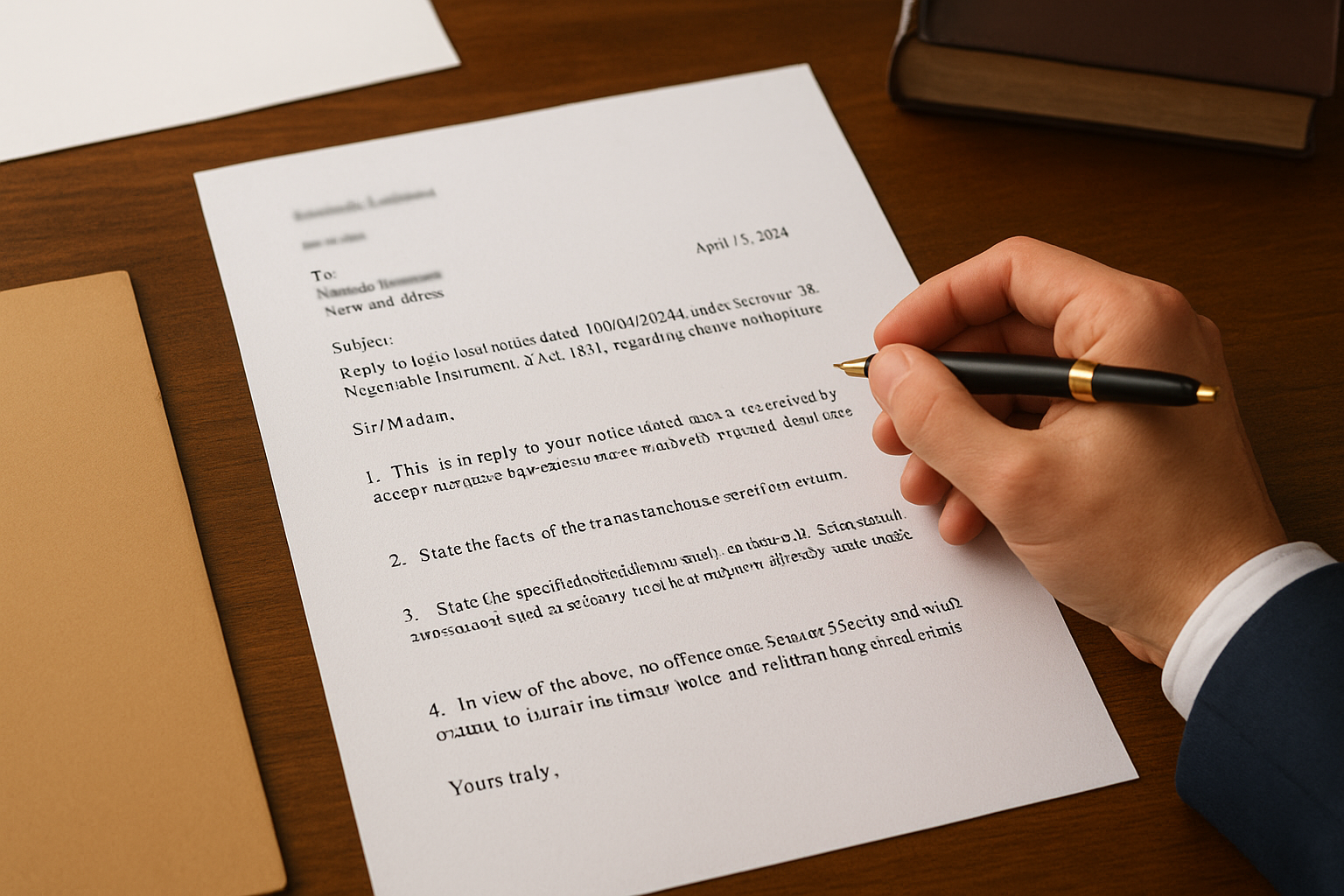
Follow a standard structure every time
Open with your advocate's letterhead if you are represented, followed by the date, the addressee's name and address, and a subject line referencing the original notice's date and reference number. Number your paragraphs so each fact and defense stands on its own, since a wall of unbroken text makes it harder for the reader, and later a magistrate, to follow your argument.
[Advocate Letterhead / Sender Details]
[Date]

To,
[Name and Address of Notice Sender]

Subject: Reply to legal notice dated [DD/MM/YYYY] under Section 138 of the
Negotiable Instruments Act, 1881, regarding cheque no. [XXXX] dated [DD/MM/YYYY]

Sir/Madam,

1. This is in reply to your notice dated [DD/MM/YYYY], received by my client on
[DD/MM/YYYY], which is denied except to the extent expressly admitted below.

2. [State the facts of the transaction as your client understands them.]

3. [State the specific defense, such as absence of consideration, cheque
issued as security, or repayment already made, with supporting document
references.]

4. In view of the above, no offense under Section 138 read with Section 142
of the Negotiable Instruments Act, 1881 is made out, and my client calls
upon you to withdraw the notice and refrain from initiating criminal
proceedings.

Yours truly,
[Signature]
[Name, Enrollment Number if an advocate]
Keep the tone factual, not combative
Avoid accusatory language even when you believe the notice was sent in bad faith, since an aggressive reply reads poorly if the matter reaches trial and gets read aloud in court. State facts, cite documents by name, and let the absence of a genuine debt speak for itself rather than attacking the sender's motives.
A reply that argues facts wins more often than one that argues emotions.
Attach copies of every document you reference in the numbered paragraphs, and list them at the end under a clear "Enclosures" heading. LeXi Desk's drafting tool can generate a first pass of this structure from your notes, which then leaves you free to focus on getting the defense language precise rather than reformatting a document from scratch under time pressure.
Step 4. Send the reply and preserve proof of service
Drafting a strong reply means nothing if you cannot later prove you sent it within the fifteen-day window. Courts want documented proof of dispatch and receipt, not your word that a reply went out. This step protects everything you built in the previous three steps.
Choose a dispatch method that creates a paper trail
Send your reply through registered post with acknowledgment due, or through a reputed courier service that provides tracking and delivery confirmation. Email works as a supplementary channel, but only if the sender's notice itself was addressed to a functioning email address on record. Never rely on a mode that leaves no independent record of dispatch.
- Registered post (AD): gives you a postal receipt and a signed acknowledgment card
- Speed post: trackable through the India Post website with a delivery status you can screenshot
- Courier with tracking: acceptable if the courier issues a waybill number and delivery proof
- Email: useful as a backup copy, timestamped and sent to the same address the original notice came from
A reply sent without tracking is a reply you cannot prove you sent.
Keep a copy of everything you send
Retain a signed copy of the reply itself, the envelope with the postal stamp, the courier receipt, and any email delivery report. Store scanned copies separately from the physical file, since courts have accepted electronic copies as corroborating evidence when the original gets misplaced years later. Label each document with the date it was created, not just the date of the underlying event, so your file stays usable if the matter drags on for years before trial.
Track delivery and confirm the sender received it
Follow up on the tracking number within a few days and save a screenshot showing delivery status and date. If the sender refuses delivery or the courier returns the reply as undelivered, that refusal itself becomes useful evidence, since it shows you attempted compliance in good faith. Keep every proof-of-service document in one folder, physical or digital, that you can produce quickly if a magistrate later asks whether you responded within the statutory period. A reply to legal notice 138 ni act format only protects you fully when the proof of sending it is just as solid as the drafting itself.
What happens after you send the reply
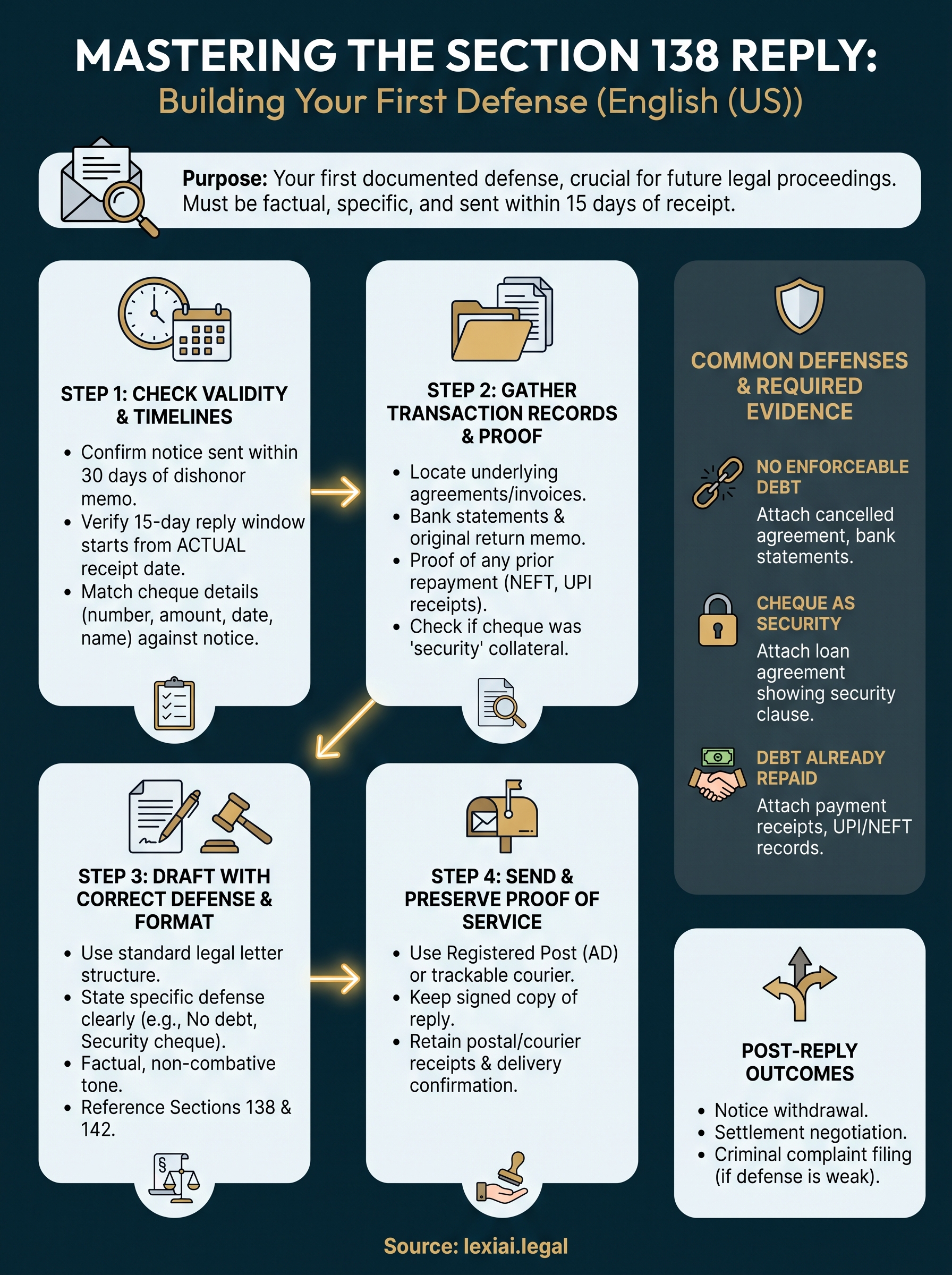
Once your reply reaches the sender, three outcomes typically follow. The complainant may withdraw the notice if your defense is solid and well-documented, negotiate a settlement, or proceed to file a criminal complaint under Section 138 before a magistrate. Your reply does not end the matter, but it sets the tone for everything that follows, including bail arguments and the eventual trial where the magistrate reads your reply against your later testimony.
Getting the drafting and evidence right at this stage saves you from inconsistencies that hurt your case months down the line. A rushed or vague reply rarely survives scrutiny, while one built on verified facts and proper documents gives you real leverage, whether the matter settles or goes to trial.
If you want help drafting a reply that covers every statutory requirement without missing a deadline, sign up for LeXi AI and let LeXi Desk handle the structure while you focus on the defense.