

Transfer of Property Act 1882 Bare Act: Sections Explained
If you searched for the transfer of property act 1882 bare act, you want the actual text of the statute, not a summary. This law has 137 sections spread across eight chapters, covering everything from Section 5's definition of transfer of property to Section 54's rules on sale of immovable property. It has governed how property moves hands in India since it was enacted, and every civil lawyer, revenue officer, and law student ends up referring back to it constantly.
This article walks through the bare act chapter by chapter, so you get the section-wise breakdown without wading through 140 years of amendments and case law on your own. You will find the structure of Chapter II on transfers of property, the specific rules for mortgages, leases, and gifts, and the sections courts cite most often in property disputes.
We also point out where the original 1882 text has been amended, particularly by the 1929 and 2016 changes, and where Indian courts have settled interpretation disputes. If you draft conveyance deeds or argue title matters, LeXi AI's research and drafting modules can pull the relevant clause language faster once you know which section actually applies.
Why the Transfer of Property Act 1882 still matters
A colonial-era law still decides who owns what
Nearly every sale deed, mortgage document, lease agreement, and gift deed drafted for a property transfer signed in India today draws its legal validity from one 1882 statute. Search for the transfer of property act 1882 bare act and you are really searching for the rulebook that decides whether a transaction actually transfers ownership or just looks like paperwork. Lawyers, revenue officers, bankers, and even chartered accountants dealing with asset transfers keep coming back to it because no later law has replaced its core machinery.
Every civil suit involving title, possession, or a disputed sale eventually lands on a section from this Act. Registration under the Registration Act, 1908 and stamp duty under state stamp laws only make a document admissible and enforceable; the Transfer of Property Act decides whether the underlying transfer is legally valid at all. A registered deed built on a transfer that violates Section 6 (what may or may not be transferred) or ignores the notice provisions in Section 3 can still fail in court.
A registered sale deed is worthless if the transfer itself breaks a rule this Act laid down in 1882.
Why lawyers cannot treat it as background reading
Understanding the TP Act 1882 matters because it sets the default terms for transactions when the deed itself stays silent. Section 55, for instance, fills in the seller's and buyer's obligations when a sale agreement forgets to spell them out, covering everything from disclosing material defects to paying property taxes up to the date of sale. Skip this section and you risk drafting a deed that leaves your client exposed on liabilities the Act would otherwise have assigned to the other party.
Courts also treat the Act's language as the starting point for interpreting almost any property dispute, even ones dressed up as contract claims under the 1872 Contract Act or tort claims. A mortgage default case, a partition suit, or a dispute over an unregistered agreement to sell will usually open with a citation to a specific section here before moving to case law. Knowing the section-wise breakdown cold saves you from scrambling mid-argument to find where a doctrine like lis pendens (Section 52) or part performance (Section 53A) actually sits in the statute.
What the Act covers, and what it deliberately leaves out
The Act's eight chapters cover general principles of transfer, then specific transaction types in detail. Knowing the boundaries of its coverage matters just as much as knowing its content, because assuming it applies where it does not is a common drafting mistake.
- Covered directly: sale (Chapter III), mortgage and charge (Chapter IV), lease (Chapter V), exchange (Chapter VI), gift (Chapter VII), and actionable claims (Chapter VIII)
- Not covered: transfer by will, which falls under the Indian Succession Act, 1925
- Not covered: transfer through insolvency proceedings, governed separately by insolvency law
- Not covered: transfers under personal laws for agricultural land, since Section 2 excludes certain matters left to state legislation
- Not covered: transfer of shares and company assets, which sits with the Companies Act, 2013
Getting this scope wrong is common among newer practitioners who try to force a will-based transfer or a company share transfer into a Transfer of Property Act analysis. Neither fits, and citing the wrong statute in a pleading undermines the argument before a judge even reaches the facts.
Amendments that keep the bare act current
Two major changes have reshaped how the original 1882 text is read today, and both remain active law rather than historical footnotes. The Transfer of Property (Amendment) Act, 1929 introduced Section 53A on part performance and reworked several mortgage provisions, closing gaps that had produced inconsistent High Court rulings for decades.
| Amendment | Year | Key change |
|---|---|---|
| TP Act Amendment | 1929 | Added Section 53A (part performance), revised mortgage sections |
| Real Estate (Regulation and Development) Act | 2016 | Overlays disclosure and registration duties on builder-buyer sale agreements without rewriting the TPA text itself |
RERA in 2016 did not amend the Transfer of Property Act directly, but it layered fresh disclosure and timeline obligations onto sale agreements for under-construction property, so practitioners now read Section 55's default seller obligations alongside RERA's stricter builder duties. Missing this layering is a frequent error in real estate transaction drafting, and it is exactly the kind of cross-reference that a properly indexed bare act, or a research tool trained on Indian statutes, catches faster than manual review.
How to read and apply the bare act in practice
Start with Section 3, not Section 1
Most readers open a bare act at Section 1 and lose momentum by Section 4. Skip that instinct. Section 3, the definitions clause, tells you what "attached to the earth," "actionable claim," and "notice" mean throughout the rest of the statute, and half the arguments in property litigation turn on how a court reads one of these terms. Once you have Section 3 fixed in your head, the operative chapters on sale, mortgage, and lease start making sense on a first read instead of a third.
Match the transaction to its chapter before you cite a section
Before quoting any section, identify which of the eight chapters governs your fact pattern. A lawyer drafting a mortgage deed who cites Section 54 (sale) instead of Section 58 (mortgage definitions) has already weakened the pleading. This sounds basic, but it is the single most common mistake junior associates make when they pull a section number from memory instead of checking the chapter heading first.
Cite the wrong chapter and the judge stops trusting the rest of your argument before reaching the facts.
Read the proviso and illustrations, not just the main text
Many sections in the transfer of property act 1882 bare act carry provisos that reverse or limit the general rule stated in the opening line. Section 53A is a clear example: the main text protects a transferee in possession under an unregistered contract, but the proviso and the surrounding conditions (a written contract, willingness to perform, part performance itself) all have to be satisfied together. Illustrations attached to sections such as Section 6 also matter, since they show the drafters' own examples of what counts as transferable property and what does not.
Check for state amendments before relying on the central text
Property law sits on the Concurrent List, so several states have amended provisions of this Act to suit local land records and registration practice. Maharashtra, West Bengal, and Uttar Pradesh, among others, have modified specific sections over the decades, particularly around lease notice periods and mortgage registration thresholds. Treating the central bare act as the final word without checking your state's amendments is a mistake that shows up in returned filings and rejected registrations.
A working checklist for applying any section
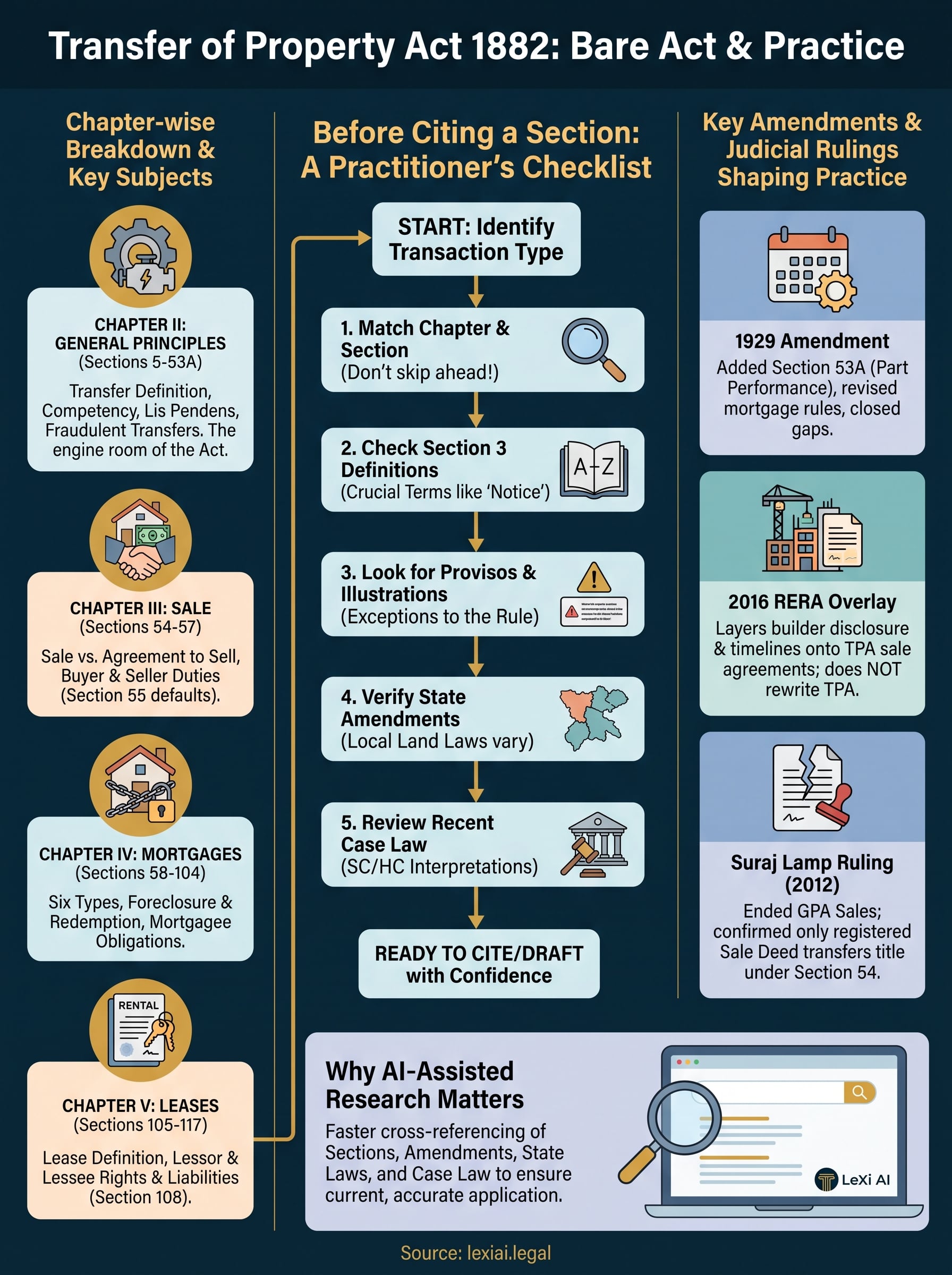
Running through a short checklist before you rely on a section in a draft or a pleading saves you from citing something that has been amended, overridden, or narrowed by a later ruling.
- Confirm the chapter and section number match your transaction type
- Read the full definitions in Section 3 for any term used in that section
- Check for a state amendment applicable to your jurisdiction
- Look for a proviso, exception, or illustration attached to the section
- Cross-check whether a later statute (RERA, the Registration Act, or a state stamp act) layers additional conditions on top
- Search for Supreme Court or relevant High Court rulings from the last five years narrowing or expanding the section
Where AI-assisted research fits into this workflow
Running that checklist manually across 137 sections takes hours, and most practitioners shortcut it by relying on memory, which is exactly how outdated readings creep into drafts. Tools like LeXi Agent are built to run this kind of cross-check quickly, pulling the current section text, flagging state amendments, and surfacing recent judgments on the same provision in one search. That does not replace reading the bare act yourself, but it does cut down the time spent verifying that the section you are about to cite still means what you think it means.
Chapter-wise breakdown of the Transfer of Property Act
Eight chapters carry the full 137 sections of the Transfer of Property Act, 1882, and each one deals with a distinct category of transaction. Knowing which chapter you are in before you start reading sections saves you from the confusion that trips up most first-time readers of the bare act. The table below maps every chapter to its section range and subject matter, so you can jump straight to the part that matters for your file.
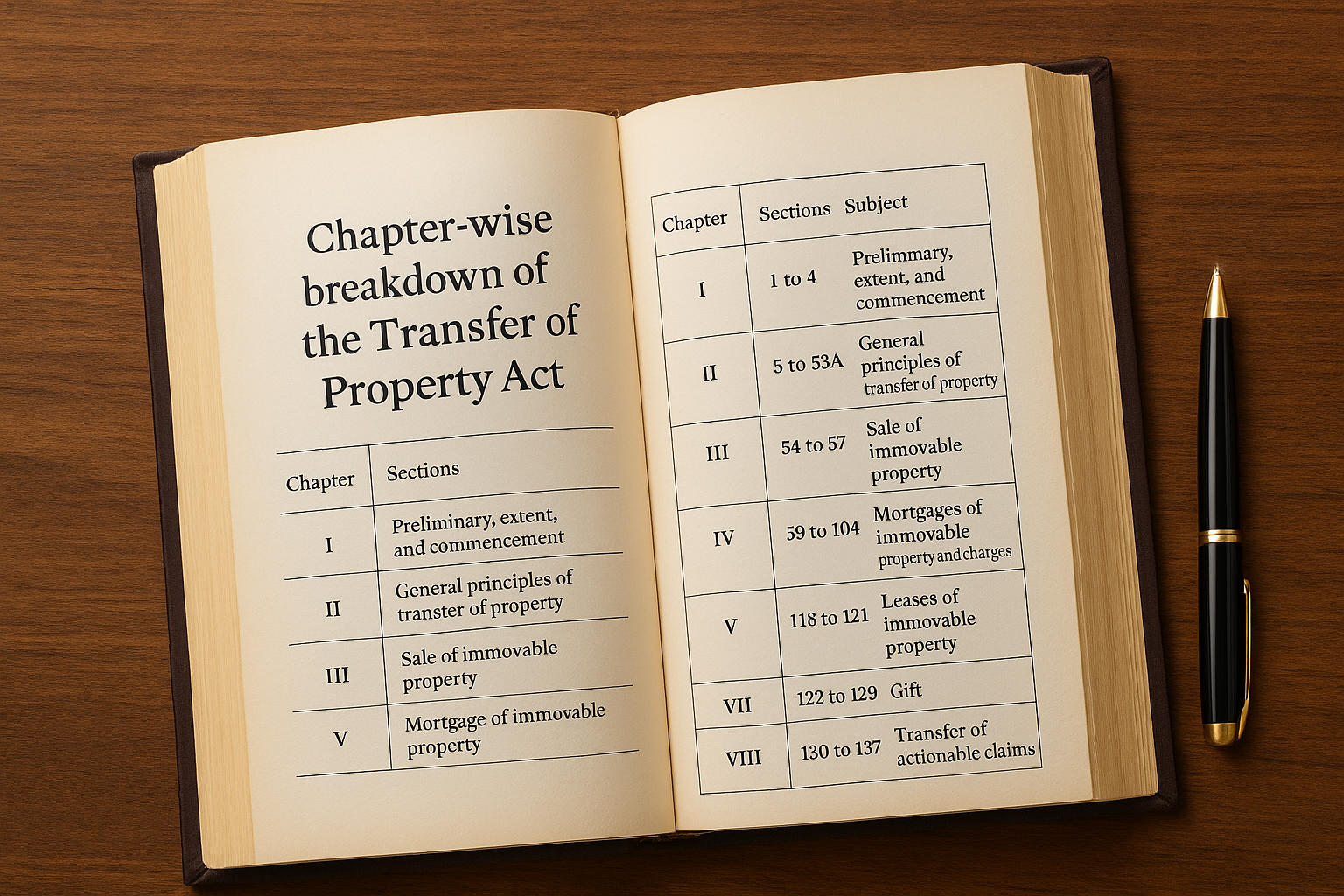
| Chapter | Sections | Subject |
|---|---|---|
| I | 1 to 4 | Preliminary, extent, and commencement |
| II | 5 to 53A | General principles of transfer of property |
| III | 54 to 57 | Sale of immovable property |
| IV | 58 to 104 | Mortgages of immovable property and charges |
| V | 105 to 117 | Leases of immovable property |
| VI | 118 to 121 | Exchange |
| VII | 122 to 129 | Gift |
| VIII | 130 to 137 | Transfer of actionable claims |
Chapter II carries the general rules that apply everywhere
Most of the heavy lifting in this Act happens in Chapter II, which stretches from Section 5's definition of transfer of property through Section 53A on part performance. This is where you find the rules on what property can be transferred (Section 6), who is competent to transfer (Section 7), the doctrine of lis pendens (Section 52), and fraudulent transfers (Section 53). Every other chapter builds on top of these general rules rather than repeating them, so a mortgage or lease dispute that seems to hinge on Chapter IV or V often actually turns on a Chapter II provision that neither side flagged early.
Chapter II is the engine room of the Act, and the specific transaction chapters only make sense once you know how it works.
Chapters III through VIII handle specific transactions
Once the general principles are set, the Act moves into transaction-specific chapters, and this is where the bulk of daily drafting work happens. Chapter III on sale runs just four sections but includes Section 55, the default obligations clause that fills gaps in nearly every sale agreement. Chapter IV on mortgages is the longest chapter in the entire statute, spanning roughly fifty sections because Indian mortgage practice recognizes six distinct types, from simple mortgage to English mortgage, each with its own foreclosure and redemption rules. Chapter V on leases and Chapter VI on exchange are shorter but still get cited constantly in tenancy disputes and barter-style transactions involving land.
Chapter VIII stands apart from the rest
Last comes Chapter VIII, dealing with actionable claims, and it behaves differently from everything before it. Rather than governing transfers of land or buildings, this chapter covers the assignment of debts and other claims that a court can enforce, such as an unsecured loan receivable or an insurance claim. Practitioners handling debt assignment or claim transfer matters, rather than straightforward property sales, will spend their time in Sections 130 through 137 almost exclusively, since these provisions rarely overlap with the land-transfer chapters that dominate the rest of the Act.
Key sections every property lawyer should know
Ask any property litigator which sections they know without checking the bare act, and you get roughly the same list every time. These are the provisions that show up in contract drafting, title opinions, and courtroom arguments far more often than the other 120-odd sections combined. Knowing them cold, including their exact wording rather than a paraphrase, saves you from getting caught out when opposing counsel quotes the section back at you differently than you remembered it.

The sections that come up in almost every file
Below is the shortlist that a working property lawyer in India actually reaches for on a normal week, not the full 137 sections in sequence.
| Section | Subject | Why it matters |
|---|---|---|
| 5 | Definition of transfer of property | Sets the baseline for whether an act counts as a transfer at all |
| 6 | What may be transferred | Lists exceptions like spes successionis and easements that cannot be sold separately |
| 52 | Lis pendens | Freezes transfers of property already under litigation |
| 53A | Part performance | Protects a possession-holder under an unregistered contract |
| 54 | Sale of immovable property | Defines sale and separates it from a mere agreement to sell |
| 55 | Rights and duties of buyer and seller | Fills gaps when the deed itself stays silent |
| 58 | Mortgage definitions | Distinguishes the six recognized types of mortgage |
| 105 | Lease defined | Anchors every tenancy dispute back to this single definition |
| 122 | Gift defined | Requires transfer without consideration, made voluntarily |
Section 6 draws the line on what cannot be sold
Beyond the definition in Section 5, Section 6 tells you what falls outside the scope of a valid transfer altogether. A chance of succeeding to property, an easement detached from the land it serves, or a right to future maintenance cannot be transferred on its own, no matter how carefully the deed is drafted. Clients frequently want to assign a mere expectancy, such as an anticipated inheritance, and Section 6 is the provision that shuts that down before the deed even gets drafted.
Section 54 separates a sale from a promise to sell
Confusion between a completed sale and an agreement to sell causes more failed pleadings than almost any other issue in this Act. Section 54 makes the distinction explicit: a sale transfers ownership immediately on registration for immovable property worth more than one hundred rupees, while an agreement to sell creates only a contractual right to obtain a sale later.
An unregistered agreement to sell never transfers ownership, no matter how long the buyer has held possession.
This is exactly where Section 53A steps in to soften the harshness of that rule, protecting a buyer in possession under part performance even without a completed, registered sale.
Section 105 anchors every lease and tenancy dispute
Tenancy litigation almost always opens with Section 105, since it defines a lease as a transfer of a right to enjoy property for a term, in exchange for rent or a premium. Distinguishing a lease from a leave and license arrangement, which grants no interest in the property itself, hinges entirely on how closely the arrangement matches this definition. Rent control statutes and state tenancy laws build on top of Section 105 rather than replacing it, so getting this definition right at the drafting stage avoids reclassification disputes years into a tenancy.
Rights and liabilities of transferor and transferee
Every transaction under the transfer of property act 1882 bare act creates a set of default obligations for both sides, and these defaults kick in the moment a deed goes silent on a point. Sellers, buyers, mortgagors, mortgagees, lessors, and lessees each get a specific bundle of rights and duties spelled out in the statute, and knowing which section governs which relationship keeps you from drafting a clause that duplicates, or worse, contradicts what the Act already assigns automatically.

Section 55 fills the gaps in every sale deed
Section 55 is the workhorse provision here, splitting obligations between seller and buyer before and after the sale completes. A seller has to disclose material defects in the property or the title, produce documents of title for examination, and pay outstanding charges up to the date of sale, while a buyer has to disclose facts increasing the property's value, pay the purchase money, and bear the risk of loss once ownership passes. Deeds that skip these terms do not escape them; Section 55 simply steps in as the default.
If your sale deed does not address who pays outstanding dues, Section 55 already answered that question for you.
| Party | Key duty under Section 55 |
|---|---|
| Seller | Disclose material defects and title issues |
| Seller | Deliver possession and title documents |
| Buyer | Disclose facts that raise the property's value |
| Buyer | Pay purchase money and bear risk after sale |
Mortgagor and mortgagee obligations run both ways
Mortgage transactions carry their own parallel scheme under Sections 65A, 66, 67, and 76, and these sections matter as much to a lender's counsel as to a borrower's. A mortgagor cannot lease the mortgaged property beyond ordinary terms without the mortgagee's consent under Section 65A, and a mortgagee taking possession under Section 76 has to manage the property with reasonable care, keep accounts, and insure it where the mortgage deed requires insurance. Ignoring these duties is what turns a straightforward default suit into a counterclaim for mismanagement, since courts routinely offset a mortgagee's recovery against losses caused by the mortgagee's own neglect while in possession.
Lessor and lessee duties under Section 108
Section 108 does for leases what Section 55 does for sales, and tenancy litigation almost always circles back to this list when a landlord-tenant relationship breaks down. The section splits duties cleanly between the two sides:
- A lessor has to disclose any material defect in the property that the lessee is not aware of
- A lessor has to give possession of the property on the lessee's request
- A lessee has to pay rent or the premium at the agreed time
- A lessee has to keep the property in the condition it was received, ordinary wear and tear aside
- A lessee cannot use the property for a purpose other than what was agreed, or in a way that damages it
Breaching any one of these gives the other party a specific remedy elsewhere in the Act, most often forfeiture under Section 111 or a claim in damages, rather than leaving the aggrieved party to argue general contract principles from scratch. Knowing this list before you draft a lease deed means you only need to add clauses that vary from these defaults, not restate obligations the statute already guarantees.
How courts have interpreted key provisions over time
Statutory text stays fixed, but its meaning shifts every time the Supreme Court or a High Court rules on a fact pattern the drafters of 1882 never anticipated. Reading the bare text of the transfer of property act 1882 bare act without tracking these rulings gives you an incomplete picture of what a section actually permits today. This section covers the interpretations that changed how practitioners use the Act's most litigated provisions.

Section 54 and the end of GPA-based property sales
General Power of Attorney sales were common in Delhi and several other cities for decades, structured as a workaround to avoid stamp duty and registration on a full sale deed. In Suraj Lamp and Industries (P) Ltd. v. State of Haryana, (2012) 1 SCC 656, the Supreme Court shut this practice down, holding that a sale of immovable property can only happen through a properly drafted and registered sale deed as Section 54 requires, and that a GPA, an agreement to sell, or a will cannot substitute for one. That ruling did not change a single word of Section 54, but it eliminated an entire category of transaction that practitioners had treated as routine for years.
A GPA sale never transferred title under Section 54, and the Supreme Court confirmed that no workaround changes that.
Section 53A and the conditions courts will not relax
Part performance under Section 53A protects a buyer in possession, but courts have consistently refused to stretch its conditions beyond what the section actually demands. In Rambhau Namdeo Gajre v. Narayan Bapuji Dhotra, (2004) 8 SCC 614, the Supreme Court reaffirmed that a party invoking Section 53A must show a written contract, part performance of that contract, and continuing willingness to perform, and that courts will not infer these elements loosely just because a buyer has occupied the property for years. This line of rulings matters for drafting practice because it warns against relying on possession alone as a fallback defense when a sale never gets properly registered.
Section 52 and how lis pendens interacts with bona fide buyers
Lis pendens under Section 52 freezes dealings in property once litigation over it is pending, but the doctrine does not automatically wipe out every transaction completed during that window. In T.G. Ashok Kumar v. Govindammal, (2010) 5 SCC 457, the Supreme Court clarified that a transfer made during pending litigation remains subject to the outcome of that suit, rather than being void outright, and that a transferee's rights survive to the extent the transferor's own rights survive the litigation. Practitioners citing Section 52 against a subsequent purchaser now need to frame the argument around subordination to the suit's outcome, not automatic invalidity, since courts read the section that narrowly.
Why tracking these rulings changes how you cite a section
Quoting Section 53A or Section 52 in isolation, without the qualifications these judgments attached, risks an argument that a judge dismisses on sight. Section 6's exceptions on spes successionis and transferable interests have similarly been tightened and clarified across decades of High Court rulings on family settlements and expectancy claims. Verifying that the version of a doctrine you remember still matches current Supreme Court and High Court positions is not optional groundwork, it is the difference between a citation that holds up and one that gets read back to you by opposing counsel.
How AI tools support research under this act
Finding the right section in the transfer of property act 1882 bare act is only step one. Confirming that section still means what it meant ten years ago, checking for a state amendment, and pulling the last three years of relevant judgments takes real time when done by hand. This is the part of the workflow where AI tools that search Indian judgments by section have made the biggest difference for practitioners handling property files day to day.
Why manual cross-referencing runs out of time
Going through the checklist from earlier in this article, chapter match, Section 3 definitions, state amendments, provisos, and recent rulings, for even one section can eat up an hour if you are searching separate databases for statutes and case law. Multiply that across a busy litigation or transactional practice handling multiple files a week, and manual verification stops happening consistently. Most lawyers admit they rely on memory for well-known sections like 54 or 55 and only slow down for less familiar ones, which is exactly where outdated readings slip through.
Memory is fine for the sections you use daily, but it is a liability for the ones you rarely touch.
What a research tool like LeXi Agent actually retrieves
A tool built specifically for Indian statutes handles this differently than a general search engine, because it can hold the full text, amendment history, and case law together in one query instead of three separate searches. When you ask about a specific provision, a properly built legal research assistant should return:
- The current text of the section, with any amendment noted inline
- State-specific amendments that apply to your jurisdiction
- Supreme Court and High Court judgments from the last few years that narrowed or expanded the provision
- Related sections that get cited alongside it in practice, such as Section 53A alongside Section 54
LeXi Agent is built around exactly this kind of cross-referencing for Indian law, which cuts the verification step down from an hour of manual searching to a few minutes of reading through what the tool surfaces.
Moving from research to drafting without losing the thread
Once you know which section applies and how courts read it, the next step is usually drafting a deed or a clause with precision that reflects it correctly. LeXi Desk picks up from there, flagging clause-level risks such as an indemnity provision that conflicts with Section 55's default seller obligations, and generating clause language with AI drafting tools that matches the current statutory position rather than a template drafted before a relevant amendment or ruling. Keeping research and drafting connected this way avoids the common gap where a lawyer researches the correct section but then drafts from an old template that never got updated.
Where judgment still has to come from you
No research tool replaces the judgment call on how a specific fact pattern fits a section, and that call still belongs to the lawyer arguing the case. What these tools change is how quickly you get to the point of making that call with current, verified information in front of you, rather than working from a half-remembered version of a section you have not checked since law school. Treat the output as a faster starting point for your own analysis, not as the final word on how a provision applies to your file.
Keeping the bare act ready for daily use
The transfer of property act 1882 bare act rewards close reading, not memorization. Section numbers matter less than knowing which chapter governs your transaction, which proviso qualifies the general rule, and which recent judgment has narrowed a doctrine you learned years ago. Getting a section right on paper still means nothing if a state amendment or a Supreme Court ruling has quietly changed how it applies.
Going forward, treat the checklist in this article as a habit rather than a one-time read. Chapter match, Section 3 definitions, state amendments, provisos, and current case law take minutes to verify once you build the routine, and skipping that routine is how outdated readings end up in a pleading or a deed.
If you want that verification done faster without losing the reasoning to you, run your next section lookup through LeXi AI at no cost and see how it handles a property file.