

8 Best AI Legal Drafting Tools for Lawyers in India
Drafting a fresh set of pleadings or a commercial contract from scratch still eats up hours you do not have. That is the exact gap ai legal drafting tools are built to close, cutting first-draft time from hours to minutes while keeping citations and clause language accurate for Indian courts and contracts.
If you are searching for legal drafting software that actually understands Indian statutes, case law, and legal drafting techniques, not just generic AI text generation, you need tools trained specifically on legal reasoning and Indian commercial law. The right platform should handle everything from a plaint under the CPC to a indemnity clause in a vendor agreement, flag risky language, and cite verified judgments rather than fabricated ones.
This list covers eight tools worth evaluating in 2026, from full platforms like LeXi AI that combine litigation drafting, contract review, and legal research in one place, to narrower point solutions. Each entry notes what it does well, where it fits into your practice, and what to check before you rely on it for client work.
1. LeXi AI
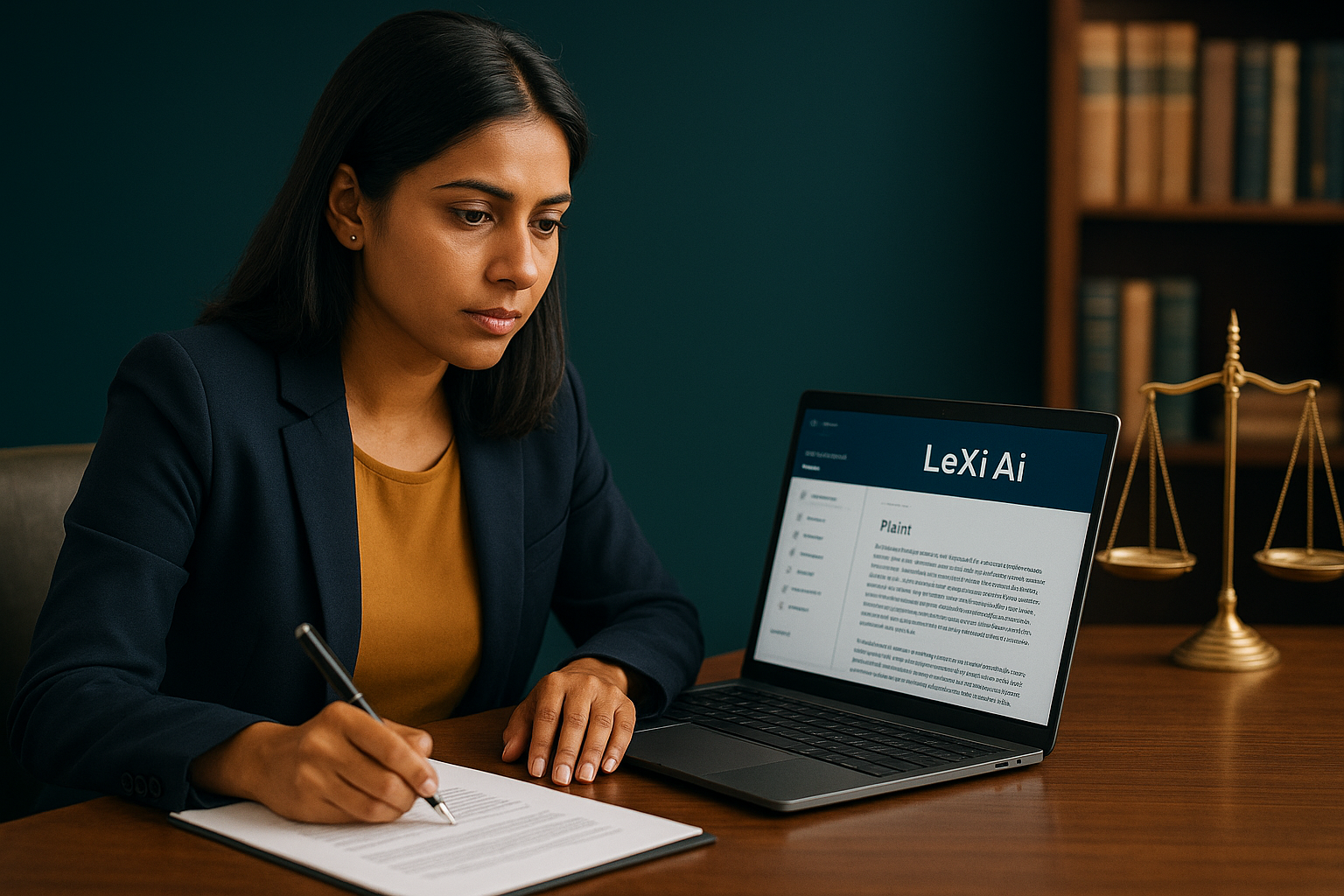
LeXi AI sits at the top of this list because it is built specifically for Indian legal practice, not adapted from a generic AI model. The platform combines litigation drafting, contract lifecycle management, and legal research into one connected system, so you are not switching between four different logins to prepare a single case. For lawyers who want ai legal drafting that understands the CPC, the Indian Contract Act, and state amendments without constant manual correction, it is the closest thing to a purpose-built solution currently available in India.
How it works
You start by describing the document you need, a plaint, a written statement, a vendor agreement, or a case strategy note, and LeXi LiTT generates a working draft using verified statutory language and case citations. LeXi Desk handles the contract side, running clause-level risk analysis and flagging problems like uncapped indemnity language before you send a document out. Behind both tools, LeXi Agent pulls precedent and statutory support from judgment databases, so citations are checked rather than guessed.
A drafting tool is only as good as its citations, and LeXi AI checks them against verified judgment databases instead of generating them from memory.
Key features
- LeXi LiTT for AI-assisted pleadings, case strategy, and courtroom preparation
- LeXi Desk for full contract drafting, clause risk flagging, and document translation
- LeXi Agent for legal research and precedent analysis with verified sources
- LeXi Academy for law students learning drafting and research through guided practice
- Case file summarization that condenses a 400-page file into a working brief
- Enterprise APIs for firms building custom internal drafting workflows
- Benchmarked at 98.95% accuracy on the AIBE 20 legal reasoning dataset, ahead of GPT 5.5 and Gemini 3.1 Pro on Indian commercial law tasks, a useful reference point for how reliable legal AI really is
Best for
Independent lawyers, litigation chambers, and corporate legal teams who want one platform for drafting, research, and contract review instead of stitching together separate subscriptions. It also suits law firms handling high volumes of commercial disputes, where legal drafting software needs to keep pace with tight filing deadlines, and law students who want AI-guided practice before they start drafting for real clients.
Pricing
LeXi AI offers tiered plans for individual lawyers, chambers, and enterprise legal teams, with custom API pricing for firms building their own tools on top of the platform. Visit the LeXi AI plans and pricing page for current plan details and a free trial option before committing.
2. Draft Bot Pro
Draft Bot Pro markets itself as legal drafting software online, aimed at small firms and solo practitioners who need quick document turnaround without a steep learning curve. It leans on template libraries and prompt-based generation rather than deep legal reasoning, so it works best for routine paperwork rather than complex litigation drafts.
How it works
Users pick a document type, notice, agreement, or affidavit, from a template library, then answer a short questionnaire that fills in party names, dates, and clause variables. The tool assembles a draft from pre-built clause blocks and lets you edit the output in a browser-based editor. There is no independent verification of citations, so anything referencing case law needs a manual check before filing.
Template-based tools speed up routine paperwork, but they cannot verify a citation the way research-backed ai legal drafting software can.
Key features
- Template library covering common contracts, notices, and affidavits
- Questionnaire-driven drafting for non-litigation documents
- Basic clause substitution and formatting tools
- Export to Word and PDF formats
- Multi-user access for small teams
Best for
Solo practitioners and small firms drafting high-volume, low-complexity documents such as rent agreements, standard notices, or NDAs, where speed matters more than nuanced legal reasoning. It suits lawyers who already know the clause language they want and just need faster assembly, not a research or strategy partner.
Pricing
Draft Bot Pro offers a limited free tier for basic templates, positioning it as free legal drafting software for very simple use cases, with paid monthly plans unlocking the full template library and multi-user access.
3. Lexlegis.ai (MIRA)
Lexlegis.ai runs on MIRA, a legal research assistant built around Indian case law databases, with drafting support layered on top of that research core. It positions itself less as a pure drafting tool and more as a research-first platform where drafting is one output among several, useful if your bottleneck is finding precedent rather than assembling clause language.
How it works
You query MIRA in plain language, asking for judgments on a specific point of law, and it returns ranked case summaries with citations pulled from its indexed databases. From there, you can generate a draft argument or clause referencing those cases, though the drafting step feels secondary to the research engine. Lawyers report needing to restructure the generated draft more than they would with a tool built drafting-first.
Research-first tools help you find the right precedent, but you still need to reshape that research into a filing-ready draft yourself.
Key features
- MIRA research engine indexing Indian case law and statutes
- Citation-linked case summaries ranked by relevance
- Basic draft generation from research results
- Keyword and concept-based search across judgments
- Export options for research notes and draft excerpts
Best for
Lawyers and researchers whose primary need is fast case law discovery, particularly for litigation matters where finding the right precedent matters more than generating a polished first draft, may also want to compare AI legal research tools for Indian lawyers. It suits best legal drafting software in india searches from users who actually want a research tool with drafting as a secondary feature, rather than a dedicated drafting platform.
Pricing
Lexlegis.ai offers subscription tiers based on query volume and user seats, with enterprise pricing available for firms needing bulk access across multiple lawyers.
4. LawChatGPT
LawChatGPT is a chatbot-style layer built on top of a general-purpose language model, tuned with legal prompts and fine-tuned on publicly available Indian legal text. It answers legal questions and drafts short documents through a conversational interface, which makes it approachable for lawyers who want a fast starting point rather than a full drafting suite. Because it inherits the limitations of its base model, it needs careful review before you rely on any citation it produces, which is the core of the ChatGPT versus purpose-built legal AI question.
How it works
You type a request in plain language, draft a legal notice for breach of contract, and the chatbot generates a response in the same window you would use for any general query. It does not run a dedicated legal reasoning layer or verify citations against a judgment database, so case references sometimes look plausible but do not exist. Lawyers using it for ai legal drafting software tasks generally treat the output as a rough skeleton, not a filing-ready draft.
A chatbot trained on general text can sound confident about a case citation that never existed, so verify every reference before you file.
Key features
- Conversational interface for quick legal queries and short drafts
- Basic clause suggestions for common contract types
- Multi-turn conversation to refine a draft interactively
- No dedicated Indian case law verification layer
Best for
Lawyers who want a quick sounding board for early-stage drafting ideas or plain-language explanations of a legal concept, not a substitute for verified research or filing-ready output.
Pricing
LawChatGPT offers a free tier with limited daily queries and a paid subscription for higher volume and faster response times.
5. LawCentral.ai
LawCentral.ai positions itself as a case management and drafting hybrid, built for litigation teams that want document assembly tied directly to a matter timeline. It leans heavily on workflow automation rather than deep legal reasoning, so drafts come out structured and consistent but need a lawyer's eye for the substantive argument. If your firm already runs on a case management system, this tool fits in as an add-on rather than a replacement.

How it works
Every draft in LawCentral.ai starts from a matter file, so the tool pulls party details, filing dates, and prior documents automatically instead of asking you to re-enter them. You select a document type, a rejoinder, an interim application, a settlement draft, and the system populates a template using data already stored against that case. Legal drafting software online built this way saves re-entry time but still relies on your input for the legal argument itself.
Workflow automation saves you re-typing case details, but it will not build your legal argument for you.
Key features
- Matter-linked drafting that pulls case data automatically
- Deadline and hearing calendar integrated with document templates
- Version control across multiple drafts of the same filing
- Team collaboration tools for shared matters
- Basic clause library for common litigation documents
Best for
Litigation teams managing a high caseload who want drafting tied to matter tracking, particularly firms already using a case management workflow and looking for software for legal drafting that plugs into it rather than sitting apart from it.
Pricing
LawCentral.ai charges per seat, with tiered plans based on the number of active matters and users, and custom quotes for larger litigation teams.
6. Lawttorney.ai
Lawttorney.ai targets independent advocates who need a lighter-weight assistant for daily drafting rather than a full litigation suite. It focuses on quick turnaround for legal notices and their required format, applications, and contract clauses, pitched as accessible legal drafting software online for practitioners who do not need enterprise features. Pricing and simplicity are its main selling points, not depth of legal reasoning.
How it works
Entering a short brief, such as party names and the type of relief sought, triggers a draft in the tool's chat-style interface within seconds. Generated text pulls from a library of clause patterns rather than a live judgment database, so the tool works fastest on standard documents with predictable structure. Editing happens inline, and you can regenerate a section if the first pass misses your intent.
Speed only matters if the draft still needs a full legal review, so treat quick-turnaround tools as a starting point, not a final filing.
Key features
- Chat-based drafting interface for notices and short applications
- Clause pattern library for standard contract types
- Inline regeneration for individual sections of a draft
- Basic formatting export to Word and PDF
Best for
Solo practitioners and small chambers who draft routine documents daily and want a fast, low-cost option rather than a research-heavy platform. It suits lawyers comparing best legal drafting software options on a tight budget, not firms handling complex commercial litigation.
Pricing
Lawttorney.ai runs on a monthly subscription with a capped number of drafts per tier, and no dedicated enterprise plan at this time.
7. SpotDraft
SpotDraft is a platform for managing contracts across their full lifecycle that has expanded into AI-assisted drafting for corporate legal teams, with a stronger presence in commercial contracts than in litigation work. Originally built for CLM workflows like approvals and e-signature, it now offers ai legal drafting features for generating and reviewing contracts from templates, making it a natural fit for in-house teams rather than litigation chambers. Its Indian statutory coverage is thinner than platforms built ground-up for Indian law, so litigation drafting sits outside its core strength.
How it works
Contracts move through SpotDraft as structured workflows, starting with a template, moving through AI-suggested clause edits, then routing to approvers before signature. The AI layer flags non-standard clauses against your playbook and suggests redlines, which speeds up review cycles on repetitive agreements like NDAs and vendor contracts. Drafting from scratch is possible but the tool shines more at review and negotiation than first-draft generation.
A CLM-first tool speeds up contract review and approval, but it was not built to draft a plaint or a written statement.
Key features
- AI-assisted clause review against a custom playbook
- Template library for common commercial contracts
- Approval workflow and e-signature integration
- Contract repository with searchable metadata
- Redline suggestions during negotiation
Best for
Corporate legal and business teams managing high contract volumes who need software for legal drafting tied to an approval workflow, rather than litigation-focused chambers.
Pricing
SpotDraft prices on a per-user, per-year basis with custom enterprise quotes for larger contract volumes, and no published free tier, which is typical of what CLM software costs in 2026.
8. Harvey AI
Harvey AI is the global legal AI platform built with OpenAI's models and adopted by large international firms for research, drafting, and due diligence work. It has strong coverage of US and UK law, which makes it useful for Indian firms handling cross-border transactions or foreign-law-governed contracts, but its Indian statutory and case law training is limited compared to platforms built specifically for Indian practice. Treat it as a supplement for international matters rather than your primary drafting tool for Indian filings.
How it works
Entering a prompt or uploading a document lets Harvey generate drafts, summaries, or answers pulled from its training data and any documents you feed into the workspace. It supports workflows like contract analysis, due diligence memos, and research summaries, with outputs formatted for a firm environment rather than a casual chat window. Integration with document management systems lets larger firms plug Harvey into existing review pipelines.
A tool built on global legal data can draft a strong US or UK contract but still needs Indian-specific verification before you rely on it here.
Key features
- Contract analysis and due diligence drafting support
- Research summaries across common law jurisdictions
- Document management system integrations for large firms
- Workflow templates for M&A and transactional work
Best for
Large firms and enterprises handling cross-border transactions or software for legal drafting work governed by US or UK law, where global precedent matters more than Indian statutory depth.
Pricing
Harvey AI operates on enterprise contracts negotiated per firm, with no published self-serve or individual pricing tier.
Picking the right drafting tool for your practice
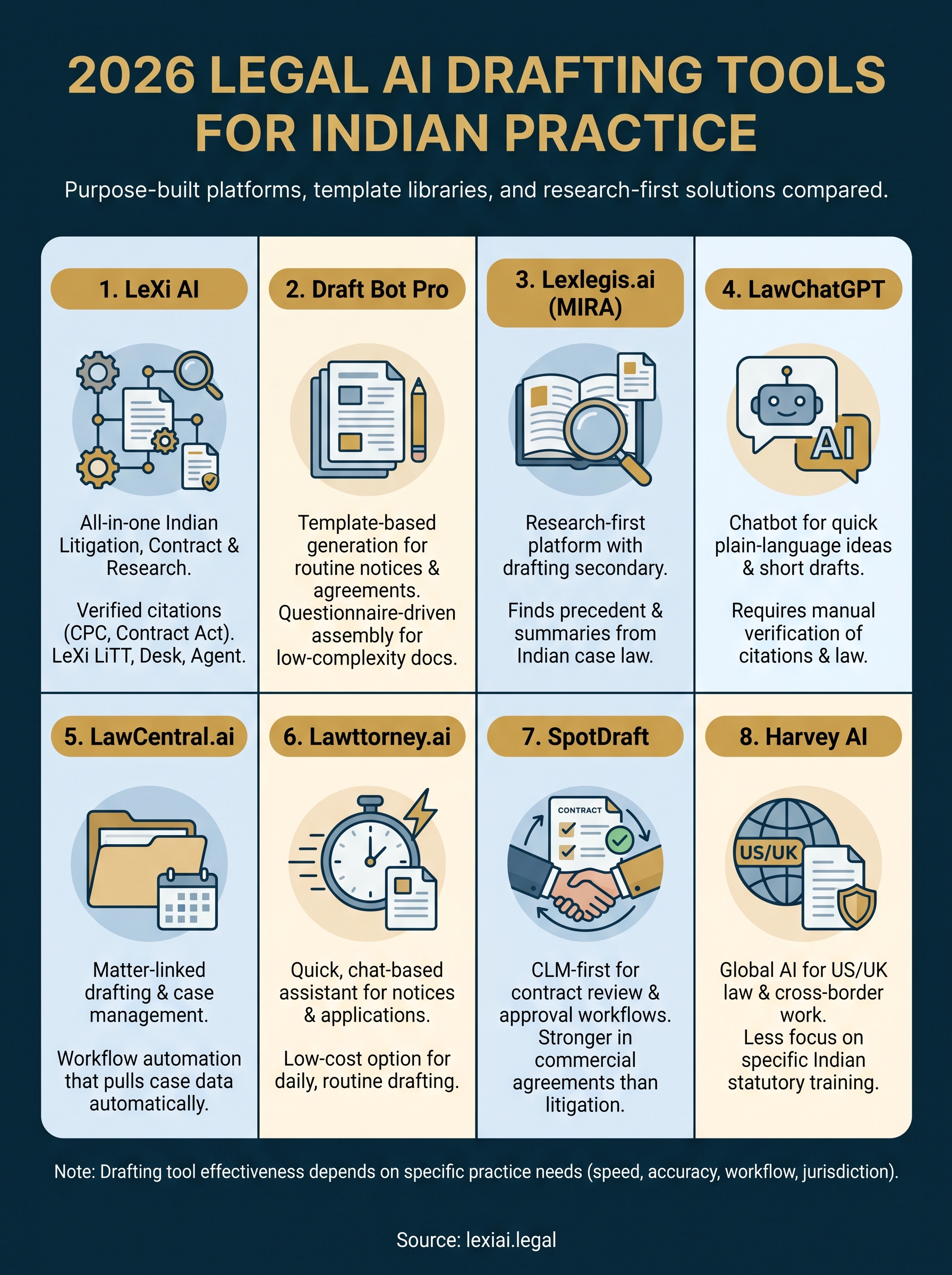
Most of the tools on this list solve one narrow problem well, templates for routine paperwork, research for precedent, workflow automation for case management. Choosing between them comes down to what actually slows down your practice: is it drafting speed, citation accuracy, or juggling separate logins for research and contracts, a question a wider side-by-side comparison of legal AI software helps settle.
For Indian lawyers who need ai legal drafting that understands the CPC, the Contract Act, and state amendments without constant correction, a purpose-built platform beats a general chatbot every time. LeXi AI covers litigation drafting, contract review, and research in one system, so you are not stitching together three subscriptions to prepare a single filing, and its verified citation checking means you spend less time chasing down case references that turned out to be fabricated.
If faster, more reliable drafts matter to your practice this year, try LeXi AI free and see how it handles your next brief before you commit to a paid plan.