

Leave and License Agreement Format: Sample and How to Draft One
A leave and license agreement format in India follows a fairly fixed structure: licensor and licensee details, property description, license period, compensation and deposit clauses, and termination conditions. If you are renting out a flat in Mumbai or Pune, this is almost always the document you need instead of a standard lease, mainly because of how Section 24 of the Maharashtra Rent Control Act, 1999 treats leave and license arrangements differently from tenancies.
Most people searching for this format want two things: a clear sample they can actually follow, and an explanation of why each clause exists. This article gives you both. You will see what a properly drafted agreement looks like, clause by clause, and why leaving out something like a revocation clause or notarization requirement can cause problems later.
We will walk through a full sample format, explain registration requirements under the Registration Act, 1908, and cover common mistakes that make these agreements unenforceable. For lawyers and property owners drafting these regularly, tools like LeXi AI can help generate a first draft and flag missing clauses, though understanding the structure yourself still matters.
Why the format of your leave and license agreement matters
Getting the format wrong does not just look unprofessional, it can change the legal character of the entire arrangement. Courts in Maharashtra and elsewhere look at the actual wording of the document, not just its title, to decide whether an arrangement is a leave and license or a disguised tenancy. If your agreement reads like a lease, with clauses granting exclusive possession or transferring an interest in the property, a court can treat it as one under the Transfer of Property Act, 1882, regardless of what you called it on the first page.
It decides whether the licensee gets tenancy rights
Section 24 of the Maharashtra Rent Control Act, 1999 protects leave and license arrangements from being converted into protected tenancies, but only if the document is drafted correctly. A poorly worded license format that grants possession without proper revocability clauses can hand the occupant tenancy-like protections you never intended to give. This matters most in cities like Mumbai, where old rent control tenancies are notoriously hard to terminate.
A leave and license agreement only protects you if its wording actually matches the legal test for a license, not a lease.
It affects stamp duty and registration validity
Maharashtra law requires leave and license agreements to be registered under the Registration Act, 1908, and stamped according to the Maharashtra Stamp Act. Missing clauses on license period, compensation, or the specific property description can cause the sub-registrar's office to reject the document outright, or worse, cause a court to treat an unregistered agreement as inadmissible evidence later. A rental agreement format built for a lease will not carry the specific declarations a sub-registrar expects for a license.
It shapes how disputes get resolved
When disputes reach court, whether over unpaid compensation, early termination, or possession, the agreement's wording is often the only evidence a judge has. Termination clauses that specify notice periods, deposit refund timelines, and conditions for re-entry give both parties something concrete to point to. Without them, disputes drag on longer and outcomes become harder to predict.
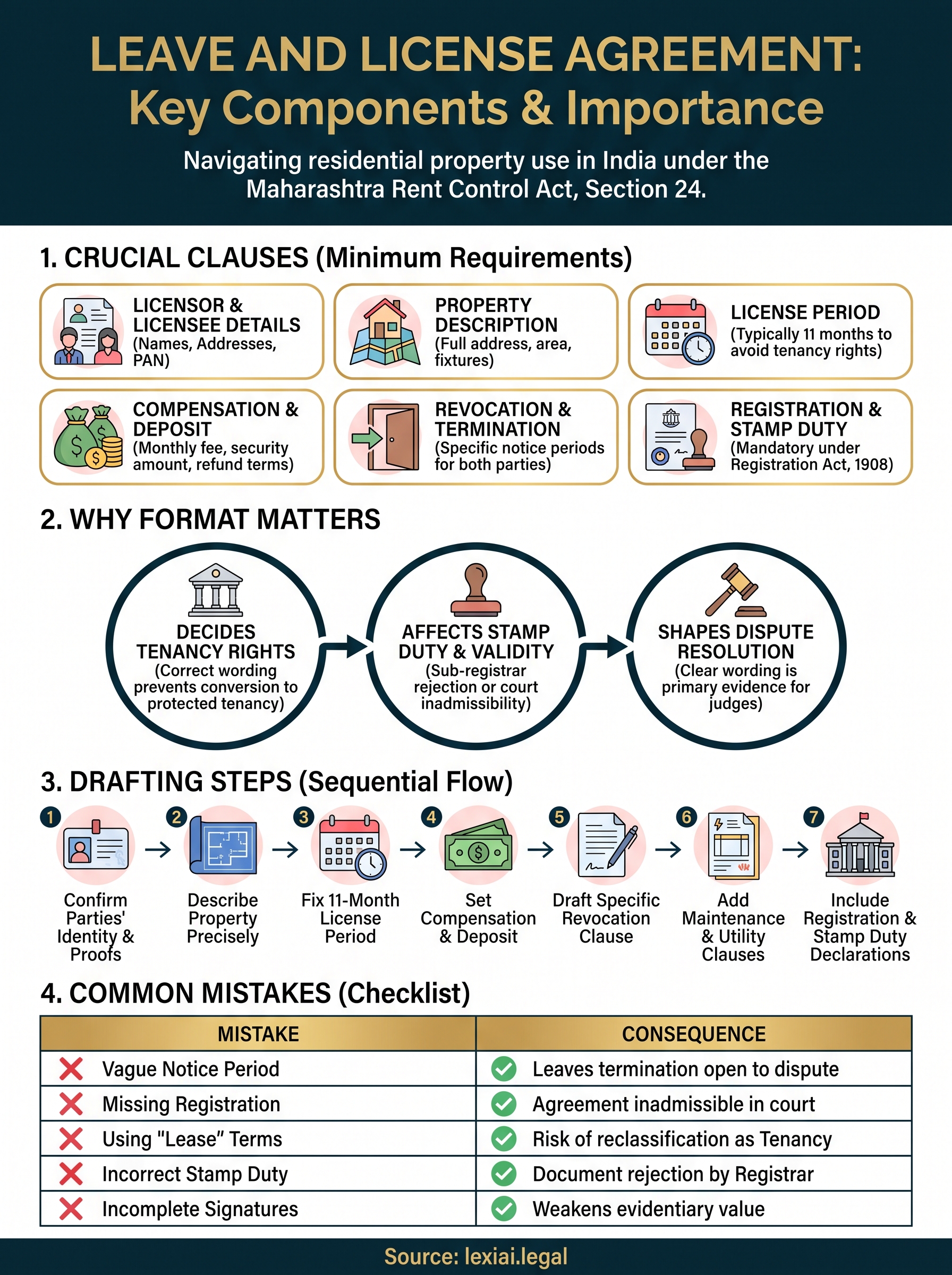
Here is what a compliant format typically needs to cover, at minimum:
- Full names and addresses of licensor and licensee
- Complete property description, including area and furnishings
- License period, usually capped at 11 months for standard residential arrangements
- Compensation, deposit amount, and refund conditions
- Revocation and termination clauses
- Registration and stamp duty details
Skipping any of these is where most homemade agreements run into trouble, which is exactly what the next section addresses.
How to draft a leave and license agreement step by step
Drafting a leave and license agreement is not just filling in a template, it is a sequence of decisions that determine whether the document holds up later, and the same core drafting skills for precise legal documents apply here as anywhere else. Start with the licensor and licensee details, then build outward to property specifics, financial terms, and exit conditions. Skipping the order does not break anything legally, but it does make it easier to miss a clause, which is how most weak agreements get created.
Here is the sequence experienced drafters follow:
- Confirm the identity and address proof of both parties, including PAN details for stamp duty purposes.
- Describe the property precisely: address, area in square feet, furnishings, and parking if applicable.
- Fix the license period, almost always 11 months for residential arrangements to avoid tenancy protections under rent control law.
- Set compensation, security deposit, payment date, and refund timeline.
- Draft the revocation clause specifying notice period for either party to terminate.
- Add maintenance, utility payment, and lock-in period clauses if relevant.
- Include registration and stamp duty declarations as required under the Registration Act, 1908.
Sequencing matters because each clause depends on the one before it. You cannot fix a sensible notice period without first knowing the license duration, and you cannot calculate stamp duty accurately without the compensation figures locked in.
Draft in order: identity, property, term, money, exit. Skipping a step is how clauses go missing.
Once the draft is complete, read it once as the licensor and once as the licensee. This single exercise catches most ambiguous wording before it becomes a dispute. If you are drafting these regularly across multiple properties, a tool like LeXi Desk can generate a compliant first draft from these inputs and flag missing clauses, much like the other tools that cut drafting and research time, though you should still review every line before signing or sending it for registration.
Sample leave and license agreement format you can follow
Below is a simplified structure you can adapt for a residential leave and license agreement. This is not a substitute for a properly stamped and registered document, but it shows you the skeleton every valid agreement follows, and how the clauses discussed above actually appear on paper.
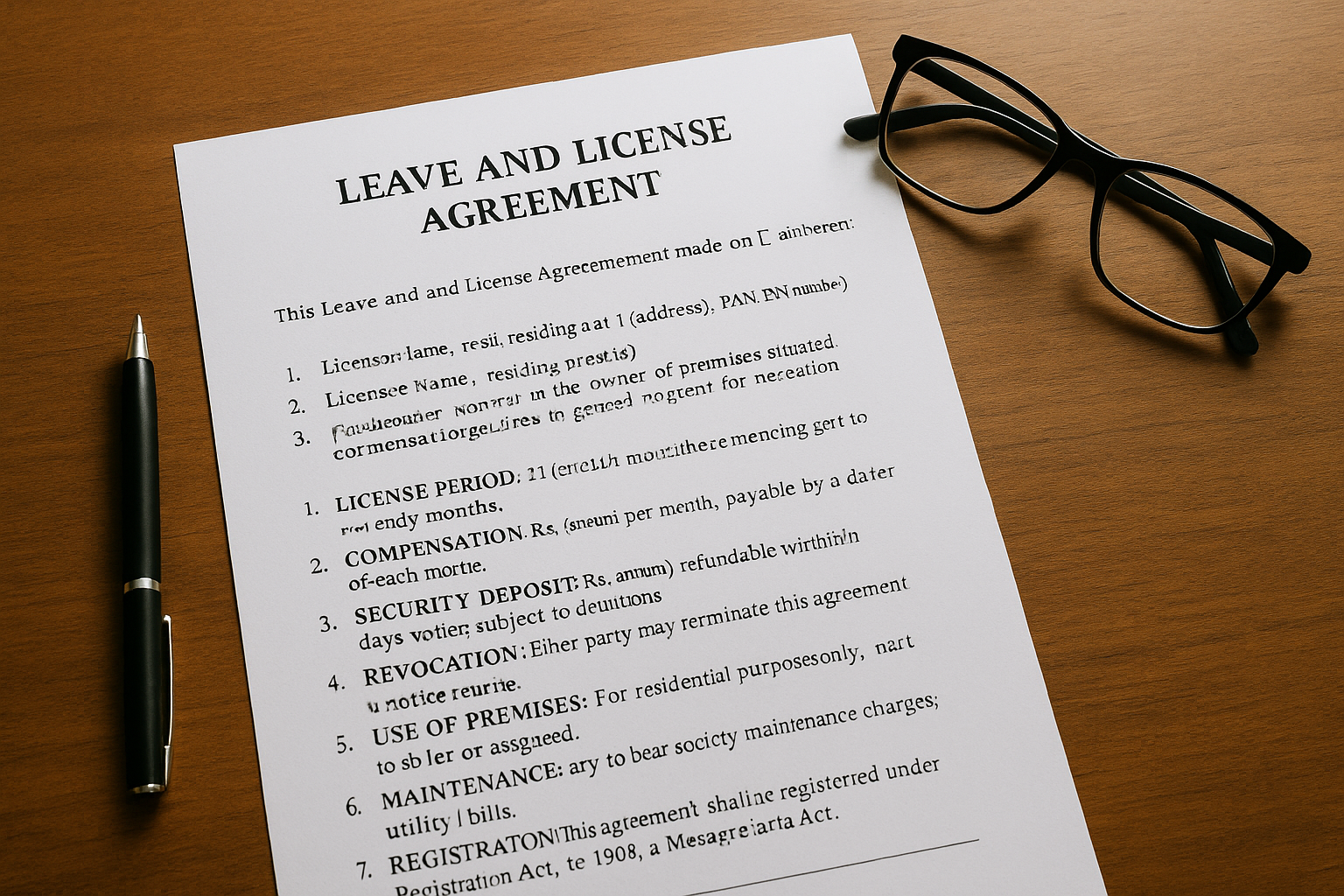
LEAVE AND LICENSE AGREEMENT

This Leave and License Agreement is made on [date] between:

1. [Licensor Name], residing at [address], PAN: [PAN number] ("Licensor")
2. [Licensee Name], residing at [address], PAN: [PAN number] ("Licensee")

WHEREAS the Licensor is the owner of the premises situated at
[full property address], admeasuring [area] sq. ft., along with
[furnishings/fixtures], and has agreed to grant leave and license
to the Licensee on the following terms:

1. LICENSE PERIOD: 11 (eleven) months commencing [start date]
   and ending [end date].
2. COMPENSATION: Rs. [amount] per month, payable by [due date]
   of each month.
3. SECURITY DEPOSIT: Rs. [amount], refundable within [days]
   of vacating, subject to deductions for damages.
4. REVOCATION: Either party may terminate this agreement by
   giving [notice period] written notice.
5. USE OF PREMISES: For residential purposes only, not to be
   sublet or assigned.
6. MAINTENANCE: [Party] to bear society maintenance charges;
   [Party] to bear utility bills.
7. REGISTRATION: This agreement shall be registered under the
   Registration Act, 1908, and stamped as per the Maharashtra
   Stamp Act.

Signed by Licensor: ____________
Signed by Licensee: ____________
Witness 1: ____________
Witness 2: ____________
Notice that every clause in this rent agreement format maps directly to something discussed earlier: the 11-month cap, the revocation notice, and the registration declaration are not optional flourishes, they are what makes the document defensible in court.
A sample is only useful if every clause in it corresponds to a real legal requirement, not just convention.
This format works for a straightforward residential arrangement. Commercial licenses, or ones involving lock-in periods and escalation clauses, need additional drafting that a template alone will not cover.
Key clauses and mistakes to check before signing
Before you sign anything, read the draft one more time against a checklist, not just for typos, but for the clauses that actually protect you. Most disputes over a leave and license agreement trace back to two or three missing or vague clauses, not fraud or bad faith. Catching these before signing costs you ten minutes; catching them after a dispute starts costs you months in court.
Clauses that need a second look
Check the revocation clause first. It should state a specific notice period for both licensor and licensee, not vague language like "reasonable notice." Next, check the deposit refund timeline and whether deductions for damages are capped or left open-ended, since open-ended deduction clauses invite disputes. Finally, confirm the license period is stated in months, not in vague terms like "short term," because ambiguity here is exactly what lets an occupant argue for tenancy rights later.
The clauses that seem minor on paper, notice period, deposit deductions, license duration, are the ones courts scrutinize most closely.
Common mistakes that make agreements weak
Here is what to verify before you or the other party signs:
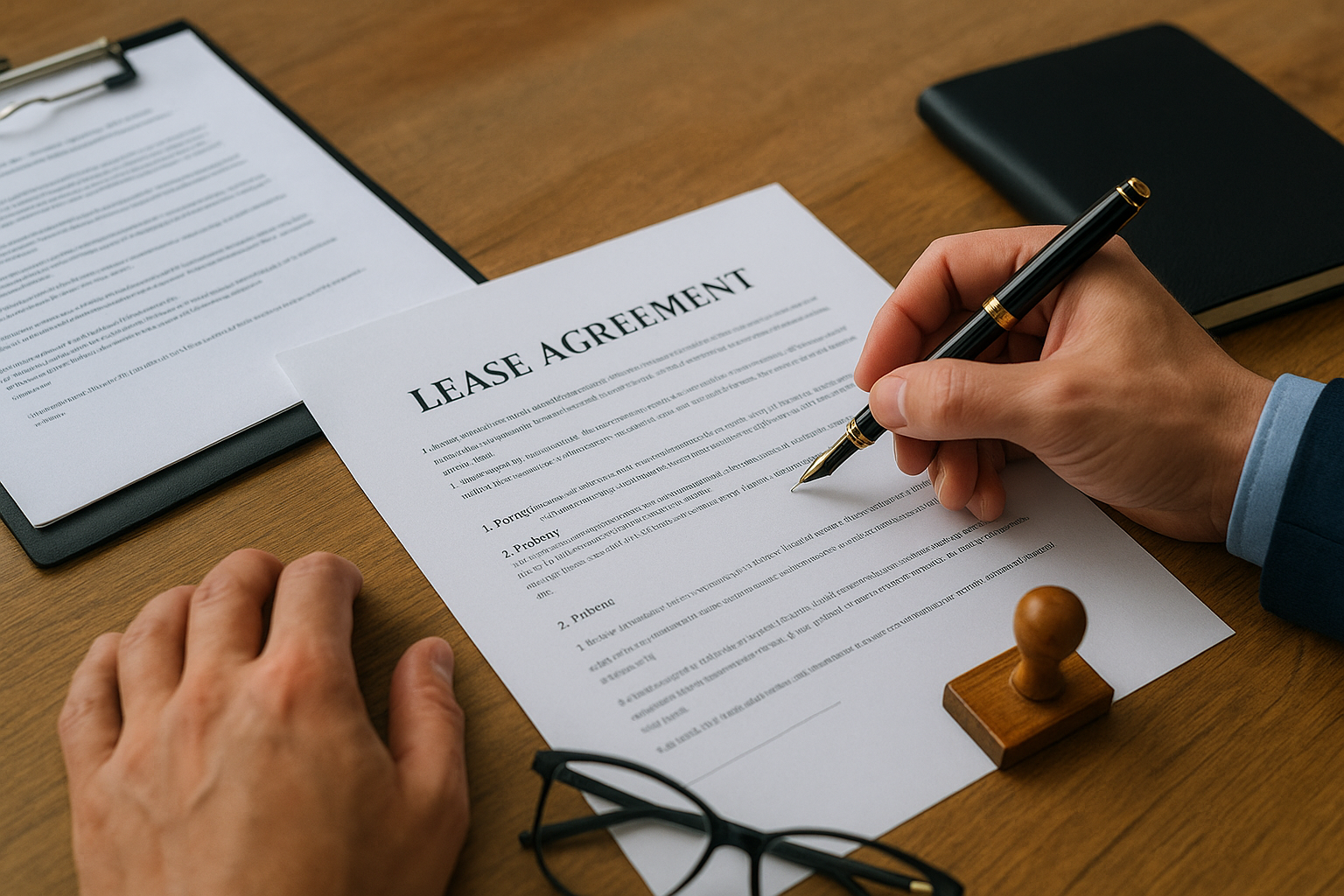
| Mistake | Why it matters |
|---|---|
| Wrong or insufficient stamp duty | Sub-registrar can reject registration outright |
| No witnesses or incomplete signatures | Weakens evidentiary value in court |
| Using lease terminology ("tenant," "rent") | Risks reclassification as a lease |
| Skipping registration entirely | Agreement becomes inadmissible as primary evidence |
| Vague notice period | Leaves termination timing open to dispute |
Always cross-check PAN details, property description, and compensation figures against supporting documents like the sale deed or society NOC. A rental agreement format that looks complete on screen can still fail registration if these details do not match official records exactly.
Before you finalize the agreement
A correct leave and license agreement format is not a formality, it is what stands between a smooth tenancy and months of litigation. Get the license period, revocation clause, and registration details right, and most disputes never reach a courtroom in the first place.
Before you sign, run through the checklist one more time: property description matched to the sale deed, compensation figures consistent throughout, notice periods spelled out in days or months, and stamp duty calculated correctly. None of this takes long if you have the structure in front of you, which is exactly what this article gave you.
If you draft these agreements often, whether for one flat or a portfolio of properties, doing it manually every time is where errors creep in. See how LeXi AI drafts property agreements: it generates a compliant first draft and flags missing clauses before you ever get to the registrar's office.