

Hindu Marriage Act 1955 Bare Act: Sections Explained
If you are searching for the hindu marriage act 1955 bare act, you want the actual sections, not a summary someone wrote in 2019 without updating. This law governs conditions for a valid marriage, grounds for divorce, restitution of conjugal rights, judicial separation, and maintenance for Hindus, Buddhists, Jains, and Sikhs across India. Section 5 lists marriage conditions, Section 13 lists divorce grounds, and Section 24 covers maintenance during proceedings, and each one matters when you are drafting a petition or advising a client.
This article walks through the full text structure of the Act, section by section, so you are not left guessing what each provision actually says. You get the practical meaning behind clauses like Section 13B (divorce by mutual consent) and Section 9 (restitution of conjugal rights), along with how courts have applied them.
Whether you are a practicing advocate, a law student preparing for exams, or an in-house counsel handling a family matter, you will find the sections explained plainly here. Tools like LeXi AI can also help you pull relevant case law or draft petitions faster once you know which section applies to your facts.
Why the Hindu Marriage Act 1955 still matters in practice
The Hindu Marriage Act, 1955 is not a relic sitting in a law library. It is the operative statute that decides whether a marriage is valid, whether a spouse can walk out, and who pays maintenance while the case drags on. Every family court in India, from Mumbai to Guwahati, still applies this Act daily, and every family law practitioner needs the exact wording of its sections, not a paraphrase from a blog written years ago.
Who does the Act actually cover?
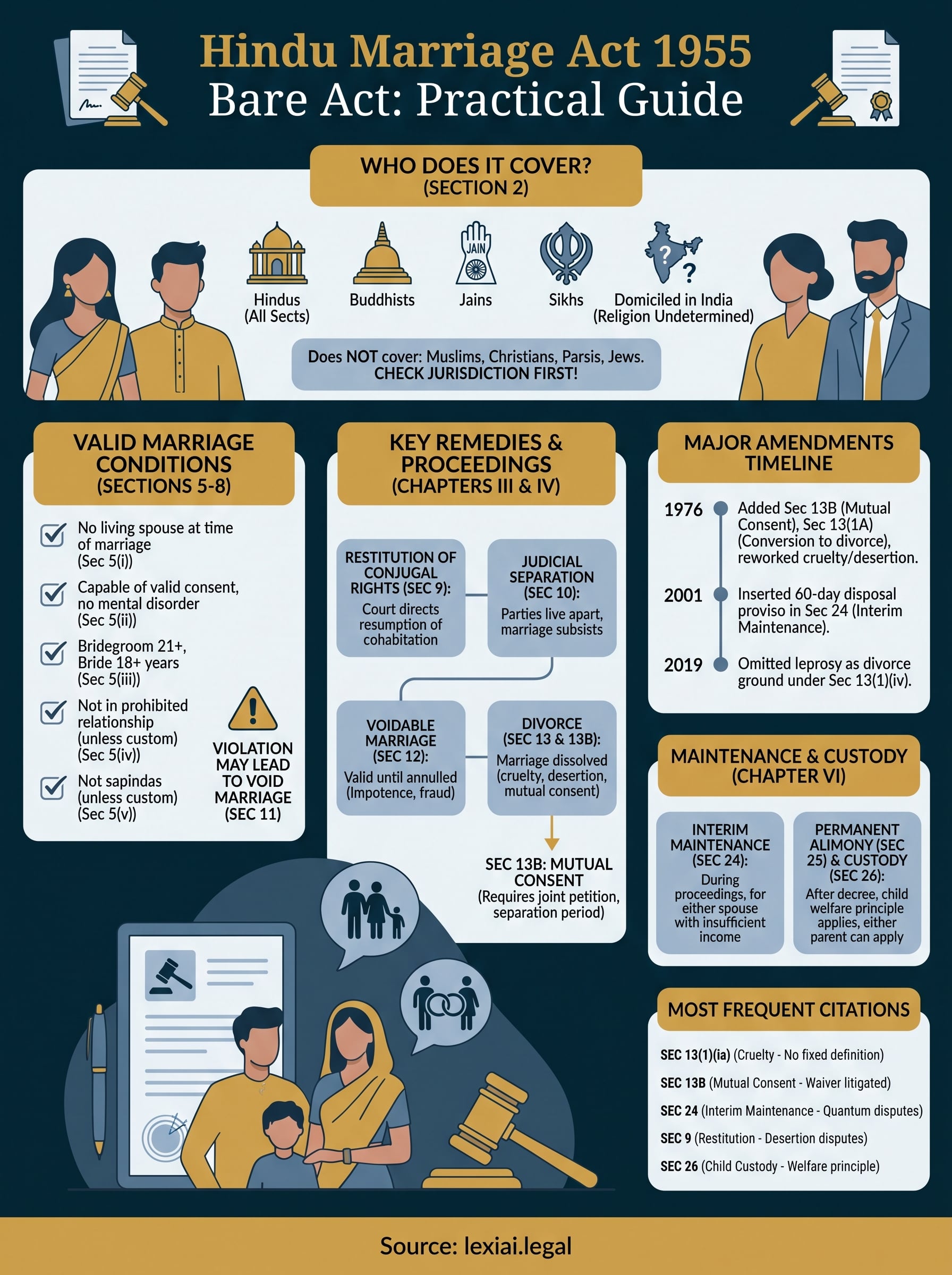
Section 2 defines the scope, and it is broader than most people assume. It applies to any person who is Hindu by religion in any form, including Virashaiva, Lingayat, or followers of the Brahmo, Prarthana, or Arya Samaj. It also applies to Buddhists, Jains, and Sikhs, and to anyone domiciled in India who is not Muslim, Christian, Parsi, or Jewish, unless proven otherwise.
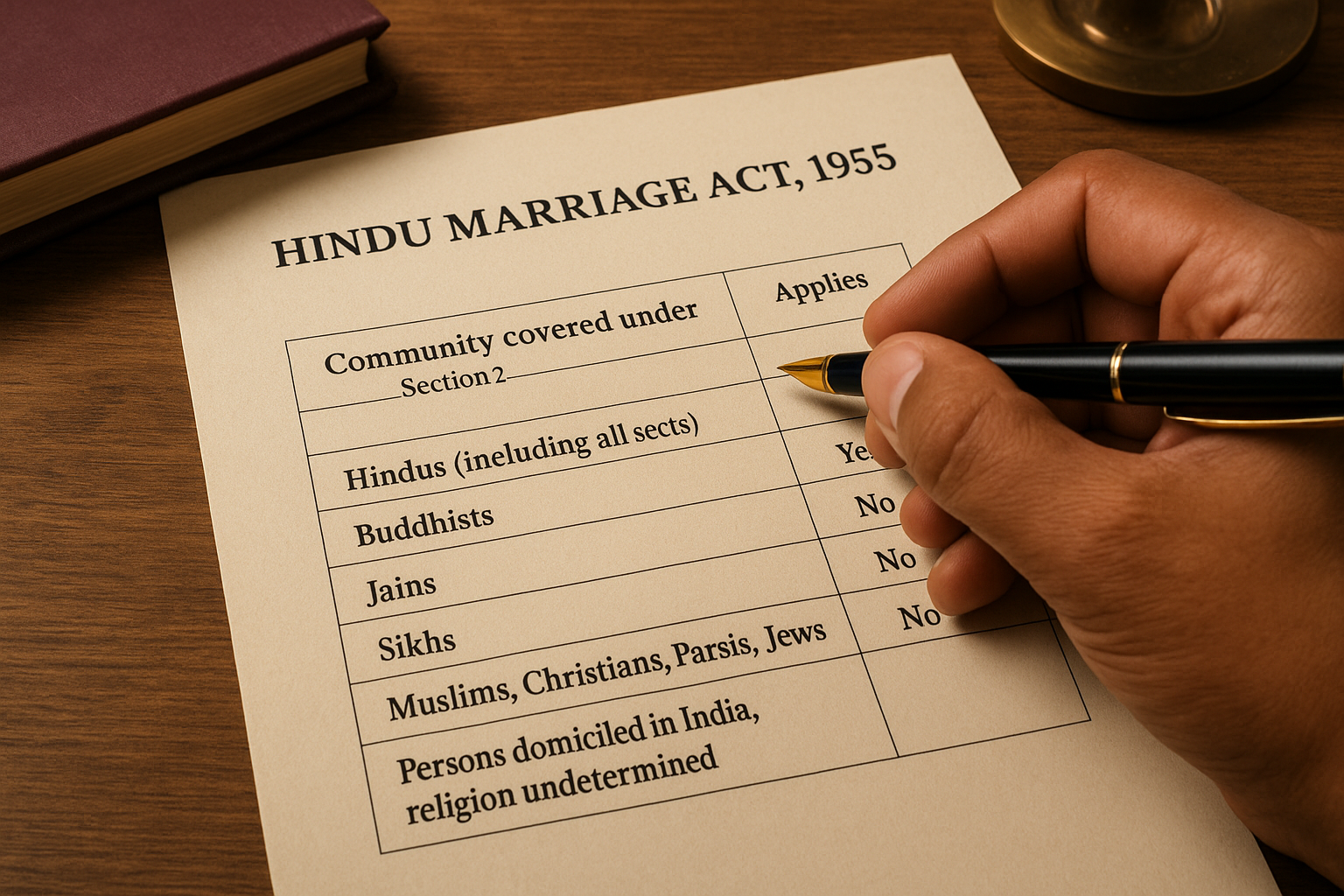
| Community covered under Section 2 | Applies |
|---|---|
| Hindus (including all sects) | Yes |
| Buddhists | Yes |
| Jains | Yes |
| Sikhs | Yes |
| Muslims, Christians, Parsis, Jews | No |
| Persons domiciled in India, religion undetermined | Yes, by default presumption |
This definition matters when you are checking jurisdiction at the very start of a matter. Get the applicability wrong, and the entire petition can fail on a technical objection before the merits are even heard.
Why courts keep coming back to this Act
Judges across India cite the same handful of sections again and again because family disputes keep raising the same questions. Is the marriage valid? Can one spouse force the other back home under Section 9? Does cruelty under Section 13(1)(ia) cover mental harassment or only physical violence? These are not academic questions. They decide whether a client gets relief in six months or six years.
A lawyer who has not read the bare text of Sections 5, 9, and 13 is arguing from memory, not from law.
That single sentence sums up why shortcuts do not work in family law. Courts expect precise section references in pleadings, and the Supreme Court has repeatedly criticized petitions that misquote or loosely paraphrase statutory language. In Shilpa Sailesh v. Varun Sreenivasan (2023), the Supreme Court examined its own power under Article 142 alongside Section 13B to grant divorce by mutual consent without the mandatory waiting period, a ruling that reshaped how family courts handle settlement matters.
Where it intersects with other laws
Many practitioners forget that the Hindu Marriage Act does not operate alone. Maintenance claims often run parallel under Section 125 of the Code of Criminal Procedure, 1973 (now Section 144 of the new criminal procedure code that replaced the CrPC), and property questions frequently pull in the Hindu Succession Act, 1956. Custody disputes almost always reference the Guardians and Wards Act, 1890, alongside Section 26 of the Marriage Act itself.
Special Marriage Act, 1954 comparisons come up too, particularly when clients ask why an interfaith couple cannot simply use the Hindu Marriage Act to solemnize their union. Knowing the boundary between these statutes saves you from filing under the wrong law entirely, a mistake that costs clients months of delay.
What this means for daily practice
Every divorce petition, every restitution suit, and every maintenance application traces back to specific sections in this Act. Litigators draft cause titles referencing Section 13, judicial separation applications cite Section 10, and void marriage declarations rely on Section 11. Missing a cross-reference, such as forgetting that Section 13(2) provides additional grounds available only to wives, can weaken an otherwise strong case.
Students preparing for judiciary exams or moot court also lean on this Act constantly because examiners love testing the fine distinctions between void marriages under Section 11 and voidable marriages under Section 12. Tools like LeXi AI can pull the exact section text alongside recent judgments when you need to confirm a citation quickly, which matters more in family law than almost any other practice area given how often small procedural errors get challenged in appeal.
How to read and apply the bare act's chapter structure
The Hindu Marriage Act, 1955 is organized into six chapters, and knowing this structure saves you from flipping through the entire statute every time you need one provision. Chapter I covers preliminary matters like definitions and applicability. Chapter II lays out marriages and their validity. Chapter III deals with restitution of conjugal rights, judicial separation, and nullity. Chapter IV covers divorce. Chapter V handles jurisdiction and procedure. Chapter VI contains savings and repeals. Once you memorize this skeleton, you know instantly where to look for any question a client raises.
What does each chapter actually contain?
Beginners often waste time searching Section 13 for maintenance provisions when maintenance actually sits in Sections 24 to 28, which fall under a separate part of the Act dealing with ancillary relief. A quick reference table prevents this kind of misdirected search.
| Chapter | Sections | Subject matter |
|---|---|---|
| Chapter I | 1 to 4 | Preliminary, definitions, overriding effect |
| Chapter II | 5 to 8 | Conditions for marriage, registration |
| Chapter III | 9 to 14 | Restitution, judicial separation, void and voidable marriages |
| Chapter IV | 15 to 18 | Divorce, remarriage, penalties for bigamy |
| Chapter V | 19 to 23A | Jurisdiction, procedure in matrimonial proceedings |
| Chapter VI | 24 to 29 | Maintenance pendente lite, custody, savings, repeals |
Notice that Section 24, which covers maintenance during proceedings, sits inside Chapter VI even though it is functionally connected to divorce and judicial separation matters in Chapters III and IV. The statutory numbering does not always follow a purely logical sequence, so relying on memory of chapter titles alone can mislead you.
Reading provisos, explanations, and cross-references correctly
Every experienced litigator learns to read past the main text of a section into its provisos and explanations, because that is often where the real controversy lives. Section 13(1)(ia), for instance, defines cruelty as a ground for divorce, but the explanatory notes and decades of judicial interpretation around that single phrase fill entire volumes of case law. Skipping the fine print here is how weak petitions get drafted, and it is the first thing sound drafting technique for statutory language guards against.
Reading only the section heading and ignoring the proviso is how half the drafting mistakes in family law petitions happen.
Cross-references matter just as much. Section 13B on divorce by mutual consent explicitly references the one-year separation period, and courts have tied it to Section 23(1)(bb), which requires the judge to be satisfied that consent was not obtained by force or fraud. Miss that cross-reference in your pleading, and a judge can send you back to refile.
A practical checklist before citing any section
Use this sequence whenever you cite a provision in a petition or client note:
- Confirm the chapter and section number against the current bare act text, not an old textbook.
- Read the full subsection, including provisos and explanations, before quoting it.
- Check for amendments, since several sections were rewritten after 1976 and 2003.
- Cross-check related sections that courts typically read together, such as 13 with 13B or 9 with 13(1A).
This habit alone catches most citation errors before they reach a judge.
Conditions for a valid marriage under Sections 5 to 8
Section 5 of the hindu marriage act 1955 bare act lays out six conditions that must all be satisfied before a marriage counts as valid in law. Neither party can have a living spouse at the time of marriage, both parties must be capable of giving valid consent, and neither should be suffering from a mental disorder that makes them unfit for marriage or procreation. The bridegroom must have completed 21 years and the bride 18 years, the parties must not fall within the degrees of prohibited relationship unless custom permits it, and they must not be sapindas of each other unless custom or usage governing each of them permits such a marriage.
Breaking each condition down helps you spot defects quickly during a client consultation. A second marriage during the subsistence of a first one violates clause (i) and exposes the husband to prosecution under Section 494 of the Indian Penal Code, now Section 82 of the penal code that renumbered IPC offences in 2023. Unsoundness of mind under clause (ii) has generated significant litigation because courts distinguish between a temporary lapse and a condition that genuinely prevents valid consent or safe procreation.
| Section 5 clause | Condition | Consequence if violated |
|---|---|---|
| (i) | No living spouse at time of marriage | Marriage void under Section 11 |
| (ii) | Capable of valid consent, free from disqualifying mental disorder | Marriage voidable under Section 12 |
| (iii) | Bridegroom 21, bride 18 years | Punishable under Section 18, marriage not automatically void |
| (iv) | Not within prohibited relationship, absent custom | Marriage void under Section 11 |
| (v) | Not sapindas, absent custom | Marriage void under Section 11 |
Get Section 5 wrong at the drafting stage, and the whole petition can collapse before evidence is even led.
Definitions in Section 3 explain what counts as a prohibited relationship and who qualifies as a sapinda, and you cannot apply Section 5 correctly without reading Section 3 alongside it. Custom is a real defense here, particularly in South Indian and certain Bengali communities where marriages between close relations are traditionally permitted, so never assume a prohibited relationship automatically defeats a marriage without checking for a proven custom.
Here is a quick sequence to run through whenever a client asks whether their marriage is valid:
- Confirm neither party has a living spouse, checking for any prior marriage records.
- Verify both parties were capable of giving consent at the time, and rule out disqualifying mental disorders.
- Check ages against Section 5(iii), keeping in mind age alone rarely voids a marriage outright.
- Map the relationship against Section 3's definitions of prohibited relationship and sapinda.
- Ask about any community custom that might override clauses (iv) or (v).
Section 7 then addresses ceremonies, recognizing that a Hindu marriage may be solemnized in accordance with the customary rites of either party, and where saptapadi is part of the ceremony, the marriage becomes complete once the seventh step is taken before the sacred fire. Section 8 permits state governments to make rules for registration of Hindu marriages, and while registration itself does not validate an otherwise invalid marriage, it becomes crucial evidence in maintenance, succession, and passport disputes, so advise every client to register regardless of community custom.
Judicial separation, divorce, and nullity explained
Sections 9 through 14 of the hindu marriage act 1955 bare act cover four distinct remedies, and confusing one for another is a common drafting error. Restitution of conjugal rights under Section 9 lets a deserted spouse ask the court to order the other back to matrimonial life. Judicial separation under Section 10 lets spouses live apart legally without dissolving the marriage. Sections 11 and 12 deal with void and voidable marriages respectively, and Section 13 lists the grounds for full divorce.
Distinguishing void from voidable marriages trips up even experienced juniors. A void marriage under Section 11 is treated as if it never existed, and either party can seek a declaration to that effect. A voidable marriage under Section 12 remains valid until a court annuls it on specific grounds such as impotence, fraud, or concealed pregnancy at the time of marriage.
| Remedy | Section | Effect | Common ground |
|---|---|---|---|
| Restitution of conjugal rights | 9 | Court directs resumption of cohabitation | Withdrawal from society without reasonable excuse |
| Judicial separation | 10 | Parties live apart, marriage subsists | Same grounds as divorce under Section 13 |
| Void marriage | 11 | Marriage null from inception | Bigamy, prohibited relationship, sapinda violation |
| Voidable marriage | 12 | Valid until annulled | Impotence, fraud, pre-marriage pregnancy by another |
| Divorce | 13 | Marriage dissolved | Adultery, cruelty, desertion, conversion, unsoundness of mind |
Grounds for divorce under Section 13(1) include adultery, cruelty, desertion for a continuous period of two years, conversion to another religion, unsoundness of mind, and incurable forms of leprosy or venereal disease in a communicable form, though the leprosy ground was later omitted by amendment. Section 13(1A) adds a separate route: either spouse can seek divorce if there has been no resumption of cohabitation for one year or more after a decree of judicial separation, or no restitution of conjugal rights for the same period after a decree under Section 9.
Section 13(2) grants wives four additional grounds unavailable to husbands, including divorce where the husband has another wife living from before the Act came into force, or where the marriage was solemnized before the wife turned fifteen and she repudiated it before turning eighteen. Missing this asymmetry in Section 13(2) is a frequent oversight when drafting a wife's petition.
Confusing a void marriage under Section 11 with a voidable one under Section 12 can cost a client their entire claim to maintenance or succession rights.
Section 13B introduces divorce by mutual consent, requiring a joint petition after living separately for one year in the structure a mutual divorce petition must follow, followed by a second motion after six months, though the Supreme Court's ruling in Shilpa Sailesh v. Varun Sreenivasan (2023) confirmed that this waiting period can be waived under Article 142 in appropriate cases. Section 14 bars most divorce petitions within one year of marriage, subject to narrow exceptions for exceptional hardship or depravity. Reading Sections 13, 13A, 13B, and 14 together, rather than in isolation, is what separates a petition that survives scrutiny from one that gets returned for correction. LeXi AI's LiTT module can flag which of these sections applies once you input the facts, saving you the manual cross-checking that this cluster of provisions otherwise demands.
Maintenance, alimony, and child custody under the act
Sections 24 to 28 of the hindu marriage act 1955 bare act deal with money and children, the two issues that keep parties fighting long after the marriage itself has fallen apart. Section 24 covers maintenance pendente lite, meaning support paid while the case is still pending. Section 25 covers permanent alimony after the final decree. Section 26 handles custody, maintenance, and education of children. Section 28A makes enforcement of orders under this Act possible in the same manner as a civil court decree.
How does maintenance pendente lite under Section 24 work?
Either spouse, not just the wife, can apply under Section 24 if they lack sufficient independent income to support themselves and to bear the litigation expenses of the proceeding. Courts weigh the applicant's income, the respondent's income, the standard of living during the marriage, and reasonable needs, and the 2001 amendment added a proviso requiring courts to dispose of such applications within sixty days of service of notice. Practically, this sixty-day mandate is ignored more often than followed, so flag delay explicitly in your application if the other side is stalling.
Section 24 exists so that the weaker party is not forced to fight a legal battle while starving financially, and courts that ignore the sixty-day rule undercut the entire purpose of the provision.
What separates Section 24 from Section 25?
Alimony under Section 25 comes after the decree, whether that decree grants divorce, judicial separation, or a nullity declaration, and it can take the form of a lump sum or periodical payments. Courts also retain power under Section 25(2) to vary, modify, or rescind an alimony order later if circumstances change materially, such as the recipient remarrying or the payer losing employment. This flexibility distinguishes Section 25 from a one-time settlement and surprises clients who assume an alimony order is permanent and unchangeable.
| Provision | Stage of proceeding | Nature of relief | Who can apply |
|---|---|---|---|
| Section 24 | During pending litigation | Interim maintenance and litigation expenses | Either spouse |
| Section 25 | After final decree | Permanent alimony, lump sum or periodical | Either spouse |
| Section 26 | Any stage, before or after decree | Custody, maintenance, education of children | Either parent |
| Section 28A | After any order under the Act | Enforcement as a civil decree | Party in whose favor order passed |
How does the Act handle child custody?
Section 26 lets the court pass interim orders regarding custody, maintenance, and education of minor children at any stage of the proceeding, and it can even revoke or vary a prior order if the child's welfare demands it. Judges apply the welfare principle above everything else, meaning a father's legal right to guardianship under the Hindu Minority and Guardianship Act, 1956 does not override what serves the child best. Custody battles frequently drag on for years, and Section 26 applications often run alongside proceedings under the Guardians and Wards Act, 1890, so check both statutes before drafting relief.
Numbers matter in these applications far more than in most family law pleadings, since the court wants specific figures for income, expenses, and the child's schooling costs. LeXi AI's contract and drafting tools built for Indian pleadings can help you organize financial disclosures and generate a first draft of a Section 24 or Section 26 application once you feed in the client's income details, cutting down the time spent formatting affidavits from scratch.
Major amendments that reshaped the 1955 act
The Hindu Marriage Act, 1955 you read today is not the Act Parliament passed seventy years ago. Several rounds of amendment have rewritten entire sections, and treating the original 1955 text as final is one of the fastest ways to cite an outdated provision in front of a judge. Knowing which year of amendment attached which change to which section is not academic trivia, it is the difference between a petition that holds up and one that gets returned with a note asking you to check the current law.

What did the 1976 amendment change?
Parliament passed the Marriage Laws (Amendment) Act, 1976, and it remains the single biggest overhaul this statute has seen. It introduced Section 13B, giving couples divorce by mutual consent for the first time, a remedy that did not exist in the original 1955 text at all. It also replaced desertion and cruelty as grounds requiring a minimum statutory period with grounds available immediately, and it inserted Section 13(1A), letting either spouse convert a decree of judicial separation or restitution of conjugal rights into a divorce after one year of non-compliance.
If you are citing Section 13B or 13(1A) as though they were part of the original 1955 draft, you are misreading the Act's own history.
Which later amendments matter for daily practice?
More recent changes are smaller in scope but still change outcomes. The Marriage Laws (Amendment) Act, 2001 inserted the sixty-day disposal proviso into Section 24 that practitioners now rely on to push stalled maintenance applications. The Personal Laws (Amendment) Act, 2019 omitted leprosy as a ground for divorce under Section 13(1)(iv), aligning this Act with similar changes made to the Special Marriage Act, 1954 and other personal statutes, reflecting updated medical understanding of the condition.
| Amendment | Year | Key change |
|---|---|---|
| Marriage Laws (Amendment) Act | 1976 | Added Section 13B, Section 13(1A), reworked cruelty and desertion grounds |
| Marriage Laws (Amendment) Act | 2001 | Inserted sixty-day disposal proviso in Section 24 |
| Personal Laws (Amendment) Act | 2019 | Omitted leprosy as a divorce ground under Section 13(1)(iv) |
How to track amendments before you cite a section
Courts do not accept "the textbook said so" as a defense when a section has since changed. Build a habit around these checks before every filing:
- Confirm the amending Act and year against the current bare text, not a secondhand summary.
- Check whether the provision you are citing predates 1976, since that year reshaped the most litigated sections.
- Verify grounds like leprosy have not been omitted in your jurisdiction's applicable text.
- Cross-reference state-specific amendments, since Andhra Pradesh, Tamil Nadu, and Karnataka have all inserted local provisions like Section 7A for self-respect marriages.
Staying current with these changes by hand is tedious, and this is exactly where a tool like LeXi AI's legal research module earns its keep, since it flags amended language and recent judgments interpreting the current text rather than the version printed in an old bound volume sitting on your shelf.
Sections most frequently cited in court judgments
Some sections of the hindu marriage act 1955 bare act show up in nearly every reported family law judgment, while others rarely leave the bare text at all. Knowing which provisions attract heavy litigation helps you anticipate the arguments opposing counsel will raise and the precedents a judge will expect you to address. Section 13(1)(ia) on cruelty tops this list by a wide margin, followed closely by Section 13B on mutual consent divorce and Section 24 on interim maintenance.
Which sections dominate reported case law?
Looking at reported High Court and Supreme Court decisions over the last two decades, a small cluster of sections accounts for the overwhelming majority of citations.
| Section | Subject | Why it gets cited so often |
|---|---|---|
| 13(1)(ia) | Cruelty as divorce ground | No fixed definition, so every fact pattern generates fresh precedent |
| 13B | Mutual consent divorce | Waiver of waiting period litigated repeatedly after Shilpa Sailesh |
| 9 | Restitution of conjugal rights | Constitutional validity challenges and desertion disputes |
| 24 | Maintenance pendente lite | Quantum disputes and delay in disposal beyond sixty days |
| 13(1A) | Conversion of decrees into divorce | Frequently combined with Section 13B applications |
| 26 | Child custody | Welfare principle applied case by case, rarely settled by statute alone |
What makes cruelty under Section 13(1)(ia) so litigation-heavy?
Cruelty carries no statutory checklist, so courts have spent decades deciding whether specific conduct, from a single slap to years of verbal abuse, crosses the threshold. This open texture forces every cruelty petition to lean on precedent rather than plain text, which is exactly why judgments interpreting Section 13(1)(ia) keep multiplying. Mental cruelty claims, in particular, now dominate matrimonial dockets far more than allegations of physical violence.
A section with no fixed definition, like cruelty under Section 13(1)(ia), will always generate more case law than one with a clear numeric test.
Why do procedural sections generate as much litigation as substantive ones?
Procedural provisions like Section 13B and Section 24 might look like formalities, but they decide who waits and who pays while a case is pending, which is precisely why parties fight over them so hard. Section 13B litigation exploded after Shilpa Sailesh v. Varun Sreenivasan (2023) opened the door to waiving the statutory cooling-off period, and family courts across India are still working out how liberally to apply that ruling. Section 24 disputes, meanwhile, rarely turn on the law itself but on the numbers, since both sides contest income figures and living standards down to the last payslip.
Given how concentrated this citation pattern is, building a research habit around these six sections pays off faster than reading the Act cover to cover. LeXi AI's judgment search tool can pull the latest rulings interpreting Section 13(1)(ia) or Section 13B against verified sources, which saves you from relying on a secondhand digest that may have missed a recent Supreme Court clarification.
Where to find the authentic bare act text and PDF
Finding the actual hindu marriage act 1955 bare act text online is harder than it sounds, because half the PDFs floating around law student forums are five amendments out of date. You want the version currently in force, not a scanned copy from someone's 2015 notes, especially when you are about to quote a section in a petition or an exam answer. The official source always beats a forwarded WhatsApp PDF, no exceptions.
Why the India Code portal is the safest starting point
The India Code portal, maintained by the Legislative Department under the Ministry of Law and Justice, hosts the consolidated and updated text of every central act, including this one. It reflects amendments as they come into force, so you get the current wording of Section 13B or Section 24 rather than the 1955 original sitting unchanged in an old bound volume. Downloading directly from this portal also gives you a citation you can defend if a judge or examiner asks where you got the text.
An outdated PDF quoted in a petition is worse than no citation at all, because it signals you never checked the current law.
What to check before trusting a PDF you find online
Many PDFs circulating on law school WhatsApp groups or generic legal blogs strip out amendment footnotes entirely, leaving you with clean-looking text that is quietly wrong, and even free databases carry limitations worth knowing before you cite them in court. Run through this checklist before you rely on any copy:
- Confirm the document states which amendments it incorporates, ideally listing 1976, 2001, and 2019 changes.
- Check the source line for a government domain or a recognized law publisher, not an anonymous blog.
- Cross-verify one or two sections, such as Section 13B or Section 24, against the India Code text.
- Look for a publication or last-updated date printed somewhere on the file.
- Avoid PDFs with no visible source at all, since these get copied and recopied with errors compounding each time.
Supreme Court judgments themselves often quote the exact statutory language too, so the Supreme Court of India's official website is a useful cross-check when you want to confirm how a bench read a particular section in a recent ruling.
How LeXi AI keeps the current text at your fingertips
Instead of juggling browser tabs between the India Code portal and a stack of old PDFs, many practitioners now pull statutory text and matching case law from one place. LeXi AI's judgment search across Supreme Court and High Court rulings surfaces the current section wording alongside verified judgments interpreting it, so you are reading Section 13(1)(ia) or Section 24 with the exact precedent a court would expect you to cite. That combination of verified sources and current statutory text saves the back-and-forth checking that eats into billable hours, particularly when a matter needs a citation confirmed quickly before a hearing.
Using the bare act as your daily reference
Getting comfortable with the hindu marriage act 1955 bare act is not a one-time reading exercise. You will return to Section 13, Section 24, and Section 13B again and again, and each time the facts will differ slightly, which is exactly why the exact statutory wording matters more than any summary you memorized in law school. Knowing the chapter structure, the amendment history, and the sections courts cite most often turns this Act from a wall of text into a working tool you reach for daily.
Treat the text as a live reference, not a static document, since amendments and Supreme Court rulings keep reshaping how sections like 13B and 24 get applied in practice. When you need the current wording paired with verified precedent in one place instead of five browser tabs, test LeXi AI free on your next matrimonial petition and see how much faster the draft comes together.