

Is Indian Kanoon Reliable? A Look at Its Limitations
If you have ever pulled up a judgment on Indian Kanoon before a hearing, you have probably asked yourself is Indian Kanoon reliable enough to cite in court. It is the most widely used free legal database in India, and most lawyers, from first year associates to senior advocates, check it daily for case law, statutes, and orders.
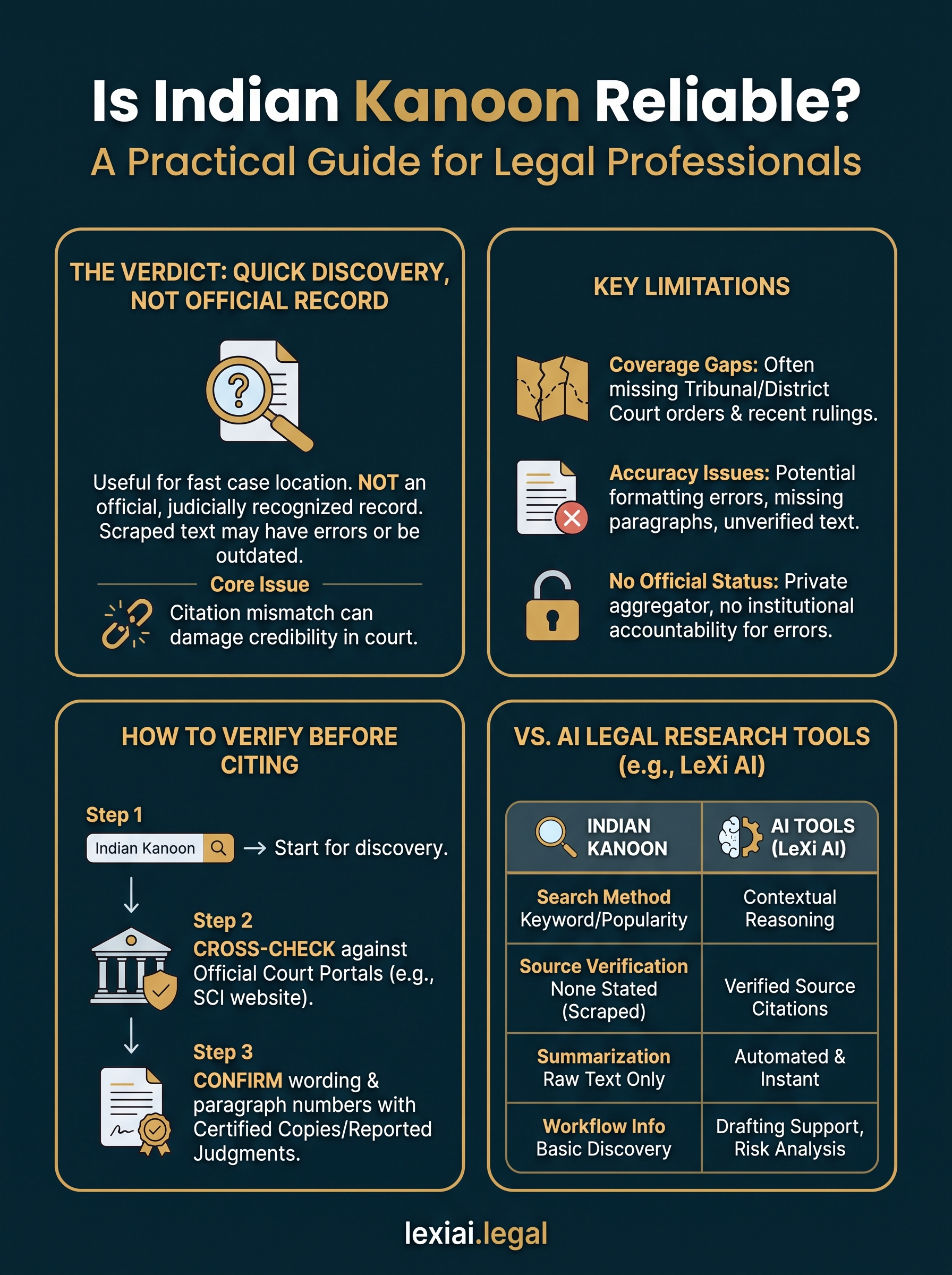
The direct answer is that Indian Kanoon is useful for locating judgments quickly, but it is not an official record. It scrapes and aggregates text from court websites and other sources without editorial verification, so formatting errors, missing paragraphs, and outdated versions do happen. Courts generally expect you to confirm citations against a verified source like the official court website or a certified copy before relying on them in filings.
This article looks at where Indian Kanoon holds up, where it falls short, how courts actually treat it during arguments, and what court acceptance really means in practice. It also touches on how tools offering verified sources, including LeXi AI's judgment search, fit into a more dependable research workflow.
Why Indian Kanoon's reliability actually matters
Reliability is not an abstract concern here, it decides whether your argument survives cross examination in front of a bench. When you cite a paragraph number from a judgment, opposing counsel or the judge can pull up the same case on the Supreme Court's official portal or the high court website and compare it line by line. If the wording does not match, your credibility takes the hit, not just the citation.
Think about what happens when a stray formatting error on Indian Kanoon drops a footnote or merges two paragraphs from a long judgment. You read it, quote it, and later find the actual reported version says something slightly different. That single mismatch can cost you an adjournment, or worse, a judge questioning your preparation in open court.
A citation that cannot survive a side-by-side check with the official record is not a citation you can rely on.
Accuracy also matters because Indian courts still lean heavily on binding precedent and exact statutory wording. A misquoted section number under an act like the full text of the Indian Contract Act, 1872, or a paraphrased holding from a Supreme Court ruling, can change how a judge reads your entire submission. Getting the text right is not a technicality, it is the foundation of the argument itself.
Beyond the courtroom, reliability affects how much time you spend double checking work. If you cannot trust a source outright, you end up cross verifying every judgment anyway, which erases much of the speed advantage a free database like Indian Kanoon is supposed to offer. Firms that skip this step often discover the gap only after a matter goes badly, which is a costly way to learn a lesson.
Ultimately, the question of is Indian Kanoon reliable matters because litigation leaves no room for approximation. Judges, senior counsel, and even junior associates preparing briefs need text that matches the official record exactly, not text that is close enough. That gap between "close enough" and "exact" is where most citation disputes in Indian courtrooms actually start.
How to verify a judgment before citing it in court
Verification does not need to take long once it becomes a habit. Before you file a written submission or hand up a compilation, run every judgment through a quick cross check against a primary source rather than trusting the Indian Kanoon copy alone.
Start with the official portals, since they remain the final word on wording and paragraph numbering.
- Search the Supreme Court of India website (main.sci.gov.in) or the relevant High Court site for the same case number, the same way you would when checking a case on the Supreme Court portal.
- Match the paragraph numbers you plan to cite, not just the overall holding.
- Check the date of the judgment against any later review or correction order.
- Pull a certified copy from the registry if the matter is contested or the stakes are high.
- Cross reference the citation in a recognized law report such as SCC or AIR if one exists, or in one of the paid research platforms that compete with SCC Online.
Quoting from memory or from a single tab open in your browser is how errors slip into filings. That habit is exactly what separates a reliable legal database from a genuinely dependable research process.
If you cannot point to where the exact wording came from, you have not actually verified the judgment.
Regularly building this check into your workflow also protects you from another problem: Indian Kanoon sometimes indexes an older or interim order alongside the final one. Skipping the verification step means you might argue from a version the court itself has already superseded.
Key limitations of Indian Kanoon every lawyer should know
Beyond citation mismatches, Indian Kanoon carries structural gaps that shape how much you can lean on it. Knowing these upfront saves you from finding out the hard way mid-brief.

Coverage and accuracy gaps
Coverage is uneven once you move past the Supreme Court and major High Courts. Tribunal orders, district court judgments, and recent rulings from smaller benches often show up late or not at all. Search ranking also favors popularity over relevance, so an older, frequently cited case can outrank the newer judgment that actually controls your point.
- No official verification of scraped text
- Gaps in tribunal and district court coverage
- Delayed indexing of recent orders
- Occasional duplicate or interim versions of the same case
- Limited headnotes or case summaries for quick screening
No official or curated status
Indian Kanoon is a private aggregator, not a government-maintained repository, and it says so in its own disclaimers. That means there is no institutional accountability if text goes missing or a judgment gets misattributed to the wrong bench.
A free database built for discovery was never meant to double as an evidentiary record.
This is not a knock against the platform's usefulness for early-stage research. It simply means every serious filing needs one more step: confirming the judgment through a source with actual editorial or institutional weight behind it.
Indian Kanoon versus AI-powered legal research tools
Comparing a plain-text search engine to a modern AI research platform built for Indian case law is not really an apples to apples exercise, but lawyers still need to know where each one fits. Indian Kanoon is built for keyword search across scraped judgments. Tools like LeXi Agent are built to reason over statutes and precedent, flag which paragraph actually supports your argument, and pull from verified sources rather than an unedited scrape.
Notice how the gap widens once you factor in speed on genuinely complex matters. A 400-page case file that takes a junior associate a full day to summarize manually can be condensed in minutes with LeXi AI's case file summarization, while Indian Kanoon simply hands you the raw text and leaves the reading to you.
Search finds text, but research tools built for law are meant to find the argument inside that text.
Table below sums up the practical differences, and a fuller breakdown of legal AI platforms for Indian firms covers the rest:
| Feature | Indian Kanoon | AI legal research tool (e.g., LeXi AI) |
|---|---|---|
| Source verification | None stated | Verified source citations |
| Case summarization | Not offered | Automated, near-instant |
| Search method | Keyword/popularity ranking | Contextual legal reasoning |
| Drafting support | None | Built-in drafting assistance |
| Risk or clause analysis | Not applicable | Included for contracts |
Given this, treat Indian Kanoon as a starting point for discovery, not a replacement for a tool designed around legal reasoning and verification from the ground up.
Where this leaves your legal research
So, is Indian Kanoon reliable? For spotting a case fast, yes. For citing it in a filing without a second check, no. Treat it as your first stop, not your last one, and always confirm wording against the official portal or a certified copy before it goes anywhere near a bench.
That second step is where most delays creep in, and it is exactly what AI-powered legal research tools are built to remove. Pairing quick discovery with verified sources and built-in summarization means you spend less time cross-checking and more time actually arguing the point.
If your practice runs on judgments, statutes, and tight deadlines, it is worth seeing how a connected research workflow feels in practice. You can run your next case file through LeXi AI at no cost before your next hearing.