

5 Best SCC Online Alternatives for Legal Research in 2026
If you are searching for a scc online alternative, you already know the frustration. SCC Online works well for judgment search, but the subscription cost is steep for solo practitioners, and it does very little for drafting, contract review, or case strategy. Lawyers and law students across India are now looking for tools that combine legal research with the drafting and analysis work that actually fills a workday, which is why the best AI legal research tools for 2026 keep coming up in these comparisons.
The good news is that several platforms now match or beat SCC Online on judgment coverage while adding features it does not offer at all. Some focus purely on case law search, others build in AI-assisted drafting, clause analysis, and citation checking, so you are not paying for five separate subscriptions to run one matter file.
This article walks through five scc online alternatives worth considering in 2026, comparing pricing, database depth, and practical features like judgment accuracy and drafting support. Where relevant, we also note where AI-native platforms such as LeXi AI fit into this comparison, since accuracy on Indian statutory interpretation and case analysis matters as much as database size.
1. LeXi AI
LeXi AI is not just a case law search engine, it is India's legal AI platform built for Indian practice, with additional coverage for US and UK law. Where SCC Online stops at judgment retrieval, LeXi AI adds drafting, contract review, and courtroom prep into the same workflow, so you stop switching between five different logins to close one matter file.
Key features
LeXi AI brings together research, drafting, and litigation prep in one place. The core modules include:
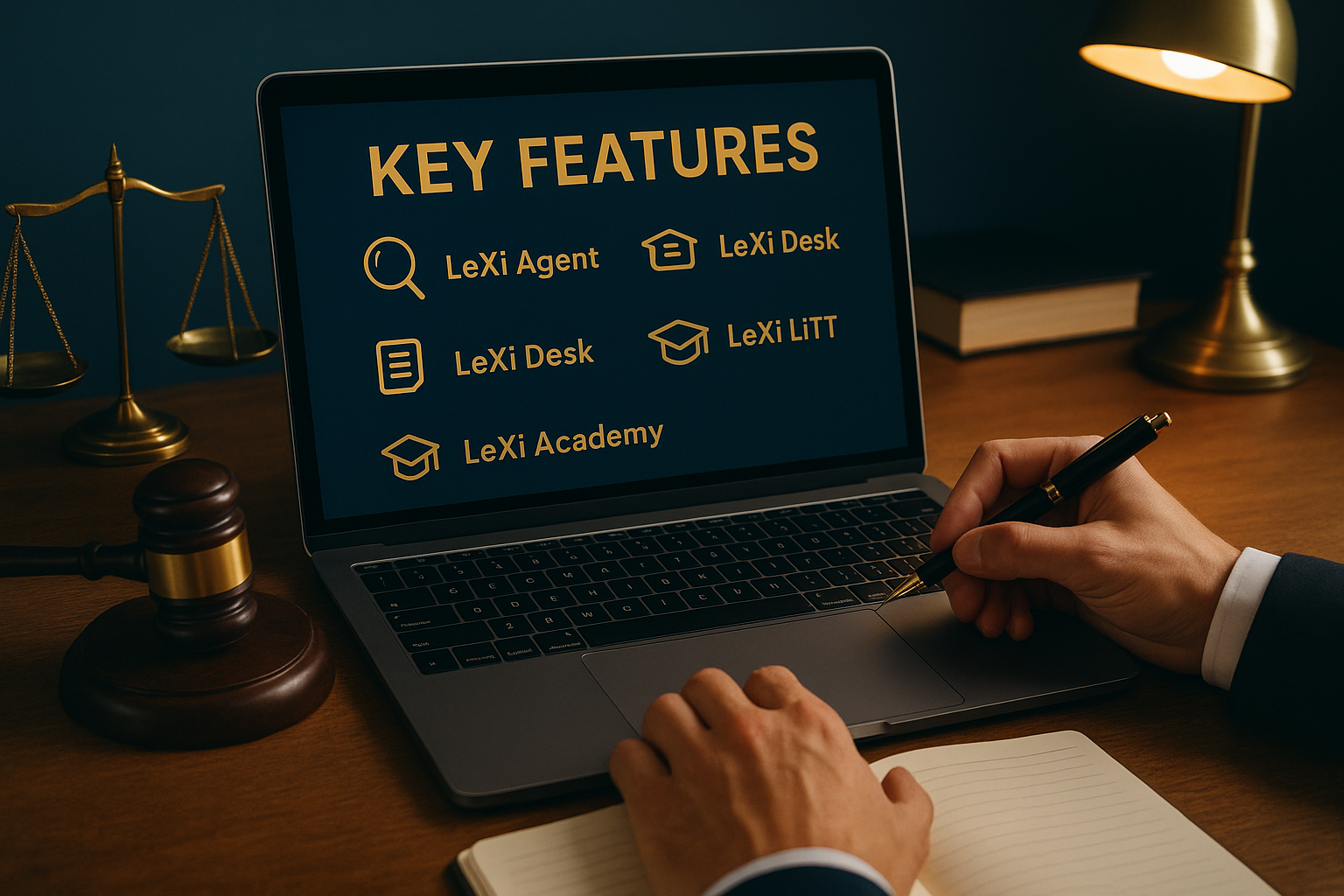
- LeXi Agent for legal research, precedent analysis, and judgment search across verified Indian case law
- LeXi Desk for contract lifecycle management, including clause risk flagging, clause generation, and legal translation
- LeXi LiTT for AI-assisted legal drafting, case strategy, and courtroom preparation at scale
- LeXi Academy for law students working on research, drafting, and case comprehension
On the AIBE 20 legal reasoning benchmark, LeXi AI scored 98.95 percent, ahead of general models like GPT 5.5 and Gemini 3.1 Pro on statutory interpretation and case analysis tasks specific to Indian commercial law, as the full AIBE 20 benchmark results set out question by question.
A judgment search tool that cannot draft or analyze a contract only solves half of a lawyer's day.
Who it is best for
This platform suits independent lawyers, litigation chambers, and corporate legal teams who want research and drafting under one roof rather than juggling separate subscriptions for judgments, contracts, and case prep. Enterprises building custom legal workflows also benefit from LeXi AI's API access, and law students get a dedicated learning module through LeXi Academy.
Pricing
LeXi AI runs on tiered plans built around firm size and usage, from solo practitioners to enterprise legal teams needing API access. Full details are available directly on the page listing LeXi AI's plan tiers, where you can compare them against your firm's actual research and drafting volume before committing to a subscription.
2. Manupatra
Manupatra is one of the oldest legal databases in India, built primarily around statutes, judgments, and commentary rather than workflow tools. It has been a staple in law firm libraries since before most AI-native platforms existed, and its bare-bones interface reflects that legacy design, which is why lawyers now shortlist Manupatra alternatives for legal research too.
Key features
Searches run across a large repository of case law, bare acts, notifications, and law journal articles. Manupatra also offers citation tools and cross-referencing between judgments, which helps when you are building a chain of precedent for a written submission.
A large database only helps if you can find what you need inside it quickly.
Who it is best for
Manupatra suits litigation lawyers and researchers who need deep statutory and journal coverage and are comfortable navigating a traditional, text-heavy interface. It works less well for anyone expecting drafting help or contract analysis, since those functions simply are not part of the platform.
Pricing
Pricing runs on institutional and individual subscription tiers, typically quoted annually and negotiated directly with the Manupatra sales team. Costs vary based on the modules and journal access you select, so get a written quote before renewal season rather than assuming last year's rate still applies.
3. CaseMine
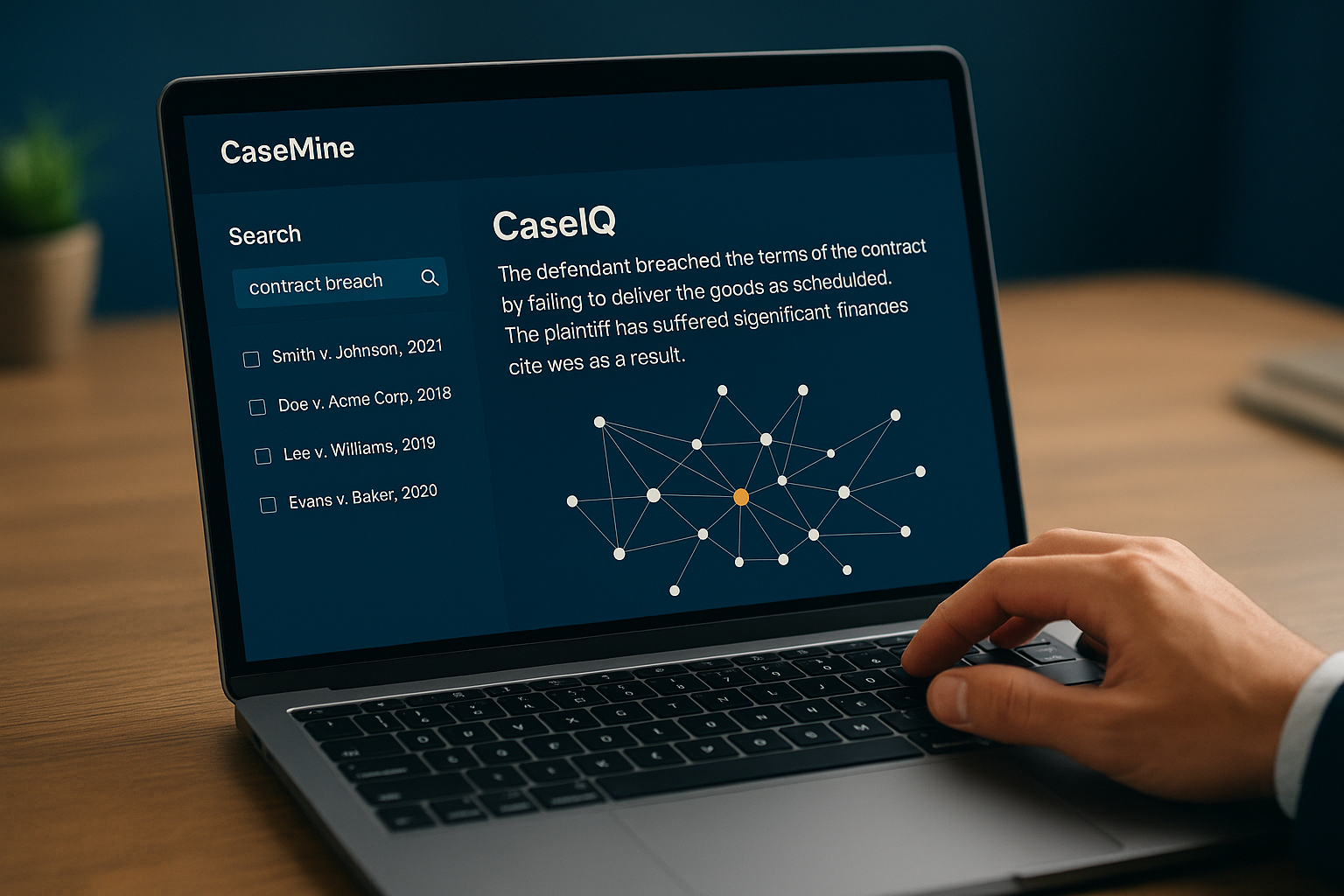
CaseMine built its reputation on AI-assisted case law search, using a tool called CaseIQ to map citation networks and surface judgments with similar reasoning, not just matching keywords. That makes it a genuine step up from keyword-only databases when you are hunting for precedent on an unusual fact pattern.
Key features
Its CaseIQ engine reads your fact summary and returns relevant case law ranked by legal similarity rather than plain string matching. CaseMine also layers in a citation network graph that shows how judgments cite and are cited by others, which helps you track whether a precedent still holds good law before you rely on it in a filing.
Finding a similar judgment matters less than knowing whether it has since been overruled.
Who it is best for
Litigators and researchers who spend real time building precedent chains will get the most out of CaseMine's similarity search and citation mapping. It works best as a research companion rather than a full practice tool, since drafting and contract features are not part of the platform at all.
Pricing
Subscription plans are quoted per user, with separate tiers for individual lawyers, law firms, and academic institutions. Contact their sales team directly for current rates, since public pricing pages change often and academic discounts apply for law schools and university libraries.
4. Indian Kanoon
Indian Kanoon is the free legal database most law students discover first, and for good reason. It indexes judgments from the Supreme Court, High Courts, and tribunals going back decades, with a search interface that loads fast even on a slow connection.
Key features
Searches return full judgment text with hyperlinked citations, so you can jump between a cited case and the judgment referencing it without leaving the page. The platform also indexes bare acts and statutes, which makes it useful for quick statutory lookups during a hearing.
Free access to judgments matters more when you are still learning how to read them.
Who it is best for
Law students, junior associates, and self-represented litigants who need reliable judgment text without a subscription will get the most value here. It works less well for litigation chambers running high-volume research, since there is no drafting support, no clause analysis, and limited filtering compared to paid platforms.
Pricing
Indian Kanoon is free to search and read, with no login required for most judgments. That makes it one of the most accessible scc online alternatives on this list, though the tradeoff is fewer advanced research tools and no case management features built in.
5. LegitQuest
LegitQuest positions itself as a budget-friendly research tool for lawyers who want solid judgment coverage without the enterprise price tag that comes with SCC Online or Manupatra. It leans on AI-based search ranking to surface relevant case law faster than a plain keyword match, which makes it a reasonable middle ground on this list of scc online alternatives.
Key features
Search results rely on a proprietary relevance algorithm that ranks judgments by legal context rather than exact phrase matching alone. LegitQuest also includes headnote summaries for major judgments, which saves time when you are scanning ten cases to shortlist two for a written submission, plus basic citation tracking across reported decisions.
Cheaper research access only pays off if the summaries save you real reading time.
Who it is best for
Solo practitioners and small firms watching their subscription budget will find LegitQuest a practical fit for day-to-day judgment lookups. It suits lawyers who need dependable case search without paying for drafting or contract features they will not use.
Pricing
LegitQuest offers tiered individual and firm plans priced lower than most legacy databases, with periodic discounts for students and new subscribers. Exact rates depend on the modules you select, so confirm current pricing directly with their sales team before renewing.
Finding the right fit for your practice
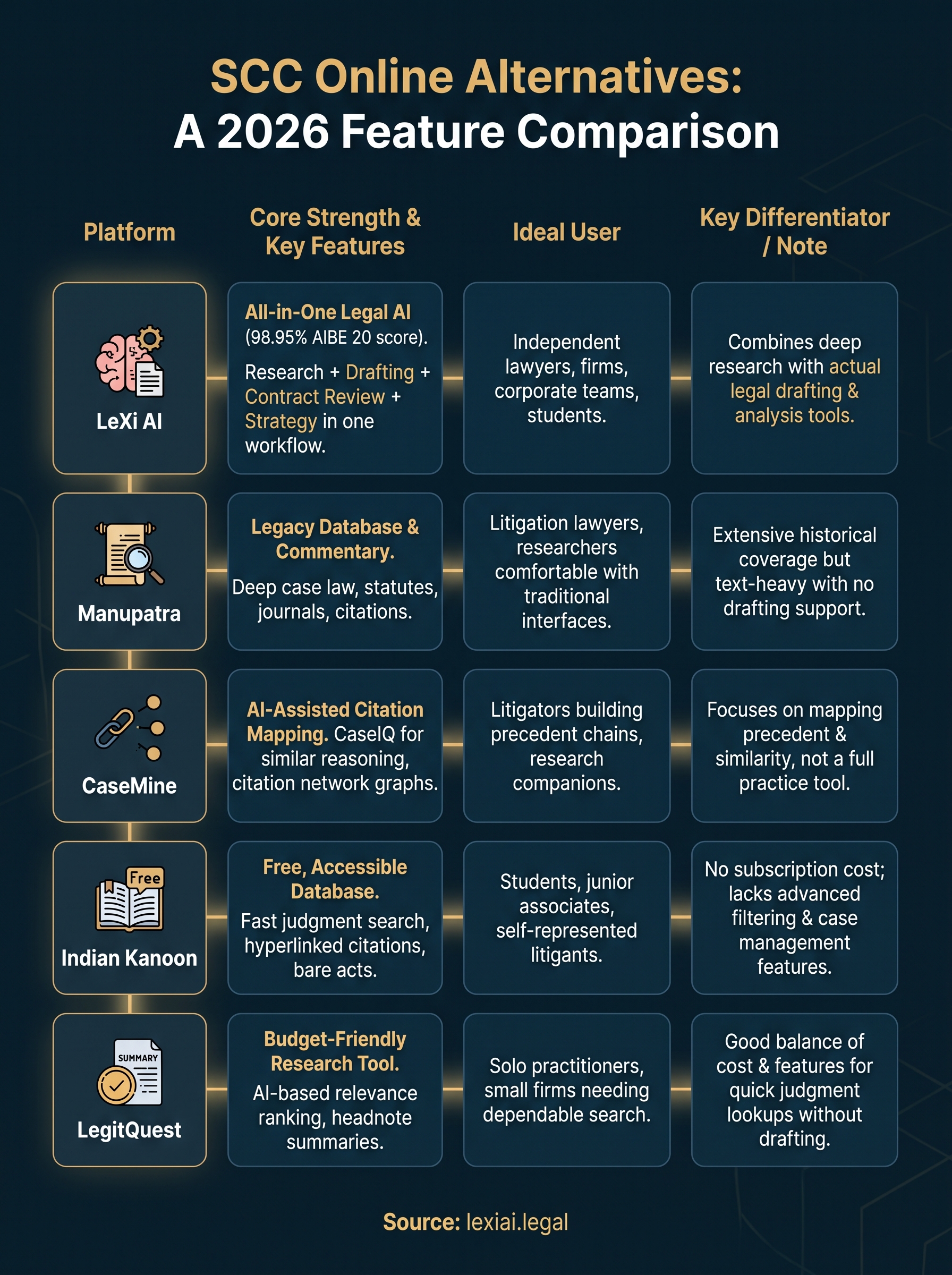
Picking a scc online alternative comes down to what actually eats your time each week. If it is judgment search alone, Indian Kanoon or LegitQuest will cover you without draining your budget. If you need deep statutory commentary, Manupatra still holds its ground. If precedent mapping matters most, CaseMine's citation graph is worth the subscription.
But if your work spans research, drafting, contract review, and courtroom prep, running four separate logins stops making sense. That is the gap LeXi AI was built to close, with verified judgment search, clause risk analysis, and case strategy tools inside one legal intelligence platform, backed by a 98.95 percent score on the AIBE 20 legal reasoning benchmark.
Most firms end up running one core research tool alongside a workflow platform. If you want to see how that pairing works for your caseload, test LeXi AI on a real matter file at no cost before you renew anything else.