

Mutual Divorce Petition Format: Section 13B Structure Explained
A mutual divorce petition under Section 13B of the Hindu Marriage Act, 1955 follows a fixed structure that most courts expect: cause title, party details, marriage particulars, grounds for separation, and prayer clause. If you are searching for a mutual divorce petition format, you likely need to see how each section fits together before you draft your own or brief your advocate on what to prepare. This article gives you that structure directly, without vague generalities about family law procedure.
Most readers land here because they want a working template, not a lecture on matrimonial law theory. The petition has to state that the parties have lived separately for one year or more, that they have not been able to live together, and that they have mutually agreed the marriage should be dissolved, exactly as Section 13B(1) requires. Getting this wording wrong often causes delays at the family court registry stage.
Below, I break down the Section 13B structure clause by clause, from the opening cause title to the affidavit format and verification clause, so you know what a family court expects to see. Where drafting tools like LeXi AI can speed up clause generation and reduce repetitive errors, I mention that too, briefly and factually.
Why the format of your petition matters
Family courts in India work through hundreds of matrimonial matters every month, and registries often reject petitions on the first read if the format does not match what Order VII of the Civil Procedure Code and local family court rules expect. A mutual divorce petition that skips a required particular, such as the date of marriage registration or the exact place of last cohabitation, gets flagged before it even reaches a judge. That flag means a fresh filing, not a quick correction, in most district family courts.
What courts check first
Judges and court clerks scan the cause title, the jurisdiction clause, and the verification section before reading the substance of your case. If the jurisdiction clause does not clearly state why that particular family court has authority, such as the marriage location or the last shared residence, the registry can return the petition outright. Correct jurisdiction wording saves you a second trip to the filing counter.
A petition with the right structure moves faster than one with the right facts but the wrong format.
Why structure affects your timeline
Both motions under Section 13B, the first and the second after the statutory cooling-off period, depend on the original petition being accepted without objection. A formatting error at the first motion stage can push your six-month waiting period back by weeks, since courts often will not count time from a rejected filing. Structure, in this sense, is not paperwork for its own sake. It is what determines whether your divorce timeline stays on track or resets.
How to draft a mutual divorce petition under Section 13B
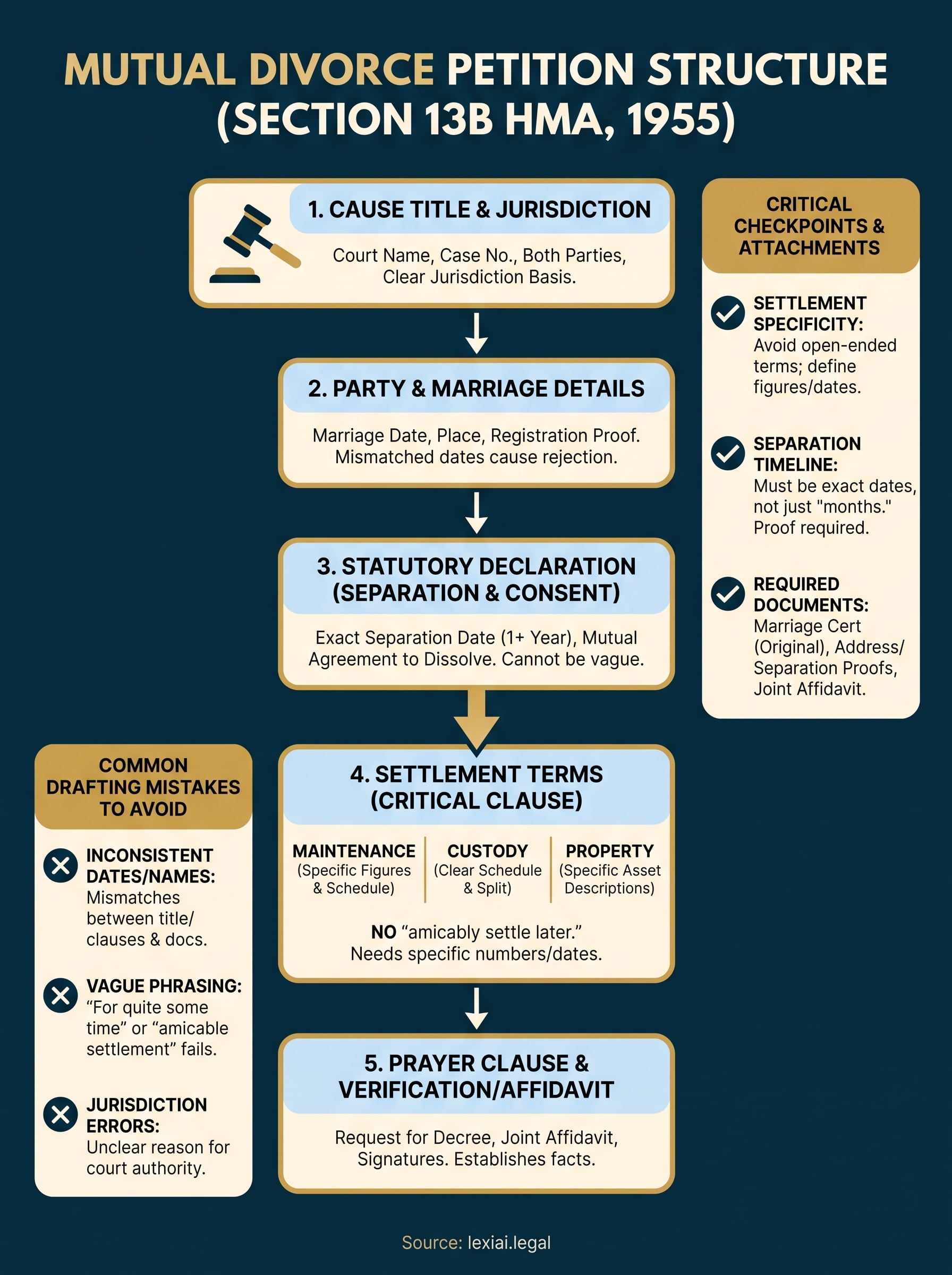
Drafting starts with the cause title and ends with the verification, but the sequence in between follows a fixed logic that most family courts expect without exception. Begin with the court's name and case number placeholder, then move through party details, marriage particulars, and the statutory declaration before you touch the prayer clause. Skipping ahead to the prayer clause before establishing the facts is the single most common reason advocates send drafts back for revision.
Follow this sequence when you draft:
- Cause title naming both parties and the court
- Marriage date, place, and registration details
- Statement of separation period and reasons
- Mutual consent declaration under Section 13B(1)
- Settlement terms covering maintenance, custody, and property
- Prayer clause requesting decree of divorce
- Verification and joint affidavit
AI drafting tools for Indian lawyers like LeXi AI can generate this clause sequence automatically and flag missing particulars before filing, which cuts down the back-and-forth with your advocate. Once each section above is in place, the petition is ready for the settlement clauses that courts scrutinize most closely.
Clauses that make or break a mutual consent petition
Certain clauses decide whether a family court accepts your petition on the first hearing or sends it back with objections. The settlement terms clause covering maintenance, alimony, and custody arrangements needs specific numbers and dates, not vague promises to "mutually decide later." Courts have rejected petitions where parties wrote "amount to be settled amicably" instead of stating an actual figure and payment schedule.
The consent and separation clause
Your petition must state the exact date separation began and confirm both parties have lived apart for the required period without interruption. Vague phrasing like "for quite some time" fails the statutory declaration test under Section 13B(1) because judges need a specific timeline to calculate eligibility for the first motion.
The clause that states your separation period precisely is the one clause that cannot be vague.
The custody and property clause
When children are involved, the petition needs a clear custody arrangement, visitation schedule, and financial responsibility split, not a general statement of cooperation. Property division similarly needs specific descriptions of assets, whether it is a flat, joint account, or vehicle, rather than references to "marital property" as a category. Missing this specificity is a leading cause of second-motion objections.
Documents to attach with the petition
A mutual divorce petition is incomplete without the supporting documents that prove the facts stated in your statutory declaration. Courts want documentary evidence of the marriage, the separation, and the settlement terms, not just written assertions. Missing paperwork is one of the fastest ways to get your filing returned at the registry counter.
No document, no proof, no first motion.
Standard attachments most family courts expect
- Marriage certificate or registration proof
- Marriage photographs, if registration is unavailable
- Address proof for both parties
- Income and asset details supporting the settlement terms clause
- Proof of separation, such as separate rental agreements or utility bills
- Joint affidavit affirming mutual consent
- Any prior maintenance or custody agreements

Why courts insist on originals
Family courts typically ask for originals of the marriage certificate at the second motion, even if certified copies were filed earlier. Advocates who anticipate this avoid last-minute scrambling six months later, when memories of where paperwork was stored have faded. Keeping a shared file with both parties from the outset prevents this entirely.
Common drafting mistakes that delay the decree
Even experienced advocates repeat certain errors that push the decree of divorce further out, most of which basic drafting techniques for precise legal documents would catch. Petitions with mismatched dates between the cause title and the marriage particulars section are the most frequent, since courts cross check every date against the attached certificate. Filing a mutual consent divorce petition with inconsistent names, such as a maiden name in one clause and a married name in another, triggers the same objection, which is why a name change affidavit format is worth sorting out before you file.
Errors that surface at the first motion
- Separation period stated in months instead of exact dates
- Settlement clause left open ended without figures
- Missing signatures on the joint affidavit
- Cause title omitting the correct court designation
A single mismatched date can cost you weeks you already spent waiting out the separation period.
Errors that surface at the second motion
Many couples change their contact details or one party relocates during the six month gap, and the petition never gets updated to reflect this. Registries then ask for fresh address proof before listing the matter, adding delay right when couples expect the divorce timeline to close. Reviewing your petition again before the second motion catches most of these issues early.
Getting your petition filing-ready
A mutual divorce petition succeeds or stalls based on structure, not sentiment. Get the cause title, statutory declaration, and settlement clauses right, attach the documents courts expect, and check your dates against the marriage certificate before you file. Family courts reward petitions that read cleanly on the first pass, and that clean read comes from following the Section 13B sequence exactly, not from hoping the judge overlooks a gap.
Going through this checklist once with your advocate before the first motion saves you weeks at the second. Precision here is not bureaucratic caution, it is what keeps your six month waiting period from resetting over an avoidable clerical error.
If you want to draft, check, and organize your petition clauses without missing a required particular, test LeXi AI free on your own petition draft and see how its drafting tools flag gaps before you ever reach the filing counter.