

Name Change Affidavit Format: Sample and How to Draft One
If you have changed your name after marriage, adoption, or personal choice, you need a legally sound name change affidavit format before you can update your Aadhaar, passport, PAN, or bank records. Most government offices and gazette notification authorities will not accept a plain letter. They want a notarized affidavit with specific declarations, your old name, new name, reason for change, and your signature before a notary or magistrate.
The short answer is that a name change affidavit must be printed on non-judicial stamp paper of the value prescribed by your state, contain a clear declaration under oath, and be attested by a notary public. There is no single central format prescribed by statute, but courts and government departments expect certain standard clauses to appear, including identity details, the reason for the change, and a statement that the change is not for any fraudulent purpose.
This article gives you a ready-to-use sample affidavit you can adapt, walks through each clause and why it matters, and explains the drafting mistakes that cause offices to reject affidavits. We also cover state-specific stamp paper requirements and how tools like LeXi AI can speed up drafting accurate legal documents without missing mandatory clauses.
Why you need a name change affidavit
Government departments, banks, and educational institutions will not update your records on your word alone. They need a sworn legal document that proves the change is genuine and not an attempt to hide a criminal record, evade a debt, or commit fraud. An affidavit, sworn before a notary or magistrate under the Indian Oath Act, 1969, gives them that proof.
Which records actually require it
Almost every identity update chain starts with this one document. You will need a name change affidavit for:
- Aadhaar update through UIDAI
- Passport reissue under the Passports Act, 1967
- PAN correction with the Income Tax Department
- Bank account and locker records
- School and university certificates
- Property and insurance documents
A name change affidavit is the single document that unlocks every other identity update you need to make.
Gazette notification depends on it
If you want your new name published in the official Gazette of India, the Department of Publication will ask for the notarized affidavit as a mandatory attachment along with your application form and identity proof. Skip the affidavit and the gazette office simply rejects the file, forcing you to restart the entire process from scratch.
Courts and employers expect it too
Banks and passport offices are not the only ones who check. Employers updating your employee records, courts amending party names in ongoing litigation, and universities issuing revised degree certificates all rely on the same sworn statement as their baseline proof. Without it, you are stuck explaining a mismatch between your old and new identity every single time a new authority asks for it, which slows down approvals and invites unnecessary scrutiny of your paperwork.
How to draft a name change affidavit
Drafting starts with collecting the right facts, not with fancy legal language. You need your old name exactly as it appears on your birth certificate or previous identity documents, your new name, your father's or husband's name, date of birth, address, and the reason for the change. Get these details wrong and every downstream authority, from UIDAI to the passport office, will flag the mismatch.
A name change affidavit only works if every detail matches your existing identity documents word for word.
Pick the correct stamp paper value
Non-judicial stamp paper requirements differ by state. Some states charge as little as ₹10, others go up to ₹100 or more, so check your state stamp duty schedule before printing.
Structure the affidavit properly
Keep the language formal but simple. A workable structure includes:
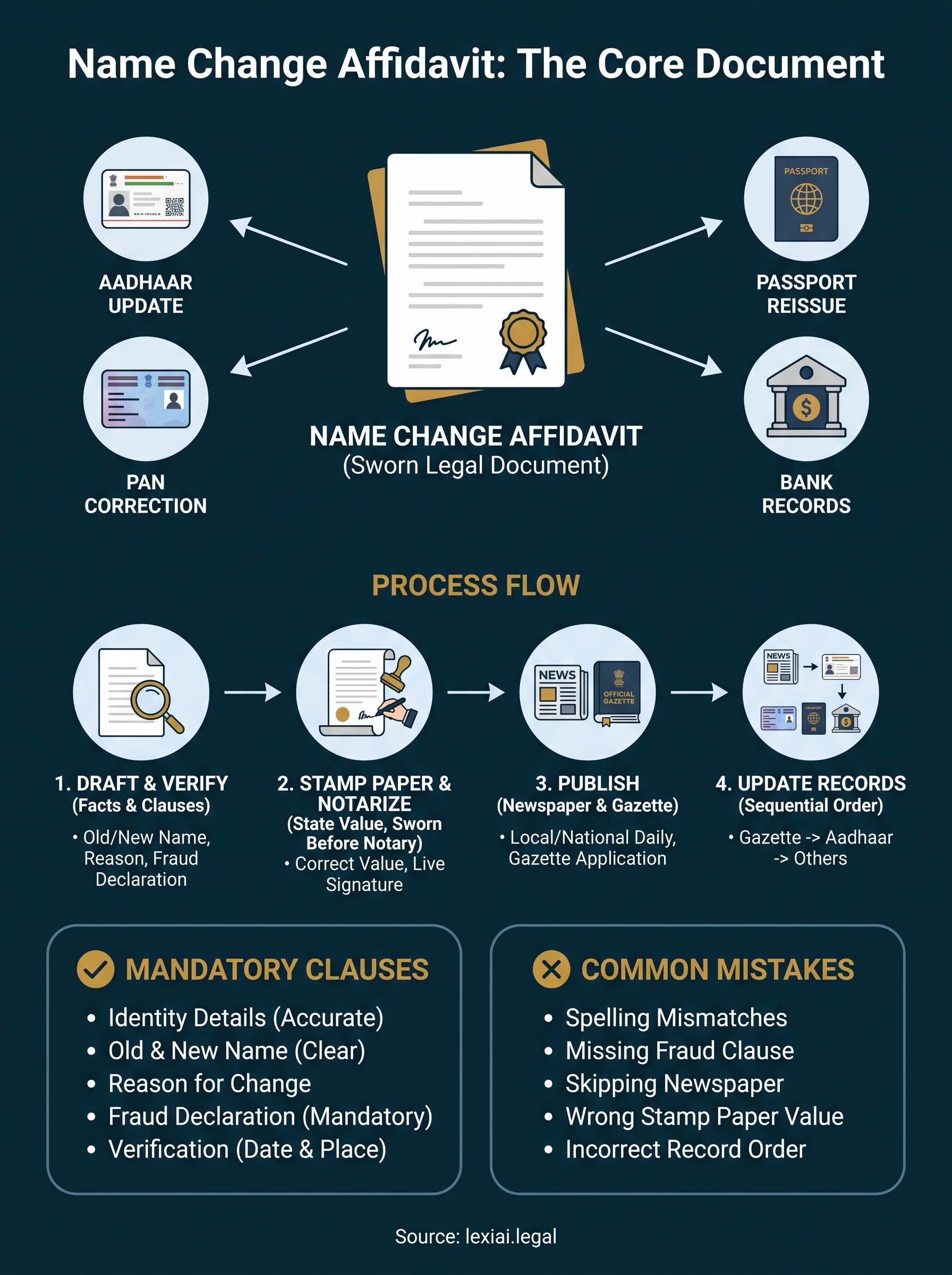
- Deponent's full details and address
- Old name and new name stated clearly
- Reason for the change
- Declaration that the change is not for fraud
- Verification clause with date and place
Once drafted, print it on the stamp paper, sign it, and carry your identity proof to the notary. Tools like LeXi AI can generate a compliant draft in minutes, checking that mandatory clauses are not missing before you pay for stamp paper and notarization.
Sample name change affidavit format
Here is a template you can adapt for your own affidavit. Fill in your details exactly as they appear on your existing identity documents, then take it to a notary along with the correct stamp paper.
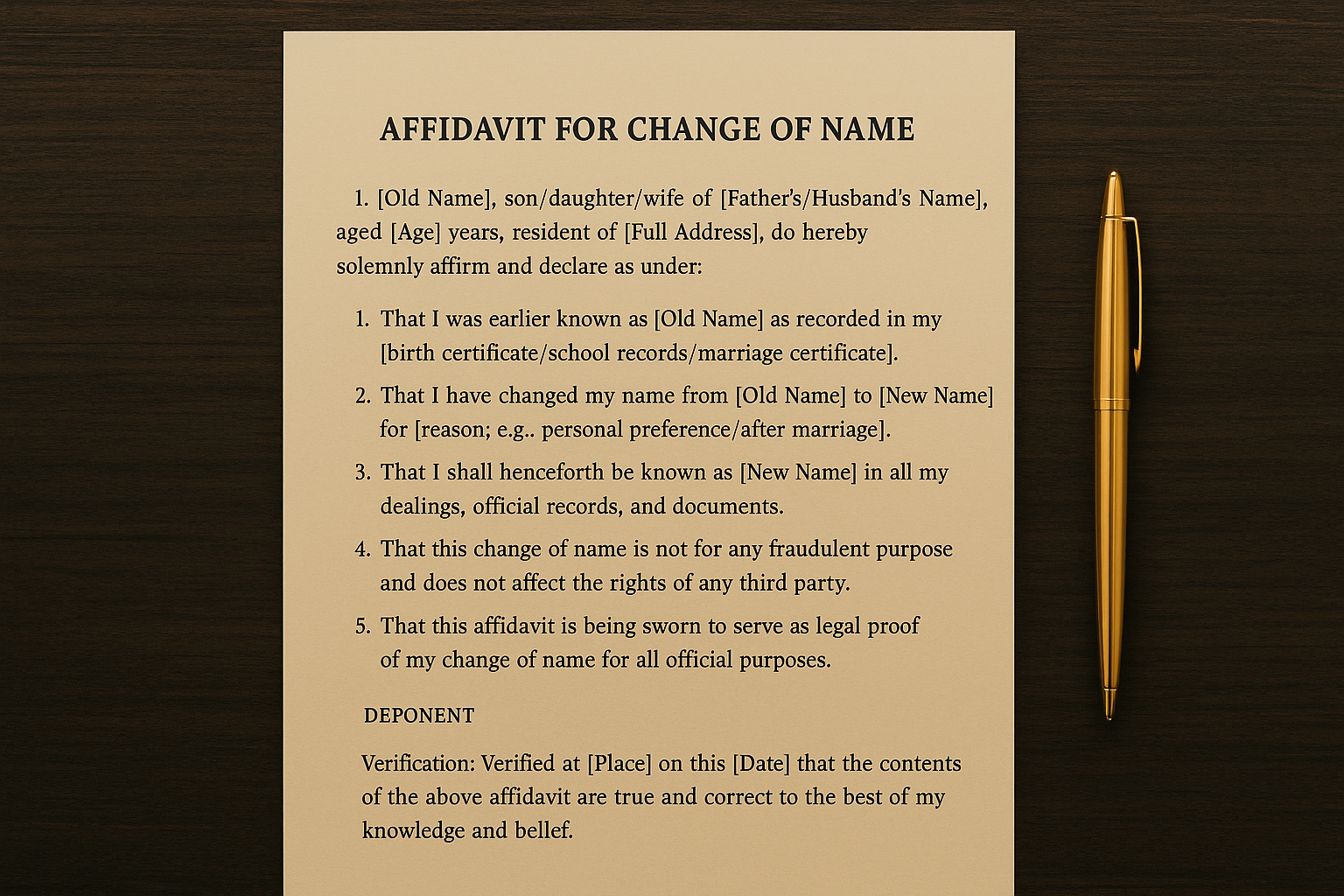
AFFIDAVIT FOR CHANGE OF NAME

I, [Old Name], son/daughter/wife of [Father's/Husband's Name],
aged [Age] years, resident of [Full Address], do hereby
solemnly affirm and declare as under:

1. That I was earlier known as [Old Name] as recorded in my
   [birth certificate/school records/marriage certificate].
2. That I have changed my name from [Old Name] to [New Name]
   for [reason: e.g., personal preference/after marriage].
3. That I shall henceforth be known as [New Name] in all my
   dealings, official records, and documents.
4. That this change of name is not for any fraudulent purpose
   and does not affect the rights of any third party.
5. That this affidavit is being sworn to serve as legal proof
   of my change of name for all official purposes.

DEPONENT

Verification: Verified at [Place] on this [Date] that the
contents of the above affidavit are true and correct to the
best of my knowledge and belief.

DEPONENT
A clean, complete affidavit format saves you multiple trips to the notary and the gazette office.
Just remember that this sample name change affidavit format is a starting point, not a final draft.
Local notaries sometimes insist on additional local-language clauses, so confirm before printing your final copy on stamp paper.
What to do after the affidavit is drafted
Once your affidavit is ready, printing it is not the finish line. You still need to get it notarized or attested and then use it to update every record that carries your old name.
Get it notarized or attested by a magistrate
Carry the printed affidavit, your original identity proof, and a photocopy to a notary public or first-class magistrate. Sign the affidavit in front of the notary, not before, since some notaries reject pre-signed documents. The notary stamps and signs it, and that stamp is what makes the document legally usable.
Publish it in the newspaper and gazette
Most states expect a newspaper publication announcing the name change in one local and one national daily before or alongside the gazette application. Submit the notarized affidavit, the newspaper clippings, and the gazette form to the Department of Publication.
A notarized affidavit without newspaper publication or gazette filing is only half the job done.
Update your identity documents in order
Follow a sequence rather than applying everywhere at once:
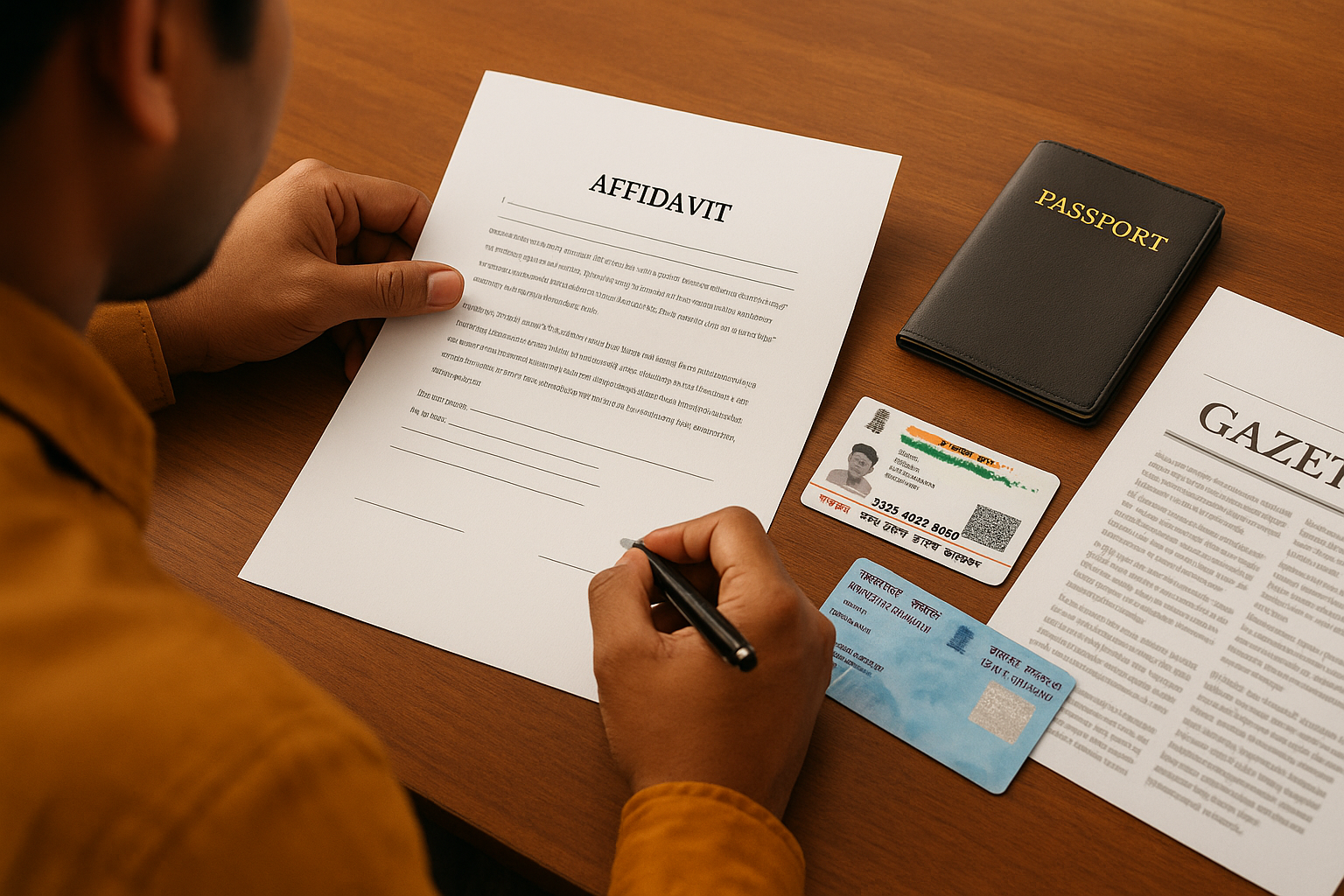
- Gazette notification first
- Aadhaar next
- PAN, passport, and bank records after that
This order avoids mismatches between databases.
Common mistakes that delay a name change
Offices reject affidavits more often for small errors than for big legal defects. Most delays trace back to inconsistent spellings, missing clauses, or skipping a required step in the sequence.
Spelling and detail mismatches
Spelling your old name one way on the affidavit and another way on your birth certificate is the single biggest reason gazette applications bounce back. Common spelling mismatches include:
- Middle name included on one document, dropped on another
- Father's name spelled differently across records
- Date of birth format inconsistent with Aadhaar
Missing the fraud declaration clause
Any affidavit that skips the declaration confirming the change is not for a fraudulent purpose gets flagged by notaries and government reviewers alike. This clause protects both you and the authority accepting the document, so never leave it out.
A single missing clause can send your entire application back to the drafting stage.
Skipping newspaper publication before gazette filing
Applicants sometimes file the gazette form without newspaper clippings, assuming the affidavit alone suffices. Departments reject these files outright, and you lose weeks waiting for the next submission cycle.
Using the wrong stamp paper value
Every state fixes its own stamp duty, and using an outdated or incorrect value invalidates the document at the notary stage itself.
Getting your name change documentation right
A name change affidavit is not complicated, but every clause has to be accurate and every spelling has to match your existing records exactly. Get the stamp paper value, the fraud declaration, and the verification clause right, and your gazette, Aadhaar, and passport updates move through without a single rejection. Skip a clause or misspell your father's name, and you lose weeks resubmitting paperwork that should have taken a single visit to the notary.
Rushing this document costs you more time than drafting it carefully the first time. If you want a compliant draft without missing a mandatory clause, LeXi AI checks your affidavit against standard legal requirements before you spend money on stamp paper and notarization. It also helps with the gazette form, newspaper notice, and every other filing that follows. Sign up for LeXi AI and get your name change documentation right the first time.