

How to Send a Legal Notice Online in India: Step-by-Step
You can send a legal notice online in India, but the process has limits you should know before you start. A notice drafted by you or an advocate can be delivered by email, WhatsApp, speed post, or registered post. Courts and statutes care less about the channel and more about proof of delivery and the contents of the notice.
The short answer is this. Draft the notice with the facts, the demand, and a clear deadline. Send it by registered post AD or speed post, and send a copy by email as backup. Keep the postal receipt, the tracking report, and the delivery acknowledgment. For cheque bounce matters, Section 138 of the Negotiable Instruments Act, 1881 requires the notice within 30 days of the bank memo. Free templates exist, but a notice signed by an advocate carries more weight.
This guide walks you through each step, from gathering facts to choosing a delivery mode and storing proof. It also covers when email and WhatsApp are enough, and when they are not. Where it helps, you will see how an AI tool such as LeXi AI can speed up the first draft.
Is an online legal notice valid in India?
Yes, an online legal notice is valid in India if it is in writing, reaches the right person, and you can prove it. No law says a notice must travel by post alone. Validity depends on content and proof of service, not on whether you used a website, an email account, or a post office counter.
What the law says about electronic notices
Section 4 of the Information Technology Act, 2000 gives electronic records the same recognition as paper wherever the law requires writing. Section 13 of the same Act fixes when an electronic message counts as dispatched and received. This is the basis on which an online legal notice in India is treated as a written communication.
Proof is where most senders slip. Under Section 63 of the Bharatiya Sakshya Adhiniyam, 2023, which replaced Section 65B of the Indian Evidence Act, 1872, an email or WhatsApp printout is admissible only with a certificate in the prescribed form. Prepare that certificate when you send the notice, not when the dispute reaches court.
How each delivery channel holds up
Each channel gives you a different kind of proof, and that difference decides how safe it is.
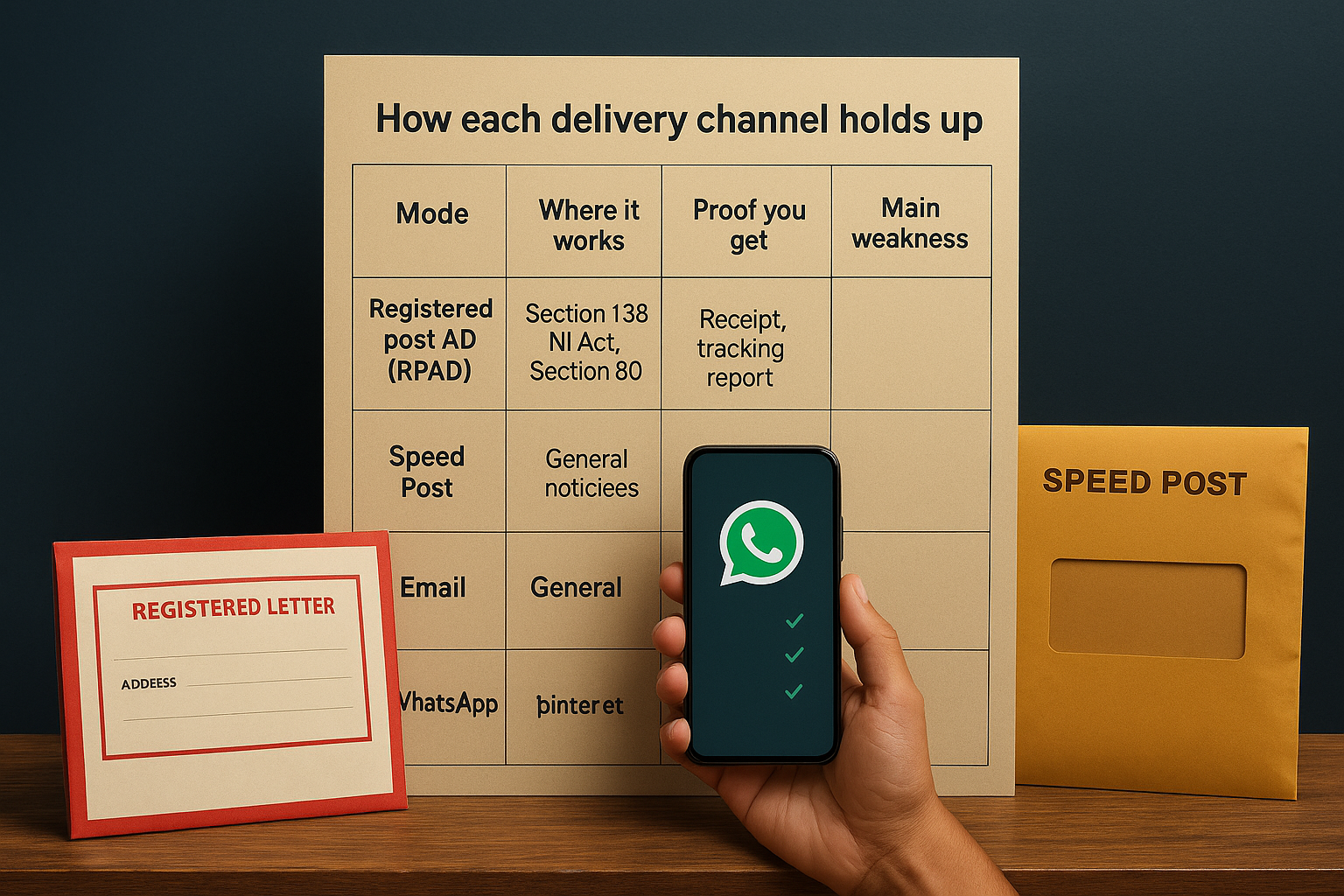
| Mode | Where it works | Proof you get | Main weakness |
|---|---|---|---|
| Registered post AD (RPAD) | Section 138 NI Act, Section 80 CPC, all general notices | Receipt, tracking report, AD card | Slower, may return as refused |
| Speed Post | Most general notices | Receipt and tracking report | Needs the tracking printout to show delivery |
| General civil and commercial notices, as a copy | Sent item, headers, read receipt | Needs a Section 63 certificate, recipient may deny it | |
| Backup only | Delivery ticks, screenshots | Disputes over number and identity |
Courts have long accepted postal service to a correct address. In C.C. Alavi Haji v. Palapetty Muhammed (2007) 6 SCC 555, the Supreme Court held that a notice sent by registered post to the correct address is presumed served, even if the addressee says it never arrived.
A notice is only as valid as your proof that it went to the right address and was received.
Where an online notice can fail
Price does not affect validity. You can send a legal notice online free using a template, and a paid online legal notice service mainly adds drafting help and dispatch convenience. The law asks whether the notice is clear, signed, and served. It does not ask who charged you.
These are the points where senders most often lose the benefit of a notice:
- Government as the recipient. Section 80 of the Code of Civil Procedure, 1908 requires a two-month written notice, delivered or left at the office of the concerned officer. Do not rely on email alone.
- Wrong or incomplete address. The presumption of service in the Alavi Haji case depends on a correct address. A typo can undo it.
- No evidence certificate. Email and WhatsApp copies without a Section 63 certificate are easy to challenge.
- Missed deadlines. A Section 138 notice sent after 30 days from the bank memo is defective, whatever the channel.
Step 1. Identify the notice type and legal basis
Before you draft anything, decide what kind of notice your dispute needs. The type fixes the deadline, the content, and the delivery mode. This is the first decision when you want to send legal notice online and have it hold up later.
Match your dispute to the statute
Some notices are mandatory. Others are not required by law but are still wise before you file a suit. Check whether a statute makes the notice a precondition, because skipping a mandatory notice can end your case before it starts.
| Situation | Legal basis | Key timeline |
|---|---|---|
| Dishonored cheque | Section 138, Negotiable Instruments Act, 1881 | Notice within 30 days of the bank memo. The drawer gets 15 days to pay |
| Suit against the government | Section 80, Code of Civil Procedure, 1908 | Two months before filing |
| Month-to-month tenant | Section 106, Transfer of Property Act, 1882 | 15 days to quit |
| Unpaid operational debt from a company | Section 8, Insolvency and Bankruptcy Code, 2016 | 10 days to reply or pay |
| Money recovery, breach of contract, defamation | No statutory mandate | Check the contract and the Limitation Act, 1963 |
Confirm the deadline and the recipient
The deadline matters most in cheque bounce cases. Send the notice on day 31 after the bank memo and the Section 138 complaint fails. If the drawer does not pay within 15 days of receiving the notice, you must file the complaint within one month under Section 142.
The statute, not the website you use, sets your deadline.
Next, identify the recipient exactly. Use the full legal name of the person or company, and for a company use the registered office address from the MCA records. If your contract has a notice clause, follow its address and mode of service strictly. For other disputes, most money claims must be filed within three years, so note that date too. A tool such as LeXi AI can suggest the likely provision from your facts, but verify it against the bare Act before you proceed.
Step 2. Draft the notice with the essential elements
A notice works when the recipient and a judge can read it once and understand the dispute. Aim for one to two pages of plain language. Whether you draft a legal notice online from a template or have an advocate prepare it, the same elements apply.
What to include in the notice
Every notice should carry the following, in this order:

- Sender and recipient details: full names, addresses, mobile numbers, and email IDs.
- Date and reference number, so you can trace the notice later.
- Facts in date order: the agreement, payment, cheque, or event, with exact amounts.
- Legal basis: the section or contract clause you rely on.
- A specific demand: the exact sum to pay or the act to perform.
- A deadline: 15 days for a Section 138 notice, and usually 15 to 30 days for other notices.
- Consequences: a statement that you will file a civil suit or criminal complaint if the demand is not met.
- Signature and enclosures: your signature or your advocate's, with the enrollment number, and a list of attached documents.
For a cheque bounce notice, state the cheque number, date, amount, and drawee bank, along with the date and reason on the return memo. Section 138 requires a demand for payment of the cheque amount, so state that amount clearly. List any interest or costs separately so the main demand stays unmistakable.
A good notice states facts and a demand, not anger.
How to create a legal notice online without errors
When you create a legal notice online, begin with a template for your notice type and replace every placeholder. Cross-check each name, date, and figure against your documents. A wrong cheque number or a mismatched date hands the other side an easy objection.
Keep the tone factual. Avoid abusive language and allegations you cannot prove, because the notice will be read in court later. An AI tool such as LeXi AI can produce a first draft from your facts and suggest the relevant clauses. Read the full draft yourself and have an advocate review it before anyone signs.
Step 3. Send it by RPAD, Speed Post, email or WhatsApp
Use two channels together. Post gives you proof of service, and email gives you a fast, free backup copy. However you choose to send a legal notice online, the trail must show who sent what, to whom, and when.
Send by RPAD or Speed Post
Registered post with acknowledgment due is the channel courts trust most. Follow these steps at the post office counter:
- Print the signed notice in three copies, one for each recipient address and one for your file.
- Ask for registered post with AD, or Speed Post if you need faster delivery.
- Copy the address exactly as written in the notice onto the envelope.
- Keep the receipt showing the article number.
- Track the article on the India Post portal and print the delivery or refusal status.
Under Section 27 of the General Clauses Act, 1897, service by registered post is presumed once the letter is properly addressed, prepaid, and posted. A refusal or an unclaimed remark usually still supports your case, so keep the returned envelope sealed.
Add email and WhatsApp as backup
Email costs nothing and arrives in seconds. Send the notice as a PDF from your own ID to the address in the contract or earlier correspondence, and copy yourself. Save the sent item with full headers, and prepare the Section 63 certificate at the same time.
Post is your proof of service, and email is your backup.
WhatsApp comes last. Send the PDF to the number the other party has used in dealings with you, and take screenshots that show the delivery ticks. Treat it as a courtesy copy, because disputes over who owns the number are common.
Online services need one check. Confirm that the service dispatches by RPAD and gives you the tracking number. A free tool that only emails the notice is not enough for a Section 138 case.
Step 4. Keep proof and plan for the reply
Sending the notice is only half the job. What you keep afterward decides whether the notice helps you in court. If you send legal notice online through a service, you still need to hold the records yourself.
What to store in your proof file
Gather every record in one place on the day of dispatch. A complete proof file lets an advocate file a complaint or suit without chasing documents. Your file should hold:
- The signed notice with all enclosures
- The postal receipt showing the article number
- The tracking printout showing delivered, refused, or unclaimed
- The AD card, once it comes back
- The email sent item with headers, plus the Section 63 certificate
- WhatsApp screenshots showing the delivery ticks
Keep the paper items in a sealed cover and back up the digital items to cloud storage. Never edit or rename the original email and chat files, because changes weaken the certificate.
How to track the deadline and the reply
Mark the response period in your calendar the day you post. In a cheque bounce case, the drawer has 15 days from receipt to pay. If the money does not arrive, you must file the complaint within one month after that period ends, as Section 142 of the Negotiable Instruments Act requires.
Calendar the deadline the day you post, because the notice period starts the clock on your next move.
For other notices, wait until the date you stated. Then check your bank account, email, and post before you decide on the next step.
What to do when the other side replies
A reply usually admits the claim, disputes it, or offers a settlement. Read it against your documents and note every factual claim you can disprove. Do not ignore a counter-allegation, because silence can look like acceptance.
If you receive a settlement offer, record any agreement in writing before you accept money. For commercial disputes, Section 12A of the Commercial Courts Act, 2015 generally requires pre-institution mediation before you file a suit, unless you seek urgent interim relief. An advocate can tell you whether your dispute falls under it.
What to do next
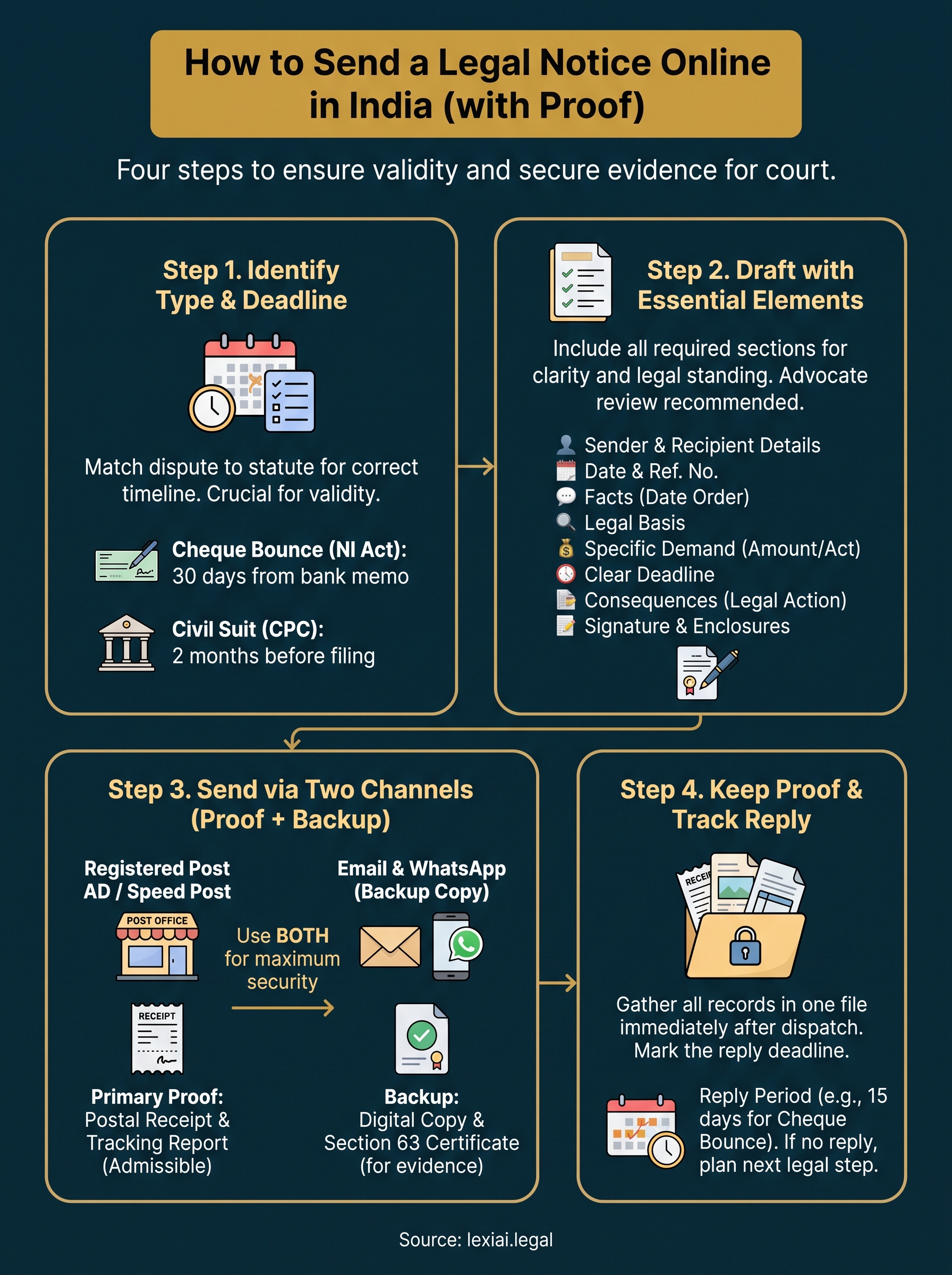
Four steps decide whether you can send a legal notice online and have it hold up later. Identify the statute and its deadline, draft a clear demand, serve it by RPAD or Speed Post with an email copy, and keep every record in one proof file.
Start today by gathering your documents and checking the deadline for your notice type. If a Section 138 timeline is running, every day counts. Have an advocate review the draft before anyone signs it.
If you want a faster first draft, try LeXi AI for free to turn your facts into a structured notice and check the relevant provisions. Then read the draft yourself and dispatch it with proof of service before the period runs out.