

Cheque Bounce Case Procedure: How to File under Section 138
The cheque bounce case procedure under Section 138 of the Negotiable Instruments Act, 1881 follows a strict sequence: dishonor of the cheque, a demand notice within 30 days, a 15 day window for the drawer to pay, and then a complaint filed within 30 days if payment does not come through. Miss any one of these deadlines and your case can collapse on a technicality, regardless of how strong the facts are. This is exactly where most complainants, and sometimes their lawyers, lose valuable ground.
This guide answers the practical question every payee or advocate asks after a cheque returns unpaid: what do I file, when do I file it, and where. We walk through the legal notice requirements, the jurisdiction rules under Section 142, the documents needed to draft the complaint, and the penalties a convicted drawer faces, including imprisonment up to two years and fine up to twice the cheque amount.
We also cover common defenses raised by accused persons, how courts have interpreted timelines in recent judgments, and where drafting accuracy and quick case preparation matter most. For lawyers handling volume cheque bounce litigation, LeXi AI's drafting and research modules can speed up notice drafting and complaint preparation, though the procedural steps below remain the same whether you draft manually or with assistance.
What counts as a cheque bounce under Section 138
Not every dishonored cheque gives you a case. Section 138 of the NI Act on cheque bounce applies only when a cheque is returned unpaid for insufficiency of funds, or because the amount exceeds an arrangement made with the bank, and the cheque was issued to discharge a legally enforceable debt or liability. A cheque given as a gift, or one dishonored for a signature mismatch unrelated to funds, generally falls outside Section 138.
The conditions that must all be met
Courts read Section 138 strictly. You need each of these elements present before you can even draft a notice.
- The cheque was drawn on an account maintained by the drawer.
- It was presented within its validity period, now three months from the date on the cheque.
- The bank returned it unpaid for funds, or an amount exceeding the arrangement.
- The cheque was issued toward a debt or liability that existed at the time of issue.
A cheque bounce case survives only if the underlying debt was real and legally enforceable when the cheque was signed.
Common reasons banks return cheques
| Return reason | Section 138 applicable? |
|---|---|
| Insufficient funds | Yes |
| Funds exceed arrangement | Yes |
| Signature mismatch | No |
| Account closed before issue | Usually no, treated as fraud under other provisions |
| Post-dated cheque presented early | No, until due date |
The cheque bounce case procedure only kicks in once the return memo confirms one of the two qualifying reasons. Everything that follows, the notice, the waiting period, and the complaint, depends on getting this classification right at the outset. If the bank's memo cites a reason outside Section 138, you may still have a civil recovery remedy, usually starting with a notice for recovery of unpaid dues, but not a criminal complaint under this section.
Step 1. Collect the cheque return memo from your bank
Your bank issues a cheque return memo the moment it dishonors a cheque, and this document is the foundation of your entire case. Without it, you cannot prove the date of dishonor, which starts every clock that follows in the cheque bounce complaint process. Ask your bank for the memo the same day the cheque bounces, since delays here only shrink your working window later.
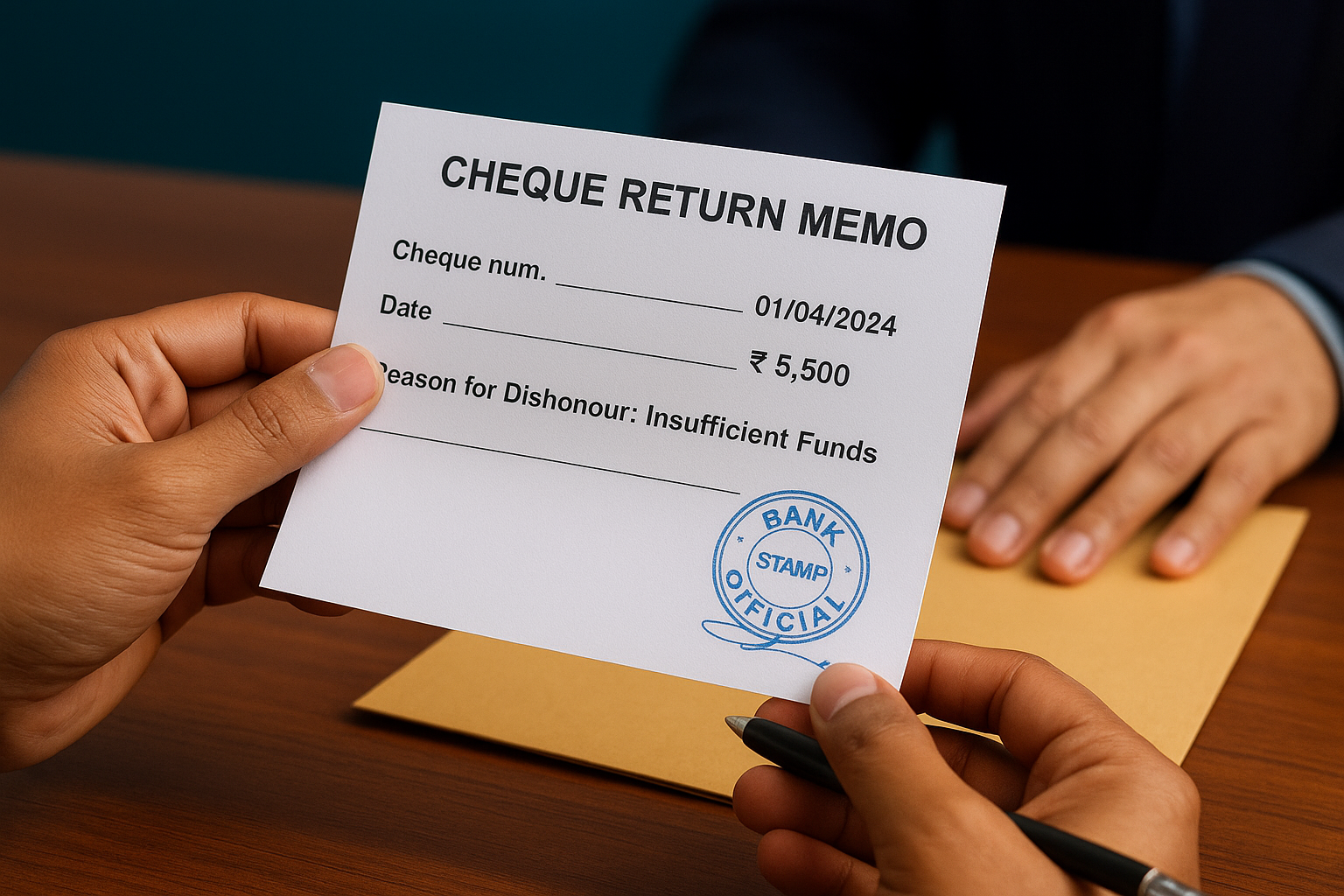
Request the memo in writing if the branch does not hand it over automatically. Most banks issue it within one or two working days, and it lists the exact reason for dishonor, either insufficient funds or funds exceeding the arrangement.
What the memo must show
Check the memo for these details before you proceed:
- The cheque number, date, and amount
- The date of presentation and the date of return
- The specific reason for dishonor, stated in bank terminology
- The bank's official stamp and signature
No memo, no case. The return memo is the single document that proves dishonor occurred and fixes your notice deadline.
Keep the original cheque and the memo together with your bank statement. You will need certified copies of both when you eventually file the complaint before the Magistrate.
Step 2. Send a demand notice within 30 days
Once you have the return memo in hand, the clock starts ticking. You must send a legal demand notice to the drawer, following a sample cheque bounce notice format, within 30 days from the date you received the memo, not the date the cheque bounced. Miss this window and Section 138 stops applying entirely, no matter how genuine the debt.
Draft the Section 138 notice in writing, addressed to the drawer at their last known address, and demand payment of the cheque amount within 15 days of receipt. Send it by registered post or speed post with acknowledgment due, since you will need proof of dispatch and delivery later.
What the notice must state
- The cheque number, date, and amount
- The date of dishonor and the reason cited by the bank
- A clear demand for payment within 15 days
- A warning that non-payment will trigger prosecution under Section 138
A demand notice sent even one day late can end your case before it starts.
Keep a copy of the notice, the postal receipt, and the tracking confirmation. These documents become central exhibits once you file the cheque bounce complaint later.
Step 3. Wait for the drawer's 15-day payment window
After the drawer receives your notice, the law gives them a full 15 days to pay, or to send a reply to the Section 138 notice, before you can treat the debt as unpaid. This statutory waiting period exists to give the drawer a genuine chance to settle, and courts do not tolerate complaints filed even a day early. The cause of action under Section 138 arises only after this window closes without payment, so patience here is not optional.
What happens if the drawer pays during this period
If the drawer pays the full cheque amount within these 15 days, your right to prosecute ends immediately. No cause of action arises, and any complaint filed afterward gets dismissed regardless of earlier defaults. Track the date of deemed receipt of your notice carefully, since courts calculate the 15 days from that date, not from when you posted it.
File one day before the 15-day window closes, and the entire cheque bounce case procedure can collapse on this technicality alone.
Once the 15 days pass without payment, mark the 16th day. Your 30-day clock to file the complaint before the Magistrate starts running from there.
Step 4. File the criminal complaint before the Magistrate
Once the 15-day window closes without payment, you have exactly 30 days to file your criminal complaint before the Magistrate. This deadline runs from the 16th day after notice service, and courts rarely condone delay without a strong explanation supported by an application under Section 142(2) of the NI Act.
Where to file: the jurisdiction rules
File the complaint before the Magistrate having jurisdiction over the branch where you maintain the account on which the cheque was presented for collection. This rule, settled after amendments to Section 142, ends the earlier confusion over multiple possible venues.
Filing in the wrong court can undo months of careful notice compliance, so verify jurisdiction before you draft the complaint.
Documents to attach
- Original cheque and the bank return memo
- Copy of the demand notice with postal proof of dispatch and delivery
- Sworn affidavit and a statement of the underlying debt or liability
- Verification statement as required under Section 200 Cr.P.C.
Get the complaint drafted precisely here, since Magistrates dismiss vague or incomplete complaints at the very first hearing.
Step 5. Follow through summons, trial, and possible appeal
Filing the complaint only starts the judicial phase. Once the Magistrate takes cognizance, the court issues summons to the accused, and the drawer must appear and respond to the charge. Many accused persons seek to delay proceedings here, so stay alert to adjournment requests that stretch beyond genuine need.
What happens during trial
The trial proceeds through evidence, cross-examination, and final arguments, much like any criminal case, though Section 143 permits summary trial for faster disposal in most instances. You will need to prove the debt, the dishonor, and valid notice compliance through your documents and testimony.
Winning a cheque bounce case depends less on courtroom argument and more on the paperwork you assembled in the first sixty days.
If either side wants to appeal
Conviction can bring imprisonment up to two years, fine up to twice the cheque amount, or both. Either side may appeal to the Sessions Court, and acquittal does not close your civil recovery options if the underlying debt still stands unpaid.
Getting the timelines right
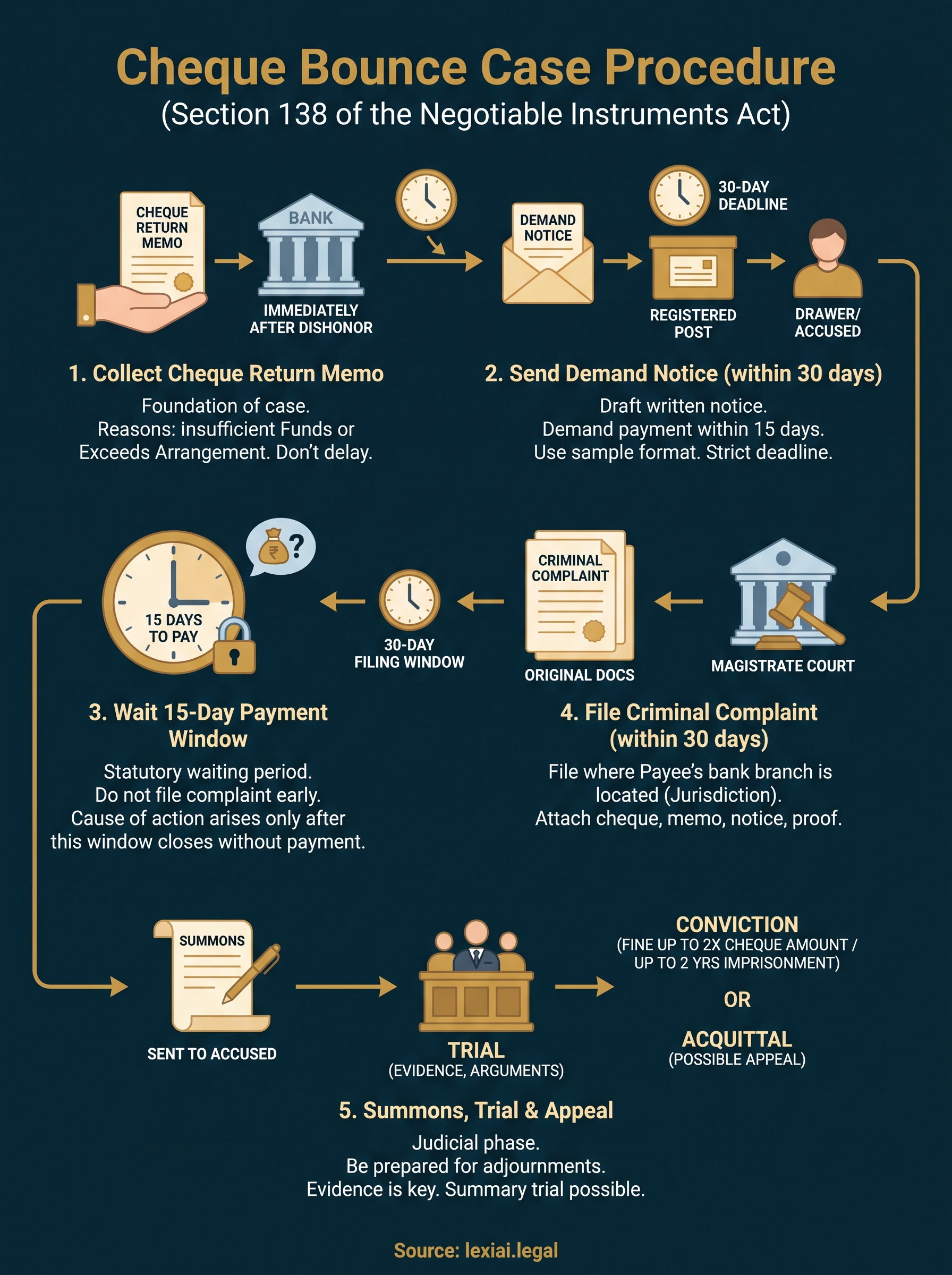
The cheque bounce case procedure rewards discipline more than eloquence. Get the return memo the day the cheque bounces, send the notice within 30 days, wait out the drawer's 15 days without flinching, and file the complaint within the next 30 days. Every stage in this sequence exists to protect a genuine creditor, but courts enforce the deadlines without sympathy for missed dates.
Questions about jurisdiction, drafting the notice correctly, or assembling the right documents come up constantly, and getting them wrong costs more than time. It costs the case itself. If you handle several cheque bounce matters and want the notice and complaint drafting done faster without cutting corners on accuracy, test LeXi AI free on your next Section 138 filing and see how it handles the drafting groundwork. The law does not forgive a late notice. Your process should not create one either.