

Written Statement Format: How to Draft One under CPC
A written statement format follows a fixed structure under Order VIII Rule 1 of the Code of Civil Procedure, 1908. It is the defendant's formal reply to the plaint, filed within 30 days of summons, extendable up to 90 days with the court's permission. Get the structure wrong, and the court can strike out your defense or treat facts as admitted under Order VIII Rule 5.
If you are searching for a sample format, you need one that covers the cause title, para-wise replies to the plaint, a preliminary objections section, and a verification clause signed by the defendant. Each paragraph of the plaint must get a specific admission or denial, since vague or evasive denials are treated as admissions under Order VIII Rule 5(1).
This guide walks through each section of the format with a working template you can adapt for your suit. It also covers common drafting mistakes lawyers make, including how drafting software built for Indian pleadings such as LeXi AI can speed up clause-level drafting and reduce the time spent on repetitive court filings.
What is a written statement under Order VIII CPC?
A written statement is the defendant's formal pleading in reply to a plaint, filed under Order VIII Rule 1 of the Civil Procedure Code that governs civil suits in India, 1908. It is not a letter or a general denial. It is a structured legal document that responds to every material fact the plaintiff has alleged, and it sets out any additional facts or legal grounds the defendant wants the court to consider. Courts treat this document as the foundation of the defense, so its format matters as much as its content.
The legal basis under Order VIII Rule 1
Order VIII Rule 1 requires the defendant to present a written statement of defense at or before the first hearing, or within the time fixed by the court. In practice, most civil courts across India follow a fixed timeline rather than leaving it open-ended. The Supreme Court's ruling in Salem Advocate Bar Association v. Union of India (2005) 6 SCC 344 clarified that the 90-day outer limit applies even in commercial disputes, though courts retain discretion in ordinary suits.
Timelines and extensions
The standard rule gives the defendant 30 days from service of summons to file the written statement. Courts can extend this period, but only for reasons recorded in writing, and the total period cannot ordinarily exceed 90 days from the date of service.
| Stage | Timeline | Governing Provision |
|---|---|---|
| Standard filing period | 30 days from service of summons | Order VIII Rule 1 |
| Maximum extension (with reasons recorded) | Up to 90 days from service | Order VIII Rule 1, proviso |
| Commercial Courts Act suits | Strict 120-day outer limit, no extension beyond | Commercial Courts Act, 2015, Order VIII Rule 1(1) as amended |
What happens if you miss the deadline
Missing the deadline carries real consequences. Under Order VIII Rule 10, if the defendant fails to file within the time permitted, the court may pronounce judgment against them or pass any other order it deems fit, including forfeiting the right to file a written statement altogether. Judges rarely show leniency once the 90-day (or 120-day, in commercial suits) ceiling passes, so treat the deadline as fixed rather than flexible.
A written statement filed late, or drafted with vague denials, can cost you the case before you ever argue the facts.
Key rules that shape the format
Three provisions inside Order VIII do the heavy lifting when it comes to structure. Rule 5 says that every allegation of fact in the plaint, if not specifically denied or stated to be not admitted, is taken as admitted, except against a person under a disability. This is why para-wise replies exist, and why a blanket denial almost always fails. Rule 6 deals with set-off, letting a defendant claim a liquidated, ascertained sum owed by the plaintiff within the same suit. Rule 6A covers counterclaims, which let the defendant raise an independent cause of action against the plaintiff, even one not directly connected to the plaint's subject matter, as long as it falls within the court's jurisdiction.
Together, these rules explain why a proper written statement is never a simple denial letter. It has to track the plaint paragraph by paragraph, flag preliminary objections up front, and end with a verified prayer clause. Get any one section wrong, and you risk admissions you never intended to make, or a set-off claim that gets dismissed on a technicality. The next sections walk through each part of that structure in the order courts expect to see it.
Step 1. Study the plaint and gather your documents
Before you touch a written statement format, read the plaint at least twice. First for the story the plaintiff wants the court to believe, second for every factual allegation, numbered paragraph by numbered paragraph. You cannot draft an accurate para-wise reply if you skim the plaint, since Order VIII Rule 5 punishes vague responses by treating them as admissions.
Break the plaint into a working chart
Create a simple three-column chart before you write a single line of the written statement. List the plaint paragraph number, a one-line summary of what it alleges, and your client's instructions on that fact. This chart becomes the backbone of your para-wise reply in Step 4, and it forces you to confront paragraphs your client has not yet addressed.
A written statement is only as strong as the plaint chart behind it.
Collect the documents that support your defense
Gather every document your client holds that relates to the dispute, not just the ones that help you. Courts under Order VIII Rule 1A require the defendant to file documents relied upon along with the written statement, or explain in writing why they are not annexed. Missing this step at the drafting stage often means scrambling for certified copies later, right before the filing deadline.
Build a document checklist before you start writing:
- The original contract, agreement, or correspondence forming the basis of the suit
- Payment records, invoices, or bank statements relevant to any monetary claim
- Notices exchanged between the parties, including the plaintiff's legal notice and your client's reply to that notice
- Any prior court orders, arbitration awards, or settlement communications touching the dispute
- Identity and authority documents if the defendant is a company or partnership, such as board resolutions or a properly executed power of attorney document
Interview your client with specific questions
General questions produce general answers, and general answers produce weak denials. Ask your client pointed questions tied to each plaint paragraph, such as dates, amounts, and names mentioned in the pleading. Pin down whether a fact is fully admitted, partly admitted, or flatly denied, because that distinction decides how you draft each reply in Step 4.
Platforms such as LeXi AI's drafting and case workspace can speed up this stage by flagging inconsistencies between the plaint and the client's documents before you draft a single paragraph. Once your chart, documents, and client instructions are in place, you are ready to move on to the formal opening of the written statement, the cause title and party details.
Step 2. Draft the cause title and party details
Every written statement format opens with a cause title that mirrors the plaint exactly, including the court's name, the suit number, and the full names and addresses of every party. Copying this from the plaint verbatim avoids a common drafting error: a mismatched cause title can get your written statement returned by the registry before a judge even sees it. Do not shorten party names or drop suffixes like "proprietor" or "through its Managing Director," since courts treat these details as part of the formal record.
Match the plaint's cause title precisely
Check the plaint's first page against your draft, line by line, before you move forward. Confirm the court name, the case number assigned after registration, and the exact spelling of each party's name, since typos here create confusion when the file moves between benches. If the plaintiff has amended the cause title after your client received summons, use the amended version, not the original one served on your client.
Sample cause title template
Use this structure as your starting point, and adjust the bracketed fields to match your suit:
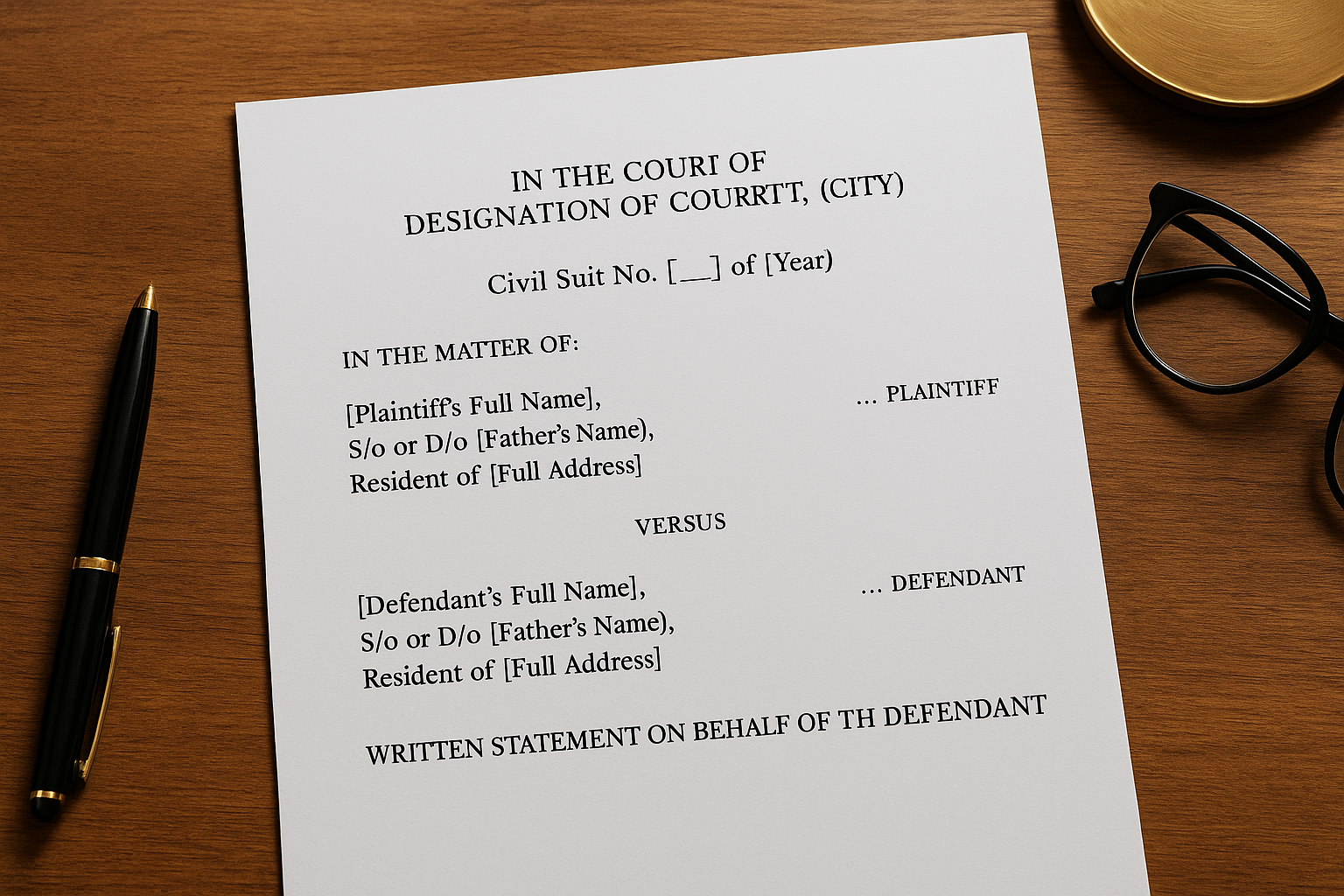
IN THE COURT OF [DESIGNATION OF COURT], [CITY]

Civil Suit No. [___] of [Year]

IN THE MATTER OF:

[Plaintiff's Full Name],
S/o or D/o [Father's Name],
Resident of [Full Address]                                    ... PLAINTIFF

VERSUS

[Defendant's Full Name],
S/o or D/o [Father's Name],
Resident of [Full Address]                                    ... DEFENDANT

WRITTEN STATEMENT ON BEHALF OF THE DEFENDANT
Get one name or one address wrong in the cause title, and the registry can return your filing before the judge reads a single defense argument.
List every party correctly, including added defendants
Handle multi-party suits with particular care, since each defendant or plaintiff needs a separate, correctly numbered entry. Number defendants exactly as the plaint numbers them, even if your client is Defendant No. 3 and the suit involves five other parties. Skipping a party number, or renumbering them for convenience, creates confusion during hearings and can delay orders on interim applications.
Once the cause title and party details are locked in, move to the substance of your defense. The preliminary objections section comes next, and it sets up the legal arguments that can dispose of the suit before the court even reaches the facts.
Step 3. Raise your preliminary objections
Preliminary objections sit right after the cause title, before you touch a single fact from the plaint. These are the threshold issues that can dispose of the suit entirely, so raise them first and raise them clearly. Courts read this section closely because a valid objection on limitation or jurisdiction can end litigation without anyone arguing the merits.
Common grounds for preliminary objections
Most written statements raise a fixed set of objections, and you should check each one against your case before drafting. Skipping this check is how lawyers lose a limitation defense they never pleaded.
| Objection | Legal Basis | Effect if Successful |
|---|---|---|
| Suit barred by limitation | Limitation Act, 1963, read with Order VII Rule 11(d) CPC | Plaint rejected outright |
| Court lacks pecuniary or territorial jurisdiction | Section 9, Order VII Rule 10 CPC | Suit returned for filing in correct court |
| No cause of action disclosed | Order VII Rule 11(a) CPC | Plaint rejected |
| Non-joinder or misjoinder of parties | Order I Rules 9 and 10 CPC | Suit may be dismissed or amended |
| Suit undervalued for court fee | Court Fees Act, 1870, applicable state amendments | Plaint returned for correction |
| Matter covered by an arbitration clause | Section 8, Arbitration and Conciliation Act, 1996 | Parties referred to arbitration |
Draft each objection as a numbered, separate paragraph
Number every objection independently, and keep each one to a single legal point rather than mixing arguments. A typical opening reads: "That the suit as filed is barred by limitation, since the cause of action, if any, arose on [date], and the suit was filed beyond the period prescribed under Article [X] of the Limitation Act, 1963." Follow the same pattern for jurisdiction, court fee, or arbitration objections, citing the exact statutory provision each time.
A preliminary objection without a cited provision reads as an argument, not a defense the court can act on.
Only raise objections you can actually support with facts already on record or documents you plan to file. Weak or copy-pasted objections invite the court's skepticism and can undercut the stronger points raised later in your para-wise reply, which is where the real factual battle of the suit begins.
Step 4. Draft the para-wise reply
The para-wise reply is the core of any written statement format, and it demands a response to every single paragraph of the plaint, in the same numbered sequence. Skipping a paragraph, or lumping three plaint paragraphs into one vague reply, hands the plaintiff an admission under Order VIII Rule 5. Work directly from the chart you built in Step 1, since it already tells you whether each fact is admitted, denied, or partly admitted.
Match your reply numbering to the plaint exactly
Number each paragraph of your written statement to correspond with the plaint paragraph it answers. If the plaint has 42 paragraphs, your reply should also run to 42 numbered paragraphs, even where several replies are short. Courts and opposing counsel scan this section paragraph by paragraph, and mismatched numbering forces everyone to cross-check manually, which annoys judges and slows down the hearing.
Choose the right response for each fact
Four response types cover almost every situation you will face while drafting a para-wise reply:
- Admission: the fact is true and you accept it without qualification.
- Denial: the fact is false, and you state so specifically, not with a general "denied for want of knowledge."
- Not admitted for want of knowledge: used only when the fact genuinely falls outside your client's knowledge, such as an internal event at the plaintiff's company.
- Partial admission with explanation: part of the paragraph is true, part is false, and you separate the two clearly.
A denial that does not specifically address the fact alleged is treated as an admission of that fact.
A sample reply paragraph reads: "That the contents of paragraph 7 of the plaint are denied as false. The defendant never received the notice dated [date] referred to therein, and no such notice was ever delivered to the defendant's registered address." Notice how the denial names the specific fact and gives a reason, rather than just saying "denied."
Keep facts and legal arguments separate
Do not mix legal argument into a factual reply, since that confuses the record and weakens both, and the same rules of precise pleading apply across every document you draft. State the fact plainly in the para-wise reply, and save legal submissions for your preliminary objections or written arguments later in the suit. Lawyers drafting at volume often use tools like LeXi Desk to flag paragraphs where a factual reply has drifted into argument, catching the error before filing rather than after a judge points it out at the first hearing.
Step 5. Add a set-off or counterclaim if needed
Once your para-wise reply is complete, decide whether your client has an independent claim against the plaintiff worth raising in the same suit. A written statement format does not require a set-off or counterclaim, but skipping one when it exists means filing a separate suit later, at extra cost and extra delay. Order VIII Rules 6 and 6A exist precisely so a defendant can settle the entire dispute in one proceeding rather than two.
When to plead a set-off under Rule 6
Rule 6 applies only to a liquidated, ascertained sum of money that the plaintiff owes the defendant, and the claim must fall within the pecuniary jurisdiction of the same court. Think unpaid invoices, a loan the plaintiff never repaid, or a fixed contractual amount due before the suit was filed. Plead it as a distinct section titled "Set-Off," state the exact sum, and explain how it arose, since a vague or unquantified figure gets rejected at the first hearing itself.
When to plead a counterclaim under Rule 6A
A counterclaim goes further than a set-off. Rule 6A lets the defendant raise any cause of action against the plaintiff, even one unrelated to the plaint's subject matter, as long as it existed before the written statement was filed and the court has jurisdiction over it. Damages for breach of a different contract, or a separate tort claim, both qualify. Draft the counterclaim as if it were a fresh plaint attached to the written statement, complete with its own facts, valuation, and court fee.
| Feature | Set-Off (Rule 6) | Counterclaim (Rule 6A) |
|---|---|---|
| Nature of claim | Liquidated money debt only | Any cause of action |
| Connection to plaint | Must relate to the same transaction | Can be unrelated |
| Court fee | Payable on the set-off amount | Payable as on a fresh plaint |
| Effect if plaintiff withdraws suit | Set-off can still be adjudicated | Counterclaim survives independently |
Filing the wrong one, a set-off where you meant a counterclaim, can cost your client a valid claim on a technicality.
Only plead a set-off or counterclaim once you have verified the amount and cause of action against your client's documents, since an unsupported claim damages your credibility on the rest of the written statement. If you are unsure which applies, tools like LeXi Desk can flag the distinction while you draft, before the registry raises an objection. With this section settled, you are ready to close the written statement with the prayer, verification, and affidavit.
Step 6. Draft the prayer, verification, and affidavit
The closing section of any written statement format has three distinct parts: the prayer clause, the verification, and the supporting affidavit. Each does a different job, and courts scrutinize all three before accepting the filing. Get the verification wrong, and the registry can raise an objection that delays your case by weeks even though the substance of your defense is sound.
Draft a prayer clause that asks for exactly what you need
End the written statement with a clear prayer asking the court to dismiss the suit with costs, and add specific relief if you have pleaded a set-off or counterclaim. State each request as a separate lettered clause rather than one long sentence, since courts read prayer clauses literally when passing orders. A typical prayer reads: "It is therefore prayed that this Hon'ble Court may be pleased to (a) dismiss the suit with costs, (b) grant the set-off/counterclaim as prayed above, and (c) pass any other order as this Hon'ble Court deems fit in the circumstances of the case."
Write the verification clause correctly
Order VI Rule 15 governs verification, and it applies to written statements the same way it applies to plaints. The defendant must verify which paragraphs are true to their own knowledge and which are based on legal advice or information received. Skipping this distinction is a common drafting error that invites objections at the first hearing.
VERIFICATION

I, [Defendant's Name], the defendant above named, do hereby verify that
the contents of paragraphs 1 to [X] of the above written statement are
true to my knowledge, and paragraphs [Y] to [Z] are based on legal
advice, which I believe to be true. Verified at [Place] on this
[Date].

[Signature of Defendant]
A written statement without a proper verification clause is not a complete pleading, no matter how strong the para-wise reply reads.
Attach the affidavit and check local rules
Most High Courts and commercial courts now require an affidavit affirming the written statement, sworn before a notary or oath commissioner, separate from the verification clause itself, so it helps to know how to draft an affidavit with a sample before you file. Check the local High Court rules before filing, since some benches insist on a specific affidavit format under the Commercial Courts Act, 2015, with statement of truth language attached. Lawyers using platforms like LeXi Desk often run a final check on formatting and citations before printing, since a missing affidavit page is still the most common reason registries return an otherwise well-drafted written statement.
Before you file your written statement
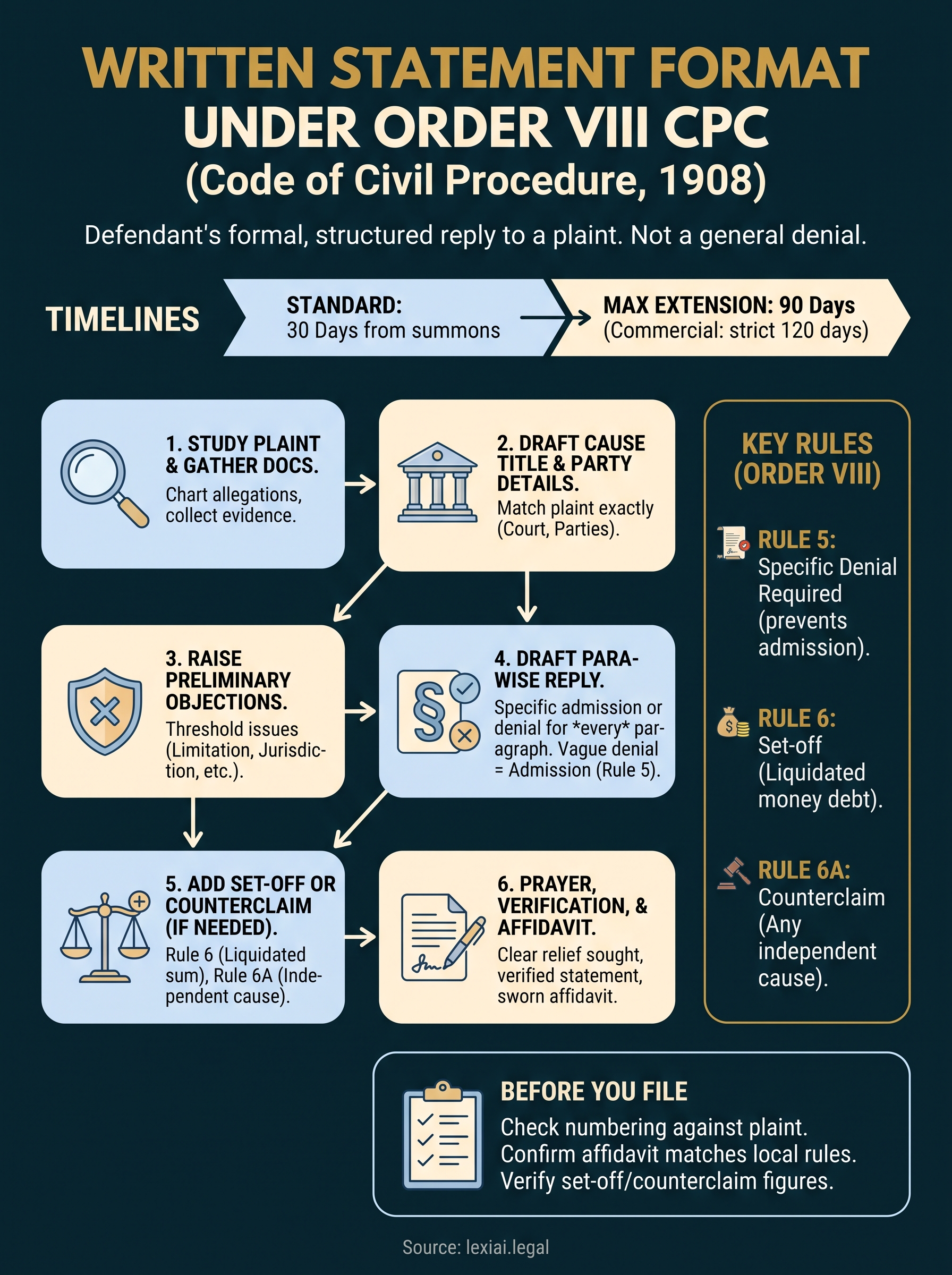
A correct written statement format follows the same six steps every time: study the plaint, draft the cause title, raise preliminary objections, reply para-wise, plead a set-off or counterclaim where it exists, and close with a verified prayer and affidavit. Skip a step, and you risk admissions you never intended, objections the registry catches before a judge even sees your defense, or a claim your client loses simply because it was never pleaded.
Before you file, read the draft once more as if you were the plaintiff's counsel looking for gaps. Check every paragraph number against the plaint, confirm your affidavit matches local court rules, and verify your set-off figures against actual documents.
Drafting this way by hand, suit after suit, eats hours you could spend on strategy. If you want to cut that drafting time down, put LeXi AI to work on your next written statement at no cost and see how it handles the para-wise reply.