

Section 420 IPC in BNS: Section 318, Punishment and Bail
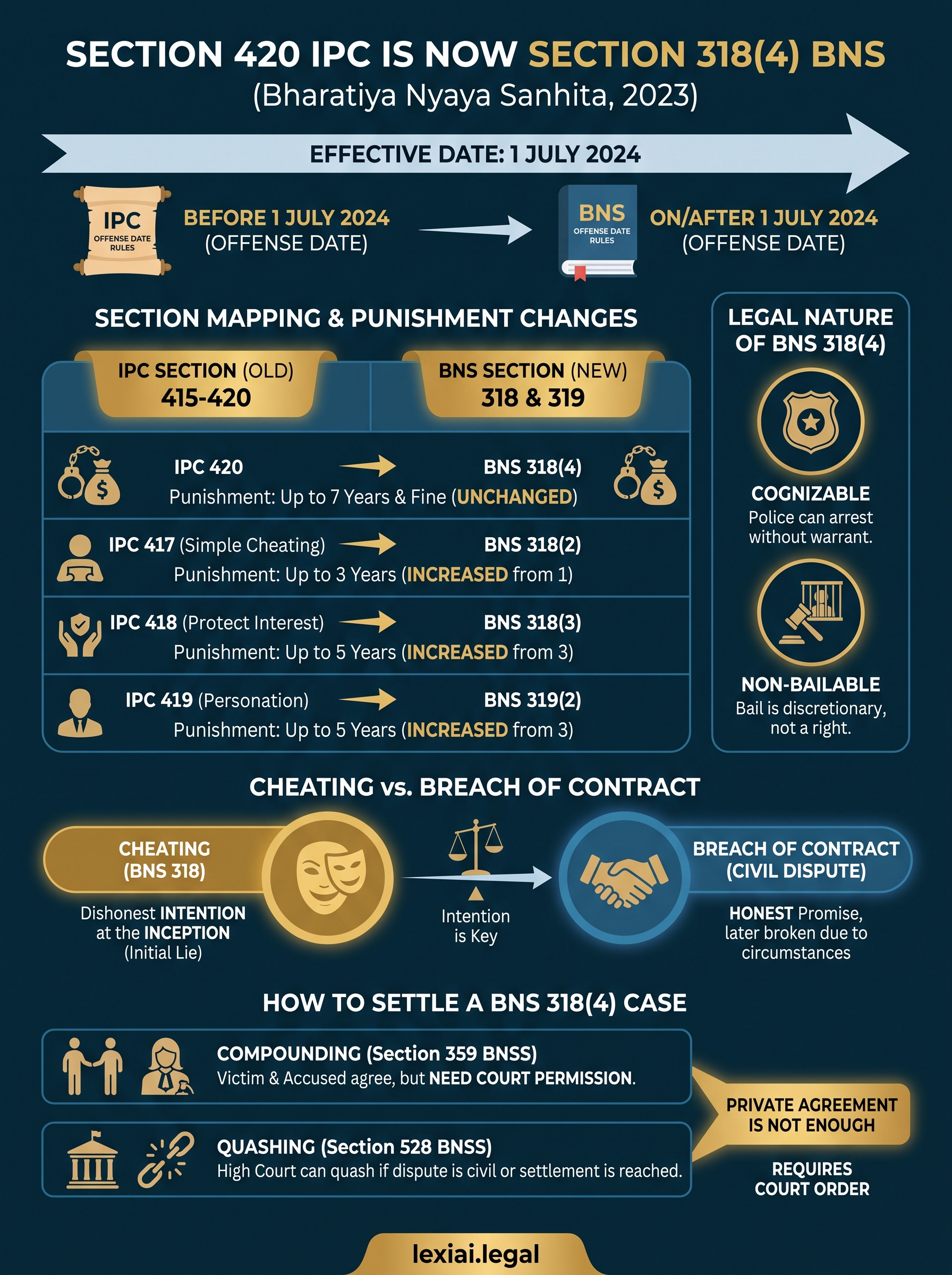
Section 420 of the Indian Penal Code, 1860 now appears as Section 318(4) of the Bharatiya Nyaya Sanhita, 2023. If you are looking for Section 420 IPC in BNS, that is the answer. Section 318(4) punishes cheating that dishonestly induces a person to deliver property or to deal with a valuable security. The maximum punishment is seven years and a fine. The offense is cognizable and non-bailable.
This article explains what changed on 1 July 2024 and how to apply Section 318 to a set of facts. It also covers the punishment under each sub-section, the bail position, the line between cheating and breach of contract, and the offenses most often confused with cheating. The last section deals with compounding and quashing.
The Supreme Court decisions that decide these cases were written under the old section, and they still apply. A research tool such as LeXi AI can help you trace those decisions to the new number. The reasoning below is what lets you read them correctly.
Why does Section 420 IPC in BNS matter now?
It matters because the number on every FIR, charge sheet, and bail order for conduct after 1 July 2024 has changed, while the law behind it has largely stayed the same. A wrong citation invites objections. A wrong assumption about which code applies can cost a client the argument.
What changed on 1 July 2024
The Bharatiya Nyaya Sanhita (BNS) replaced the IPC on 1 July 2024, along with the Bharatiya Nagarik Suraksha Sanhita (BNSS) and the Bharatiya Sakshya Adhiniyam. The IPC spread cheating across Sections 415 to 420. The BNS places it in two sections, Section 318 for cheating and Section 319 for cheating by personation. The full text is available on the Ministry of Home Affairs website as the Bharatiya Nyaya Sanhita, 2023.
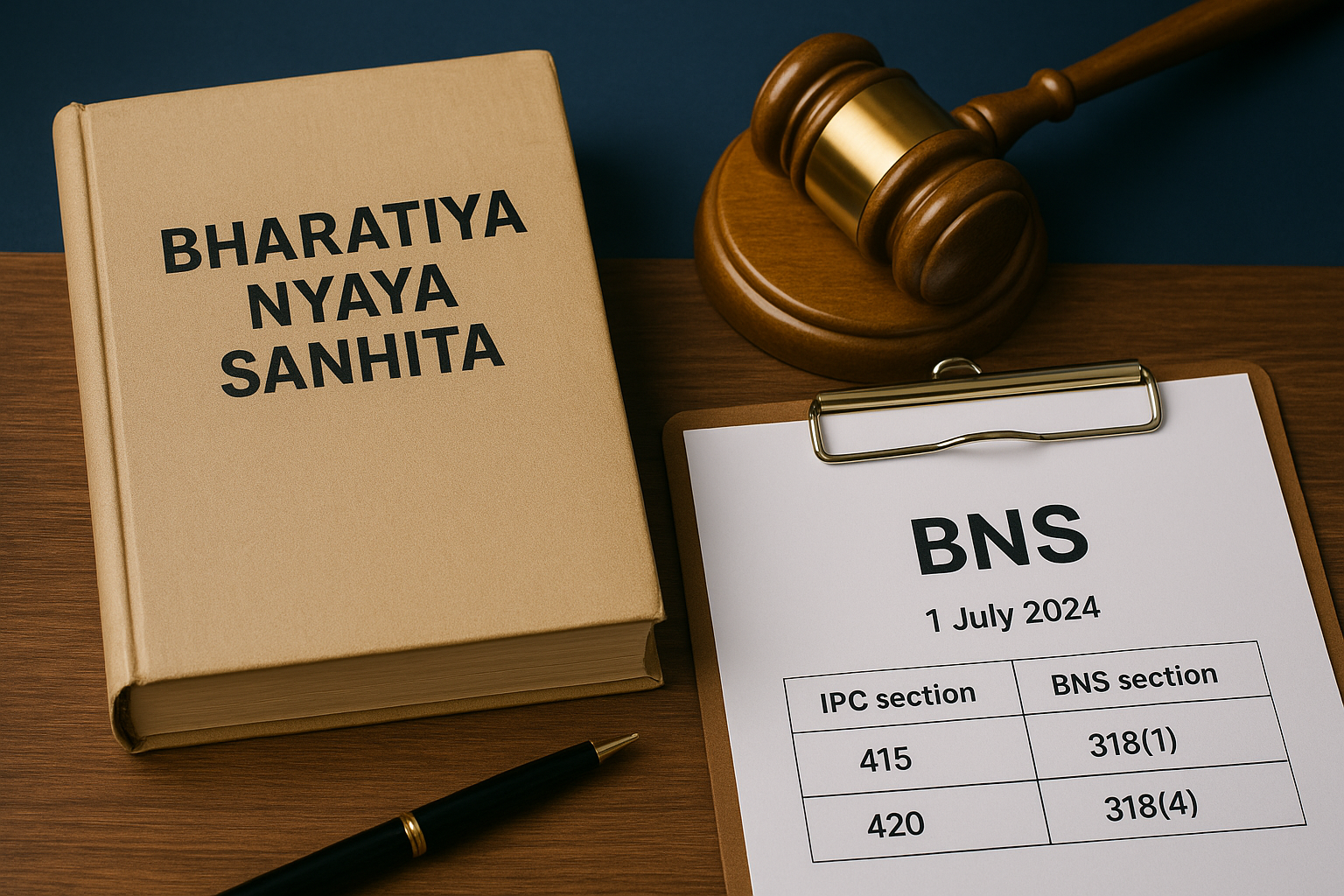
| IPC section | BNS section | What it covers |
|---|---|---|
| 415 | 318(1) | Definition of cheating |
| 416 | 319(1) | Definition of cheating by personation |
| 417 | 318(2) | Punishment for cheating |
| 418 | 318(3) | Cheating a person whose interest the offender must protect |
| 419 | 319(2) | Punishment for cheating by personation |
| 420 | 318(4) | Cheating and dishonestly inducing delivery of property |
The definition of cheating moved across almost word for word. The numbers changed, and so did some of the punishments, which the punishment section below sets out.
Which code applies to your matter
Offenses committed before 1 July 2024 are still governed by the IPC. Article 20(1) of the Constitution bars a penalty heavier than the one in force when the act was done. Section 358 of the BNS, the repeal and savings provision, preserves liability incurred under the old law. A cheating allegation about a 2023 transaction is therefore charged under Section 420 IPC, even if the FIR is registered after July 2024.
Procedure is a separate question. The BNSS governs proceedings begun after its commencement, subject to its own savings clause. In practice, an old offense can be investigated and tried under the new procedural code. Check the date of the offense and the date of the proceeding separately.
The date of the offense, not the date of the FIR, decides whether you cite Section 420 IPC or Section 318 BNS.
Why the old number still appears everywhere
Every judgment on cheating decided before mid-2024 speaks of Section 415 or Section 420 IPC. Those judgments remain binding authority, because the BNS carried the definition forward. A decision from 2000 or 2022 still decides a Section 318 case filed today.
The word "420" has also become shorthand in everyday speech for a fraudster. That shorthand will outlive the section. In pleadings, write the BNS number and the IPC number together, so a reader can connect your charge to the case law you rely on.
How to apply Section 318 BNS to a real case
To apply Section 318 BNS, test the facts against each element of cheating in Section 318(1). Then choose the sub-section that matches the outcome and the relationship between the parties. Finally, cite it in a form that connects to the old case law. Do the steps in this order, because the wrong sub-section usually comes from skipping the first one.
Step 1: test the elements of cheating
Section 318(1) says a person cheats when, by deceiving another, he fraudulently or dishonestly induces that person to deliver any property, or to consent that any person retain property. The second limb covers intentionally inducing that person to do or omit something he would not otherwise have done. In either case the act or omission must cause, or be likely to cause, damage or harm to the person in body, mind, reputation, or property. The Explanation adds that dishonest concealment of facts is deception.
Break the facts into four elements:
- Deception. A false statement, a false impression, or dishonest concealment of a material fact.
- Inducement. The deception caused the victim to act, and the accused acted fraudulently or dishonestly. Under the second limb, the inducement must be intentional.
- Act or omission. The victim delivered property, consented to its retention, or did or omitted something he would otherwise not have done.
- Harm. Actual or likely damage to body, mind, reputation, or property.
The words "dishonestly" and "fraudulently" are defined in Section 2 of the BNS. Dishonestly means with the intention of causing wrongful gain to one person or wrongful loss to another. Carelessness, optimism, or a failed business plan does not satisfy either word.
Every Section 318 charge stands or falls on the lie told and on what the victim parted with because of it.
If a complaint cannot name the lie, the date it was told, and the thing the victim gave up because of it, the first and third elements are missing. That is where most weak complaints fail.
Step 2: choose the right sub-section
Two questions decide the sub-section. Did the victim part with property, or deal with a valuable security, because of the deception? Was the accused bound by law or by a legal contract to protect the victim's interest in that transaction?
- If the victim delivered property or made, altered, or destroyed a valuable security, the charge is Section 318(4).
- If the accused was bound to protect the victim's interest and cheated with knowledge that wrongful loss was likely, the charge is Section 318(3).
- If neither applies but the deception caused harm, the charge is Section 318(2).
- If the deception was about who the offender is, the charge is Section 319.
A fake sale of land where the buyer pays a token amount falls under Section 318(4). An online seller who takes payment and never ships, having planned that from the start, also falls under Section 318(4). The same facts can fit more than one grade. Investigators usually choose the heaviest grade that the facts support, and the court tests that choice at the charge stage.
Step 3: cite the section correctly
For conduct after 1 July 2024, cite the BNS and add the IPC equivalent. This lets a judge or opposing counsel match your charge to the earlier precedent. Here is a form you can copy:
Section 318(4) of the Bharatiya Nyaya Sanhita, 2023
(corresponding to Section 420 of the Indian Penal Code, 1860)
Do not write "Section 420 BNS". The BNS ends at Section 358, so no such section exists. When you research, search both numbers, because older judgments will not mention Section 318.
A legal research tool such as LeXi AI can retrieve judgments by either number and help you assemble a short list of authorities. Whatever tool you use, verify each citation against the reported judgment before it goes into a filing.
What is the punishment under Section 318 BNS?
The punishment depends on the sub-section. Cheating under Section 318(2) carries up to three years. Section 318(3) carries up to five years. Section 318(4), the old Section 420, carries up to seven years and a fine. Cheating by personation under Section 319(2) carries up to five years.
Maximum punishment by sub-section
| Provision | Offense | Maximum punishment | Old IPC maximum |
|---|---|---|---|
| 318(2) | Cheating | 3 years, or fine, or both | 1 year (Section 417) |
| 318(3) | Cheating a person whose interest the offender must protect | 5 years, or fine, or both | 3 years (Section 418) |
| 318(4) | Cheating and inducing delivery of property or a valuable security | 7 years and fine | 7 years and fine (Section 420) |
| 319(2) | Cheating by personation | 5 years, or fine, or both | 3 years (Section 419) |
Imprisonment "of either description" means simple or rigorous, at the court's discretion. These are maximum terms, not fixed terms. The statute sets no minimum sentence for any grade of cheating.
What increased and what stayed the same
Three of the four grades went up. Simple cheating rose from one year to three. Cheating a person you were bound to protect rose from three years to five. Cheating by personation rose from three years to five. The old Section 420 alone kept its seven-year ceiling.
Many summaries describe the change as a pure renumbering. That is incomplete. For an advocate advising on a simple cheating complaint, the tripled maximum is the change that matters.
Only the old 420 kept its punishment. The grades below it were all raised.
The increases apply only to offenses committed on or after 1 July 2024. For earlier conduct, Article 20(1) keeps the old, lower maximums in force.
How fine and sentence work in practice
Section 318(4) says the offender "shall also be liable to fine". The section sets no cap on the amount. The general fine provision of the BNS treats an unstated amount as unlimited but not excessive. Courts usually look at the value of the property involved, any restitution, and the accused's role.
Courts can also direct that fine money be paid to the victim as compensation under Section 395 of the BNSS. This is the successor to Section 357 CrPC. For a complainant, this is often the most realistic route to recovering money in a criminal case.
Is Section 318(4) BNS bailable or non-bailable?
Section 318(4) BNS is cognizable and non-bailable. Police can register an FIR and arrest without a warrant, and bail is granted at the court's discretion, not as a right. The lower grades of cheating are bailable.
Cognizable, non-bailable, and triable by a Magistrate
The classification comes from the First Schedule of the BNSS. For Section 318(4) it is the same as it was for Section 420 IPC under the old Code of Criminal Procedure.
- Cognizable: the police can register and investigate without a Magistrate's order, and can arrest without a warrant, subject to the safeguards below.
- Non-bailable: bail depends on the court's discretion.
- Triable by: a Magistrate of the first class.
Simple cheating under Section 318(2) is non-cognizable and bailable. Section 318(3) and Section 319(2) are bailable. Check the First Schedule for the exact entry on cognizability for those grades before you advise a client.
What non-bailable means in practice
Non-bailable does not mean bail is refused. It means the accused cannot demand bail as a matter of right. Courts weigh the gravity of the accusation, the accused's antecedents, the risk of absconding, and the risk of tampering with evidence. They also weigh the stage of the investigation.
Where the facts show a commercial dispute with documented payments, courts often grant bail with conditions. Typical conditions are cooperating with the investigation and not leaving the country without permission. In Satender Kumar Antil v. CBI (2022) 10 SCC 51, the Supreme Court issued guidelines for offenses punishable up to seven years, stressing that arrest should not be routine.
Non-bailable means bail is a matter of discretion. It does not mean bail is out of reach.
Anticipatory bail and the arrest safeguards
If you expect an FIR under Section 318(4), you can apply for anticipatory bail under Section 482 BNSS, the successor to Section 438 CrPC. The court can direct that, if you are arrested, you be released on bail. The application goes to the Sessions Court or the High Court.
The maximum punishment of seven years also brings in the arrest safeguards. In Arnesh Kumar v. State of Bihar (2014) 8 SCC 273, the Supreme Court directed that police must not arrest automatically for offenses punishable up to seven years. The notice of appearance under Section 35 BNSS, formerly Section 41A CrPC, is the BNSS successor to that safeguard. If police arrest without applying it, raise that ground in your bail or anticipatory bail application.
Cheating or breach of contract: where is the line?
The line is dishonest intention at the time the promise was made. A promise made honestly and broken later is a breach of contract, and the remedy is a civil suit. A promise made with no intention of keeping it is cheating under Section 318 BNS.
The rule on intention at the inception
The leading authority is Hridaya Ranjan Prasad Verma v. State of Bihar (2000) 4 SCC 168. The Supreme Court held that cheating requires fraudulent or dishonest intention at the time of the inducement. A later failure to keep a promise does not, by itself, prove that intention.
The rule works in both directions. In Mahadeo Prasad v. State of West Bengal (AIR 1954 SC 724), the Court treated an intention not to pay, present when the accused took delivery of goods, as cheating. Intention at the start is the whole test. The same unpaid bill can be a civil debt or a crime depending on what the accused meant when he took the goods.
A broken promise becomes a crime only if the accused never meant to keep it.
Signs that point to a civil dispute or to cheating
Courts read the complaint for objective signs of early intent. The table sets out what usually points each way.
| Points to a civil dispute | Points to cheating |
|---|---|
| A promise made honestly, then missed due to cash flow or market change | A false statement of an existing fact, such as ownership, license, or identity |
| Part payments or ongoing negotiation after the default | Forged documents used to obtain the payment |
| A complaint that pleads only non-payment | The accused became unreachable or closed accounts right after receiving money |
| A dispute about quality, delay, or terms | The same lie told to several victims |
No single sign decides the case. A court weighs them together, and the complaint's own allegations carry the most weight at the quashing stage.
How the Supreme Court polices cheating FIRs
The Court has repeatedly warned against giving a civil dispute the color of a criminal offense. In Vijay Kumar Ghai v. State of West Bengal (2022) 7 SCC 124, it quashed proceedings arising from a commercial dispute. In Sarabjit Kaur v. State of Punjab (2023) 5 SCC 360, it held that mere breach of contract is not cheating without dishonest intention at the inception. It also stressed that a Magistrate must apply his mind before issuing summons. A.M. Mohan v. State, 2024 INSC 233, is a more recent decision in the same line.
This doctrine is not a shield for fraudsters. Where a complaint pleads the original lie with specifics, the case survives and Section 318(4) applies in full. The test asks for proof of dishonesty at the start. It does not excuse it.
How is cheating different from related offenses?
Cheating differs from related offenses in how the accused obtained the property. In cheating, the victim hands it over because of a lie. In criminal breach of trust, the accused already held it lawfully. In extortion, the victim hands it over because of fear. Each gets a different section, and charging the wrong one weakens a case.
Side-by-side comparison
| Offense | BNS section | How the property reaches the accused |
|---|---|---|
| Cheating | 318 | Delivered by the victim because of deception |
| Cheating by personation | 319 | Delivered because the accused pretended to be someone else |
| Criminal breach of trust | 316 | Lawfully entrusted, then dishonestly misappropriated |
| Extortion | 308 | Delivered because the victim was put in fear of injury |
| Forgery for the purpose of cheating | 336(3) | Not a property offense on its own, a document is falsified to cheat |
Cheating is dishonest at the moment of acquisition. Criminal breach of trust begins with honest possession that later turns dishonest. A deposit given to a builder who never intended to build looks like cheating. Money given to an agent who later diverts it looks like breach of trust. The fact that decides it is whether the dishonesty came first.
When more than one section is charged
Real fact patterns rarely stay in one box. A fraudster who forges a title deed to sell land can face Section 318(4) and the forgery sections together. An online impersonation scam can attract Section 319 and Section 318(4), and often the Information Technology Act, 2000 as well.
Prosecutors often plead sections in the alternative, but the evidence still has to match each ingredient. For the defense, the useful question is whether the complaint pleads facts for every section charged. Where it does not, ask the court to discharge on that section.
The section that fits is the one whose ingredients the complaint actually pleads.
Can a Section 318(4) case be compounded or quashed?
Yes, both are possible. The person cheated can compound a Section 318(4) offense, but only with the court's permission under Section 359 BNSS. The High Court can also quash the FIR or proceedings under Section 528 BNSS to prevent abuse of process or to secure the ends of justice.
Compounding under Section 359 BNSS
Compounding means the complainant agrees to a settlement and the law allows the case to end on that basis. Section 359 BNSS lists the offenses that can be compounded and says who may do it. For cheating under Section 318(4), the person cheated may compound it with the permission of the court.
The court examines the settlement before it allows compounding. A private agreement signed by both sides does not close the FIR on its own. The parties must apply, and the court must record the compounding.
Quashing under Section 528 BNSS
Section 528 BNSS preserves the High Court's inherent power, which Section 482 CrPC used to provide. A cheating FIR that is really a disguised recovery suit, with no dishonest inducement pleaded, is the classic candidate for quashing. The Supreme Court's cases on civil disputes dressed as cheating, discussed above, are the usual authorities.
Where the parties settle a dispute that is mainly private, the High Court can also quash on the strength of the settlement. The guiding case is Gian Singh v. State of Punjab (2012) 10 SCC 303. A petition that only attaches the settlement deed is weak. Explain why the dispute is essentially civil and why continuing the case would serve no purpose.
Does repaying the money end the case?
Not automatically. Repayment does not extinguish a cognizable offense like Section 318(4). What it does is make a settlement possible. The parties can then seek court-permitted compounding under Section 359 BNSS, or a quashing order under Section 528 BNSS.
A settlement does not close a Section 318(4) case until the court passes an order.
Common mistakes with Section 318 BNS
Most errors with Section 318 come from treating the IPC to BNS renumbering as the whole change. They fall into two groups, one in charging and citation and one in bail and settlement. Each is easy to avoid once you know it.
Mistakes in charging and citation
- Citing the BNS for pre-July 2024 conduct. The IPC section governs the charge for earlier offenses.
- Writing "Section 420 BNS". The correct reference is Section 318(4) BNS.
- Charging Section 318(4) where no property was delivered. Without delivery or a valuable security, the facts support at most Section 318(2).
- Pleading only non-payment. A complaint without the original lie reads like a recovery notice and invites quashing.
Mistakes in bail and settlement
- Assuming non-bailable means no bail. It means bail is discretionary, and well-prepared applications succeed regularly.
- Skipping the Section 35 BNSS argument. Where police arrest without the notice, say so in the application.
- Treating a signed settlement as the end. Compounding Section 318(4) needs the court's permission, and a quashing petition needs a reasoned case.
- Ignoring the lower grades. The tripled maximum for simple cheating changes the risk for clients who assumed it was minor.
What to remember about the new number
Section 420 IPC is Section 318(4) BNS. It carries up to seven years and a fine, is cognizable and non-bailable, and is tried by a Magistrate of the first class. The definition and the case law carried over, so the dishonest intention test still separates cheating from breach of contract. The lower grades were raised, and the offense date decides which code applies.
If you draft, defend, or research cheating matters, keep both numbers in every citation. You can test LeXi AI free on a cheating matter to trace judgments from Section 420 IPC to Section 318 BNS and verify each authority before you file.