

IPC vs BNS: Section-Wise Comparison Chart and What Changed
The Bharatiya Nyaya Sanhita, 2023 (BNS) replaced the Indian Penal Code, 1860 (IPC) for all offenses committed on or after July 1, 2024. In the IPC vs BNS comparison, the number of sections dropped from 511 to 358, and many familiar numbers changed. Murder moved from Section 302 IPC to Section 103 BNS. Cheating moved from Section 420 IPC to Section 318 BNS.
If you need an IPC to BNS conversion table, you will find one below, organized by offense category so you can locate a section quickly. You will also see what was added, what was removed, and what was only renumbered. New offenses include organized crime (Section 111) and mob lynching (Section 103(2)). Sedition under Section 124A IPC is gone, replaced by a new provision on acts endangering sovereignty in Section 152.
This article covers the section-wise comparison chart, the major substantive changes, and the points where old cases still run under the IPC. At LeXi AI, we see lawyers and students struggle with this mapping daily, so we have kept the chart practical and easy to check against the bare act. You can also save it as a PDF for quick reference.
Why the IPC to BNS change matters to lawyers
Two codes now run side by side
The IPC has not disappeared from court. Offenses committed before July 1, 2024 are still tried under it, and those trials will continue for years. In a single week, you may handle one file that cites Section 302 IPC and another that cites Section 103 BNS.
Judgments create the second problem. Decades of precedent interpret IPC provisions, and courts still cite them. If you rely on a ruling about Section 420 IPC in a cheating case from 2025, you must map the precedent to Section 318 BNS and say so in your submissions. A reader should never have to guess which section you mean.
Procedure changed as well. The BNS arrived with the Bharatiya Nagarik Suraksha Sanhita, 2023 (BNSS), which replaced the Code of Criminal Procedure, and the Bharatiya Sakshya Adhiniyam, 2023, which replaced the Indian Evidence Act. Anticipatory bail, for example, moved from Section 438 CrPC to Section 482 BNSS. So the IPC vs BNS question usually comes with a CrPC vs BNSS question attached.
What a wrong section number costs you
An incorrect citation is not a small slip. FIRs, charge sheets, bail applications, and quashing petitions all depend on the right section, because the section decides the punishment, whether the offense is bailable, and whether it is cognizable. A mismatch invites objections and adjournments, and it weakens your credibility with the bench.
The real task is not memorizing new numbers. It is citing the correct code for the date of the offense.
Four areas feel this change first, and each one needs a reliable mapping and a habit of checking the bare act:
- Drafting: FIRs, complaints, bail petitions, and written statements.
- Research: matching IPC-era judgments to current BNS numbers.
- Client advice: explaining which code governs a particular charge.
- Contracts: updating indemnity and compliance clauses that still cite IPC sections.
Some changes also go beyond numbering. Section 4 BNS adds community service as a punishment, and Section 152 replaces the old sedition provision with different wording. Those are covered in detail below.
How to convert IPC sections to BNS sections
A four-step method
To convert a section, start with the date of the offense, then use an official correspondence table. The IPC vs BNS mapping is not always one to one, so follow the steps in order.
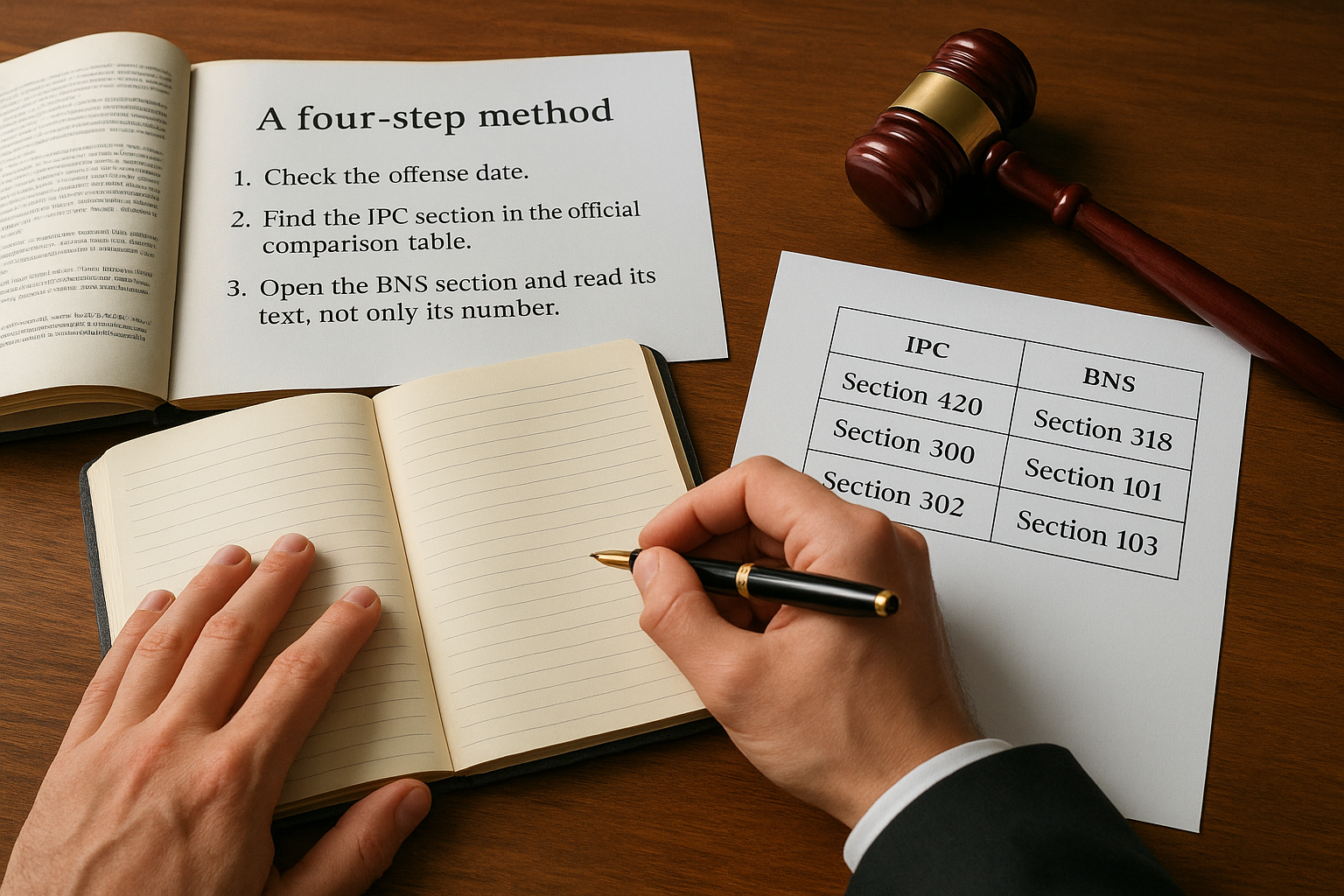
- Check the offense date. If it falls before July 1, 2024, the IPC section stays.
- Find the IPC section in the official comparison table issued by the Ministry of Home Affairs.
- Open the BNS section and read its text, not only its number.
- Record both numbers in your draft, for example: Section 318 BNS (earlier Section 420 IPC).
Where conversions go wrong
Numbers rarely tell the full story. Some IPC sections were split across several BNS sections. Section 300 IPC, which defines murder, now sits in Section 101 BNS, while the punishment under Section 302 IPC sits in Section 103 BNS.
Convert a section by its content, never by its number alone.
Other provisions were merged, reworded, or given a different punishment. Always compare the sub-sections and exceptions before you cite a BNS number. A quick check of the bare act takes two minutes and avoids an objection from the other side.
Research tools can speed up the first pass. LeXi Agent, for instance, can match an IPC-era judgment to the relevant BNS provision. You should still confirm the final citation against the text of the Sanhita.
IPC to BNS conversion table for commonly used sections
The table below covers sections that appear most often in FIRs, bail matters, and quashing petitions. It is a working IPC to BNS conversion table, not a complete schedule of all 511 sections.
Common IPC sections and their BNS equivalents
| Offense | IPC | BNS |
|---|---|---|
| Common intention | 34 | 3(5) |
| Criminal conspiracy | 120B | 61(2) |
| Murder (definition) | 300 | 101 |
| Murder (punishment) | 302 | 103(1) |
| Attempt to murder | 307 | 109 |
| Culpable homicide not amounting to murder | 304 | 105 |
| Death by negligence | 304A | 106(1) |
| Dowry death | 304B | 80 |
| Rape (definition, punishment) | 375, 376 | 63, 64 |
| Theft | 379 | 303(2) |
| Cheating | 420 | 318(4) |
| Cruelty by husband or relatives | 498A | 85 |
| Defamation | 499 | 356 |
Checking the chart before you cite it
Figures in brackets are sub-sections, and they matter. For an IPC BNS comparison chart PDF, paste this table into your own file and add a column for the offense date. Then verify every row against the bare act before filing.
A conversion chart tells you where to look, and the bare act tells you what to cite.
Some rows hide differences. Section 124A IPC has no true twin, because Section 152 BNS describes different conduct. Treat it as a new offense, not a renumbered one.
What changed in the BNS: new, omitted and revised offenses
New offenses with no IPC counterpart
The BNS brings in offenses that the IPC never covered. Organized crime and terrorist acts now sit in the main penal code instead of only in special statutes. In the IPC vs BNS comparison, these are the rows with nothing to map back to.
| Offense | BNS section |
|---|---|
| Organized crime | 111 |
| Petty organized crime | 112 |
| Terrorist act | 113 |
| Mob lynching | 103(2) |
| Snatching | 304 |
| Hit and run | 106(2) |
| Sexual intercourse by deceitful means | 69 |
Omitted and revised provisions
Several IPC provisions have no BNS twin. Sedition under Section 124A and adultery under Section 497 are gone, and so is Section 377. The Supreme Court had already struck down adultery in Joseph Shine v. Union of India (2018) and read down Section 377 in Navtej Singh Johar v. Union of India (2018). The BNS, however, has no replacement for non-consensual carnal intercourse against adult men, so flag that gap when you advise.
A renumbered section keeps its old law, but a new or omitted one changes the law itself.
Revisions matter just as much. Community service is now a punishment under Section 4(f), and life imprisonment is defined in Section 2(11) as imprisonment for the remainder of natural life. Section 309 IPC on attempted suicide is dropped, though Section 226 BNS punishes an attempt made to compel a public servant. Finally, "unsound mind" gives way to "mental illness" in Section 22.
Which law applies to cases before and after 1 July 2024
The date of the offense decides the code
In the IPC vs BNS question of governing law, the date of the offense decides the penal code, not the date of the FIR. Article 20(1) of the Constitution bars conviction under a law that was not in force when the act was done. It also bars a heavier penalty than the one then available. Section 358 BNS repeals the IPC but saves offenses committed under it, along with the related investigations and trials.
An offense is judged by the code in force on the day it was committed.
| Situation | Penal code that applies |
|---|---|
| Offense before July 1, 2024, FIR registered in 2025 | IPC |
| Offense on or after July 1, 2024 | BNS |
| Offense continuing across the cutoff date | Examine the facts, then argue |
Cases that need extra care
Procedure runs on a separate track from the penal code. Section 531 BNSS keeps pending trials, appeals, and investigations under the CrPC, so an older case can carry IPC sections and CrPC procedure together. Check which procedural code governs each stage before you file.
Where an offense straddles the cutoff, such as a conspiracy that began in 2023 and ended in 2025, read the charge closely. Record the date of each act in your pleadings. If the BNS punishment is lighter, you can argue for the milder penalty, but Article 20(1) only guarantees protection against a harsher one.
Using the comparison in daily practice
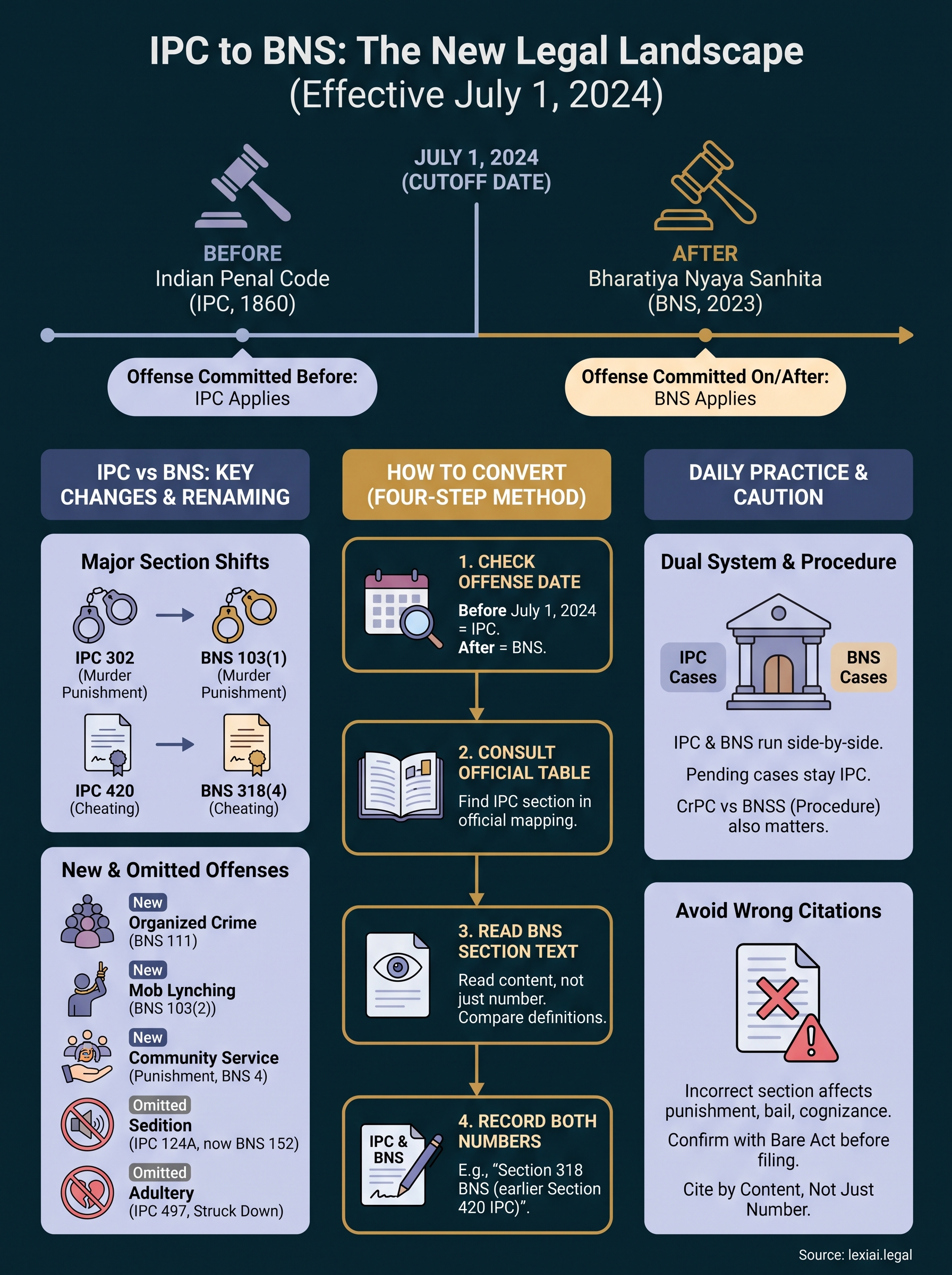
The IPC vs BNS question comes down to two habits. First, fix the date of the offense, because that decides whether you cite the IPC or the BNS. Second, convert by content and not by number alone, then check the sub-sections against the bare act.
Keep the conversion table beside your drafts and note the offense date in every file. Record both numbers on first citation, such as Section 318 BNS (earlier Section 420 IPC), so the court never has to guess. Treat new and omitted offenses as separate law, not as renumbered ones.
Tools can take over the repetitive part of this work. If you want help with matching old judgments to current sections and drafting with the right citations, you can try LeXi AI at no cost. Confirm every final citation against the text of the Sanhita before you file.