

Legal Notice for Defamation Format: Sample and How to Draft One
A legal notice for defamation is a formal written warning sent to a person or entity before you file a defamation suit or criminal complaint under Section 356 of the Bharatiya Nyaya Sanhita, 2023 (the old Section 499 IPC). It puts the other party on record, demands a retraction or apology, and often resolves the dispute without ever reaching court.
If you are searching for a sample format of legal notice for defamation, you need one that states the defamatory statement, when and where it was published, the harm caused to your reputation, and a clear demand, whether that is a public apology, removal of content, or damages. A vague or poorly drafted notice weakens your position later, so the format matters as much as the content.
This guide walks through a complete defamation legal notice format you can adapt, explains each clause and why it belongs there, and covers the drafting and sending process step by step. You will also see how tools like LeXi AI can speed up drafting and flag weak language before the notice goes out.
What is a legal notice for defamation
A legal notice for defamation is a written warning, usually drafted by an advocate, that tells the person who defamed you to stop, retract, or pay damages before you go to court. It is not a court filing. It is a private communication that becomes public record only if the dispute escalates. Under Indian law, defamation runs on two tracks, civil (a tort claim for damages) and criminal (Section 356 of the Bharatiya Nyaya Sanhita, 2023, which replaced Section 499 of the Indian Penal Code). A notice can reference either or both, depending on what relief you want.
Civil defamation notice vs criminal defamation notice
Indian statutes do not prescribe one rigid legal notice format for defamation. What changes is the tone, the relief demanded, and the legal provision you cite, depending on whether you plan to sue for damages or file a criminal complaint.
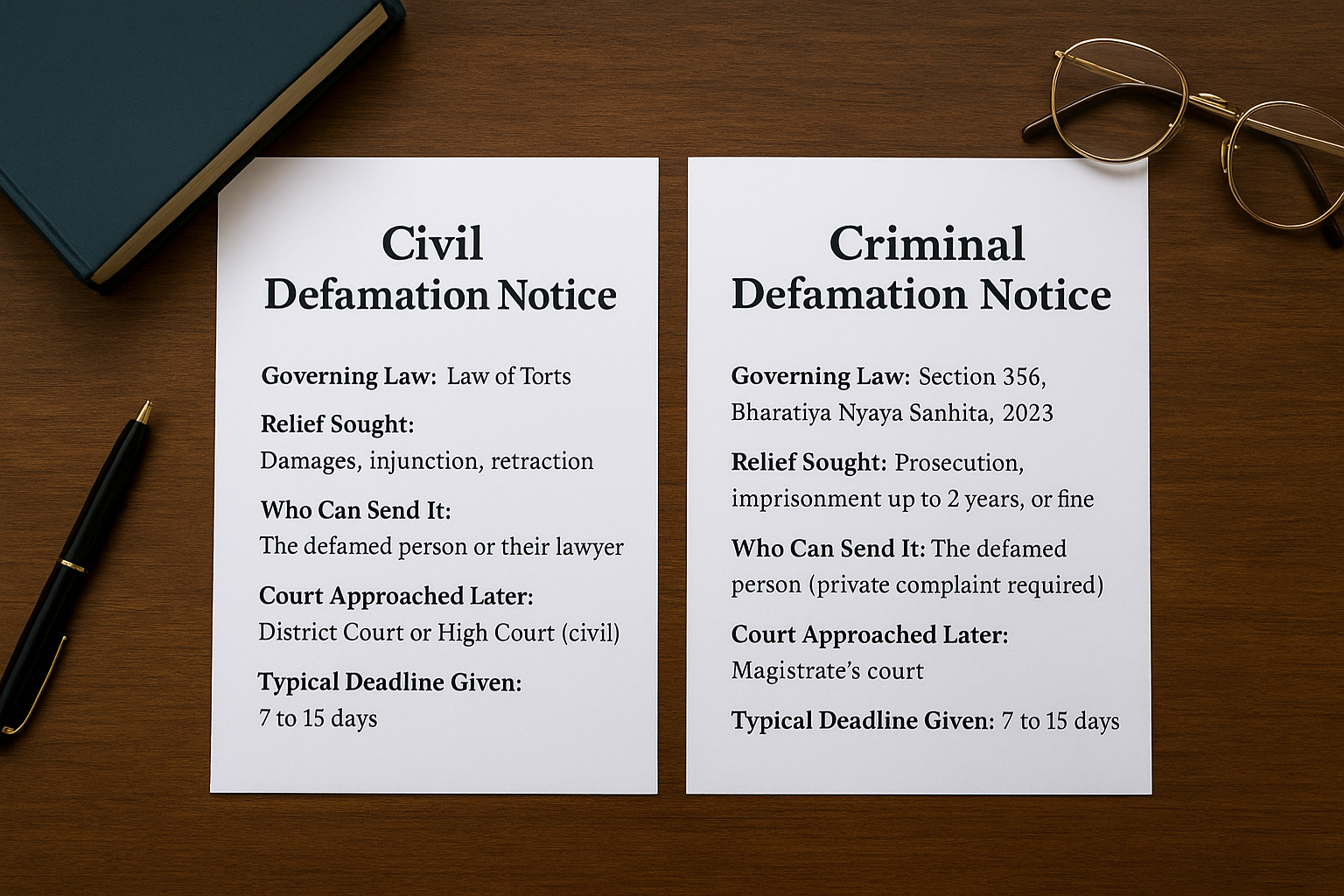
| Aspect | Civil defamation notice | Criminal defamation notice |
|---|---|---|
| Governing law | Law of torts, Specific Relief Act, 1963 | Section 356, Bharatiya Nyaya Sanhita, 2023 |
| Relief sought | Damages, injunction, retraction | Prosecution, imprisonment up to 2 years, or fine |
| Who can send it | The defamed person or their lawyer | The defamed person (private complaint required) |
| Court approached later | District Court or High Court (civil) | Magistrate's court |
| Typical deadline given | 7 to 15 days | 7 to 15 days |
Why send a notice before you sue
Sending a notice first almost always works in your favor, even if you expect the recipient to ignore it. It shows the court that you tried to resolve the matter without litigation, which strengthens your credibility when you eventually file a suit or complaint. It also creates a paper trail with a fixed date, which matters because defamation claims in India are governed by a one-year limitation period under Article 75 of the Limitation Act, 1963.
A well-drafted defamation notice often gets you a retraction faster than a lawsuit ever would.
Many disputes end right here. Once a business, journalist, or individual receives a formal notice on legal letterhead, they often issue an apology or take down the content within days, because the alternative is a public court case with reputational cost of its own. That is why understanding the correct format of legal notice for defamation matters as much as understanding the law itself.
What the law expects from the notice
Neither the Bharatiya Nyaya Sanhita nor the Code of Civil Procedure, 1908 lays down a mandatory template, but courts and opposing lawyers expect certain minimums. Skipping them makes your notice look amateurish and gives the recipient room to argue it was vague or defective.
Expect any properly drafted legal notice for defamation format to identify the parties, quote the defamatory statement verbatim, state the date and mode of publication, explain the harm caused, and set a clear deadline for compliance. Missing even one of these elements can weaken your position if the matter reaches a Magistrate or a civil court later, because the other side's lawyer will point to the gap as proof that the claim was never taken seriously in the first place.
Step 1. Confirm the statement is defamatory
Before you draft anything, check whether the statement actually meets the legal bar for defamation. Not every insult, criticism, or unflattering post qualifies. Under Section 356 of the Bharatiya Nyaya Sanhita, 2023, a statement is defamatory if it was made with intent to harm, or with knowledge or reasonable belief that it would harm, the reputation of a person, and it was published or spoken to a third party. If you skip this check, you risk sending a legal notice for defamation over something a court would dismiss as opinion or fair comment.
What makes a statement defamatory
Run the statement through these four questions before you proceed:
- Was it published? A statement said only to you in private, with no third party present, generally does not count. Defamation needs an audience, even if that audience is one other person, a WhatsApp group, or a public post.
- Is it false? Truth is a complete defense under both the civil and criminal tracks. If the statement is factually accurate, no notice will hold up later.
- Does it harm reputation? The test is whether an ordinary, reasonable person would think less of you after reading or hearing it, not whether you personally felt hurt.
- Does an exception apply? Fair comment on a matter of public interest, statements made in good faith to a person with authority over the subject (like a complaint to an employer), and privileged communications in judicial proceedings are all protected under the exceptions to Section 356.
If a defense like truth, fair comment, or privilege clearly applies, no notice will save your case later.
Separate opinion from factual claims
Courts distinguish sharply between "X is a thief" and "I think X's business practices are questionable." The first is a factual assertion capable of being proved true or false, which makes it actionable. The second reads as opinion, and Indian courts, following the same logic as English common law on fair comment, rarely entertain defamation claims built on subjective opinion alone.
Read the exact wording again, not your memory or a paraphrase of it. Screenshots, recordings, and printouts should show the statement verbatim, because a defamation legal notice format built on a misquoted line gives the recipient an easy way to deny everything. If you are unsure whether the statement crosses the legal threshold, running it past a practicing advocate, or using a legal research tool like LeXi Agent to check similar precedents, saves you from sending a notice that gets laughed off in a reply.
Step 2. Gather evidence and identify the recipient
Once you have confirmed the statement meets the legal bar, start collecting proof before the content disappears. Social media posts get deleted, WhatsApp messages get erased, and news articles get edited quietly. A legal notice for defamation without solid evidence attached is just a strongly worded letter, so treat this step as the foundation of your entire case.
What evidence to preserve
Gather every piece of proof that shows the statement was made, published, and seen by others. Courts want dates, sources, and originals, not your summary of what happened.
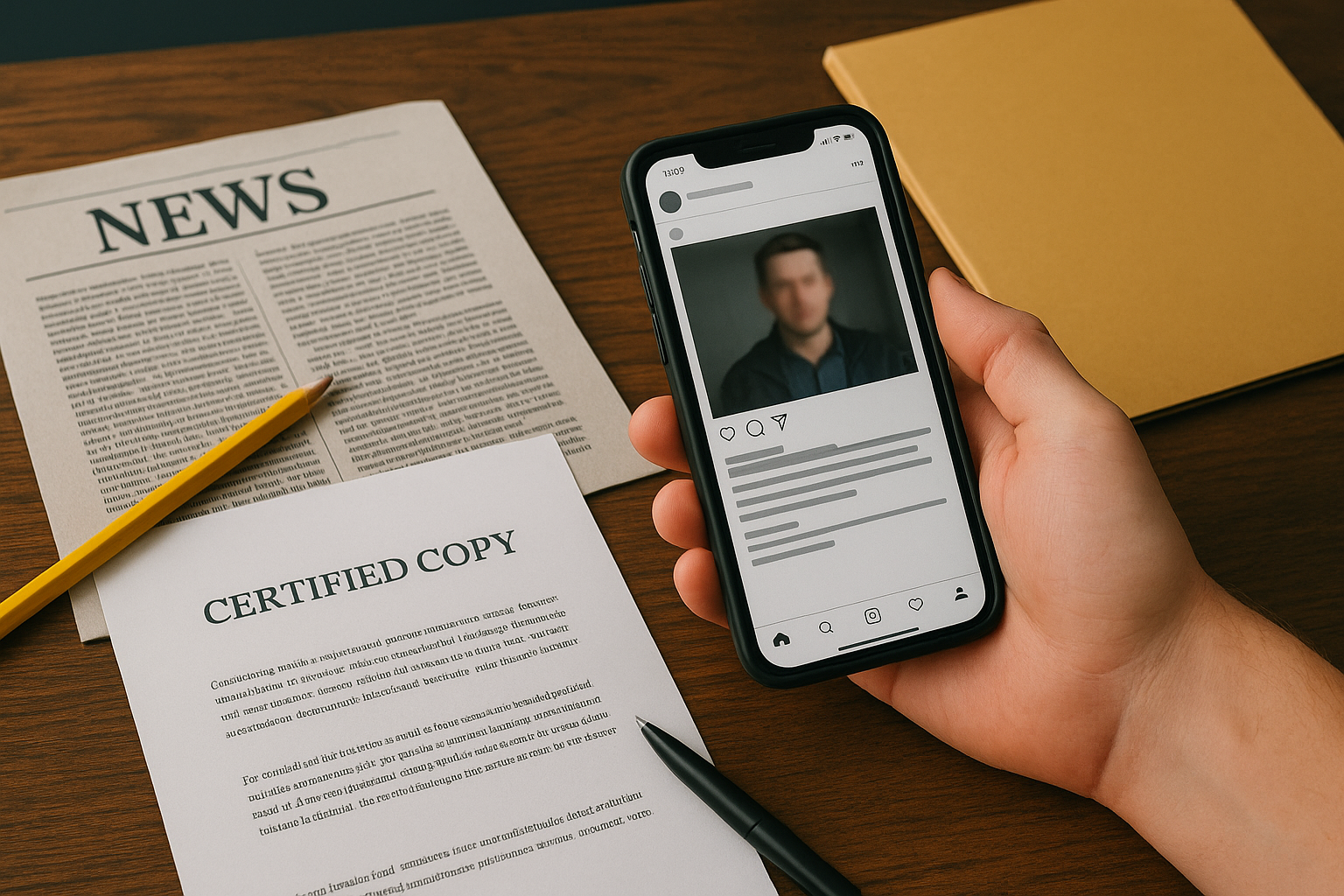
- Screenshots with timestamps and URLs. Capture the full page, including the date, handle, or publication name, not just the offending line.
- Certified copies of newspapers or notarized printouts. For print media, get the actual edition or a certified copy from the publisher's archive.
- Witness statements. If the statement was spoken aloud, get a written account from anyone who heard it, signed and dated.
- Metadata and audit trails. For emails or messages, preserve headers and delivery receipts, since these establish when the statement reached a third party.
- A record of the harm. Lost business, canceled contracts, or messages from people who saw the statement and reacted, all help quantify damages later.
Evidence you collect after the fact is never as strong as evidence preserved the moment you saw the statement.
Identifying the correct recipient
Getting the recipient's name and address wrong is one of the most common reasons a defamation legal notice format fails to achieve anything. If the statement appeared in a newspaper, the notice usually goes to the author, the editor, and the publisher, since all three can be held liable under Section 356 read with vicarious liability principles. If it appeared online, identify the actual poster where possible, and separately consider whether the platform qualifies as an intermediary under Section 79 of the Information Technology Act, 2000, which affects whether you can hold it liable at all.
Check the person's full legal name, registered address, and, for companies, the registered office as listed with the Ministry of Corporate Affairs. Sending a notice to a defunct address or an outdated designation gives the recipient grounds to claim they never received proper notice, which delays your case further. If the recipient's identity is unclear, such as an anonymous social media account, a lawyer can help you file an application for disclosure before you draft the notice itself. Tools like LeXi Agent can also help you pull registered addresses and past filings quickly when you are preparing to serve a corporate entity.
Step 3. Draft the notice with essential clauses
Now that you have the evidence and the correct recipient, sit down and draft the notice itself. Every legal notice for defamation format follows the same basic skeleton: sender details, recipient details, a statement of facts, the legal basis, and a demand. Skipping any of these gives the recipient's lawyer an easy line to attack in a reply, so treat this as a checklist, not a suggestion.
The clauses every notice needs
Open with the sender's name, address, and the advocate's details if a lawyer is drafting it on your behalf. Follow with the recipient's full legal name and address, exactly as you confirmed in Step 2. Then move through these clauses in order:
- Introduction of the sender. State who you are and, if relevant, your profession or business, since this establishes why the statement caused harm.
- The defamatory statement, quoted verbatim. Reproduce the exact words, not a paraphrase, along with the date, platform, or publication where it appeared.
- The legal basis. Cite Section 356 of the Bharatiya Nyaya Sanhita, 2023 for criminal defamation, or the relevant tort principles if you are pursuing civil damages, or both if you intend to keep both options open.
- The harm caused. Describe specific damage, lost clients, canceled deals, public ridicule, rather than a general claim of hurt feelings.
- The demand. State exactly what you want, whether that is a written apology, removal of the content, or monetary compensation.
A notice without a specific demand reads like a complaint letter, not a legal notice.
Getting the tone and language right
Write in formal, precise language, but avoid threats that go beyond what the law allows. A line like "pay me now or face consequences" sounds weak in front of a judge, while a line citing the exact section and the exact relief sought sounds credible. Reference the defamation legal notice format conventions lawyers actually use, short numbered paragraphs, each covering one fact or one legal point, rather than long unbroken text.
Keep sentences short enough that a Magistrate reading the notice later understands the claim without needing the underlying file. Use headers like "Statement of Facts" and "Notice and Demand" to organize the document, since this structure also makes it easier for an AI drafting tool like LeXi Desk to flag missing clauses or vague language before you finalize the draft. Number every paragraph, since Indian courts and opposing counsel both expect it, and it makes referencing specific claims easier during any later hearing.
Step 4. Set the deadline and demand relief
Every legal notice for defamation needs a fixed deadline and a specific demand, or it reads as a complaint rather than a legal document. Courts and opposing lawyers both look for these two elements first, because they show you are serious about escalating if the recipient ignores you. Vague language like "immediately" or "at the earliest" gives the recipient room to stall, so always name an exact number of days.
How long should the deadline be
Most defamation notices give the recipient 7 to 15 days to respond, though the exact number depends on how urgent the harm is and how complex the demand is. A short deadline, say 7 days, works well when the defamatory content is still online and spreading. A longer window, closer to 15 days, suits cases involving corporate recipients who need time to consult their own counsel before replying.
A notice with no deadline is a request, not a legal notice.
State the deadline as a calendar date, not just a number of days, so there is no room for dispute later. For example: "You are required to comply with the demands set out above within 10 days from the receipt of this notice, that is, on or before [exact date]." This phrasing removes any ambiguity about when the clock started running.
What relief to demand
The relief you demand should match what you actually want, since courts later ask why you sought one remedy in the notice and a different one in the suit. Pick from the options that fit your situation, and list them clearly rather than bundling everything into one sentence.
| Relief sought | When it fits | How to phrase it |
|---|---|---|
| Written apology | Statement was made in personal capacity, reputational harm is the main concern | "Issue an unconditional written apology, published with the same prominence as the original statement" |
| Removal or retraction | Content is still live online or in print | "Take down the post/article within [X] days and confirm removal in writing" |
| Monetary damages | Financial loss can be shown, business or professional harm occurred | "Pay compensation of Rs. [amount] for the loss and damage caused" |
| Both retraction and damages | Harm is ongoing and quantifiable | Combine both demands with separate paragraphs and separate deadlines if needed |
Close this section of the notice with a warning that names the specific consequence, civil suit, criminal complaint under Section 356 of the Bharatiya Nyaya Sanhita, 2023, or both, that follows if the deadline passes without compliance. This is where a well-structured defamation legal notice format separates itself from a generic warning letter.
Step 5. Sign and send the notice correctly
Once the draft is final, get the signature and delivery right, because a strong notice sent the wrong way still fails to protect your position later. Courts care about proof of service almost as much as the content of the notice itself. A legal notice for defamation that never reaches the recipient, or that you cannot prove reached them, gives the other side an easy defense when the matter escalates.
Who should sign the notice
An advocate typically signs the notice on your behalf, with their bar enrollment number, chamber address, and contact details printed below the signature. This signals to the recipient that the matter is being handled formally, and it usually gets a faster response than a notice signed by the aggrieved party alone. If you sign it yourself without a lawyer, that is legally valid too, but include your full name, address, and a clear statement that you are the person defamed.
Date the notice on the day you sign it, and keep the date consistent across the notice, the courier receipt, and any covering letter. This detail matters later, since the one-year limitation period under Article 75 of the Limitation Act, 1963 runs from the date of publication, not the date of your notice, so keep your own timeline of events alongside the notice itself.
How to send it so it holds up in court
Send the defamation legal notice format through a method that creates a paper trail, never a method you cannot prove later.
- Registered post with acknowledgment due (RPAD). This is the standard method Indian courts recognize, since the postal receipt and the acknowledgment card both show delivery.
- Speed post with tracking. Acceptable and faster than RPAD, though keep the tracking printout as proof.
- Email, as a secondary channel. Send a copy to the recipient's known email address alongside the postal copy, since this shows attempted delivery through multiple channels.
- Courier with signed delivery proof. Works if the courier company provides a delivery confirmation with the recipient's signature.
A notice you cannot prove was delivered is a notice that never legally happened.
Keep a physical or scanned copy of the notice, the postal receipt, and the acknowledgment card together in one file. If the recipient refuses delivery or the notice returns undelivered, do not assume the process is over. Indian courts generally treat a properly addressed notice sent by registered post as deemed served even if it comes back marked "refused" or "unclaimed," so preserve that returned envelope too, since it becomes evidence in itself.
Sample format of a legal notice for defamation
Here is a complete sample format of legal notice for defamation that you can adapt for most civil or criminal situations. Fill in the bracketed portions with your own facts, and remove any clause that does not apply to your case. Treat this as a starting skeleton, not a final draft, since every dispute has its own set of facts that change what you emphasize.
Copy-ready template
Use the block below as your working draft. An advocate should still review the final version before you send it, especially the legal basis and the demand paragraphs.
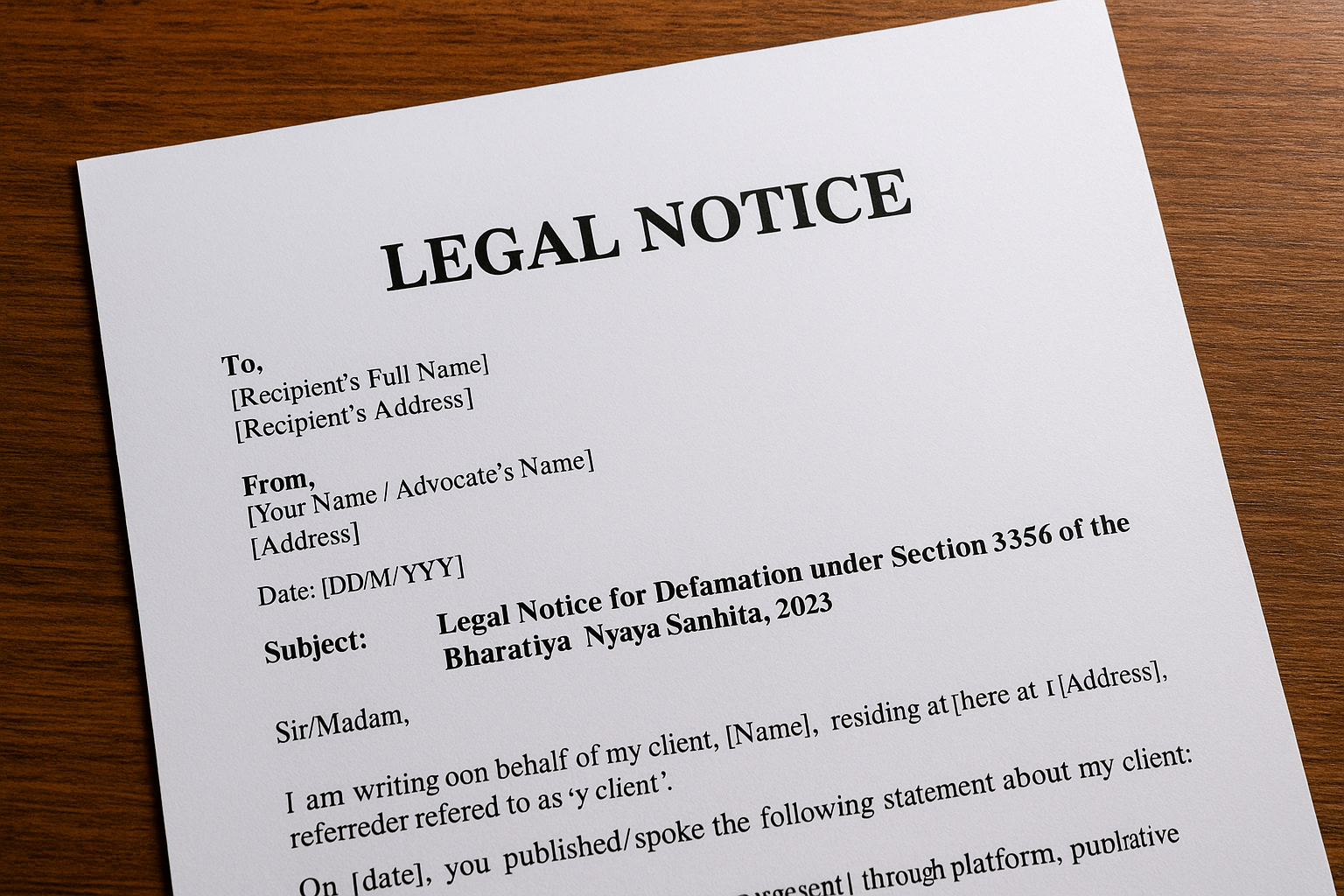
LEGAL NOTICE

To,
[Recipient's Full Name]
[Recipient's Address]

From,
[Your Name / Advocate's Name]
[Address]
[Contact details]

Date: [DD/MM/YYYY]

Subject: Legal Notice for Defamation under Section 356 of the Bharatiya Nyaya Sanhita, 2023

Sir/Madam,

1. I am writing on behalf of my client, [Name], residing at [Address], hereinafter referred to as "my client."

2. On [date], you published/spoke the following statement about my client: "[quote the exact defamatory statement]" through [platform, publication, or medium].

3. The above statement is false, defamatory, and has caused serious harm to my client's reputation, including [specific harm, e.g., loss of business, public humiliation, canceled contracts].

4. The statement satisfies the requirements of Section 356 of the Bharatiya Nyaya Sanhita, 2023, and my client reserves the right to pursue both criminal and civil remedies.

5. You are hereby called upon to:
   a) Issue an unconditional written apology, published with the same prominence as the original statement, and
   b) Remove/retract the statement within [X] days, and
   c) Pay compensation of Rs. [amount] for the loss and damage caused.

6. Comply with the above within [X] days from receipt of this notice, that is, on or before [exact date], failing which my client shall initiate civil and/or criminal proceedings against you, entirely at your cost, risk, and consequence.

A copy of this notice is retained for record.

[Signature]
[Name, Advocate / Party]
[Bar enrollment number, if applicable]
A template only works if you fill it with your specific facts, not general complaints.
Adjusting the template to your situation
Modify paragraph 4 depending on whether you want to pursue a criminal complaint, a civil suit, or both, since the legal basis paragraph changes the tone of the entire notice. Corporate recipients often need an extra paragraph naming the registered office and the individual officer responsible, since liability under Section 356 can attach to specific persons within a company, not just the entity. Any correct format of legal notice for defamation should still read as your own voice and your own facts once you are done editing it, not a generic letter with names swapped in.
What happens after you send the notice
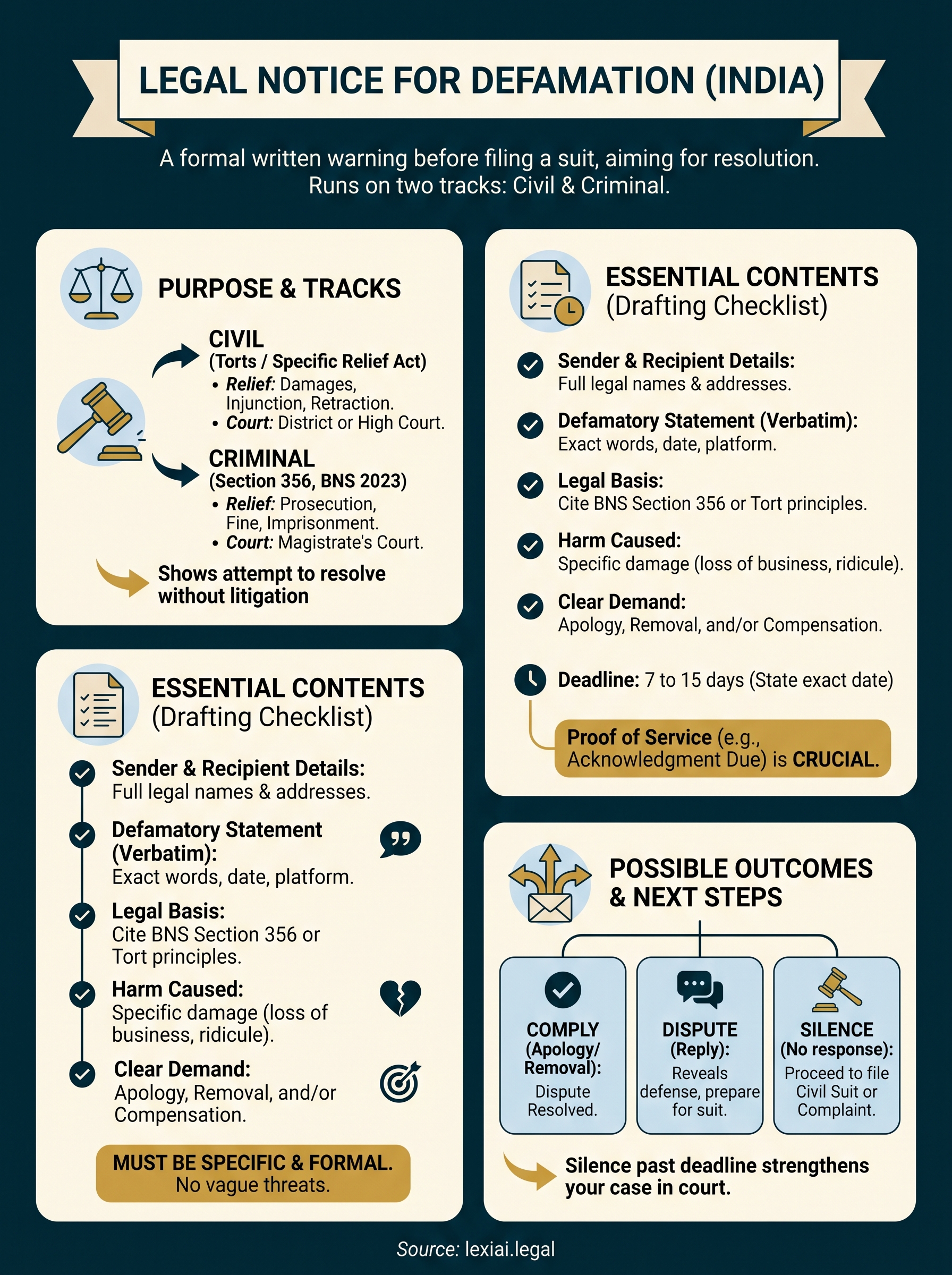
Once the notice reaches the recipient, three things typically happen: they comply, they respond disputing your claims, or they stay silent. Silence past your deadline is your cue to move forward with a civil suit or a criminal complaint under Section 356, using the notice itself as proof you tried to resolve things first. A reply disputing the facts often reveals their defense early, which helps you prepare your suit with fewer surprises later.
Getting the legal notice for defamation format right at the start saves you weeks of back and forth, and it often ends the matter before you ever see a courtroom. If you want help drafting a notice with the correct clauses, checking the statement against precedent, or catching vague language before you send it, sign up for LeXi AI and let LiTT and Desk handle the heavy lifting while you focus on the facts.