

How to Send a Legal Notice Online in India
You can send a legal notice online in India today, draft it, get it reviewed, and dispatch it through email, WhatsApp, or registered post, all without stepping into a lawyer's office. Courts under Section 80 of the Civil Procedure Code and Section 138 of the Negotiable Instruments Act still expect the same formal language and proof of delivery, but the process of getting there has moved almost entirely digital. That shift means faster drafting, lower costs, and fewer trips to a physical office.
Most readers searching this term want one of three things: a quick drafting service, a way to send the notice with valid proof, or a method to check a notice someone else has sent them. Each step has specific rules on format, signature, and delivery that Indian courts check closely, and getting them wrong can delay your case by weeks.
This guide walks through the exact steps to draft, send, and track a legal notice online, including where AI drafting tools like LeXi AI fit into speeding up the paperwork without cutting corners on legal accuracy.
What is a legal notice and when do you need one
A legal notice is a formal written statement one party sends to another before starting a court case. It states the facts of a dispute, cites the law involved, and sets out a clear demand with a deadline to respond. Courts across India treat this as a mandatory first step for many disputes, not a courtesy.
A legal notice is your last formal warning before litigation, and Indian courts expect proof that you sent it before they hear your case.
Why courts require this step
Section 80 of the Civil Procedure Code, 1908, requires a two-month notice before suing the government or a public officer, giving them a chance to settle without court involvement. Section 138 of the Negotiable Instruments Act, 1881, requires a notice within 30 days of a bounced cheque before you can file a criminal complaint. Skipping this step gets cases dismissed on procedural grounds, regardless of how strong your facts are.
Common situations that call for a legal notice
Beyond these two statutes, lawyers draft legal notices for a wide range of disputes. Here are the situations you will see most often in practice.
| Situation | Common Legal Basis |
|---|---|
| Bounced cheque | Section 138, Negotiable Insutrument Act, 1881 |
| Landlord-tenant dispute | Rent Control Acts (state-specific) |
| Employment termination or unpaid dues | Industrial Disputes Act, 1947 |
| Breach of contract | Indian Contract Act, 1872 |
| Consumer complaint | Consumer Protection Act, 2019 |
| Suit against government body | Section 80, Civil Procedure Code, 1908 |
Each of these carries its own notice period and drafting requirements, so copying a generic template rarely holds up. Getting the legal basis right at the outset saves you from a notice that opposing counsel can challenge as defective, which is exactly why the next step in this process matters so much.
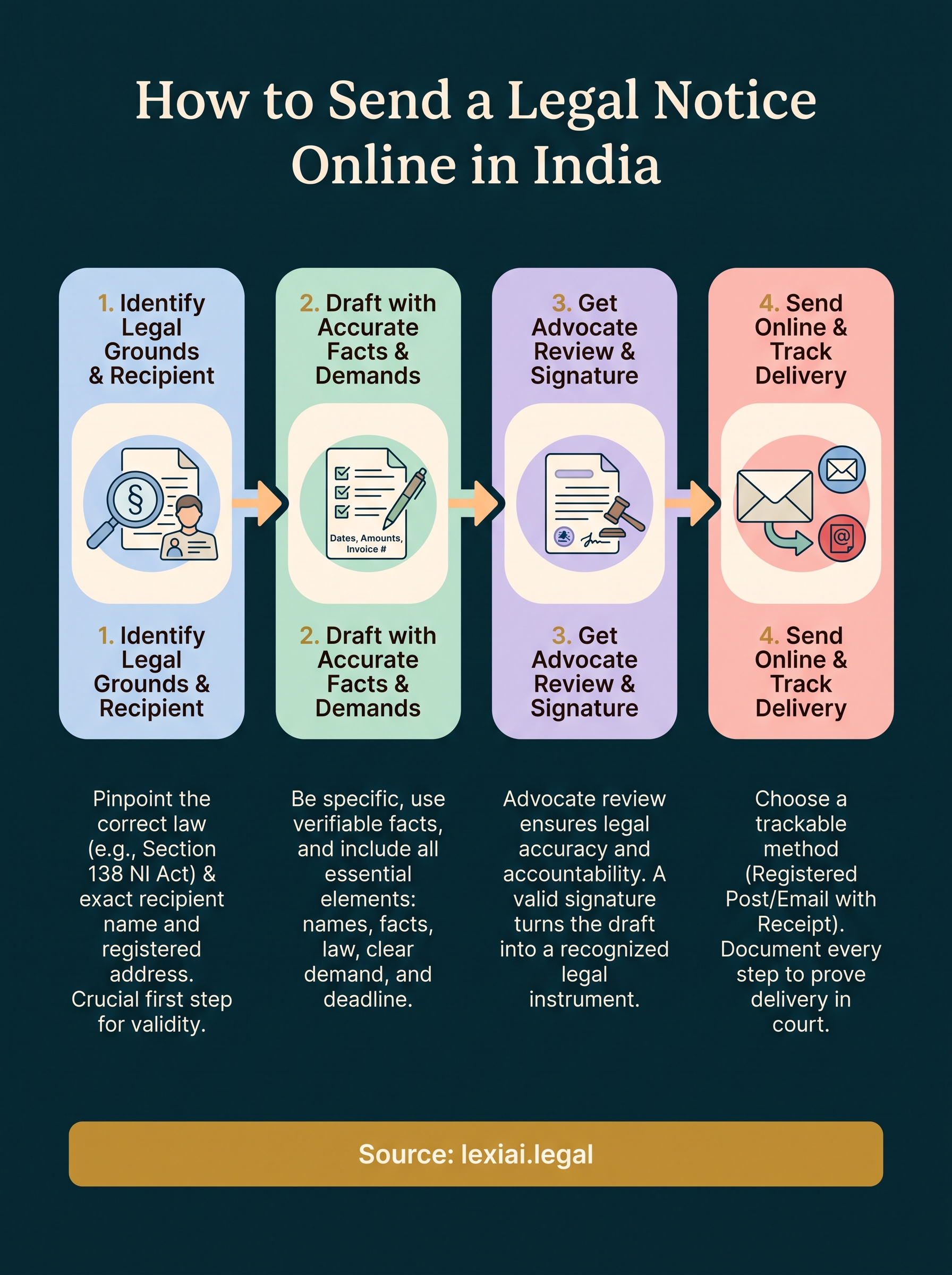
Step 1. Identify the right legal grounds and recipient
Before you write a single word, pin down which law applies to your dispute and who the notice needs to name. A legal notice online that cites the wrong section or reaches the wrong entity gives the other side an easy way to challenge it in court, and you lose weeks refiling.
Get the legal ground and the recipient right first, because a well-drafted notice sent to the wrong party is worthless in court.
Pin down the exact legal provision
Match your facts to the specific statute, whether that is Section 138 of the Negotiable Instruments Act for a bounced cheque or the Consumer Protection Act, 2019 for a defective product. Check the limitation period too. Most notices carry a fixed window, often 15, 30, or 60 days, and missing it can bar your claim entirely.
Verify the recipient's correct name and address
Use the recipient's full legal name, not a nickname or trade name, and confirm the registered address through public records like MCA filings or property documents. For companies, name the registered office and, where relevant, the authorized signatory. Quick checks that save trouble later:
- Confirm spelling of the recipient's name against official ID or registration documents
- Verify the current registered or residential address
- Identify whether you are dealing with an individual, partnership, or company
- Note the correct designation if serving a government officer under Section 80, CPC
Step 2. Draft the legal notice with accurate facts and demands
Once you have the legal ground and the recipient confirmed, write the notice itself in plain, formal language that a judge can follow without guesswork. A legal notice online template only helps if you fill it with facts that match your documents exactly, dates, amounts, invoice numbers, and prior communication attempts included.
A notice built on vague facts invites the other side to deny everything, so specificity is your strongest weapon here.
Include the essential elements every notice needs
Every valid notice, regardless of the dispute, needs these components:
- Full names and addresses of both sender and recipient
- A clear, chronological statement of facts
- The specific law or contract clause being invoked
- A precise demand, whether payment, action, or cessation
- A firm deadline, typically 15 to 30 days
- The sender's signature or the advocate's signature block
Keep the tone formal and the facts verifiable
Because opposing counsel will scrutinize every line, avoid emotional language and stick to what you can prove with documents. Numbers matter more than adjectives, so state the exact amount owed or the exact clause breached rather than describing it loosely. This is where AI drafting tools like LeXi AI help, since they pull relevant clauses and precedent language automatically, cutting draft time while keeping the structure courts expect.
Step 3. Get the notice reviewed and signed by an advocate
A draft, however well-researched, needs a licensed advocate's eyes before it goes out. Courts and opposing counsel both check whether the notice carries a valid signature, and an unsigned or improperly signed legal notice online can be dismissed as invalid regardless of how solid the underlying facts are.
A signature from a practicing advocate is what turns your draft from a letter into a legal instrument courts will recognize.
Why advocate review catches what drafting tools miss
Even the best AI drafting tools cannot verify jurisdiction quirks, recent amendments, or how a particular court bench has interpreted a similar dispute. An advocate reviewing your draft checks for these gaps and adjusts language that might otherwise weaken your position later in litigation. Practicing lawyers also carry professional accountability under the Advocates Act, 1961, which adds weight the other side cannot dismiss.
What a proper review covers
Before signing, ask your advocate to confirm each of these points:
- The correct statute and section numbers are cited
- The recipient's name, address, and designation match official records
- The demand and deadline are legally enforceable
- No factual claim exceeds what your documents can prove
- The signature block includes bar enrollment details
Once the advocate signs off, you have a document ready for formal dispatch, not just a well-written letter sitting in a folder.
Step 4. Send the notice online and track delivery
With the advocate's signature in place, you can now dispatch the notice through registered post with acknowledgment due, email, or a combination of both. Courts accept digital delivery as valid proof today, provided you can show the recipient actually received it, so pick a method that generates a clear delivery record rather than one that just feels fast.
Proof of delivery matters more than the delivery method itself, so never send a legal notice without a trackable record.
Choose a delivery method that creates proof
Registered post through India Post remains the gold standard because it produces a signed acknowledgment card that courts readily accept. Email works well as a backup or primary channel for corporate recipients, especially when you request a read receipt and keep the sent-mail header intact. Many advocates now send the same notice by both post and email on the same date, which strengthens your position if the recipient later claims non-receipt.
Track and document every step
Build a simple record so you can prove delivery months later if the matter reaches court.
- Save the registered post tracking number from the India Post website
- Screenshot email delivery and read receipts with timestamps
- Keep a WhatsApp delivery and read receipt as supporting evidence, not primary proof
- File the signed acknowledgment card once it arrives by post
- Note the exact date the response deadline expires on your calendar
Getting your notice right the first time
Sending a legal notice online works only when every step lines up: correct legal ground, precise facts, an advocate's signature, and a delivery method that proves receipt. Skip any one of these, and you hand the other side an easy defect to argue in court, no matter how strong your underlying claim is.
Most delays and dismissed notices trace back to sloppy drafting or missed proof of delivery, not weak facts. Treat each step in this guide as a checklist rather than a suggestion, and you avoid the refiling and lost weeks that come with getting it wrong the first time.
If you want to cut drafting time without cutting corners on accuracy, tools built specifically for Indian legal work make the difference. Sign up for LeXi AI and draft your next notice with the structure and citations courts expect, ready for your advocate's review.