

What Is the Companies Act 2013 Bare Act? Chapter-Wise Guide
The Companies Act 2013 bare act is the official text of the statute exactly as Parliament enacted it, without commentary, case notes, or explanations. It has 470 sections, divided into 29 chapters, and 7 schedules. Lawyers, company secretaries, and students use it as the primary source before relying on any guide or digest.
If you want to read it, the official text is free on the India Code portal and the Ministry of Corporate Affairs website. Both let you read it online or download a PDF. A printed edition is useful when you need amendments and rules in one place, but always check that it reflects changes made through the Companies (Amendment) Acts, including the 2015, 2017, 2019, and 2020 amendments.
This guide explains what a bare act is and how the Companies Act 2013 is organized. It then walks through the chapter-wise structure, from incorporation in Chapter II to winding up in Chapter XX. Along the way, it shows where the key sections sit, such as Section 2 on definitions and Section 149 on directors. It also notes how an AI research platform built for Indian law like LeXi AI can help you trace a section to its judgments.
Why the Companies Act 2013 bare act matters
Every other resource on company law is someone's reading of the statute. Notes, digests, and compliance checklists can be outdated or simply wrong, but the statutory text decides the question before a tribunal. Reading the primary source first keeps you from repeating another person's mistake.
It is the text that courts and tribunals apply
The NCLT, the NCLAT, and the High Courts decide disputes by reading the section as written. A petition for oppression and mismanagement under Section 241, or a winding up petition under Section 271, has to fit the words of the provision. If your argument rests on a paraphrase, it can fail on a missing condition.
Take Section 135 on corporate social responsibility. It applies to a company with a net worth of Rs 500 crore or more, or turnover of Rs 1,000 crore or more, or a net profit of Rs 5 crore or more in the immediately preceding financial year. A summary that drops one "or" gives a client the wrong answer on whether a CSR committee is required.
A digest tells you what someone understood. The bare act tells you what Parliament said.
Who uses it and what they check first
Different readers open the same document for different reasons. The table below shows where each group usually starts.
| Reader | Sections usually checked first |
|---|---|
| Founder or promoter | Section 3 (forms of company), Section 7 (incorporation) |
| Director | Section 166 (duties), Section 184 (disclosure of interest), Section 188 (related party transactions) |
| Company secretary | Section 92 (annual return), Section 134 (board report), Section 203 (key managerial personnel) |
| Litigator | Section 241 (oppression), Section 245 (class action), Section 447 (fraud) |
| Law student | Section 2 (definitions), Section 149 (directors) |
Notice that Section 2 appears for almost everyone. Defined terms such as "small company" in Section 2(85) or "private company" in Section 2(68) control how later sections apply. Skipping the definitions is the quickest way to misread a provision.
Why the current text keeps changing
The Act replaced the Companies Act 1956, which Section 465 repealed. It has not stayed still since. Parliament passed the Companies (Amendment) Acts of 2015, 2017, 2019, and 2020, and each one changed the wording of live provisions.
The 2019 amendment, for example, moved several defaults out of criminal prosecution and into civil penalties decided by an adjudicating officer under Section 454. Fraud under Section 447 stayed serious, with imprisonment of six months to ten years. An older printed copy or a stale PDF will not show you this shift.
That is why the edition you read matters as much as the Act itself. Searching Indian judgments by section with a tool such as LeXi AI can link a provision to the rulings that interpret it, but you should still confirm the section text against the official source before you cite it.
How to read the bare act chapter by chapter
The Companies Act 2013 bare act is easier to read when you treat it as the timeline of a company's life. The 29 chapters roughly follow that order: formation, funding, running the business, accounts, directors, inquiry, and exit. You do not need to read all 470 sections in sequence. You need to know which chapter holds your question.
Start with the map, not Section 1
Begin with the table of contents at the front of the Act. It works as a section-wise index, and it shows in a minute where a topic sits. Then read Chapter I, which has only Sections 1 and 2, because the definitions in Section 2 apply to every later chapter.
Use a fixed routine for each section
Reading a provision once, top to bottom, is how provisos get missed. A short routine fixes that, much like the classification of research methods used in law gives a study its structure.
- Check Section 2 for every defined term used in the provision.
- Read the main text, then each proviso and explanation. The proviso often carries the exception that decides your case.
- Note cross references such as "subject to the provisions of Section 62" and read those sections too.
- Find the penalty. Many sections end with their own penalty, and Section 450 covers defaults where none is stated.
- Look for the related rules. Section 135, for example, is read with the Companies (Corporate Social Responsibility Policy) Rules, 2014.
Read the section, then its provisos, then its penalty, then its rules, because stopping at the first full stop is the most common error.
Most wrong answers on company law come from skipping step 2 or step 5. A rule can change a threshold or a form without any change to the Act itself.
Match the chapter to your task
You will rarely read the Act for its own sake. Usually you have a task, so open the chapters that match it first.
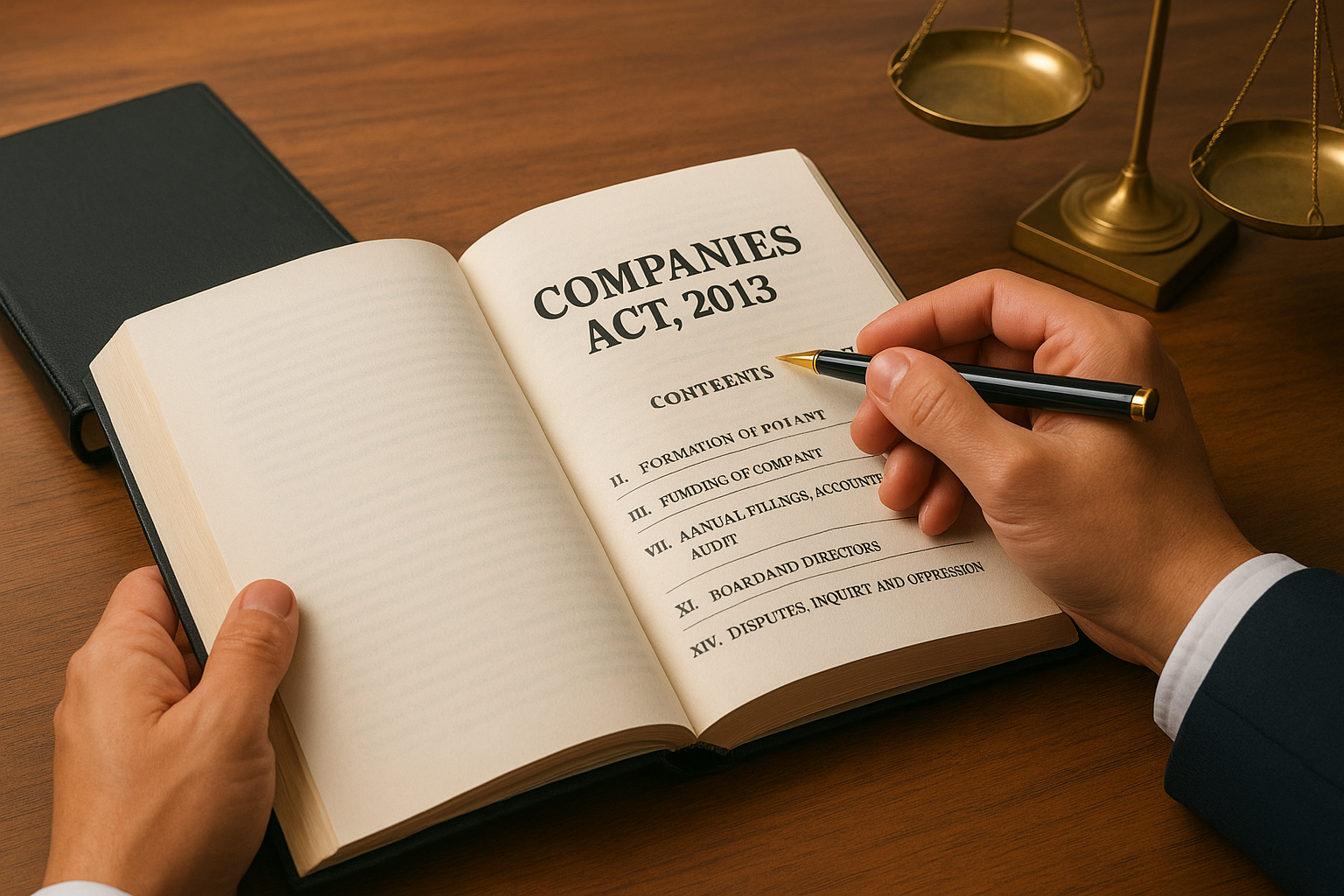
| Task | Chapters to open first |
|---|---|
| Forming a company | II and III |
| Raising money through shares or debentures | III and IV |
| Annual filings, accounts, and audit | VII, IX, and X |
| Board and director matters | XI, XII, and XIII |
| Disputes, inquiry, and oppression | XIV, XV, and XVI |
| Striking off or closing a company | XVIII and XX |
The next three sections follow this same grouping. Each one names the key sections and the points where readers usually go wrong.
Chapters I to VI: incorporation, capital and charges
These six chapters cover Sections 1 to 87 and follow a company from its first filing to its first loan. Most founder and finance questions sit here. Open them in this order when you read the Companies Act 2013 bare act for the first time.
Chapters I and II: definitions and incorporation
Chapter I has only Sections 1 and 2. Chapter II runs from Section 3 to Section 22. Section 3 sets the forms of company: a public company needs at least seven members, a private company at least two, and a one person company just one. Section 7 lays out the incorporation process with the Registrar, and Section 8 covers non-profit companies that need a Central Government licence.
Section 10 deserves a closer look. It makes the memorandum and articles bind the company and its members as if each had signed them. Changes need care, because Section 13 requires a special resolution to alter the memorandum and Section 14 does the same for the articles.
The memorandum and articles work as a contract, so read them alongside the bare act on contracts in India before you rely on any template.
Chapters III and IV: raising money
Raising money is governed by two chapters. Chapter III (Sections 23 to 42) deals with prospectus and allotment. Section 42 allows a private placement to not more than 200 persons in a financial year, a limit fixed by the Companies (Prospectus and Allotment of Securities) Rules, 2014. A company that skips the prescribed offer procedure risks penalty under the section.

Under Chapter IV (Sections 43 to 72), Section 43 names equity and preference shares. Section 62 governs rights issues and further issue of capital. Section 66 covers reduction of capital, Section 68 covers buy-backs, generally capped at 25% of paid-up capital and free reserves, and Section 71 covers debentures.
Chapters V and VI: deposits and charges
Deposits come next. Chapter V (Sections 73 to 76A) restricts how a company may accept deposits, and you must read it with the Companies (Acceptance of Deposits) Rules, 2014. Chapter VI (Sections 77 to 87) deals with charges. Section 77 requires you to file particulars within 30 days of creation, and Section 78 allows a further 300 days on payment of additional fees.
Lenders should note Section 77(3). A liquidator does not take an unregistered charge into account. A secured creditor who misses the filing window can therefore end up ranking as an unsecured creditor when the company is wound up.
Chapters VII to XIII: management, accounts and directors
These seven chapters run from Section 88 to Section 205 and govern the day-to-day running of a company. If you work with the Companies Act 2013 bare act as a director, secretary, or auditor, this is the block you will reopen most often.
Chapters VII to IX: meetings, dividends and accounts
Chapter VII (Sections 88 to 122) covers registers, the annual return under Section 92, the annual general meeting under Section 96, and resolutions under Section 114. Section 101 requires at least 21 clear days of notice for a general meeting, unless members holding 95% of voting power agree to shorter notice.
Chapter VIII (Sections 123 to 127) allows dividends only out of profits. Section 125 moves dividends unpaid for seven years to the Investor Education and Protection Fund. Chapter IX (Sections 128 to 138) then covers books of account, financial statements under Section 129, the board report under Section 134, and CSR under Section 135.
Chapters X and XI: audit and directors
Chapter X (Sections 139 to 148) deals with auditors. Section 139 sets a five-year term, Section 143 lists the auditor's powers and duties, and Section 148 requires cost records for prescribed classes of companies.
Chapter XI (Sections 149 to 172) is about the board itself. Section 149 requires at least three directors in a public company, two in a private company, and one in a one person company. It also requires one director who is resident in India for at least 182 days in the year.
Chapter XI decides who may sit on the board, and Chapter XII decides what that board may do.
Chapters XII and XIII: board powers and managerial pay
Chapter XII (Sections 173 to 195) sets the board meeting rules. Section 173 requires at least four meetings a year, with no more than 120 days between two meetings. Section 177 covers the audit committee, Section 179 lists powers that only the board can exercise, and Sections 185, 186, and 188 restrict loans, investments, and related party transactions.
Chapter XIII (Sections 196 to 205) covers managerial personnel. Section 197 caps total managerial remuneration at 11% of net profits, subject to the exceptions in the section and Schedule V. Section 203 requires prescribed companies to appoint key managerial personnel, such as a company secretary and a chief financial officer.
Chapters XIV to XXIX: inquiry, winding up and courts
These chapters run from Section 206 to Section 470. They cover what happens when a company is investigated, restructured, sued, or closed. They also hold the enforcement machinery for the rest of the Companies Act 2013 bare act, so read them with your earlier chapters open.
Chapters XIV to XVI: inquiry, schemes and oppression
Chapter XIV (Sections 206 to 229) deals with inspection, inquiry, and investigation. Section 206 lets the Registrar call for information or inspect books. Section 212 allows the Serious Fraud Investigation Office to take over a case where the affairs of a company need a deeper probe.
Chapter XV (Sections 230 to 240) covers compromises, arrangements, and mergers. Section 232 governs mergers and demergers before the NCLT. Section 233 offers a fast-track merger for small companies and holding-subsidiary pairs, without a full tribunal hearing.
Chapter XVI (Sections 241 to 246) handles oppression and mismanagement. Section 244 sets who may apply, generally 100 members or one-tenth of the total membership, or holders of one-tenth of issued share capital. Section 245 adds class action suits.
Sections 241 to 245 give minority shareholders a real remedy, but only if they meet the threshold in Section 244.
Chapters XVII to XX: valuers, strike off and winding up
The table shows how these four chapters divide the ground.
| Chapter | Sections | Subject |
|---|---|---|
| XVII | 247 | Registered valuers |
| XVIII | 248 to 252 | Removal of names from the register |
| XIX | 253 to 269 | Revival and rehabilitation of sick companies |
| XX | 270 to 365 | Winding up |
Section 248 lets the Registrar strike off a company that has not carried on business for two years. Section 252 gives an aggrieved person an appeal to the NCLT. Chapter XIX has largely been overtaken by the Insolvency and Bankruptcy Code, 2016, so check the notified status before you rely on it.
Chapter XX is the longest in the Act. Section 271 lists the grounds on which the Tribunal may order winding up, including inability to pay debts and a finding that it is just and equitable. Section 272 says who may petition.
Chapters XXI to XXIX: special companies, tribunals and offences
Chapters XXI to XXVI cover companies registering under the Act, foreign companies, Government companies, registration offices, and Nidhis under Section 406. Most readers skip them unless their client falls in one of those classes.
Chapter XXVII (Sections 407 to 434) creates the NCLT and NCLAT, and once a petition is filed you can track an NCLT matter and its orders online. Section 421 gives 45 days to appeal to the NCLAT, extendable by up to 45 days. Section 423 gives 60 days to go to the Supreme Court.
Chapter XXVIII (Sections 435 to 446) sets up Special Courts for serious offences. Chapter XXIX (Sections 447 to 470) then closes with Section 447 on fraud, compounding under Section 441, and the repeal provision in Section 465.
How to find the current text with amendments and rules
Finding the Companies Act 2013 bare act is easy. Finding the version that is current is the harder part. Start with official sources, and treat any PDF that carries no date as unverified.
Where to read online or download the PDF
Two government portals carry the text. The India Code portal, run by the Legislative Department, lets you read the Act online section by section and download it as a PDF. The Ministry of Corporate Affairs website carries the rules and the notifications that bring sections into force.
| Source | What you get | Use it for |
|---|---|---|
| India Code | Act text, section-wise view, PDF | Reading and citing a section |
| MCA website | Rules, notifications, circulars, forms | Checking rules and commencement dates |
How to confirm the text is current
Before you rely on any copy, run three checks.
- Look for an "as amended up to" date and compare it with the latest amending Act, such as the 2020 amendment.
- Check commencement. Section 1(3) lets the Central Government bring provisions into force on different dates, so a section that appears in the text may not yet be in force.
- Open the related rules on the MCA site. Rules fix thresholds, forms, and timelines that the Act leaves to them.
A bare act is only as current as its last amendment date.
Most errors here come from the second check. A reader sees a section in the text and assumes it applies, when the notification for it has not been issued.
What to look for in a printed edition
Buy a printed copy when you want the Act, the rules, and the forms in one volume. Check the edition year on the cover and confirm that the publisher states the amendment date it covers. An edition that mentions only the 2013 enactment is almost certainly out of date.
Remember that a printed book starts aging on the day it is printed. Keep it for reading and marking up, and then verify any section you plan to cite against the online source. That habit takes two minutes and protects you from citing a provision that has since changed.
How to use the schedules and rules with the Act
The schedules and the rules work as part of the Companies Act 2013 bare act in practice, even though the rules sit in separate notifications. The sections state the principle. The schedules and rules supply the formats, numbers, and procedures that make it usable.
What the main schedules contain
Schedules come at the end of the Act and carry the same legal force as the sections. Each one is called up by a specific section, so you rarely need to read them cold. Open the schedule when the section points to it.
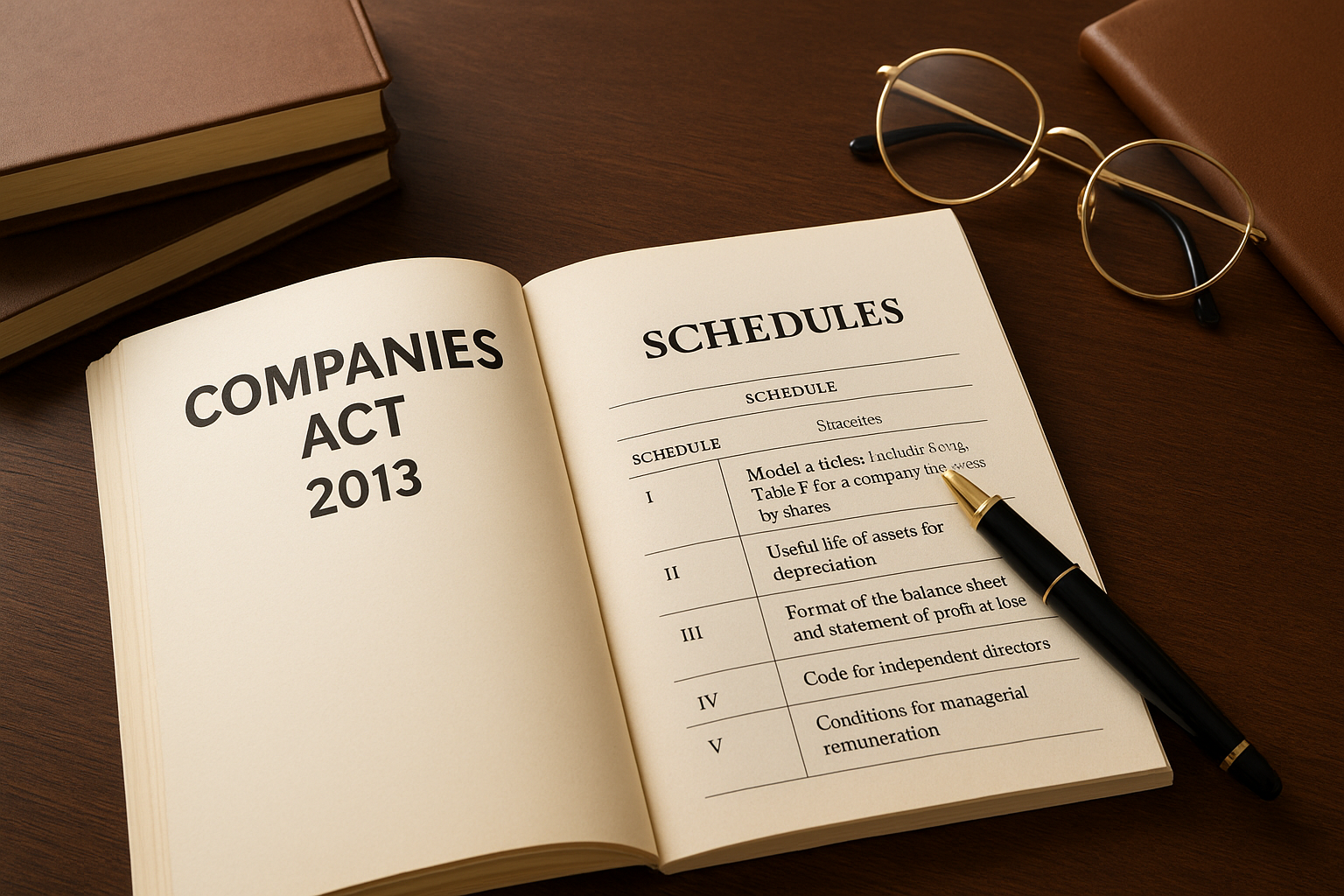
| Schedule | Subject | Read with |
|---|---|---|
| I | Model articles, including Table F for a company limited by shares | Section 5 |
| II | Useful life of assets for depreciation | Section 123 |
| III | Format of the balance sheet and statement of profit and loss | Section 129 |
| IV | Code for independent directors | Section 149 |
| V | Conditions for managerial remuneration | Section 197 |
| VII | Activities eligible for CSR spending | Section 135 |
Accountants live in Schedules II and III. Directors should read Schedule IV before accepting an independent directorship, because it sets out the duties and the appointment terms. Schedule V matters whenever managerial pay goes past the limits in Section 197.
How to read the rules alongside a section
Rules are made by the Central Government under Section 469, and each set is named after its subject. Examples are the Companies (Incorporation) Rules, 2014 and the Companies (Accounts) Rules, 2014. They carry the thresholds, forms, and timelines that the Act leaves open. Skipping them leaves most compliance questions unanswered.
Section 149 is a good example. The Act requires independent directors in prescribed companies, but it does not name them. The Companies (Appointment and Qualification of Directors) Rules, 2014 say that a listed public company needs one-third of its board to be independent. A public company above certain paid-up capital, turnover, or borrowing limits needs at least two.
The Act names the duty, and the rules fix the threshold, the form, and the deadline.
A simple habit helps. For every section you use, note the rule set that applies and the form number it requires. Then check the commencement date and amendment date for both the section and the rule, since each can change separately. Keep this as a one page sheet for each client, and update it whenever the MCA issues a new notification.
Common mistakes when reading the bare act
Readers make the same few errors with the Companies Act 2013 bare act, and all of them are avoidable. Most come from treating the text as a standalone document. The three below cause the most wrong citations in practice.
Using old section numbers from the 1956 Act
Many precedents and older practitioners still quote the Companies Act 1956. Section 465 of the new Act repealed it, so those numbers now point to a different provision or to nothing at all. Convert every reference before you cite it.
| 1956 Act | 2013 Act |
|---|---|
| Sections 397 and 398 (oppression and mismanagement) | Sections 241 and 242 |
| Section 292A (audit committee) | Section 177 |
| Section 58A (deposits) | Sections 73 to 76A |
Judgments decided before 2013 use the old numbers. Read them with this table open, and compare the new wording, because the test did not always carry over unchanged.
Assuming only the Companies Acts changed the text
Amendments reach the Act through other statutes as well. The Finance Act, 2017, for example, removed the cap of 7.5% of average net profits on political contributions in Section 182. A reader who checks only the four Companies (Amendment) Acts will miss that change. Listed companies carry an extra layer of obligations under the SEBI listing regulations, which no bare act will show.
A section can change without a Companies (Amendment) Act, so check the amendment history of the section itself.
On India Code, open the section and look at the footnotes and the amending notes. They show which law changed the wording, and when.
Expecting the text to explain itself
The Act uses terms that it never fully explains. Section 241 allows a member to complain of conduct that is "oppressive" or prejudicial to the company, yet it does not define oppression. Courts filled that gap over decades, and cases such as Needle Industries (India) Ltd v Needle Industries Newey (India) Holding Ltd (1981) still shape how tribunals apply the test.
So read the bare act for what the law says, and read judgments for what it means. An AI research tool like LeXi AI can pull judgments on a section with verified sources, which saves time. Still, open the original judgment before you rely on any summary, including one from an AI tool or a free database whose gaps are worth knowing before you cite it.
Reading the Act with confidence
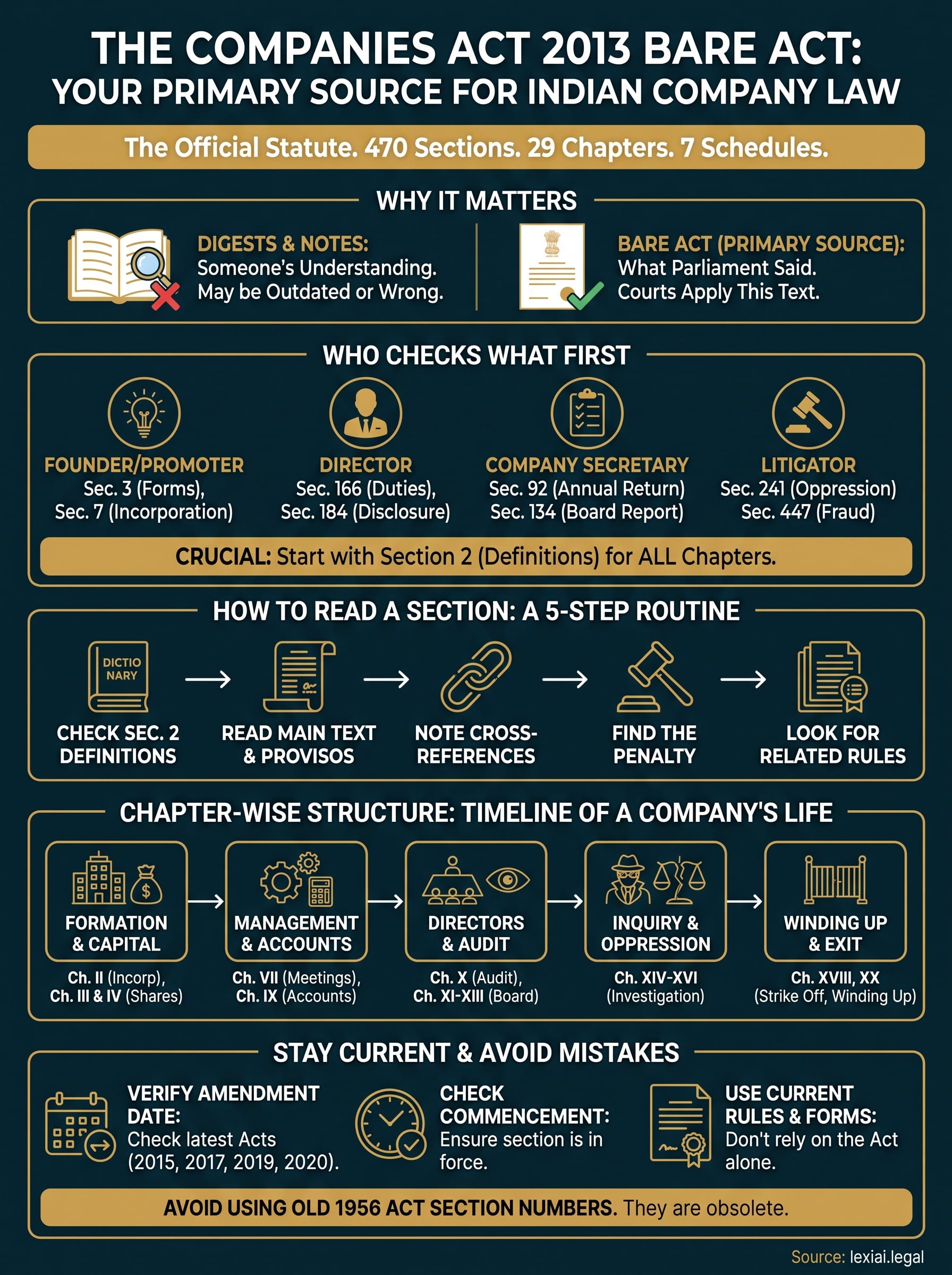
The Companies Act 2013 bare act is the statute exactly as Parliament wrote it, and every reliable answer on company law starts there. Digests and notes help, but only the text decides a matter before the NCLT.
Work through it by chapter, not by page. Check Section 2 for defined terms, read each proviso and penalty, and then open the related rules. Finally, confirm the amendment and commencement dates before you cite anything.
Those habits take minutes and prevent most wrong citations. The Act tells you what the law says, and judgments tell you what it means. If you want to trace a section to its case law quickly, test LeXi AI free on the Companies Act sections you cite and check each result against the original judgment.