

Legal Research Methods: Doctrinal, Non-Doctrinal, and More
Most law students and even practicing lawyers use the term legal research methods without knowing there is an actual classification behind it. Ask someone to name the methods beyond "reading case law and statutes," and the answer usually gets vague fast. That gap matters because your dissertation, moot memo, or client opinion is judged partly on whether you picked the right method for the question you are answering.
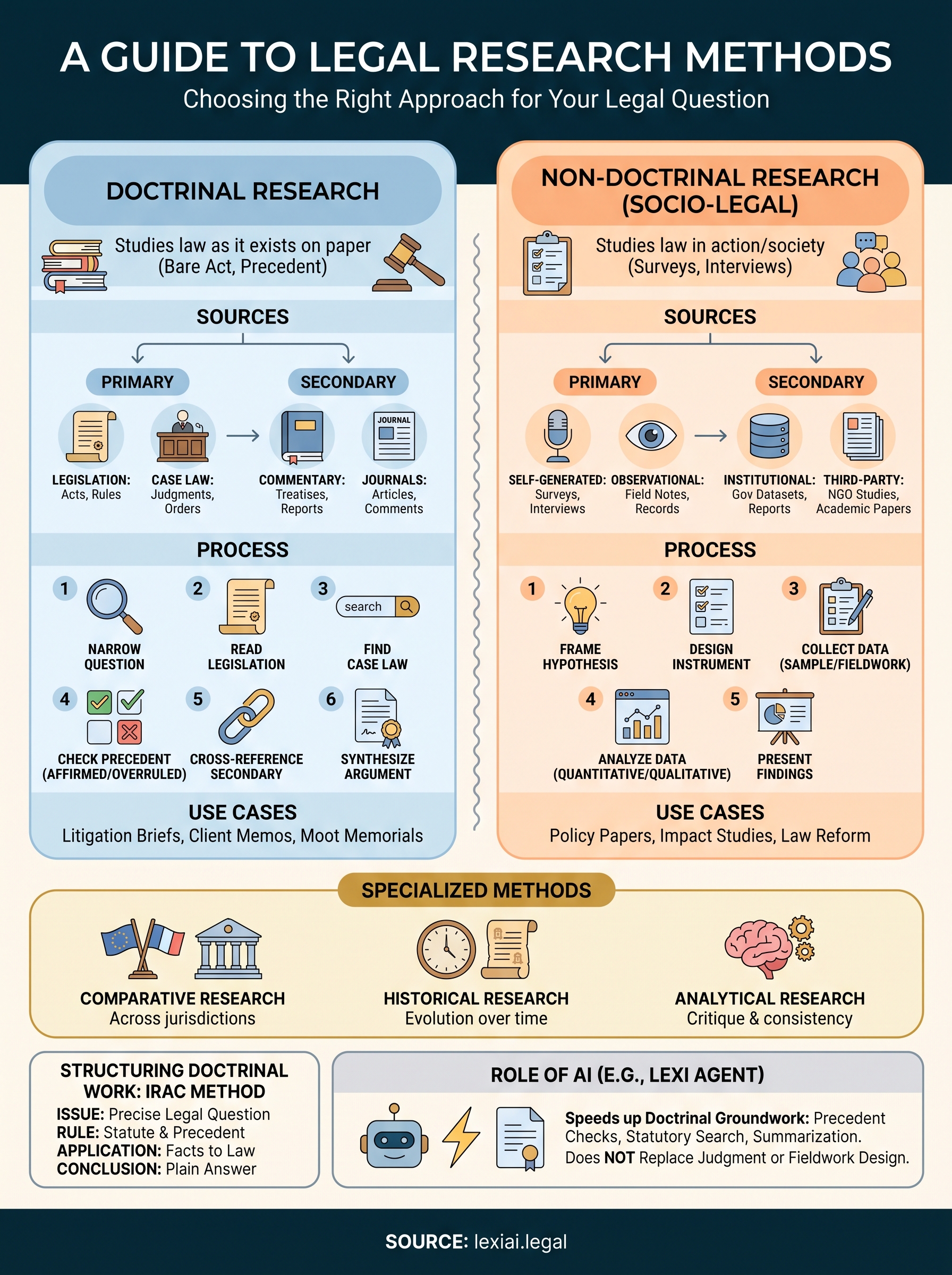
The short answer is that legal research splits into two broad families: doctrinal research, which studies statutes, case law, and legal principles as they exist on paper, and non-doctrinal research (also called empirical or socio-legal research), which studies how law actually operates in society through surveys, interviews, and data. Within these, you will find comparative, historical, and analytical approaches, each suited to different questions.
This article walks through each method with concrete examples relevant to Indian legal practice and academia, so you can identify which one fits your research problem before you start. We will also touch on how tools like LeXi Agent can speed up the doctrinal side, particularly precedent analysis and statutory interpretation, without replacing the judgment a proper methodology demands.
Why choosing the right research method matters
Picking the wrong method does not just make your research harder. It makes your conclusions unreliable, no matter how many hours you put in. A dissertation built entirely on doctrinal analysis when the question demands field data will read as incomplete to any examiner who knows the subject. A litigation memo built on survey statistics when the judge wants a clean reading of Section 73 of the Indian Contract Act, 1872 bare act text will miss the point entirely. The method is not a formality, it is the lens that decides what counts as evidence for your argument.

When doctrinal research alone falls short
Suppose you are writing on whether the Prevention of Sexual Harassment (POSH) Act, 2013 has actually reduced workplace harassment complaints reaching courts. Reading the bare text of the Act, the rules, and a handful of judgments tells you what the law says an Internal Committee should do. It tells you nothing about whether committees are even constituted in most companies, whether employees trust the process, or whether complaints get buried before they reach a tribunal. That gap is exactly what non-doctrinal research is built to fill, through surveys of HR departments, interviews with complainants, or company compliance audits. Skip that step and your paper answers a question nobody asked.
When non-doctrinal research overreaches
The reverse mistake shows up just as often, usually among students who enjoy fieldwork more than statute-reading. Say you are arguing before a bench that a particular indemnity clause falls outside the scope of Section 124 of the Contract Act. No amount of survey data on how commonly indemnity clauses appear in Indian contracts will move that argument forward. What moves it is a tight doctrinal reading of the section, the relevant Law Commission reports, and precedent such as Gajanan Moreshwar Parasharam v. Moreshwar Madan Mantri. Courts decide questions of law through legal reasoning, not opinion polls, so empirical findings without doctrinal grounding carry little weight in a courtroom filing.
The right research method is not a stylistic choice, it is what separates a defensible legal argument from an interesting but useless one.
The stakes look different depending on who is reading your work
The consequences of a mismatched method change depending on your audience, but they are never trivial. A quick comparison makes this clearer:
| Context | Wrong method used | Likely consequence |
|---|---|---|
| LLM or PhD dissertation | Pure doctrinal review for a policy-impact question | Examiners flag lack of empirical grounding, viva gets tough |
| Moot court memorial | Socio-legal survey data instead of case law | Judges dismiss the submission as not legally reasoned |
| Client advisory memo | Historical analysis without current statutory position | Client relies on outdated advice, exposure to liability |
| Litigation brief | No precedent analysis, only academic commentary | Weak persuasive value before the bench |
| Legislative drafting note | No comparative study of other jurisdictions | Draft misses workable models already tested elsewhere |
Each row above represents hours of wasted effort, and in the litigation and advisory rows, real financial or reputational cost to a client. This is precisely why senior counsel spend time at the outset scoping the research question before assigning it to a junior. Getting that scoping wrong is expensive in ways that only show up much later, when the brief is already filed or the dissertation is already submitted.
Time pressure raises the cost of a wrong turn
Time is the other hidden cost. Litigation teams working on tight filing deadlines cannot afford to spend three days building an empirical survey when what the case needs is a fast, accurate precedent search. This is where tools like LeXi Agent earn their place, by compressing the doctrinal side of research, AI-assisted precedent search across Indian judgments and statutory cross-referencing, into minutes rather than days, freeing up time for the analytical judgment that no software can replace. Understanding the method landscape upfront, even briefly, is what lets a lawyer or student decide fast whether the task calls for reading, asking, or both.
How to choose the right legal research method
Before you open a single database, ask yourself what kind of answer your work requires. A legal research methodology is not something you retrofit after collecting materials, it is the decision that determines what materials you go looking for in the first place. Get this sequencing wrong and you end up with a folder full of case law when you needed field data, or a stack of survey responses when the assignment wanted statutory interpretation.
Start with the nature of the question, not the topic
Topic and question are not the same thing. "Arbitration in India" is a topic. "Why do Indian courts set aside domestic arbitral awards under Section 34 of the Arbitration and Conciliation Act, 1996 more often than international awards" is a question, and it tells you immediately that you need doctrinal analysis of grounds under Section 34, paired with a review of reported set-aside orders. If instead the question were "why do businesses avoid arbitration despite the 1996 Act," you would need interviews or surveys with in-house counsel, because the statute cannot tell you why people avoid using it.
If your question asks what the law says, go doctrinal. If it asks how the law behaves in practice, go non-doctrinal.
Match the method to the output you must produce
The deliverable shapes the method as much as the question does. A checklist helps here:
- Litigation brief or memorial: doctrinal research, built on statute, precedent, and applicable rules
- Client advisory memo: doctrinal research first, supplemented by industry practice notes if the client needs commercial context
- LLM or PhD dissertation on legal impact: non-doctrinal research supported by a doctrinal foundation
- Comparative policy paper: comparative research across two or more jurisdictions
- Historical or constitutional commentary: historical research tracing statutory or judicial evolution
Check what sources are actually available to you
Ambition has to meet reality. A brilliant empirical design falls apart if you cannot get HR departments to respond to a survey, or if court registries will not release the data you need for a sample size that means anything. Before committing to a method, confirm you can access primary sources, whether that is a case law database, a government dataset, or willing interview subjects, within your actual timeline.
Confirm your method against your deadline
Doctrinal research scales faster than fieldwork. You can pull, read, and cross-reference a hundred judgments in a week with the right tools; recruiting and interviewing thirty respondents rarely fits that same week. This is where speed matters practically, not just academically. Platforms like LeXi Agent exist precisely to compress the doctrinal leg of the work, verified precedent search and statutory cross-referencing, so that when a mixed-method approach is genuinely warranted, you have time left for the fieldwork the question demands rather than rushing both halves badly.
Doctrinal research: sources, process, and use cases
Doctrinal research, often called black-letter law research, studies what a rule says rather than how it behaves once it leaves the statute book. You read the Bare Act, judicial pronouncements, and secondary commentary, then work out the settled legal position for a given fact pattern. This is the default method for most law school assignments, moot memorials, and case comments, because the brief almost always asks you to state the law and apply it, not measure its social effect.

What sources count as doctrinal research?
Sources split into two tiers, and mixing them up is a common mistake among first-year students. Primary sources carry binding or persuasive legal authority on their own. Secondary sources help you interpret primary sources but carry no authority by themselves.
| Source type | Examples | Role in your research |
|---|---|---|
| Primary, legislation | Bare Acts, rules, notifications, ordinances | States the rule itself |
| Primary, case law | Supreme Court and High Court judgments, tribunal orders | Shows how courts interpret the rule |
| Secondary, commentary | Law Commission reports, textbooks, treatises | Explains gaps and legislative intent |
| Secondary, journals | Law review articles, case comments | Offers critical analysis and competing readings |
Verifying that a judgment is still good law matters more than finding it in the first place. A precedent overruled last year does nothing for your argument except embarrass you before a judge who remembers the overruling.
Doctrinal research is only as strong as your last check on whether the precedent you are citing is still good law.
Getting that check right is exactly where legal research methods built on manual citators used to slow lawyers down for hours. AI research tools for Indian lawyers like LeXi Agent now flag whether a cited case has been affirmed, distinguished, or overruled before you build an argument on it, which matters more in fast-moving areas like arbitration and insolvency where High Court positions shift often.
How does the doctrinal research process actually work?
Working through doctrinal research follows a fairly fixed sequence, whether you are drafting a memorial or a client note:
- Frame the legal question narrowly, tied to a specific section or doctrine rather than a broad topic.
- Locate the primary legislation and read the full provision, not just the subsection you think applies.
- Pull judgments interpreting that provision, starting with the Supreme Court and working down to relevant High Courts.
- Check the subsequent citation history to confirm the precedent still holds good.
- Cross-reference secondary sources such as Law Commission reports to understand legislative intent behind the provision.
- Synthesize the findings into a reasoned position, flagging any conflicting High Court views for the reader.
Skipping step four is the single most common error among students and junior associates alike, because it is the step that takes the most patience and the least obvious payoff until it saves you from citing dead law.
Where doctrinal research earns its keep
This approach fits any situation where a court, examiner, or client wants a clear statement of law rather than a survey of opinion. Picture interpreting the grounds for setting aside an arbitral award under Section 34 of the Arbitration and Conciliation Act, 1996, arguing limitation under Article 137 of the Limitation Act, 1963, or drafting an opinion on whether a non-compete clause survives Section 27 of the Indian Contract Act, 1872. In each of these, the answer sits in statute and precedent, and a fieldwork-heavy research methodology would only slow the work down without adding anything a judge or client actually needs.
Non-doctrinal research: sources, process, and use cases
Non-doctrinal research, sometimes called empirical or socio-legal research, asks how law functions once it leaves the courtroom and enters offices, homes, and police stations. Instead of reading what a statute says, you measure what people actually do because of it, through surveys, interviews, field observation, or statistical datasets. Where doctrinal work answers "what is the rule," this method answers "does the rule work," which makes it the natural fit for policy papers, impact studies, and law reform proposals.

What sources count as non-doctrinal research?
Unlike doctrinal work, primary sources here are not statutes or judgments but the raw data you generate or collect yourself, and secondary sources are studies that others have already produced on the same question.
| Source type | Examples | Role in your research |
|---|---|---|
| Primary, self-generated | Surveys, structured interviews, focus groups | Captures first-hand experience or opinion |
| Primary, observational | Court attendance records, field observation notes | Records behavior as it actually happens |
| Secondary, institutional | NCRB crime data, NALSA reports, RBI circular compliance data | Provides existing datasets you can build on |
| Secondary, third-party studies | NGO reports, bar council surveys, academic empirical papers | Offers comparable findings from prior work |
Getting access to these sources takes longer than pulling a judgment off a database, and that timeline needs to be planned into any dissertation schedule from day one.
How does the non-doctrinal research process actually work?
Running a socio-legal study follows a different rhythm than statutory interpretation, and skipping a step here damages the validity of your findings rather than just weakening an argument.
- Frame a testable hypothesis, such as "POSH Internal Committees are rarely constituted in companies with fewer than 500 employees."
- Design your instrument, whether a survey questionnaire or an interview schedule, and pilot it on a small group first.
- Identify a sample large and varied enough to support generalization, not just convenient respondents.
- Collect data through fieldwork, keeping records of response rates and any bias in who chose to participate.
- Analyze the data using appropriate statistical or qualitative coding methods.
- Present findings alongside the doctrinal position, so the reader sees both what the law says and what actually happens.
Non-doctrinal research measures whether the law works, not just what it says on paper.
Where non-doctrinal research earns its keep
Researchers reach for this method when the question genuinely cannot be answered from a Bare Act or a judgment. Studying whether the POSH Act, 2013 has changed workplace reporting behavior, whether fast-track courts have actually reduced pendency, or whether litigants trust mediation over trial all demand field data, because no provision in any statute records how people feel or behave. A PhD thesis on legal impact almost always leans on this method, paired with a doctrinal chapter that sets out the legal framework before the fieldwork begins. Skipping the fieldwork here produces a paper that restates the law confidently while answering a question nobody actually asked.
Other legal research methods worth knowing
Beyond the doctrinal and non-doctrinal split, a handful of other legal research methods show up often enough in Indian legal writing that you should recognize them by name. None of these replace the core two, they usually sit inside a doctrinal or non-doctrinal project as a specific technique for handling a particular kind of question. Knowing the label helps you explain your approach clearly in a methodology chapter or a moot memorial's research note.

Comparative research
Comparative research places Indian law side by side with another jurisdiction to see what works, what does not, and what India could borrow. A paper examining how the UK's Bribery Act, 2010 handles corporate liability compared to the Prevention of Corruption Act, 1988 is comparative research, and so is a legislative note studying Singapore's arbitration framework before proposing amendments to the Arbitration and Conciliation Act, 1996. This method demands doctrinal fluency in two legal systems at once, which is why it takes longer than a single-jurisdiction doctrinal paper and rewards researchers who read primary sources rather than secondhand summaries of foreign law.
Historical research
Historical research traces how a legal principle or statute evolved over time, often to explain why a provision reads the way it does today. Tracking the amendments to Section 138 of the Negotiable Instruments Act, 1881 since its introduction in 1988, or reading Constituent Assembly debates to understand the intent behind Article 21, both fall under this method. It works well for constitutional commentary and for arguments that rely on legislative intent, since courts themselves often reach into legislative history when a provision's plain text is ambiguous.
Analytical and interpretative research
Analytical research goes a step beyond stating the law, it critiques it, questioning whether a rule is internally consistent, whether it achieves its stated purpose, or whether competing judicial interpretations can be reconciled. A paper arguing that the "seat versus venue" distinction in Indian arbitration law creates avoidable litigation is analytical research built on a doctrinal foundation.
Analytical research asks not just what the law says, but whether what it says actually makes sense.
Quantitative versus qualitative approaches within non-doctrinal work
Within non-doctrinal projects, researchers further split their approach by the kind of data they collect:
| Approach | What it measures | Typical tool |
|---|---|---|
| Quantitative | Numbers, frequencies, statistical trends | Structured surveys, court data analysis |
| Qualitative | Experiences, motivations, perceptions | Open interviews, case studies, focus groups |
Most strong dissertations blend both, using quantitative data to show scale and qualitative interviews to explain why the numbers look the way they do. Recognizing which of these methods your research question calls for, before you start collecting data, saves you from a mismatched dataset later. Tools like LeXi Agent will not run your survey for you, but they do speed up the doctrinal groundwork that almost every comparative, historical, or analytical paper still needs before the original analysis begins.
Applying the IRAC method to structure your research
IRAC stands for Issue, Rule, Application, and Conclusion, and it is the framework you use to write up doctrinal research once you have gathered it, not a separate research method in itself. Think of it as the container that forces scattered case law and statutory reading into an argument a judge, examiner, or client can actually follow. Skip this structure and even solid doctrinal research reads like a pile of notes rather than a reasoned position.
Each letter maps to a specific job, and skipping one usually means the reader has to guess what you actually concluded:
Issue: State the precise legal question in one sentence.
Rule: Set out the governing statute and the precedent that interprets it.
Application: Apply that rule to your specific facts, addressing counterarguments.
Conclusion: State your answer plainly, without hedging.
Working through a real example makes this concrete. Say the issue is whether an indemnity clause in a commercial contract survives termination. The rule comes from Section 124 of the Indian Contract Act, 1872, read alongside Gajanan Moreshwar Parasharam v. Moreshwar Madan Mantri. The application section walks through your specific clause wording against that precedent, addressing the opposing party's likely reading. The conclusion states, without qualification, whether the clause survives. A memorial that jumps straight from rule to conclusion, skipping application, leaves the bench to do your reasoning for you, and benches rarely do that favor.
A conclusion without an application section is just an opinion dressed up as legal argument.
This structure also protects you from a common weakness in mixed-method papers, where doctrinal and non-doctrinal findings sit side by side without connecting. If your dissertation pairs a doctrinal chapter on the POSH Act, 2013 with survey data on Internal Committee compliance, IRAC still gives you a way to frame the doctrinal half cleanly before your empirical findings complicate the picture. The issue and rule stay purely legal, and the application section is where you can note that the law's text assumes compliance that your survey data shows is rare in practice.
Examiners and senior counsel reach for IRAC instinctively when reading your work, even if they never name it, because it tells them within a paragraph whether you understand the difference between stating law and applying it. Building your case notes or moot memorial around this structure from the first draft saves you the painful exercise of restructuring a finished document the night before submission. Tools built for legal research methods work, including drafting assistants like LeXi LiTT, can help organize case strategy along these same lines, pulling relevant precedent into an issue-by-issue structure so the application section has material to work with rather than a blank page.
How technology and AI tools are changing legal research
Twenty years ago, doctrinal research meant physical volumes of the All India Reporter and a librarian who knew where everything sat. Today, most of that work happens on a screen, and the shift is not just about speed. AI legal research tools now read, cross-reference, and flag case law faster than a team of juniors could manage in a week, which changes what a lawyer or student is actually expected to produce in a given timeframe.
What AI actually speeds up
AI does not replace the judgment doctrinal research demands, but it removes the grunt work that used to eat most of the time. A few concrete examples:
- Pulling every reported judgment interpreting a specific section across Supreme Court and High Court databases in seconds rather than hours
- Flagging whether a precedent has been affirmed, distinguished, or overruled before you cite it
- Summarizing a 400-page case file into the facts and issues that actually matter to your brief
- Translating filings and judgments across languages for multi-jurisdictional or regional matters
- Drafting a first pass at an issue-by-issue case strategy that a senior can then sharpen
Platforms like LeXi Agent, built as an AI platform trained on Indian statutes and judgments, handle the first two on that list directly, running precedent analysis and statutory cross-referencing with verified sources rather than a general search engine's best guess. LeXi LiTT takes the case-file summarization and strategy-building further, condensing lengthy records and helping structure courtroom preparation around the issues a bench will actually ask about.
AI shortens the search for what the law says, it does not shorten the thinking about what that means for your case.
Why accuracy still needs checking
General-purpose AI models were never built for legal reasoning, and it shows the moment you ask one to interpret an Indian statute with any nuance, as the studies comparing AI and lawyers on legal research make clear. That gap is why benchmarking matters. On the AIBE 20 legal reasoning benchmark, which tests statutory interpretation and case analysis accuracy, purpose-built legal models score meaningfully higher than general models repurposed for law, because they are trained on the reasoning patterns Indian courts actually use rather than generic internet text. A tool that gets an indemnity clause analysis wrong once is a tool you stop trusting, so verified sourcing matters more in legal work than in almost any other AI application.
What technology has not changed
No AI tool decides whether your research question calls for doctrinal or non-doctrinal treatment, and none of them design a survey instrument or interview schedule for you. That scoping decision, covered earlier in this piece, still sits entirely with the researcher. What AI has changed is the cost of getting the doctrinal groundwork done, freeing up hours that a junior associate or a dissertation student can now spend on the analytical or empirical work that actually needs a human mind. Used this way, AI is not a shortcut around legal research methods, it is a faster on-ramp into them.
Common mistakes to avoid in legal research
Most weak legal research fails for a handful of repeatable reasons, not because the writer lacked effort. Recognizing these patterns before you submit a memorial, dissertation chapter, or client note saves you from a rewrite that a senior or examiner will otherwise force on you. The mistakes below cut across doctrinal and non-doctrinal work alike, and most of them trace back to skipping a step covered earlier in this piece.
Treating a topic as a research question
Students often start with a broad area, such as "data protection in India," and begin reading everything available before narrowing anything down. That approach wastes weeks on material that never makes it into the final draft. A sharper research question, tied to a specific provision like Section 43A of the Information Technology Act, 2000, tells you immediately which sources matter and which do not, which is exactly the scoping discipline discussed under choosing the right method.
Skipping the check on whether precedent still holds
Citing a judgment without confirming its current status is the single most common error among junior researchers, and it is also the most damaging in front of a bench.
A brief built on overruled precedent collapses the moment opposing counsel points it out.
Building a citation-checking habit into your workflow, rather than treating it as an afterthought, protects every argument that rests on that precedent.
Mixing methods without a reason to
Adding a survey to a doctrinal dissertation because "empirical work looks rigorous" backfires when the fieldwork does not actually answer the legal question posed. Every method you add should earn its place by answering a specific part of the question, not by padding the word count. Reviewing the checklist under choosing the right method before you commit to a mixed approach avoids this trap entirely.
Ignoring who actually reads the work
A dissertation chapter and a litigation brief demand different depth even when they cover the same legal research methods. Writing a client memo with academic hedging, or a memorial with survey statistics a judge has no use for, misreads the audience rather than the law.
A quick checklist before you submit
- Confirm your question is narrow enough to point to specific sources
- Verify every cited judgment is still good law
- Justify any method beyond the core one you started with
- Match depth and tone to who will actually read the final document
- Check that your conclusion answers the question you originally framed
Running through this list takes ten minutes and catches most of the errors that otherwise surface only after submission, when fixing them costs far more than ten minutes.
Putting these methods into practice
Good legal research starts with a question, not a stack of downloaded judgments. Once you know whether you need doctrinal research, non-doctrinal fieldwork, or a mix of both, everything else, sources, structure, timeline, falls into place faster. The framework matters more than any single tool, but the right tool still saves you the hours that used to go into manual citation checks and precedent hunts.
That is the gap legal research methods built on AI are closing right now. Whether you are drafting a memorial, building a client opinion, or structuring a dissertation chapter around IRAC, the doctrinal groundwork no longer needs to eat your week. Spend that time on the analysis a machine cannot do for you.
If you want to see how this works on an actual brief rather than a hypothetical, see what LeXi AI does for doctrinal research and try it against your next research question.