

AI vs Lawyers in Legal Research: What the Studies Show
AI vs lawyers legal research is not a hypothetical debate anymore. Multiple benchmark studies, including bar exam simulations and case law retrieval tests, have measured how AI models perform against practicing lawyers on statutory interpretation, precedent analysis, and drafting speed. The results are specific enough to matter for your practice, not just academic curiosity.
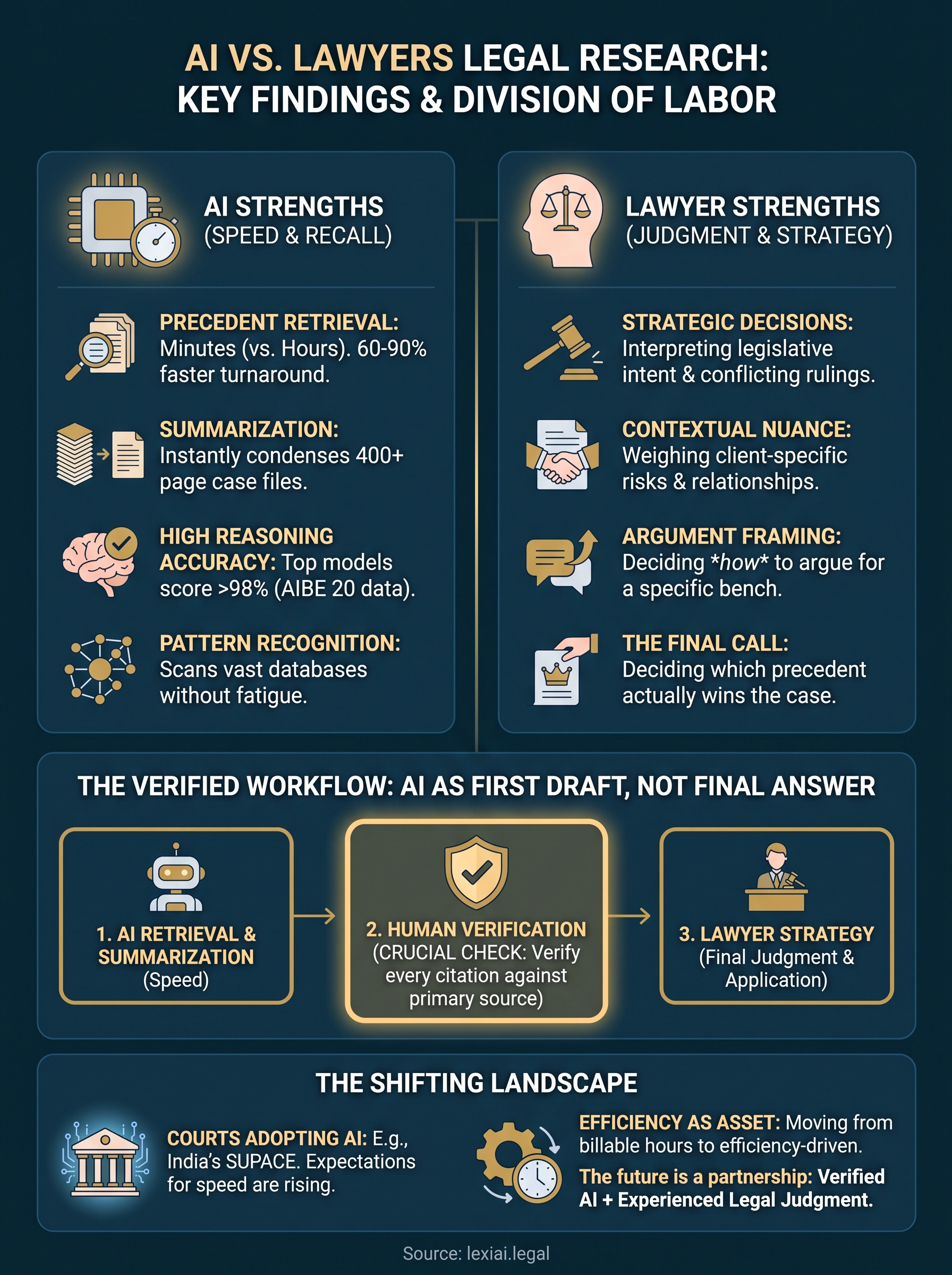
The direct answer is this: AI tools now match or beat human lawyers on speed and recall in structured legal research tasks, but lawyers still hold the edge on judgment calls involving context, strategy, and client-specific nuance. Studies on datasets like AIBE 20 show top-performing legal AI models scoring above 98 percent on legal reasoning accuracy, while research turnaround time drops by 60 to 90 percent compared to manual methods. That gap in speed is real, and it changes how research gets allocated within a firm.
This article walks through what the actual studies measured, where AI outperforms human researchers, where it falls short, and what that means for how you structure research work in your practice. We look at accuracy benchmarks, real case data, and where tools like LeXi Agent fit into that ai vs lawyers legal research comparison for Indian commercial law specifically.
Why the AI versus lawyers debate matters right now
Indian courts carry more than five crore pending cases, according to the National Judicial Data Grid, and every one of those files needs research before it moves an inch. That backlog is not an abstract statistic for you. It means more precedent to sift through, more statutes to cross-check, and less time to do it in. When legal research bottlenecks slow down case preparation, clients notice, and so do opposing counsel who move faster.
This is exactly why the ai vs lawyers legal research question stopped being theoretical. Benchmark studies over the past two years have started testing AI models against practicing lawyers on the same tasks: statutory interpretation, precedent retrieval, and drafting under time pressure. The results are specific, repeatable, and increasingly hard to dismiss as marketing claims.
The pressure point: case backlogs and billable hours
Litigation research eats a disproportionate share of a lawyer's week. Surveys of Indian law firms consistently show junior associates spending 15 to 20 hours a week just locating and reading precedent, before any drafting even begins. That is time billed to clients or absorbed as overhead, and neither option scales well when caseloads keep growing. Faster research cycles translate directly into either lower client costs or higher throughput per associate, which is why firms are paying close attention to what the studies actually say AI can do.
What the benchmark studies actually tested
Most of the credible studies compare three things: accuracy on legal reasoning tasks, time to complete a research task, and recall, meaning how much relevant precedent actually gets found. A 2024 study from Stanford University's RegLab found that hallucination rates in general-purpose AI tools reached as high as 82 percent on legal queries, which is exactly why legal-specific benchmarks like AIBE 20 matter more than generic AI test scores. General AI models are not trained on the statutory language and precedent structure that Indian commercial law depends on, and that gap shows up fast under testing.
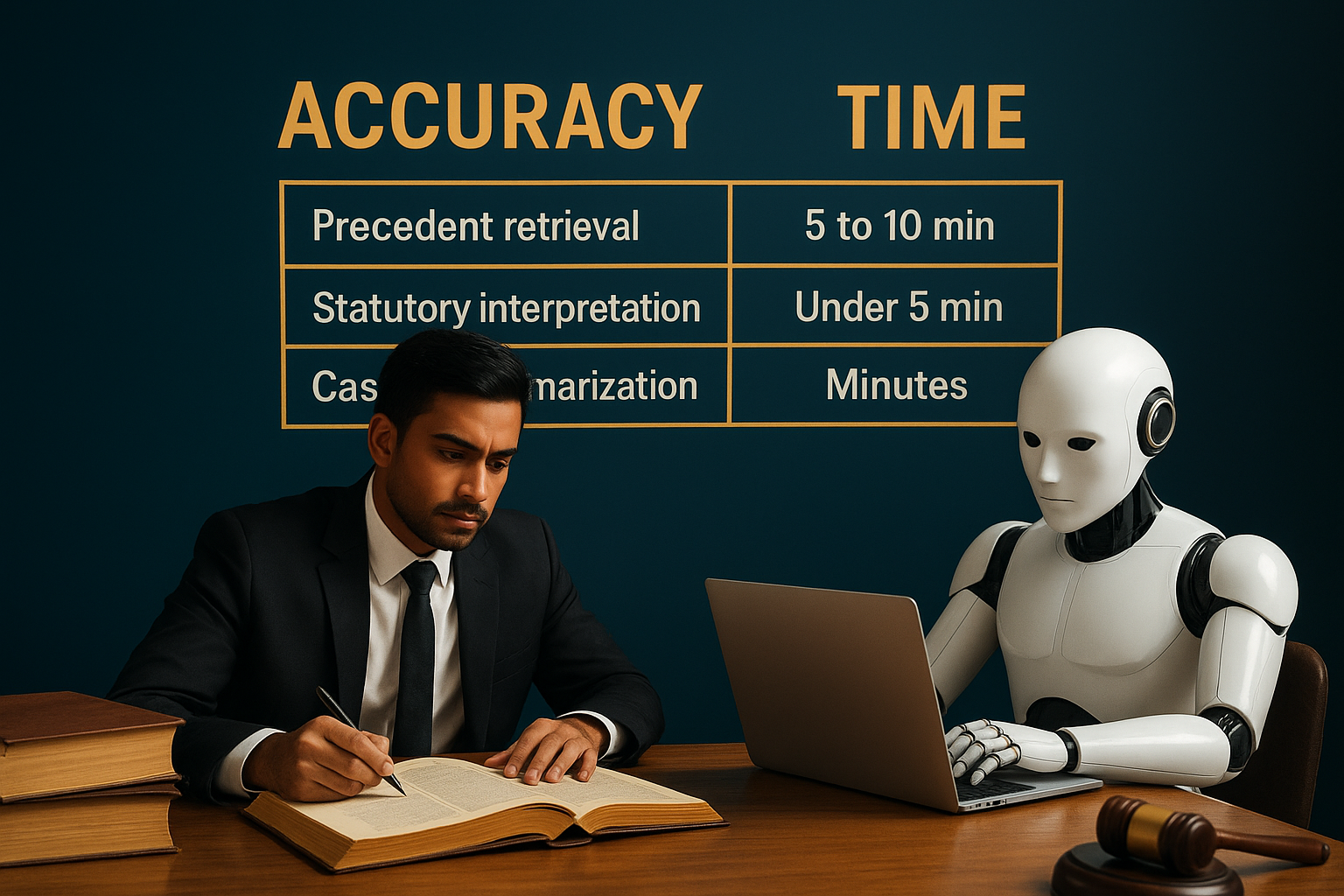
| Task type | Average lawyer time | Average AI time | Reported accuracy gap |
|---|---|---|---|
| Precedent retrieval | 3 to 5 hours | 5 to 10 minutes | AI recall higher, context judgment lower |
| Statutory interpretation | 1 to 2 hours | Under 5 minutes | Comparable on plain text, weaker on legislative intent |
| Case file summarization (400+ pages) | Full day | Minutes | AI faster, human review still required |
Speed is no longer the differentiator between AI and lawyers in legal research; judgment is.
Why firms cannot ignore this anymore
Clients now ask direct questions about turnaround time and cost, and they compare quotes across firms that have already built AI-assisted research into their process. Firms that stick to fully manual research risk losing pitches on price and speed alone, regardless of how strong their legal reasoning is. Corporate legal teams managing high contract volumes face the same math: manual clause review and precedent checks slow down deal cycles that competitors close faster with AI-assisted research already in the loop.
Gradually, this debate matters because the practice of law is shifting from a pure billable-hours model toward one where research efficiency itself becomes a competitive asset. Ignoring the data does not make the pressure disappear, it only delays the decision about how your practice adapts to it.
How to use AI for legal research without losing accuracy
Using AI for legal research works only when you treat it as a first draft, not a final answer. AI-assisted legal research speeds up retrieval and summarization, but every citation, statute reference, and case name still needs a human check before it reaches a filing or a client memo. Skipping that step is how hallucinated cases end up in court submissions, and Indian courts have already sanctioned lawyers for exactly that mistake.
Verify every AI-generated citation before you cite it
Build verification into your workflow as a fixed step, not an afterthought you do when time allows. Treat the AI output as a lead, then confirm it against a primary source before it goes anywhere near a draft.
- Pull the actual judgment or statute text from a verified database, never rely on the AI's summary alone.
- Cross-check party names, citation numbers, and court names against the original source.
- Confirm the case has not been overruled or distinguished in later judgments.
- Flag any statutory reference to the specific section number, not just the act name.
Trust the AI's speed, but never trust its citation without checking the source yourself.
Match AI use to task type
Running research reliability checks matters more for some tasks than others, so match the tool to the job instead of applying one workflow to everything. Precedent retrieval and case summarization are low-risk for AI-first drafts because you review the output before using it. Statutory interpretation involving legislative intent or conflicting High Court rulings needs a lawyer's judgment from the start, with AI used only to surface the relevant provisions faster.
Grading of tasks also depends on how the AI tool was trained. General-purpose models trained on broad internet text carry higher hallucination risk on legal queries, as the Stanford RegLab findings cited earlier show. Tools benchmarked specifically on Indian commercial law, such as LeXi Agent, are built against datasets like AIBE 20 and cite verified sources by design, which cuts down the manual checking load without removing it entirely.
Eventually, the accuracy question stops being about which tool you use and becomes about the process wrapped around it. A junior associate using a well-verified AI workflow will outproduce one relying on either pure manual research or unchecked AI output, because the combination catches errors that either method alone would miss.
Where AI wins and where lawyers still outperform it
Split the research task list in half and you get a fairly clean picture of where the ai vs lawyers legal research comparison actually lands. AI pulls ahead on volume, speed, and pattern recognition across large document sets, while lawyers keep the advantage wherever a decision depends on context that no dataset fully captures. Neither side wins outright, and pretending otherwise misreads what the benchmark studies actually measured.
Where AI has the clear edge
Retrieval speed is the most obvious win. AI models scan thousands of judgments in the time it takes a junior associate to open a single database tab, and they do it without fatigue affecting the tenth hour the way it affects a human researcher. Pattern matching across precedent also favors AI, since it can surface every case citing a particular section without missing one buried in an obscure High Court ruling.

- Locating precedent across large judgment databases in minutes rather than hours
- Summarizing lengthy case files, including 400-page records, into usable briefs
- Flagging every statutory reference to a section, even scattered across unrelated judgments
- Translating filings and documents for multi-jurisdiction matters without manual retyping
Where lawyers still outperform AI
Judgment calls are where the balance flips. Reading legislative intent behind an ambiguous provision, weighing which precedent a particular bench is likely to favor, or deciding how aggressively to frame an argument for a specific client all depend on experience that no model has lived through. Strategy is not a retrieval problem, it is a decision problem, and that distinction matters more than most benchmark scores admit.
AI finds the precedent faster, but a lawyer still decides which precedent actually wins the case.
Conflicting High Court rulings on the same statutory question require exactly this kind of judgment. An AI tool can list every conflicting judgment instantly, but choosing which line of reasoning to argue before a particular bench, and how to distinguish the unfavorable ones, stays a human call. Client-specific nuance works the same way. Two contracts with identical clauses can carry entirely different risk depending on the counterparty relationship, and that context rarely sits inside a document an AI tool has access to. Ultimately, the honest reading of the data is that AI compresses the research timeline, while lawyers still own the strategy built on top of it.
What this means for legal research in Indian courts
Indian courts are not waiting on the sidelines of this debate. The Supreme Court of India has already deployed SUPACE, its own AI research assistant, to help judges sift through case files faster, and several High Courts have piloted similar tools under the e-Courts Mission Mode Project. When the bench itself uses AI for research support, the expectation on practicing lawyers to match that pace only grows heavier.
How courts are already using AI research tools
SUPACE was built specifically to extract facts, identify relevant precedent, and organize case files for judges handling high-volume dockets, not to replace judicial reasoning. That distinction matters for how you should read the trend. Courts are adopting AI for the exact tasks the benchmark studies show it handles well: retrieval, summarization, and pattern recognition across large document sets, while leaving the interpretive and strategic work to the judge or the lawyer.
If the bench is using AI to speed up research, lawyers who skip it are the ones falling behind, not the courts.
What changes for your filings and case preparation
Expect scrutiny on turnaround time to increase, since courts and clients alike now have a reference point for how fast research can move. Filing delays that used to get attributed to case complexity will get questioned more directly when opposing counsel produces research-backed submissions faster.
Practically, this shifts a few things in how you prepare matters for Indian courts:
- Precedent citations in your filings need to be verified against primary sources even more carefully, since courts are cross-checking with their own AI-assisted tools.
- Statutory interpretation arguments carry more weight when backed by a clear reading of legislative intent, not just a list of matching provisions.
- Case file summaries prepared for court should highlight the strategic argument up front, since AI-generated summaries already cover the factual compression.
- Multi-jurisdiction matters benefit from AI-assisted translation of filings, cutting delays that used to come from manual document conversion.
Ultimately, AI in Indian courts is moving from experimental to expected, and that shift changes what counts as competent preparation. Lawyers who pair AI-assisted research with verified judgment will meet that bar. Those who ignore the shift risk looking slower than the very bench they are appearing before.
Where legal research goes from here
The studies point in one direction. AI vs lawyers legal research is not a contest with a single winner, it is a division of labor that is already settling into place. AI handles retrieval, summarization, and pattern recognition at a scale no associate can match manually. Lawyers keep the strategic judgment that no benchmark score replaces, and that split will only sharpen as courts themselves lean further into AI-assisted research.
Waiting for more studies before adapting is not a neutral choice, it is a decision to fall behind firms already building this into their workflow. The practical move is to pair verified AI research with the judgment that only comes from practicing law daily. If you want to see how that pairing works on Indian commercial law specifically, explore what LeXi AI's research tools can do for your practice or start a free trial.