

Arbitration and Conciliation Act 1996 Bare Act: Sections Explained
You need the actual text of the arbitration and conciliation act 1996 bare act, not another summary that skips the sections you are trying to cite in a petition or opinion. Maybe you are drafting an application under Section 34 to set aside an award, or checking whether Section 9 lets you get interim relief before an arbitral tribunal is even constituted. Either way, you need the provision itself, plus a clear read on what it actually means in practice.
This article gives you that. It walks through the Act's structure, from Part I covering domestic arbitration and conciliation to Part II on foreign awards under the New York and Geneva Conventions, and explains the key sections lawyers cite most often, including Sections 7, 11, 17, 34, and 36. Each section is explained in plain terms, with reference to how courts have interpreted it, so you are not left guessing at legislative language alone.
By the end, you will have a working reference to the full text of the statute and a practical sense of how each part fits into arbitration practice in India. If you draft frequently under this Act, a tool like LeXi Desk can also help you pull relevant clauses and precedents faster once you know which sections apply.
Why the Arbitration and Conciliation Act 1996 matters
Why India needed a new arbitration law
Before 1996, arbitration in India ran under the Arbitration Act, 1940, a statute that let courts interfere at almost every stage. Parties would get an award only to watch it sit in a district court for years while one side challenged the reference, the proceedings, or the award itself. Delay was the norm, not the exception, and businesses stopped trusting arbitration clauses because enforcement took as long as ordinary litigation. Parliament scrapped that framework and replaced it with the arbitration and conciliation act 1996, built to make arbitration a genuine alternative to court, not a slower detour through one.
What the 1996 Act actually changed
The drafters based Part I of the Act on the UNCITRAL Model Law on International Commercial Arbitration, which the United Nations Commission on International Trade Law adopted to give countries a common template for modern arbitration statutes. That choice matters because it aligned Indian arbitration law with international practice, so foreign parties contracting with Indian counterparties could recognize the framework instead of navigating something entirely local. Section 5 of the Act is the clearest signal of the shift: it bars judicial authorities from intervening in matters governed by Part I except where the Act itself allows it. Party autonomy became the organizing principle instead of court supervision, and Section 34 replaced the old, wide-open grounds for setting aside an award with a narrow, defined list.
The 1996 Act turned Indian arbitration from a court-supervised process into a party-driven one, and every major amendment since has tried to protect that shift.
Why lawyers still cite it every single day
Walk into any commercial court in Mumbai, Delhi, or Bengaluru on a motion day, and you will find a docket full of matters under this Act. Litigators file Section 9 applications for interim relief before a tribunal is even constituted, opposing counsel argue Section 34 petitions to resist enforcement, and transactional lawyers draft arbitration clauses under Section 7 as a matter of course in every commercial contract, read alongside the statutory text of India's contract law. Corporate counsel reviewing a vendor agreement or a shareholder dispute check the arbitration clause first, because getting it wrong under Section 7 can mean the whole dispute resolution mechanism fails when you need it most. The Act is not background reading, it is the statute practitioners open multiple times a week.
The Act's place in India's dispute resolution system
Government policy has leaned hard into arbitration as a tool for improving India's ease of doing business rankings, and Part II of the Act, which governs enforcement of foreign awards under the New York Convention and the Geneva Convention, sits at the center of that push. Foreign investors negotiating contracts with Indian entities want to know that an award obtained in Singapore or London will actually be enforceable in an Indian court, and Sections 44 to 60 answer exactly that question. India has also positioned itself to compete as an arbitration seat, with institutions like the Mumbai Centre for International Arbitration and infrastructure at GIFT City in Gujarat built specifically to attract international arbitration business that would otherwise go to Singapore or Hong Kong.
The table below summarizes what actually changed between the two regimes, which is useful context when you are explaining to a client, or a junior colleague, why the current framework looks the way it does.
| Feature | Arbitration Act, 1940 | Arbitration and Conciliation Act, 1996 |
|---|---|---|
| Model | Purely domestic, court-centric | Based on UNCITRAL Model Law |
| Court intervention | Extensive, at multiple stages | Limited, defined under Section 5 |
| Grounds to challenge award | Broad, open-ended | Narrow, listed under Section 34 |
| Interim relief before tribunal formed | Not clearly available | Available under Section 9 |
| Foreign award enforcement | Separate, fragmented statutes | Consolidated under Part II |
| Conciliation | Not separately codified | Codified under Part III |
Understanding this history is not academic. When you cite a provision from the arbitration and conciliation act 1996 bare act in a petition, the underlying logic, minimal court interference, party autonomy, faster enforcement, shapes how a judge reads your argument. Courts routinely fall back on the Act's stated purpose when interpreting an ambiguous section, so knowing why the statute exists helps you argue what it means.
How to use the bare act text for research and drafting
Start with an official source, not a random PDF
Search results are full of PDFs claiming to be the arbitration and conciliation act 1996 bare act, and many of them carry outdated numbering from before the 2015 or 2019 amendments, which is exactly why sound legal research methods start with source verification. Before you rely on any text for drafting or a filing, cross check it against the India Code portal, the Indian government's official repository at indiacode.nic.in, which carries the current, consolidated text with amendments incorporated. A stray PDF from a coaching institute or an old blog post can cost you an argument if opposing counsel points out you cited a repealed sub section.
Never cite a section number in a filing until you have checked it against the government's own text, because a single amendment can shift what a sub section says.
Read the marginal note, then the section, then the proviso
Every section in the Act carries a marginal note, the short phrase beside the section number that summarizes its content. Do not skip it. It often tells you how courts have categorized that provision, and it is the fastest way to scan the Act when you are trying to locate the right section under time pressure. Once you have the section text, read any provisos and explanations attached to it separately, because a proviso can carve out an entire exception that changes how the main provision applies to your facts, and lawyers who skim past a proviso often build an argument that collapses on a second reading.
Track which version applies to your dispute
The Act you cite depends on when the arbitration agreement was executed or when proceedings began, since the 2015 and 2019 amendments changed timelines and eligibility rules without applying retroactively to every pending matter. Before drafting a Section 34 petition or a Section 11 application, confirm which version of the relevant section governs your case, because courts have repeatedly turned away arguments built on the wrong recension of the statute. This is where checking the amendment history section by section, rather than relying on memory, saves you from an embarrassing correction in open court.
Build a citation format that holds up
When you draft pleadings or an opinion, keep your citation format consistent and complete, the same way any other disciplined drafting technique works. A clean citation habit also makes it easier for a junior associate or an AI drafting assistant, LeXi Desk included, to pull the right clause when you ask it to check a section reference.
Section 34(2)(a)(iii), Arbitration and Conciliation Act, 1996
(as amended by Act 33 of 2019, w.e.f. [date])
Followed consistently, that format tells the reader exactly which provision you mean and which version applies, and it removes any ambiguity about whether you are citing the original 1996 text or a later amendment. It also forces you to actually check the amendment status every time you cite a section, which matters more than the format itself.
Structure of the Act: parts, chapters, and schedules
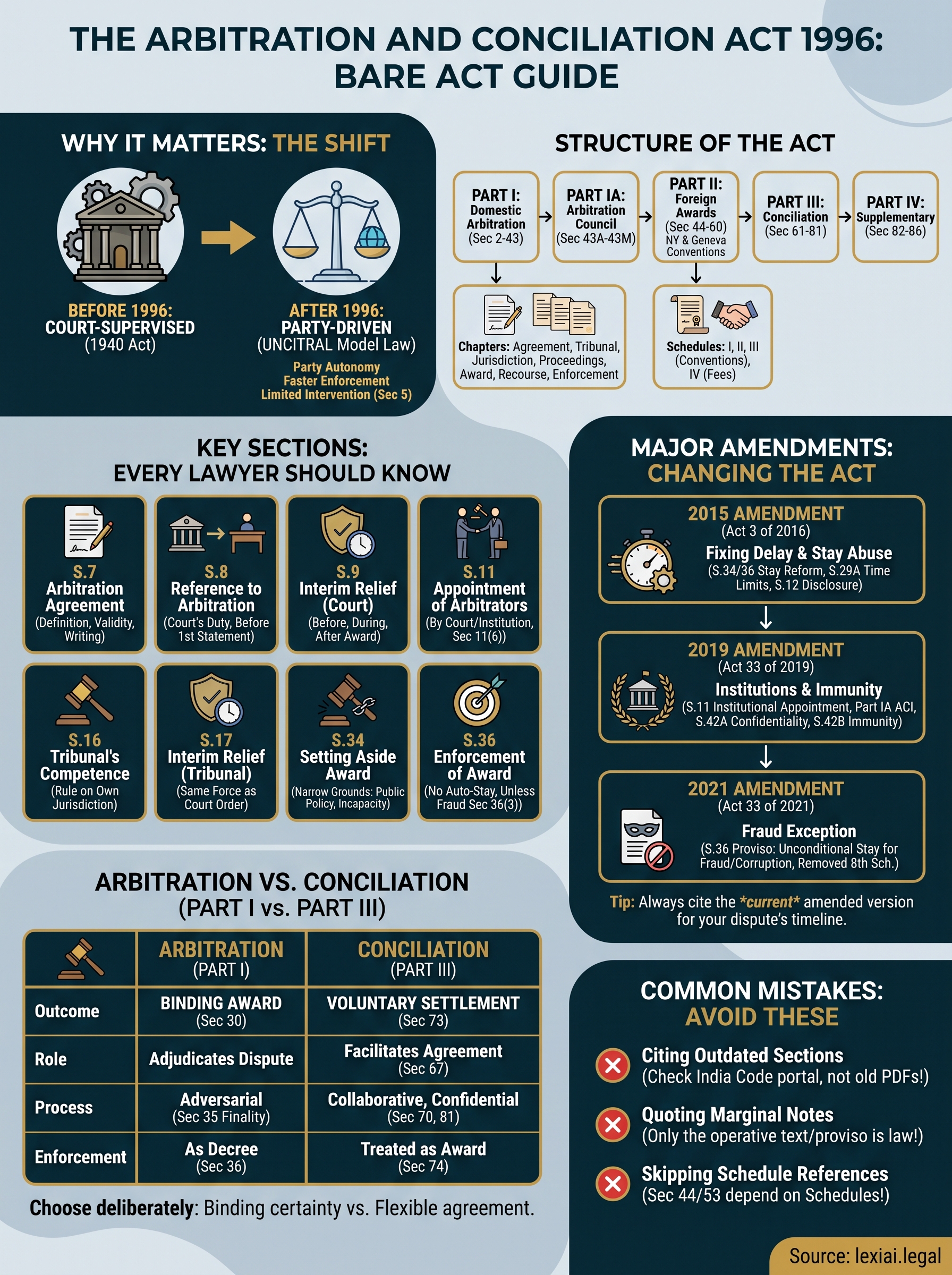
Knowing the layout of the arbitration and conciliation act 1996 bare act saves you from flipping through fifty pages looking for one provision. The Act is organized into five parts, each covering a distinct stage or type of dispute resolution, and within each part, chapters group related sections together. Once this structure sits in your head, you can jump straight to the right zone of the statute instead of scrolling a PDF.
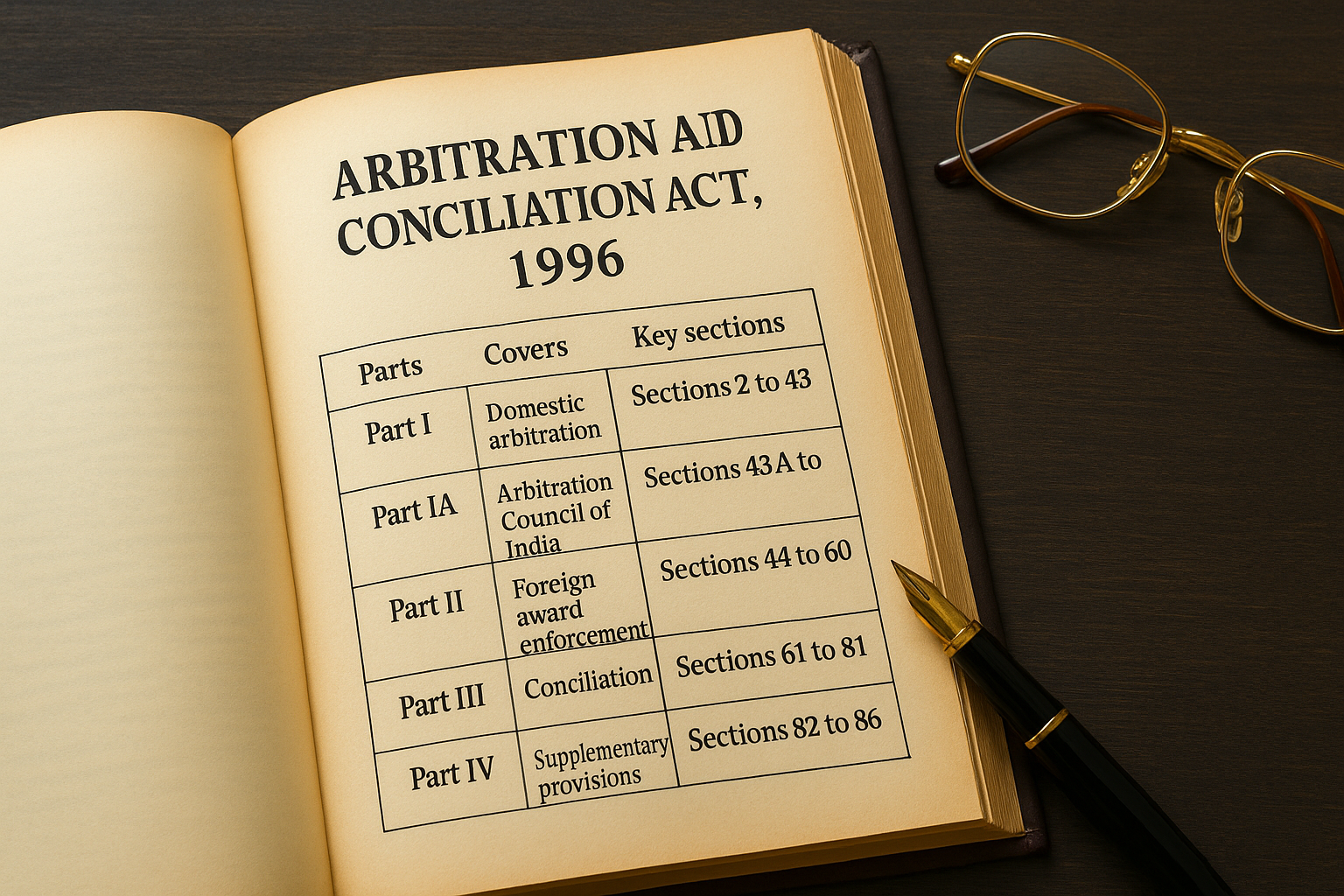
The five parts of the Act
Part I governs domestic arbitration seated in India and is where most of your daily practice lives. Part IA, added by the 2019 amendment, sets up the Arbitration Council of India to grade arbitral institutions and accredit arbitrators. Part II deals with enforcement of foreign awards, split between Chapter I for New York Convention awards and Chapter II for Geneva Convention awards. Part III codifies conciliation as a distinct process with its own procedural rules, separate from arbitration. Part IV holds supplementary provisions, including the power to make rules and the repeal of the old 1940 Act.
| Part | Covers | Key sections |
|---|---|---|
| Part I | Domestic arbitration | Sections 2 to 43 |
| Part IA | Arbitration Council of India | Sections 43A to 43M |
| Part II | Foreign award enforcement | Sections 44 to 60 |
| Part III | Conciliation | Sections 61 to 81 |
| Part IV | Supplementary provisions | Sections 82 to 86 |
Chapters within Part I
Part I breaks down further into chapters that track the lifecycle of an arbitration from clause to enforcement. Chapter I covers general provisions and definitions, Chapter II deals with the arbitration agreement itself, and Chapter III governs composition of the tribunal, including appointment and challenge of arbitrators. Chapter IV addresses the tribunal's jurisdiction, Chapter V lays out the conduct of proceedings, and Chapter VI covers how the tribunal makes its award and terminates proceedings. Chapter VII deals with recourse against an award, which is where Section 34 sits, and Chapter VIII through Chapter X handle enforcement, appeals, and miscellaneous matters like limitation and costs.
Once you know which chapter handles which stage of arbitration, you stop searching the whole Act and start searching one chapter.
What the schedules actually contain
The schedules attached to the Act are not filler, they carry operative legal text that Sections 44 and 53 in Part II directly reference. The First Schedule reproduces the New York Convention, the treaty that lets an award made in one member country get enforced in another. The Second Schedule sets out the Geneva Protocol, and the Third Schedule reproduces the Geneva Convention itself, both relevant only to older awards that predate India's move to the New York Convention regime for most trading partners. A Fourth Schedule, added by the 2015 amendment, lays out a model fee structure for arbitrators, a provision tribunals cite when a party disputes fees charged under an ad hoc arbitration.
Reading a section without checking its schedule reference is a common way to miss half the picture. If Section 44 tells you a foreign award qualifies for enforcement only where the country is a signatory notified by the central government, you need the First Schedule and the corresponding government notification to confirm your specific jurisdiction actually counts. Treat the schedules as part of the operative statute, not an appendix you can skip.
Key sections every lawyer should know
Some sections in the arbitration and conciliation act 1996 bare act get cited so often that you end up knowing them by number rather than by name. Learning what each one actually does, and what courts have said about it, saves you from re-reading the whole chapter every time a new matter lands on your desk. The sections below are the ones you will use in almost every arbitration file, whether you are drafting a clause or opposing enforcement.
The sections that shape the whole arbitration
Section 7 defines what counts as a valid arbitration agreement, and it matters because a poorly worded clause can sink your entire dispute resolution strategy before the arbitration even starts. Courts have held that the agreement need not use the word arbitration at all, so long as the intent to refer disputes to a private tribunal is clear. Section 8 works alongside it, requiring a judicial authority to refer parties to arbitration if a valid clause exists and one side raises it before filing its first statement on the substance of the dispute. Section 11 governs appointment of arbitrators when parties cannot agree, and after the 2019 amendment, courts examine only the existence of the arbitration agreement at this stage, leaving deeper questions of validity to the tribunal itself.
Get Section 7 wrong at the drafting stage, and no later section in the Act can fully rescue you.
Section 9 lets a party seek interim relief, an injunction, security for costs, or preservation of property, either before arbitration begins, during it, or after the award but before enforcement. Section 17 gives the tribunal itself the power to grant similar interim relief once it is constituted, and since the 2015 amendment, a Section 17 order carries the same force as a court order under the Civil Procedure Code, 1908 and its key provisions.
The sections that decide whether an award survives
Section 34 sets out the narrow, defined grounds on which a court can set aside an award, including incapacity of a party, invalid arbitration agreement, lack of proper notice, and conflict with the public policy of India. Section 36 governs enforcement, and the 2015 amendment made clear that merely filing a Section 34 petition does not automatically stay execution of the award, a change that closed off years of tactical delay by award debtors.
| Section | Deals with |
|---|---|
| Section 7 | Definition and validity of an arbitration agreement |
| Section 8 | Judicial reference to arbitration |
| Section 9 | Interim measures by court |
| Section 11 | Appointment of arbitrators |
| Section 16 | Tribunal's power to rule on its own jurisdiction |
| Section 17 | Interim measures by the tribunal |
| Section 34 | Grounds to set aside an award |
| Section 36 | Enforcement of an award |
Understanding these eight sections gives you a working map of the Act's practical spine. Verifying the exact wording still matters, since amendments have touched several of them, so pull the current text before you finalize any pleading, and consider a tool like LeXi Desk when you need to cross check a clause against the latest amended language quickly.
Major amendments and how they changed the Act
The arbitration and conciliation act 1996 bare act you read today is not the same text Parliament passed in 1996. Three amendments, in 2015, 2019, and 2021, rewrote large chunks of Part I, and citing an unamended provision in a filing is one of the fastest ways to lose credibility with a bench. Knowing what changed, and why, helps you read the current text with the right context instead of treating each section as if it dropped from nowhere.
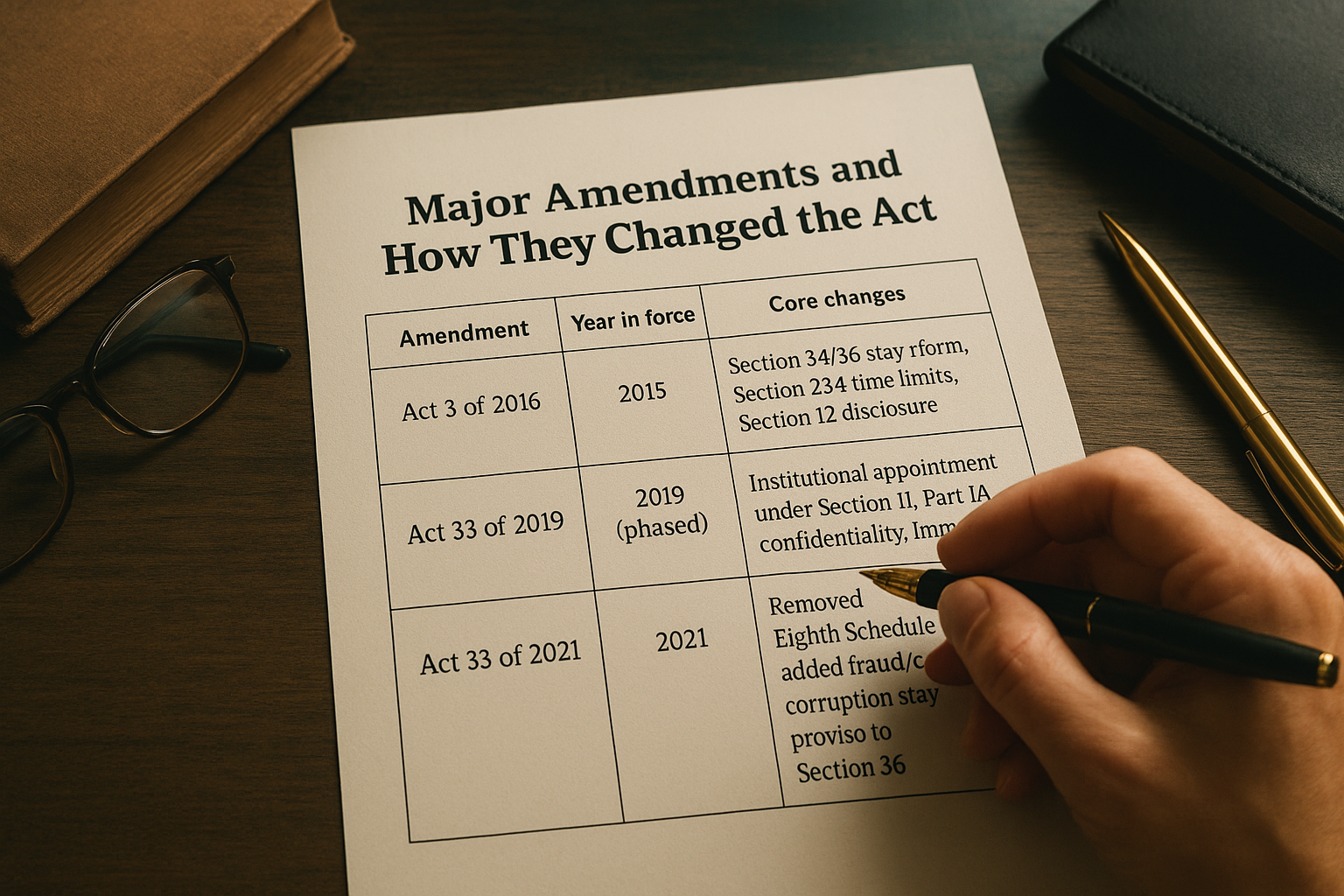
The 2015 Amendment: fixing delay and stay abuse
Parliament passed the 2015 Amendment (Act 3 of 2016) after the Law Commission's 246th Report flagged how award debtors were using Section 34 petitions to delay payment for years, since filing the petition automatically stayed enforcement. The amendment fixed that by rewriting Section 36 so a stay only follows a specific court order, not the mere act of filing. It also added Section 29A, which forces a tribunal to deliver an award within twelve months of completing pleadings, extendable by six months with party consent, and Section 12, which introduced mandatory disclosure of any relationship that could raise doubts about an arbitrator's independence, backed by the Fifth and Seventh Schedules listing disqualifying circumstances.
Filing a Section 34 petition used to buy an award debtor years of delay for free, and the 2015 amendment closed that loophole for good.
The 2019 Amendment: institutions and immunity
Act 33 of 2019 shifted how arbitrators get appointed under Section 11. Instead of a High Court or the Supreme Court appointing an arbitrator directly, the amendment lets courts designate an arbitral institution to make the appointment, a change meant to speed up a process that had become its own source of delay. This amendment also created Part IA and the Arbitration Council of India to grade institutions and accredit arbitrators, added Section 42A to impose confidentiality on arbitral proceedings, and Section 42B to give arbitrators immunity for anything done in good faith. A separate Eighth Schedule tried to prescribe qualifications for arbitrators, but the criteria proved so restrictive that they effectively barred many foreign-qualified professionals from sitting as arbitrators in India.
The 2021 Amendment: fraud exception to automatic stay
Act 33 of 2021 did two things. First, it removed the Eighth Schedule after widespread criticism that its qualification list contradicted the Act's own party autonomy principle. Second, and more consequential for daily practice, it inserted a proviso to Section 36 allowing a court to grant an unconditional stay on enforcement where the arbitration agreement, the underlying contract, or the making of the award itself is shown, prima facie, to have been induced by fraud or corruption. That single proviso now shows up in nearly every high-value enforcement dispute where a losing party wants to buy time.
| Amendment | Year in force | Core changes |
|---|---|---|
| Act 3 of 2016 | 2015 | Section 34/36 stay reform, Section 29A time limits, Section 12 disclosure |
| Act 33 of 2019 | 2019 (phased) | Institutional appointment under Section 11, Part IA, confidentiality, immunity |
| Act 33 of 2021 | 2021 | Removed Eighth Schedule, added fraud/corruption stay proviso to Section 36 |
Each amendment answered a specific complaint from practitioners rather than a general policy wish, which is why reading the amendment's statement of objects and reasons often explains a section better than the bare text alone.
Arbitration and conciliation compared under the Act
Most readers open the arbitration and conciliation act 1996 bare act looking for arbitration provisions and forget that Part III, Sections 61 to 81, covers a genuinely different process. Conciliation is not a lighter version of arbitration, it is a separate mechanism with its own rules on appointment, procedure, and the legal weight of the outcome. Confusing the two in a client memo, or worse in a filing, signals that you have not actually read the statute you are citing.
Why the Act treats them as separate processes
Arbitration produces an award that binds the parties whether they like the outcome or not, and Section 35 makes that award final and binding subject only to the narrow challenge under Section 34. Conciliation, by contrast, never forces an outcome. A conciliator appointed under Section 64 facilitates a settlement, but the parties themselves must agree to any terms, and either side can walk away at any point under Section 76 without breaching the process. That distinction shapes everything else, from confidentiality obligations to how a resulting agreement gets enforced.
An arbitrator decides your dispute for you, a conciliator only helps you decide it yourselves, and that single difference explains every other gap between Part I and Part III.
How Part III conciliation actually works
Section 62 lets a party invite the other side to conciliate, and Section 65 gives the conciliator power to request statements of facts from both parties, something an arbitrator would never do unprompted since arbitration runs on adversarial submissions rather than joint fact-finding. Conciliators can also, under Section 67, suggest terms of settlement on their own initiative, a role that would disqualify an arbitrator for bias in a heartbeat. Section 70 imposes confidentiality on the entire process, and Section 81 goes further, barring parties from relying on anything said during conciliation, including admissions or proposals, in any later arbitral or court proceeding on the same dispute.
The settlement agreement's special status
Once conciliation succeeds, Section 73 requires the settlement to be drawn up and signed by both parties and the conciliator, and Section 74 gives that signed agreement the same status and effect as an arbitral award made under Section 30. That single provision is what makes conciliation attractive for commercial parties who want a resolution they can enforce directly, without running a fresh suit for breach of contract. Practically, this means a well-drafted settlement agreement under Section 74 can go straight to execution proceedings the same way a Section 36 arbitral award does.
| Feature | Arbitration (Part I) | Conciliation (Part III) |
|---|---|---|
| Outcome | Binding award, Section 30 | Voluntary settlement, Section 73 |
| Decision maker's role | Adjudicates the dispute | Facilitates agreement |
| Can suggest settlement terms | Generally no, risks bias | Yes, under Section 67 |
| Confidentiality | Section 42A, added 2019 | Section 70, original Act |
| Enforcement | Section 36, as a decree | Section 74, treated as an award |
| Party can walk away mid-process | No, bound once tribunal seized | Yes, under Section 76 |
When you draft a dispute resolution clause, decide deliberately whether you want the binding certainty of arbitration or the flexibility of conciliation, since a hybrid clause that invokes both without sequencing them clearly tends to generate satellite litigation over which process governs first.
Common mistakes when citing the bare act
Even experienced litigators slip up when citing the arbitration and conciliation act 1996 bare act, usually because they rely on memory or an outdated PDF instead of pulling the current text. These errors are avoidable, but only if you know exactly where practitioners tend to go wrong. Below are the mistakes that show up most often in petitions, opinions, and even reported judgments before a sharp opposing counsel catches them.
Citing a section number that has since moved or changed
Practitioners often quote Section 11 or Section 34 exactly as they learned it years ago, without accounting for how the 2015 or 2019 amendment altered the sub-clauses within that same section. A sub-section that existed in the original 1996 text may have been renumbered, deleted, or split into a proviso, and citing the old version in a fresh filing invites an immediate correction from the bench. Always confirm the current sub-section structure before you type a citation into a draft, rather than trusting what you memorized from law school or a previous matter.
A citation that was correct in 2014 can be flatly wrong today, and no judge accepts "that used to be right" as an excuse.
Forgetting which version governs a pending matter
Lawyers frequently apply the amended Section 36 stay provisions to disputes that started before the amendment took effect, forgetting that prospective application rules under the amending Acts often shield pending arbitrations from certain changes. Conflating the pre-2015 and post-2015 stay regime, for instance, has cost parties real time in court while a judge sorts out which recension actually applies to their facts. Getting this wrong is not a technicality, it can change whether an award gets stayed automatically or not at all.
Quoting the marginal note instead of the actual text
Some drafts lean on the marginal note beside a section, the short summary phrase, as if it were the operative provision itself, when it carries no independent legal weight. Marginal notes help you navigate the Act quickly, but courts interpret the substantive text and any attached proviso or explanation, not the heading. Quote the actual language a tribunal or court will apply, and use the marginal note only to find your way there.
Leaving out the schedule a section depends on
Numerous sections in Part II, including Sections 44 and 53, only make sense alongside the First, Second, or Third Schedule, yet many drafts cite the section in isolation and skip the schedule reference entirely. Overlooking that connection can leave a judge unconvinced that a particular foreign award actually qualifies for enforcement under the Act.
Run through this quick checklist before finalizing any citation:
- Confirm the section text against the India Code portal, not an old PDF
- Check whether a 2015, 2019, or 2021 amendment touched that section
- Identify whether the amendment applies to your matter's timeline
- Read the full proviso and explanation, not just the main clause
- Cross check any schedule reference tied to the section
Tools like LeXi Desk can flag an outdated citation automatically when you paste a draft in for review, which is a useful backstop even for lawyers who check their citations carefully by habit.
Keeping your reading of the Act current
The arbitration and conciliation act 1996 bare act rewards careful reading more than memorization. You now know its structure, its most cited sections, the amendments that reshaped it, and the mistakes that trip up even seasoned litigators. What matters going forward is discipline: pull the current text before every filing, track which recension applies to your matter, and never quote a marginal note as if it were the operative provision.
Amendments will keep coming, and courts will keep refining how they read Sections 34 and 36, which is where searching Indian judgments by section earns its place in your routine. Staying current is not a one-time task, it is a habit built into how you draft. If you want that habit backed by a tool that flags outdated citations and pulls the amended text automatically, test LeXi AI on your next arbitration petition at no cost and see how much faster it comes together.