

Section 66A IT Act: What It Was and Why It Still Haunts India
Section 66A IT Act no longer exists on paper, yet police stations across India still invoke it in FIRs even a decade after the Supreme Court declared it void. If you searched for this section, you likely want to know what it actually said, why it was struck down, and why arrests under a dead law keep making headlines. This piece answers all three directly.
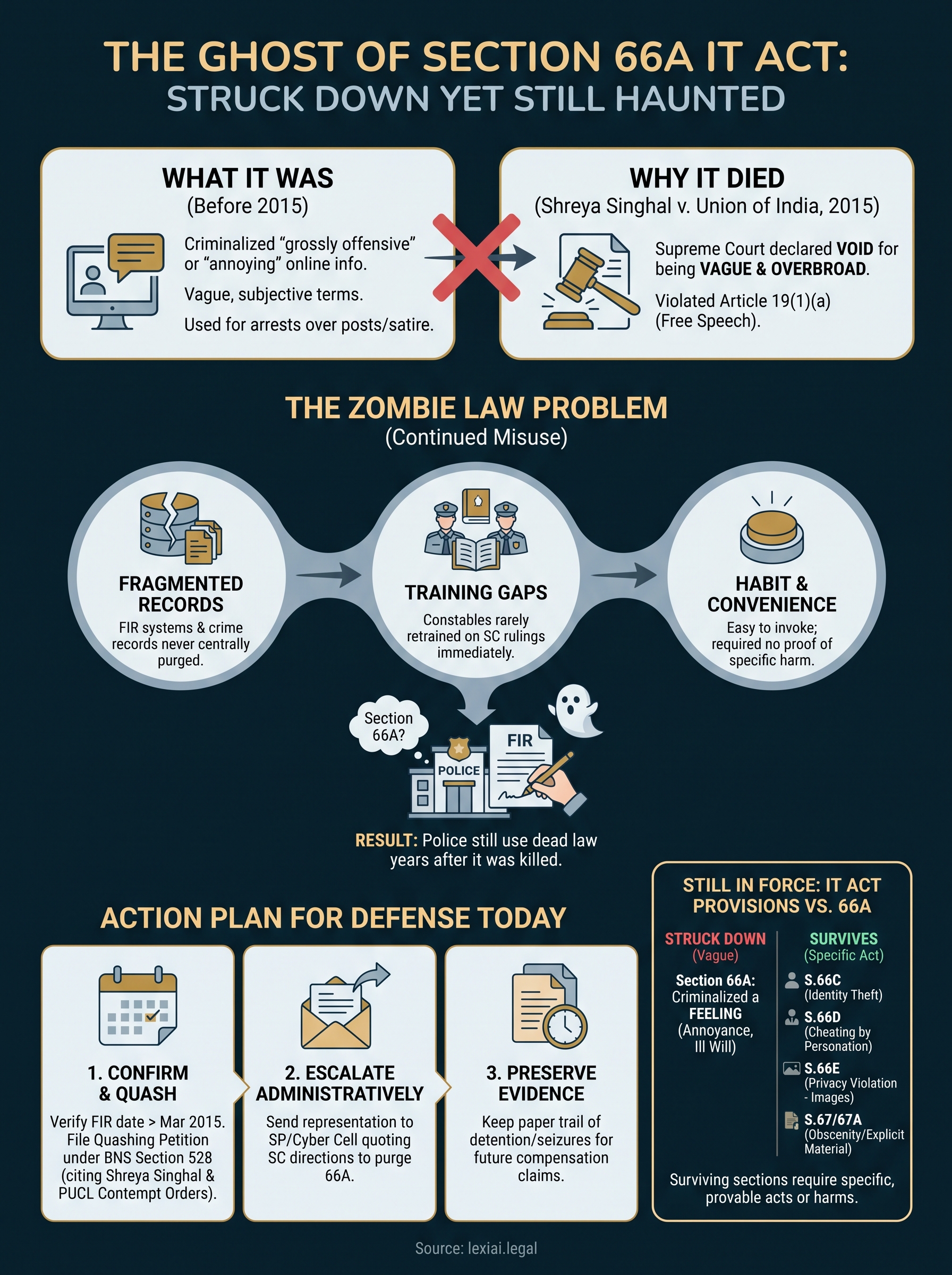
Section 66A of the Information Technology Act, 2000 criminalized sending information that was "grossly offensive" or caused "annoyance" through a computer resource. The wording was so loose that police used it to arrest students for Facebook posts and cartoonists for satire. In Shreya Singhal v. Union of India (2015), the Supreme Court struck it down for being vague and overbroad, holding it violated Article 19(1)(a) of the Constitution.
Below, we walk through the original text of Section 66A, the reasoning behind the judgment, and the documented cases of continued misuse by police even after 2015. If you are researching this for a brief or a moot, tools that search verified Indian judgments in seconds can pull the judgment text and related orders instantly, saving you the search through outdated law digests.
Why section 66A still matters even though it is unconstitutional
Section 66A of the IT Act criminalized sending information through a computer resource that was "grossly offensive," caused "annoyance, inconvenience, danger, obstruction, insult, injury, criminal intimidation, enmity, hatred, or ill will," or was known to be false but sent to cause annoyance. Punishment ran up to three years imprisonment with a fine. None of those terms carried a fixed legal meaning, which meant an officer's personal reaction decided whether a Facebook post, a tweet, or a forwarded joke became a crime. That vagueness is exactly what the Supreme Court attacked in Shreya Singhal v. Union of India, filed after two young women were arrested in Palghar for a Facebook comment questioning a shutdown following Bal Thackeray's death.
The zombie law problem
Here is the part that should worry every practicing lawyer. Being struck down in a judgment does not automatically purge a section from every FIR register, charge sheet, or trial court cause list in the country. A 2018 study by the People's Union for Civil Liberties, working with the Internet Freedom Foundation, found over 1,300 cases still pending under section 66A across eleven states, filed years after Shreya Singhal. Police stations in Uttar Pradesh, Bihar, and Maharashtra kept booking people under the dead provision because station-level record systems, and often the officers themselves, never got updated.
A law the Supreme Court killed in 2015 has still been used to jail people in 2021, simply because nobody told the police station.
Government records back this up. Data placed before Parliament showed section 66A appearing in crime statistics well past its expiry date, prompting the Supreme Court to step back into the matter through contempt proceedings brought by PUCL. The bench, led by Justice Rohinton Nariman, expressed open frustration that its own 2015 order had been ignored at the ground level for years.
Why this keeps happening
Three structural reasons explain the persistence, and each one matters if you are advising a client:
- Fragmented record systems: FIR software and crime record bureaus in many states were never centrally purged of the struck-down section.
- Training gaps: Constables and sub-inspectors filing complaints are rarely retrained on Supreme Court rulings the moment they are delivered.
- Habit and convenience: Section 66A was easy to invoke because it required no proof of specific harm, unlike defamation or provisions under the Bharatiya Nyaya Sanhita, the code that replaced the IPC, which demand more concrete elements.
For a defense lawyer, this means you cannot assume the other side, or even the investigating officer, knows the law is void. You have to prove it, every single time, with the judgment in hand.
Why every lawyer should still know the text
Even students who will never litigate a 66A case need to understand the provision because it remains the standard teaching example for vagueness doctrine and chilling effect analysis in Indian constitutional law. Moot court problems, judicial service exams, and CLAT-level constitutional law papers regularly test whether a candidate can explain why "grossly offensive" failed the test of reasonable restriction under Article 19(2). Knowing the original text, the judgment's reasoning, and the aftermath data together gives you a complete answer, not just half of one. Researching this history manually across old bare acts and scattered news reports is slow; a legal AI platform built for Indian law like LeXi AI's LeXi Agent pulls the struck-down text, the Shreya Singhal ruling, and the later contempt orders in one search, which matters when you are prepping a brief the night before a hearing.
How to respond if a client is booked under section 66A today
If a client walks in with an FIR citing section 66A of the IT Act, your first move is confirming the date of the alleged offense and the date of registration. Since Shreya Singhal struck down the provision in March 2015, any FIR filed after that date citing section 66A is void on its face, and you can say so in the very first hearing. Pull a certified copy of the FIR immediately, because the charge sheet often quietly drops the dead section while retaining others, and you need the original wording to prove the police relied on struck-down law from day one.
File a quashing petition without delay
Once you confirm the FIR cites section 66A after 2015, do not wait for the trial court to notice on its own. Move a quashing petition before the High Court under section 528 of the Bharatiya Nagarik Suraksha Sanhita, 2023 (the provision that replaced section 482 of the old CrPC), attaching the Shreya Singhal judgment and, where relevant, the 2019 contempt order the Supreme Court passed in the PUCL matter. Courts have quashed such FIRs on a single hearing when counsel comes prepared with both citations rather than arguing the vagueness point from scratch.
The fastest relief in a 66A case comes from citing the judgment, not re-arguing it.
Escalate to the police hierarchy in parallel
While the court petition moves, send a written representation to the Superintendent of Police or the Cyber Cell nodal officer, quoting the Supreme Court's own direction that section 66A be purged from active use. Many states, including Uttar Pradesh after the contempt proceedings, issued internal circulars instructing stations to drop the section, and citing that circular alongside the judgment often gets faster administrative relief than waiting on a court date.
Preserve grounds for compensation
Finally, keep a paper trail of every wrongful detention day, seized device, or bail condition imposed under the void section, because clients have separately pursued compensation claims once a quashing order confirms the arrest had no legal basis. For research at this stage, LeXi AI's LiTT module can pull the quashing precedents from your state's High Court alongside the Supreme Court orders, which saves the hours you would otherwise spend cross-checking scattered case law the night before a bail hearing.
Section 66A compared to provisions still in force under the IT Act
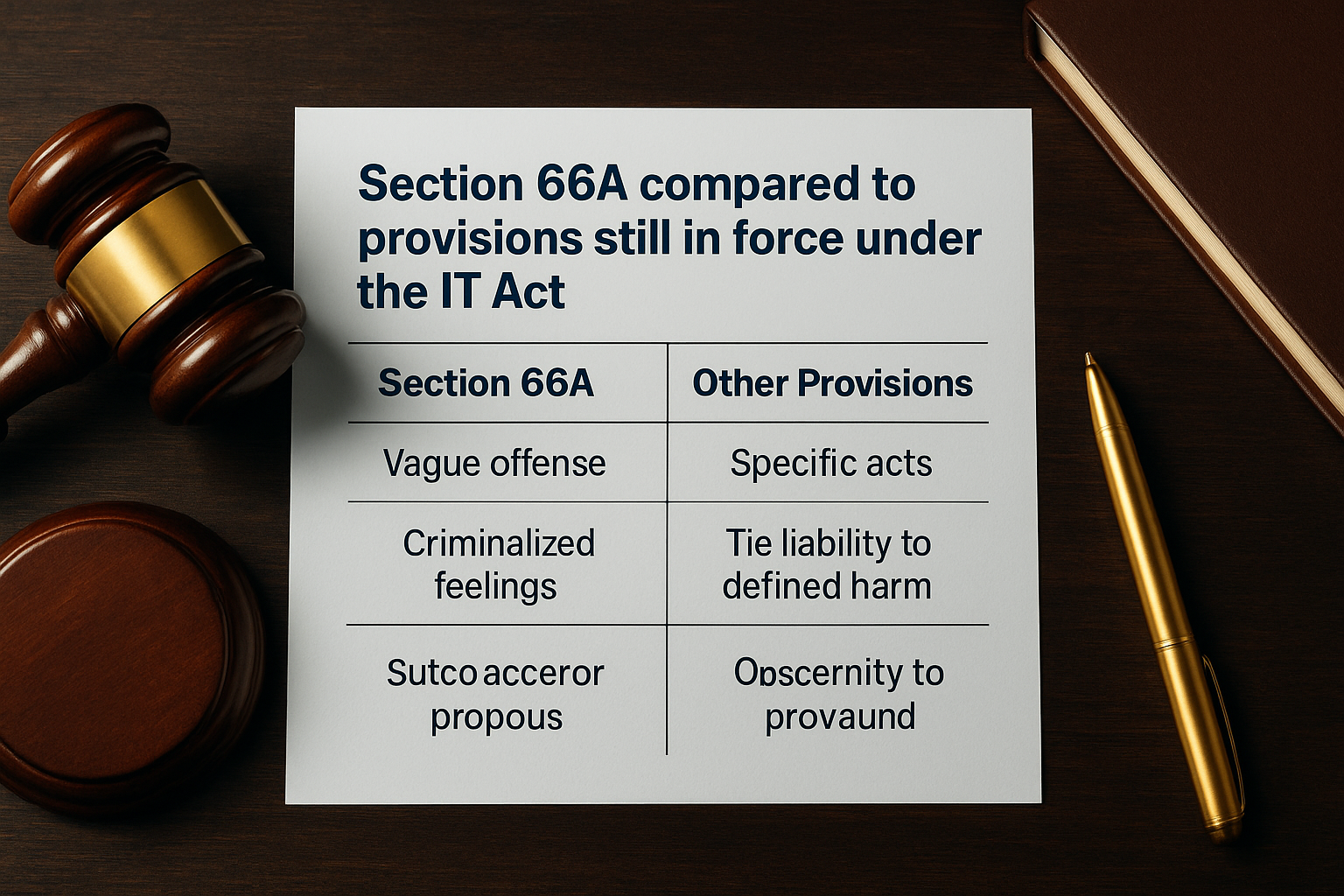
Struck down as it is, section 66A did not take the whole of the IT Act down with it. Several provisions dealing with online conduct remain fully enforceable today, and the difference between them and the dead section comes down to one thing: specificity of harm. Section 66A criminalized a feeling, annoyance, insult, ill will, without asking what act actually caused it. The surviving sections instead tie liability to a defined act: identity theft, obscenity, unauthorized access, or a specific category of content a court or government authority has already flagged.
What replaced the gap 66A left behind
Lawyers often ask what a client can actually be booked under now for objectionable online content, since 66A is gone. The honest answer is that several targeted provisions fill parts of that space, each requiring proof the vague 66A never demanded.
| Provision | What it actually punishes | Why it survives where 66A did not |
|---|---|---|
| Section 66C, IT Act | Identity theft, using another person's password or digital signature | Requires a specific, provable act, not a subjective reaction |
| Section 66D, IT Act | Cheating by personation using a computer resource | Tied to the established offense of cheating under the Bharatiya Nyaya Sanhita |
| Section 66E, IT Act | Capturing or publishing images of a person's private area without consent | Defines the exact conduct and the privacy harm involved |
| Section 67, IT Act | Publishing or transmitting obscene material in electronic form | Obscenity has a settled judicial test from Aveek Sarkar v. State of West Bengal |
| Section 67A, IT Act | Publishing sexually explicit material | Narrower category, requires the material to meet a defined threshold |
| Section 69A, IT Act | Government blocking of specific content for defined security and public order grounds | Requires recorded reasons and a defined procedure, unlike open-ended police discretion |
Section 66A criminalized a feeling, while every provision that replaced it criminalizes an act.
Where the confusion still trips up clients
Clients and even junior counsel sometimes assume section 67 or 66C can be stretched to cover the same ground 66A once did, particularly for social media posts that merely offend someone. Resist that instinct. Each surviving provision has a defined element the prosecution must prove, so check the FIR wording against the actual statutory text before assuming any charge under the current IT Act framework will stick. LeXi AI's LeXi Desk flags this mismatch automatically when you run a charge sheet through its clause and provision checker.
Key Supreme Court orders on section 66A after Shreya Singhal
Shreya Singhal was not the last word from the Supreme Court on this provision. Multiple orders followed, each responding to fresh evidence that police stations kept treating a void law as live. Knowing these later orders matters because a lawyer citing only the 2015 judgment misses the stronger, more recent ammunition available for a quashing petition.
The 2019 PUCL contempt order
After the People's Union for Civil Liberties documented over 1,300 pending prosecutions across eleven states, it filed a contempt petition directly before the Supreme Court, arguing that continued use of section 66A defied the 2015 ruling. In September 2019, a bench led by Justice Rohinton Nariman directed the Director Generals of Police in every state to issue circulars instructing officers that section 66A stood struck down and could not form the basis of any FIR. The Court also directed compliance reports to be filed, turning what had been a constitutional ruling into an enforceable administrative direction.
A judgment tells you the law is dead. A contempt order forces the police to act like it.
The 2021 status report and continued monitoring
Compliance did not arrive quickly. Reports placed before the Court in 2021 showed several states had only partially circulated the 2019 directions, and fresh FIRs under section 66A were still surfacing in Uttar Pradesh, Bihar, and Rajasthan. Facing this, the bench asked states to file updated affidavits confirming that internal databases and station registers had been corrected, not just that a circular had been signed and filed away.
Why lawyers still track this litigation
Given this history, treat the PUCL matter as an ongoing file rather than a closed case. Later orders in the same proceeding, rather than Shreya Singhal alone, give you the sharpest language to quote when a magistrate hesitates to quash an FIR on constitutional grounds alone. Include both the 2015 judgment and the 2019 contempt order, along with any state-specific circular, in your quashing petition. Running that combined citation through LeXi Agent takes minutes rather than the hours it once took to dig through Supreme Court cause lists and state police gazette notifications separately.
Where things stand for lawyers today
Section 66A of the IT Act is dead in law but stubbornly alive in police stations, and that gap is where your job as counsel actually begins. The Supreme Court struck it down in 2015, reinforced that ruling through contempt proceedings in 2019, and is still monitoring compliance today. None of that history matters to a client sitting in a lockup unless you can produce the right citation within minutes of walking into court.
What separates a quick quashing from a drawn-out mess is preparation: having Shreya Singhal, the PUCL contempt order, and the relevant state circular ready before the first hearing, not after. Manually tracking scattered orders across eleven states wastes time you rarely have. If you want that research done in one search instead of ten, create a free LeXi AI account and see how quickly a dead law stops causing live problems for your clients.