

Plaint Format in a Civil Suit: Contents and Sample Draft
A plaint format in a civil suit is a written statement that opens the case and sets out who is suing whom, the facts, the cause of action, and the relief sought. Order VII Rule 1 of the Code of Civil Procedure, 1908 lists what it must contain. If you miss a required particular, the court can return the plaint under Order VII Rule 10 or reject it under Rule 11.
The standard structure has nine particulars under Order VII Rule 1, starting with the name of the court and ending with the relief claimed. In practice, a plaint runs in this order: the title and cause title, the parties and their addresses, the facts in numbered paragraphs, the cause of action, jurisdiction, valuation and court fee, limitation, the prayer, and the verification. Rule 1 particulars such as valuation and jurisdiction are where drafts most often fall short.
This article walks through each part of the plaint with the relevant provisions, including Order VI Rules 14 and 15 on signing and verification. It then gives a sample draft you can adapt for a money recovery suit. Drafting tools such as LeXi AI can help you generate the first version, but you should still check every particular yourself.
Why the format of a plaint matters
A plaint is the document that starts a civil suit under Section 26 and Order IV Rule 1 of the Code of Civil Procedure, 1908. Every later step, from the written statement to the framing of issues, grows out of it. So the plaint format is a matter of substance, not neatness. A badly structured draft can cost you months of time before the court even looks at the merits.
The plaint sets the boundaries of your case
Courts decide a suit on the pleadings. Order VI Rule 2 requires you to state material facts and not the evidence, and the plaint is where you do that. A fact you do not plead is a fact you will struggle to prove at trial.
Issues under Order XIV Rule 1 arise from propositions that one party affirms and the other denies. The defendant answers your plaint paragraph by paragraph in the written statement under Order VIII. Numbered paragraphs, one fact each, make that exchange clean. If you mix facts, arguments, and law in a single block, the reply becomes vague, and so do the issues.
Fixing gaps later is possible but not guaranteed. The proviso to Order VI Rule 17 bars an amendment after the trial begins unless you show that you could not have raised the matter earlier despite due diligence. It is far cheaper to get the structure right on day one.
What a defective plaint costs you
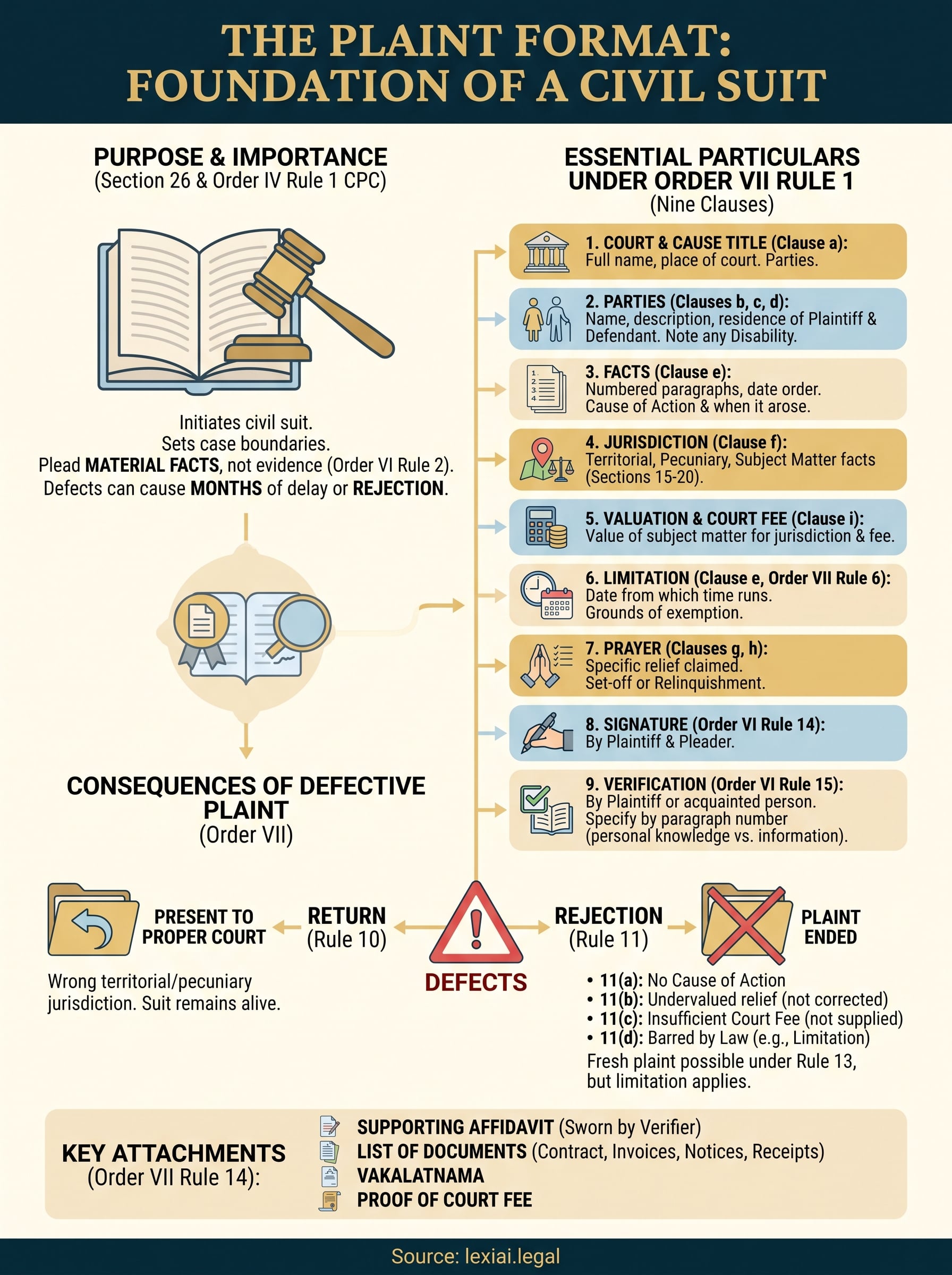
Each default in the format of a plaint has a specific consequence under Order VII. The table below lists the ones you will meet most often.
| Provision | Consequence | Common trigger |
|---|---|---|
| Order VII Rule 10 | Plaint returned for presentation to the proper court | Wrong territorial or pecuniary jurisdiction |
| Order VII Rule 11(a) | Rejection | No cause of action disclosed |
| Order VII Rule 11(b) | Rejection if not corrected in the time fixed | Relief undervalued |
| Order VII Rule 11(c) | Rejection if stamp paper is not supplied in time | Insufficient court fee |
| Order VII Rule 11(d) | Rejection | Suit appears barred by law, including limitation |
Return and rejection are not the same thing. A return under Rule 10 keeps the suit alive, and you present the plaint to the correct court. A rejection under Rule 11 ends that plaint, although Rule 13 lets you present a fresh one on the same cause of action. Limitation may still hurt you, and Section 14 of the Limitation Act, 1963 only excludes time spent in good faith before a court without jurisdiction.
A plaint is tested on its own words, so every required particular must appear on its face.
The Supreme Court applied this test in Dahiben v. Arvindbhai Kalyanji Bhanusali (2020) 7 SCC 366. It held that a Rule 11 application is decided on the plaint averments and the documents filed with it, not on the defendant's version. In T. Arivandandam v. T.V. Satyapal (1977) 4 SCC 467, the Court also said a plaint should be read meaningfully, and an illusory cause of action can be cut off at the threshold.
Commercial suits carry one more trap. Section 12A of the Commercial Courts Act, 2015 requires pre-institution mediation unless you seek urgent interim relief. In Patil Automation Pvt. Ltd. v. Rakheja Engineers Pvt. Ltd. (2022) 10 SCC 1, the Court held this mandatory, with non-compliance leading to rejection under Order VII Rule 11(d). Plead your compliance, or your reason for urgency, in the plaint itself.
How to draft a plaint under Order VII CPC
Start with the statute, not a precedent book. Order VII Rule 1 lists the particulars, and a sound plaint format follows that list in sequence. Before you write, collect the documents, the dates, and the exact amount or property in dispute.
Build the draft in this order
Work through the plaint in the steps below. Each step maps to a clause of Rule 1 or to a related rule.
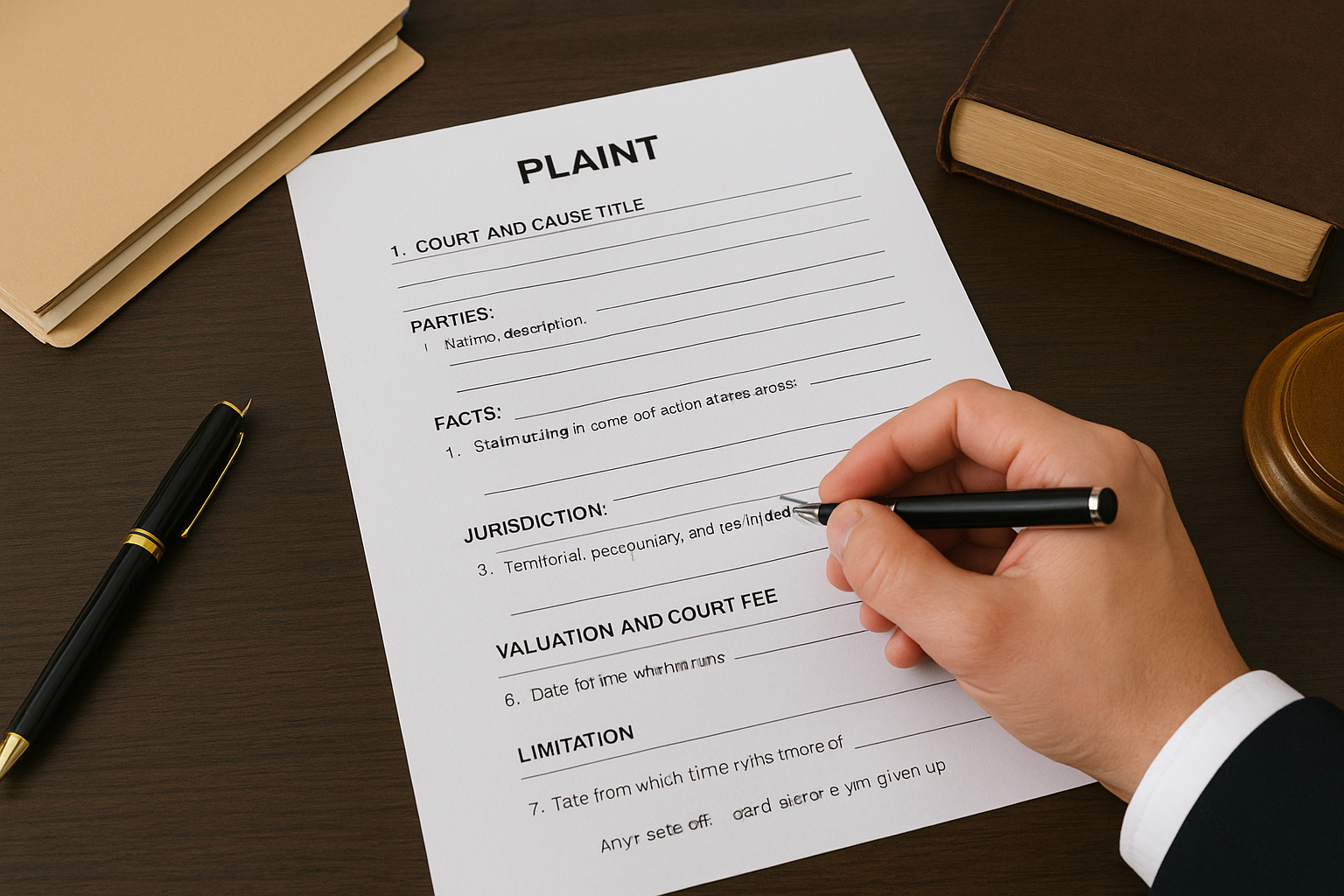
- Court and cause title. Name the court (Rule 1(a)), then list the parties and the nature of the suit.
- Parties. Give the name, description, and residence of the plaintiff and each defendant (Rule 1(b) and (c)). State if a party is a minor or of unsound mind (Rule 1(d)).
- Facts. Write them in numbered paragraphs, in date order, ending with when the cause of action arose (Rule 1(e)).
- Jurisdiction. Plead territorial, pecuniary, and subject matter jurisdiction (Rule 1(f)), with reference to Sections 15 to 20 of the Code.
- Valuation and court fee. State the value of the subject matter for both purposes (Rule 1(i)).
- Limitation. Give the date from which time runs. Under Rule 6, plead the grounds of exemption if the suit is otherwise late.
- Prayer. State each relief (Rule 1(g)), and mention any set-off allowed or part of the claim given up (Rule 1(h)).
- Signature and verification. Follow Order VI Rules 14 and 15.
Draft to Order VII Rule 1 first, and add style only after every particular is in place.
Apply the specific rules that shape each part
Three rules change how you write particular sections. Rule 2 requires a precise amount in a money suit, so show the principal and the interest to the date of filing separately. Rule 3 requires a description of immovable property that is sufficient to identify it, such as survey number, boundaries, and area.
Rule 7 requires every relief to be stated specifically. You may add an alternative relief or a plea for such other relief as the court thinks fit. Do not rely on that general plea to cover a relief you forgot to name.
Keep the language plain and the pleading tight
Write in the third person and keep one fact in each paragraph. Plead material facts and the legal basis for the claim, but leave out evidence and argument. Order VII Rule 14 also requires you to list the documents you rely on and file them with the plaint.
A drafting tool such as LeXi AI can arrange your facts into this structure quickly. You should still compare the output against Rule 1, clause by clause.
Particulars every plaint must contain
The nine particulars under Rule 1
The plaint format rests on clauses (a) to (i) of Order VII Rule 1. The table shows what each clause asks for, so you can check your draft clause by clause.
| Clause | Particular | What to write |
|---|---|---|
| (a) | Court | Full name and place of the court, such as the District Judge, Pune |
| (b) | Plaintiff | Name, description (parentage, occupation), and place of residence |
| (c) | Defendant | The same details for each defendant |
| (d) | Disability | A statement if a party is a minor or of unsound mind |
| (e) | Cause of action | The facts constituting it and the date it arose |
| (f) | Jurisdiction | Facts showing the court can hear the suit |
| (g) | Relief | Each relief you claim, stated specifically |
| (h) | Set-off or relinquishment | The amount allowed or given up |
| (i) | Valuation | Value of the subject matter for jurisdiction and court fee |
Two clauses carry qualifiers. Clause (c) asks for the defendant's details only so far as they can be ascertained, so state plainly what you could not trace. Clause (i) asks for valuation so far as the case admits, which matters in suits for accounts or declarations where no exact value exists.
Plead the cause of action with dates
Your cause of action decides whether the plaint survives Rule 11(a). Plead the bundle of facts that gave you the right to sue and the date on which that right arose. In a money suit, that means the contract, the performance, the invoice, the default, and the legal notice, each with a date.
Jurisdiction under clause (f) also needs facts, not a bare assertion. State the territorial facts, meaning where the defendant resides or carries on business and where the cause arose, as Sections 16 to 20 of the Code require. Then show why the claim falls within the pecuniary limit of the court.
A plaint that pleads the right, its breach, and the date of the breach has pleaded a cause of action.
Add the particulars that depend on the suit
Some suits need more than the nine clauses. Plead these wherever they apply:
- Representative suits (Rule 4): show that you have an actual existing interest and have taken the steps needed to sue.
- Defendant's liability (Rule 5): show that the defendant is interested in the subject matter and liable to answer your demand.
- Delayed suits (Rule 6): plead the ground of exemption if limitation would otherwise have run out.
- Suits against the Government (Section 80): state that the notice was delivered, with its date.
Sample plaint for a money recovery suit
This sample applies the plaint format from the earlier sections to a suit for recovery of money on an unpaid invoice. Treat it as a skeleton. The facts, dates, and amounts are placeholders.
A short draft you can adapt
The draft below follows the order of Order VII Rule 1. Verification under Order VI Rule 15 comes right after it, covered in the next section.
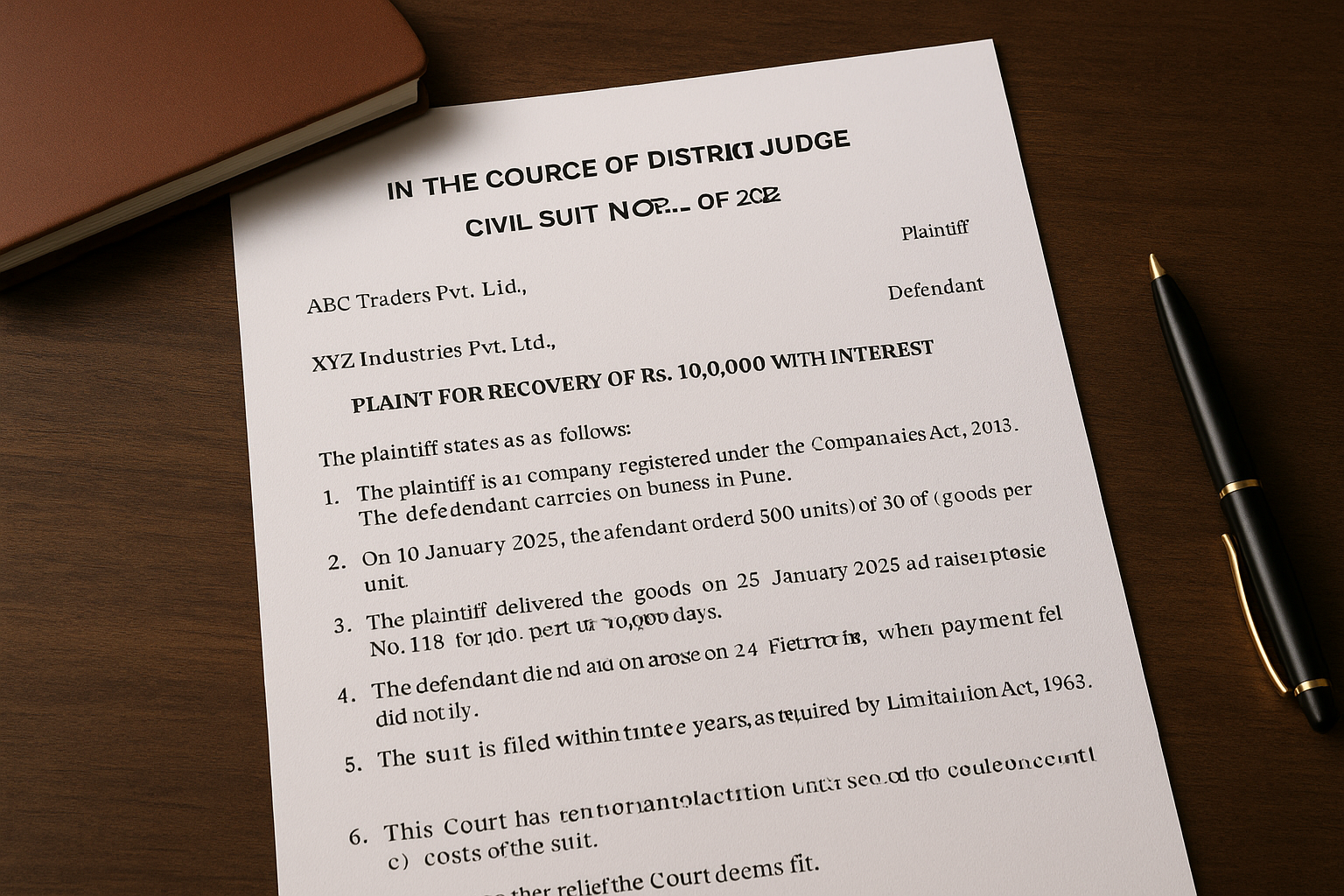
IN THE COURT OF THE DISTRICT JUDGE, PUNE
CIVIL SUIT NO. ____ OF 2026

ABC Traders Pvt. Ltd., [address] ... Plaintiff
Versus
XYZ Industries Pvt. Ltd., [address] ... Defendant

PLAINT FOR RECOVERY OF Rs. 10,00,000 WITH INTEREST

The plaintiff states as follows:
1. The plaintiff is a company registered under the Companies Act, 2013. The defendant carries on business at Pune.
2. On 10 January 2025, the defendant ordered 500 units of [goods] at Rs. 2,000 per unit.
3. The plaintiff delivered the goods on 25 January 2025 and raised Invoice No. 118 for Rs. 10,00,000, payable within 30 days.
4. The defendant did not pay. The plaintiff sent a legal notice on 5 June 2025. The defendant did not reply.
5. The cause of action arose on 24 February 2025, when payment fell due, and continues until payment.
6. The suit is filed within three years, as required by the Limitation Act, 1963.
7. This Court has territorial jurisdiction under Section 20 CPC, as the defendant carries on business and the goods were delivered at Pune. The claim is within its pecuniary limit.
8. The suit is valued at Rs. [amount] for jurisdiction and court fee. Court fee of Rs. [amount] is paid.
9. The plaintiff claims no set-off and gives up no part of the claim.
10. The documents relied on are listed in the annexed list.

PRAYER
The plaintiff prays for:
(a) a decree for Rs. 10,00,000 against the defendant;
(b) interest at 12% per annum from 24 February 2025 until realization;
(c) costs of the suit; and
(d) any other relief the Court deems fit.

Place: Pune        Date: [date]
[Advocate for the Plaintiff]
Adapt it to your facts
Replace every bracket with a verified fact from your file. Rule 2 requires the precise amount, so add a paragraph that shows the interest accrued up to the date of filing as a separate figure from the principal. If the suit is a commercial dispute, also plead your Section 12A mediation compliance or the urgent relief you seek.
Every bracket in a sample is a fact you must supply, not a blank to skim past.
Check the sample against your contract as well. A fixed credit period, an interest clause, or an arbitration agreement changes paragraphs 3 to 6. Note that Rule 14 requires you to file the listed documents with the plaint, so do not annex any paper you have not read.
Verification, affidavit, and documents to attach
How to verify the plaint under Order VI Rule 15
A plaint format is incomplete without a verification at its foot. Order VI Rule 15 lets the plaintiff, or another person acquainted with the facts, verify it. The verifier must specify by paragraph number what is true to personal knowledge and what is true on information believed to be correct. The verification must be signed and must state the date and place of signing.
VERIFICATION
I, [name], director of the plaintiff company, verify that paragraphs 1 to 5 and 9 are true to my knowledge. Paragraphs 6 to 8 and 10 are based on legal advice and company records, which I believe to be true.
Verified at Pune on [date].

[Signature of verifier]
Verify each paragraph by number, and state whether it rests on knowledge or on information.
When a company sues, Order XXIX Rule 1 allows its secretary, a director, or another principal officer who can depose to the facts to sign and verify. Under Order VI Rule 14, the pleader also signs the plaint if the party has engaged one.
The supporting affidavit
Since the 2002 amendment, Order VI Rule 15(4) also requires the verifier to furnish an affidavit in support of the pleading. The affidavit repeats the verification on oath and should be sworn before a notary or oath commissioner. Keep its paragraph references identical to the verification, because a mismatch invites an objection from the registry.
In a commercial suit, Order VI Rule 15A replaces this with a statement of truth in the prescribed form. Check which regime applies before you finalize the draft.
Documents to attach
Order VII Rule 14 requires you to produce the documents you sue upon when you present the plaint, and to enter them in a list. Under Rule 14(3), a document not produced or listed cannot be received in evidence without the leave of the court. Attach the following, as applicable:
- Vakalatnama under Order III Rule 4, signed by the party and accepted by the advocate.
- Contract, invoices, and ledger extracts on which the claim rests.
- Legal notice, postal receipt, and any reply, since they prove the date of default.
- Proof of court fee paid, as the plaint is not valid without it.
- Certificate for electronic records under Section 63 of the Bharatiya Sakshya Adhiniyam, 2023, which replaced Section 65B of the Evidence Act, 1872.
- Pre-institution mediation report under Section 12A of the Commercial Courts Act, 2015, if the suit is commercial.
- Copies of the plaint and documents for each defendant, as Order VII Rule 9 requires once the court orders summons.
If a document is in the defendant's possession, say so in the list and name the person holding it, as Rule 14(2) directs.
Common drafting errors that lead to rejection or return
Most plaints fail for a small set of reasons, and each one is avoidable. A correct plaint format only helps if the facts inside it are complete and the valuation and court fee are right.
Mistakes that risk return or rejection
Begin with the table below. It adds clauses (e) and (f) of Order VII Rule 11, which the earlier table left out.
| Error | Consequence | Fix |
|---|---|---|
| Bare line saying the cause of action arose at Pune | Rejection, Rule 11(a) | Plead dated facts showing the right and its breach |
| Wrong court on territorial or pecuniary limits | Return, Rule 10 | Check Sections 15 to 20 and the court's limit before filing |
| Undervalued relief or short court fee | Rejection, Rule 11(b) and (c) | Compute the fee on the full relief under the state court fee statute |
| No limitation facts for an old claim | Rejection, Rule 11(d) | Plead the Rule 6 ground of exemption |
| No duplicate copy, or Rule 9 not complied with | Rejection, Rule 11(e) and (f) | File copies and process fees with the plaint |
Rule 11 works on the plaint as a whole. In Sejal Glass Ltd. v. Navilan Merchants Pvt. Ltd. (2018) 11 SCC 780, the Supreme Court held that a plaint cannot be rejected in part. One weak relief does not sink the plaint, but a missing cause of action sinks all of it.
A short court fee can be cured within the time the court fixes, but a missing cause of action usually cannot.
Mistakes that draw registry objections
Registry objections are not grounds for rejection, but they delay numbering and listing. They also show a careless draft. Watch for these:
- General verification. Writing "paragraphs 1 to 10 are true to my knowledge" ignores Order VI Rule 15, which asks you to separate knowledge from information.
- Missing or mismatched affidavit. The paragraph references must match the verification.
- Unsigned plaint. Order VI Rule 14 requires the party and the pleader, if one is engaged, to sign.
- Unlisted documents. Under Order VII Rule 14(3), a document you did not list needs the court's leave before it is received in evidence.
- Evidence argued as fact. Quoting witness statements or case law in the facts breaches Order VI Rule 2.
Copying an old plaint is the usual source of these slips. Stale party names, a wrong court, and an outdated section reference travel quietly from one draft to the next. A tool such as LeXi AI can flag a missing particular, but you must still read every paragraph against the file before it goes to the registry.
How to check a plaint draft before filing
Review your plaint in two passes. The first tests the plaint format against Order VII Rule 1. The second tests whether every figure and date agrees with your file.
First pass: check the content against Rule 1
Open the statute beside your draft and tick each item as you confirm it. Do not rely on memory, because most defects come from a clause you forgot, not one you misread.
- The court named, and its place, match the forum you chose under Sections 15 to 20 of the Code.
- Every party has a name, description, and residence, and any disability is stated.
- The cause of action is pleaded with dates, and the jurisdiction facts are stated.
- Valuation for jurisdiction and court fee is computed on the full relief.
- Limitation is addressed, with a Rule 6 ground of exemption if the claim is old.
- The prayer names each relief, and a money claim shows a precise amount under Rule 2.
- The plaint is signed under Order VI Rule 14, verified by paragraph, and backed by an affidavit.
Second pass: check the draft for consistency
Next, read the draft as the defendant's counsel would. Ask whether you could give a clear admission or denial for each paragraph. If a paragraph carries two facts, split it now, because the written statement will answer it line by line.
Then compare the numbers across the document. The amount in the title, the prayer, the valuation, and the court fee calculation must all match. The dates in the facts must agree with the notice, the invoices, and the limitation paragraph.
A plaint is ready only when every figure, date, and paragraph number agrees with the file.
Finally, match your list of documents to the annexures. Each listed paper should be attached, paginated, and mentioned in the facts. Each annexure should appear in the list, because Order VII Rule 14(3) bars an unlisted document without leave.
Get a second reader before the registry does
Ask a colleague who has not seen the file to read the plaint cold. If that person cannot state the cause of action and the relief in two sentences, the draft is unclear. A tool such as LeXi AI can summarize your file so you can verify dates quickly. The final read must still be yours.
Drafting a plaint with care
A sound plaint format follows Order VII Rule 1 clause by clause. Plead dated facts, state the cause of action, value the relief correctly, and verify each paragraph by number under Order VI Rule 15. These steps keep your plaint clear of return under Rule 10 and rejection under Rule 11.
Most defects come from haste, not from difficulty. Check the draft twice, once against the statute and once against your file, and ask a second reader to test it. The sample in this article is a starting skeleton, and every bracket needs a verified fact from your own papers.
If you want help with the first draft, you can test LeXi AI free on your own plaint draft to structure your facts, summarize case files, and flag a missing particular. A plaint is tested on its own words, so read every paragraph yourself before it reaches the registry.