

Vakalatnama Format: Sample and How to Draft One
A vakalatnama format is a written authorization that lets you appoint an advocate to represent you in an Indian court, much like a power of attorney sample for appointing an agent works outside litigation. Without it filed on record, your lawyer cannot even enter appearance for you, no matter how strong your case is. Most High Courts and District Courts follow a similar structure, but small variations in wording and stamp requirements trip up first-time litigants and even some junior associates.
If you searched for this term, you probably want a ready template you can adapt, not a long lecture on procedural law. This article gives you exactly that. You will see the standard clauses every vakalatnama needs, a sample draft you can copy, and the specific fields that change depending on whether you are filing in a civil court, criminal court, or before a tribunal.
We also cover stamp duty rules, signature requirements for the client and advocate, and common mistakes that get vakalatnamas rejected by court registries. Drafting one correctly takes minutes once you know the format. Tools like LeXi Desk can also generate a compliant draft instantly if you would rather not start from a blank page.
Why a vakalatnama matters in Indian courts
A vakalatnama is not paperwork you file for the sake of formality. Order III Rule 4 of the Code of Civil Procedure, 1908 makes it the legal proof that an advocate is authorized to act for a party, and Section 30 of the Advocates Act, 1961 ties an advocate's right of audience to exactly this kind of authorization. Courts treat it as the document that turns a lawyer's opinion into a party's official representation on record.
What the document actually establishes
Once filed, the vakalatnama confirms three things at once: who the client is, who the advocate is, and the scope of powers handed over, whether that is signing pleadings, accepting summons, or entering compromise on your behalf. Registries check this before allowing your advocate to file a single application, and judges rely on it to know they are speaking to someone with actual client authorization, not just anyone claiming to represent a party.
No vakalatnama on file means no advocate on record, and no advocate on record means your case does not move.
What happens if it is missing or defective
Without a properly executed vakalatnama, the court can refuse to take your advocate's appearance, adjourn matters, or reject filings outright until the defect is cured. This is not a rare technicality. Registries routinely return plaints, written statements, and bail applications for a missing signature, an unstamped page, or a mismatch between the party named in the vakalatnama and the party named in the case title.
Why the vakalatnama format varies by forum
High Courts, District Courts, consumer forums, and tribunals each carry their own stamp duty schedules and clause conventions under their respective state Court Fees Acts. A vakalatnama that works in a Delhi District Court filing may need a different stamp value in Mumbai. Knowing this vakalatnama format variation upfront saves you a return trip to the filing counter and keeps your case from losing time on something entirely avoidable.
How to draft a vakalatnama step by step
Drafting a vakalatnama is mostly about getting the fixed clauses right and matching them to the correct court format, the same legal drafting techniques that keep any court document precise. You do not need to reinvent the wording each time. Most advocates keep a template and only swap out party names, case numbers, and the scope of authority.
The clauses every draft needs
Start with the court name and case number, then move through the party names, advocate details, scope of authority, and signatures. Skipping any of these fields is the fastest way to get your filing bounced back at the registry.
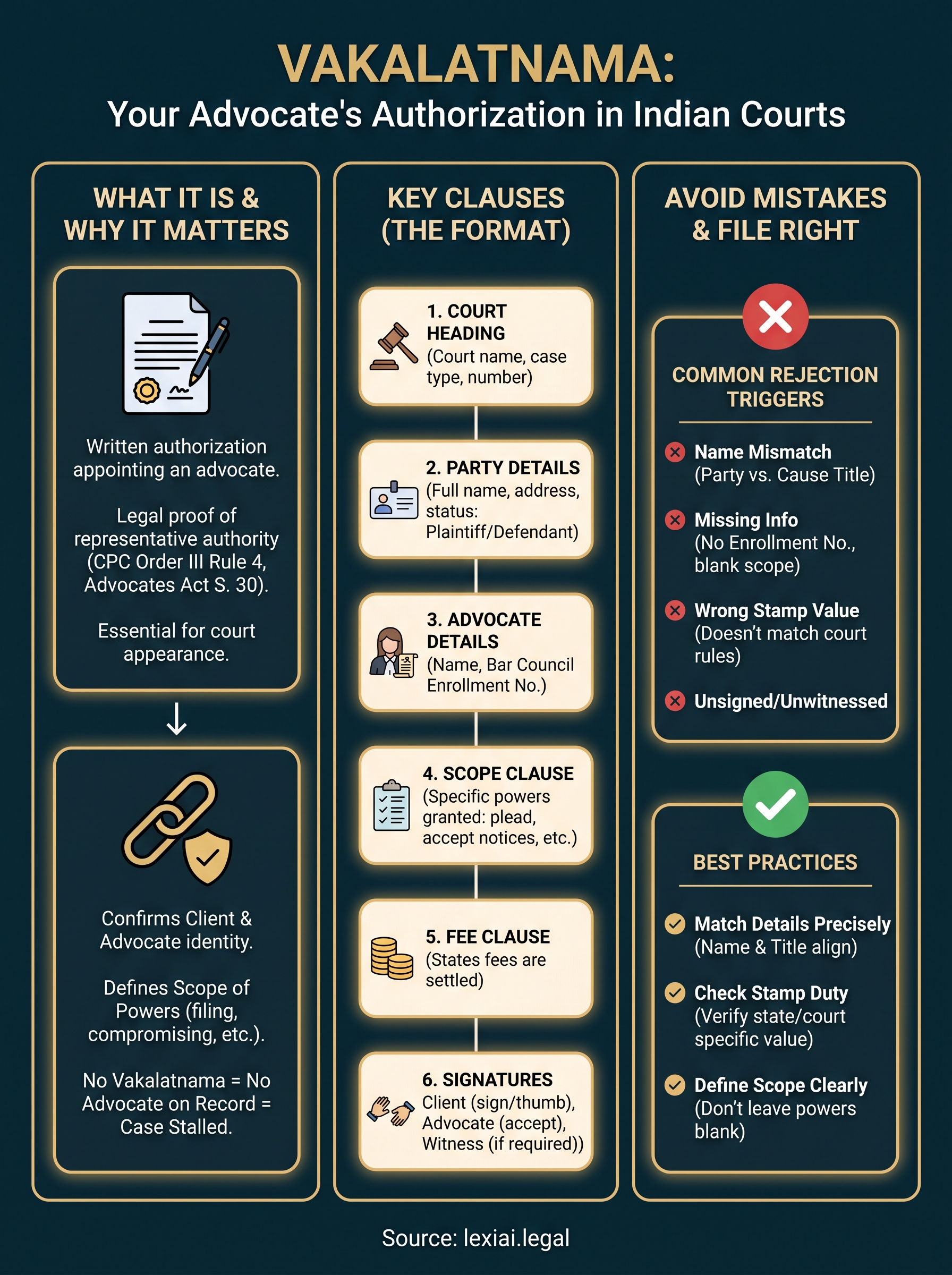
- Court heading: Name of the court, case type, and case or diary number if already allotted.
- Party details: Full name, address, and status (plaintiff, defendant, appellant, accused) of the person granting authority.
- Advocate details: Name, enrollment number, and bar council registration of the advocate being appointed.
- Scope clause: The specific powers granted, such as filing pleadings, accepting notices, or compromising the matter.
- Fee clause: A line noting that fees have been settled between client and advocate, common in most state formats.
- Signatures: Client's signature or thumb impression, advocate's countersignature, and, in many states, a witness.
Every clause exists because a court once had to decide a dispute over exactly that missing detail.
Once these fields sit correctly on the page, stamping and filing become straightforward, which the next section shows through an actual sample.
A sample vakalatnama format you can reference
Here is a generic vakalatnama draft you can adapt for a civil suit in a District Court. Treat it as a starting skeleton, since your state's format or the specific forum may need small wording changes.
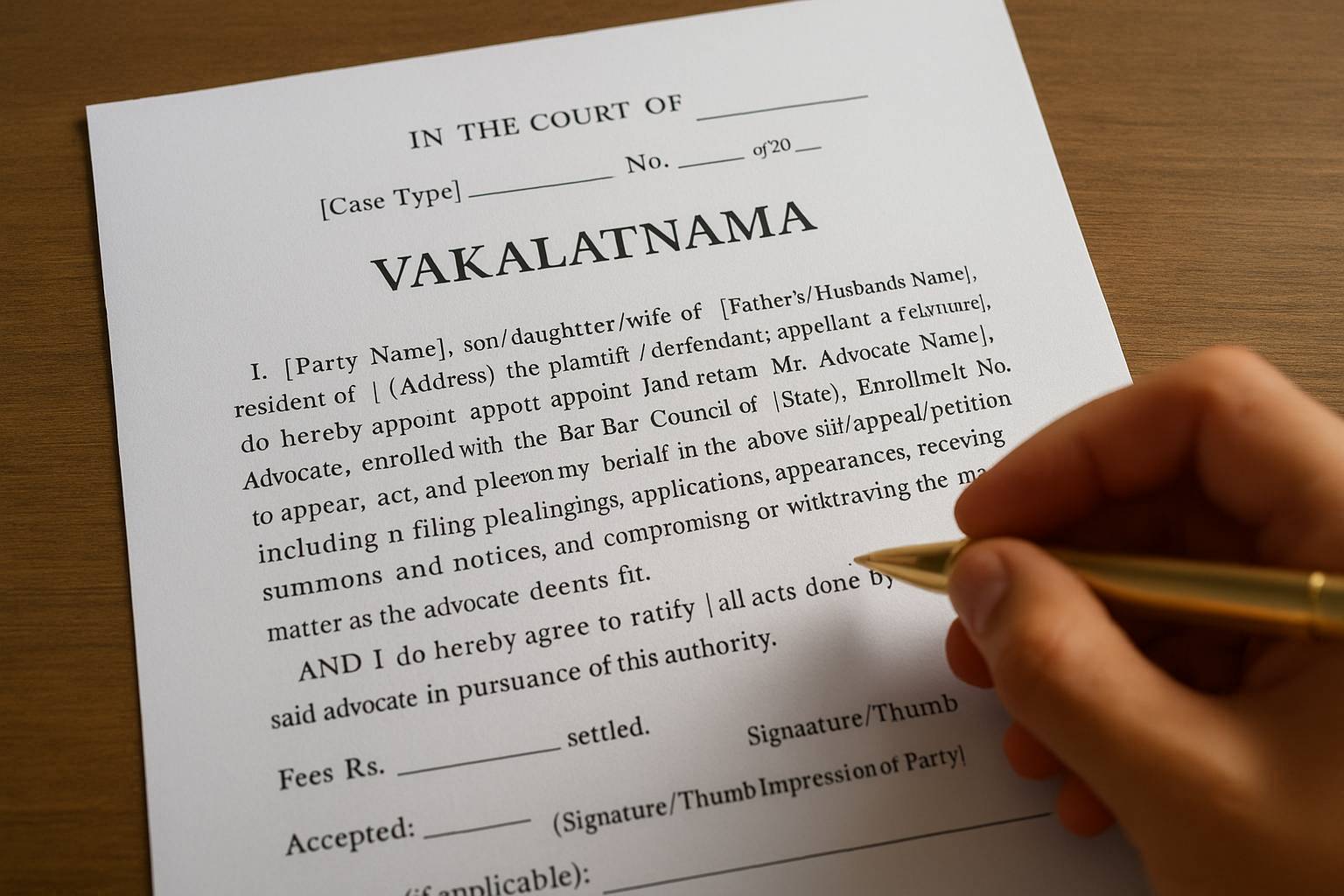
IN THE COURT OF [Designation of Judge], [City]

[Case Type] No. _____ of 20__

[Plaintiff Name] ... Plaintiff
Versus
[Defendant Name] ... Defendant

VAKALATNAMA

I, [Party Name], son/daughter/wife of [Father's/Husband's Name],
resident of [Address], the plaintiff/defendant/appellant in the
above matter, do hereby appoint and retain Mr./Ms. [Advocate Name],
Advocate, enrolled with the Bar Council of [State], Enrollment No.
[Number], to appear, act, and plead on my behalf in the above
suit/appeal/petition and in all proceedings arising therefrom,
including filing pleadings, applications, appearances, receiving
summons and notices, and compromising or withdrawing the matter
as the advocate deems fit.

AND I do hereby agree to ratify all acts done by the said advocate
in pursuance of this authority.

Fees Rs. ______ settled.

Accepted:
[Signature of Advocate] [Signature/Thumb Impression of Party]
Date: __________ Witness (if applicable): __________
Judges expect this same skeleton in matrimonial petitions, criminal bail applications, and writ filings, with only the case heading and scope clause changing to match the forum.
A vakalatnama that names the wrong party or leaves the scope clause blank is treated as no vakalatnama at all.
Keep a saved copy of this vakalatnama format in your own template library, or generate it instantly through LeXi Desk when case details change from filing to filing.
Common mistakes that get a vakalatnama rejected
Most rejections trace back to careless drafting rather than any real dispute over authority. Registry clerks compare the vakalatnama against the case file line by line, and a single mismatch sends it back to your advocate's desk instead of the judge's file.
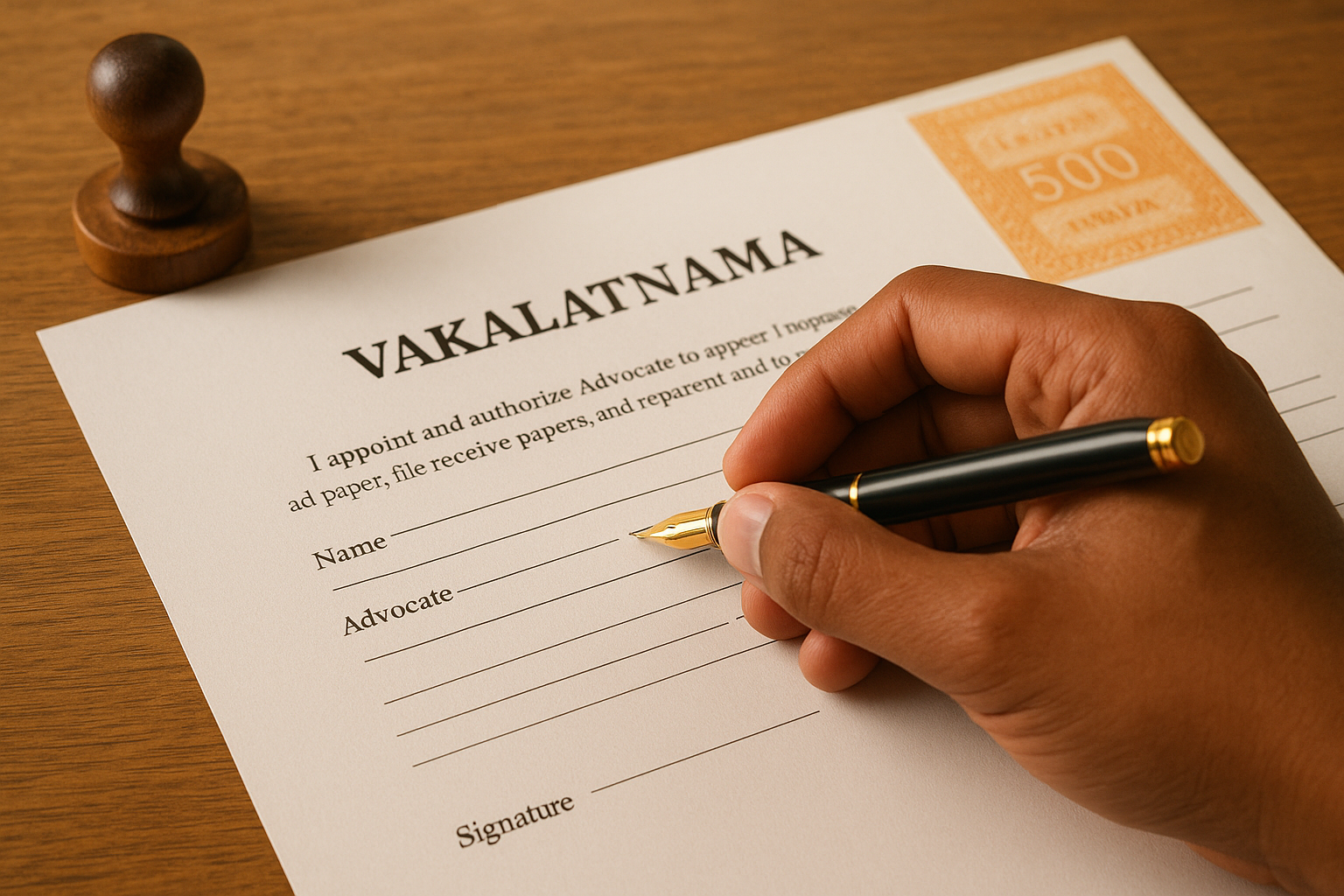
Errors that trigger registry rejection
Certain slip-ups repeat across courts because drafters copy old templates without checking the current filing. Watch for these before you submit:
- Name mismatch: The party name in the vakalatnama does not exactly match the cause title, including spelling of initials or surname order.
- Missing enrollment number: The advocate's bar council enrollment number is left blank or outdated after a state transfer.
- Wrong stamp value: The stamp paper or court fee stamp does not match the amount fixed under the relevant state Court Fees Act.
- Unsigned or unwitnessed execution: The client's signature, thumb impression, or required witness line is skipped.
- Blank scope clause: No powers are specified, leaving the registry unsure what the advocate is actually authorized to do.
A single wrong initial in the party name is enough for a registry to reject an otherwise perfect vakalatnama.
Fixes that take under a minute
Running a quick checklist before filing catches nearly every one of these errors. Compare the party name against the cause title, confirm the stamp value for your specific forum, and confirm both signatures are in place. Software built for this, including LeXi Desk, flags missing fields automatically, which removes the guesswork for anyone filing across multiple states.
Getting your vakalatnama filed right
A vakalatnama looks like a small form, but it decides whether your advocate can even step into the courtroom for you. Get the party details exact, match the stamp value to your forum, and never leave the scope clause blank. Those three habits alone prevent most rejections we covered above.
Drafting one from scratch every time wastes minutes you do not need to lose, especially when you are filing across multiple courts with different stamp schedules. Keeping a checked, reusable vakalatnama format on hand, whether as a saved template or through software that fills in the fixed clauses for you, turns a routine filing task into something you barely think about.
If you would rather skip the manual drafting altogether, see how LeXi AI generates court-ready vakalatnamas along with the rest of your case paperwork, in minutes instead of hours.