

MoU Format: How to Draft an MoU with Standard Clauses
A standard MoU format has a title, date, parties, background, purpose, scope, roles, term, confidentiality, dispute resolution, and signature blocks. That is the structure most Indian companies, institutions, and organizations use for a partnership. You can fill it in and adapt it to your deal in under an hour if you know what each part does.
The main point to understand is that an MoU is not automatically binding. Courts look at the wording and the intent of the parties, as the Supreme Court did when examining a preliminary agreement in cases on enforceability under the Indian Contract Act, 1872. So you must state clearly which clauses bind and which do not. Also check stamp duty under the state stamp act, because an unstamped document may not be admissible as evidence.
This guide walks you through each standard clause, with sample wording you can adapt. It also covers the mistakes that make an MoU unenforceable or vague. If you draft often, an AI tool like LeXi Desk can help you generate clauses and flag risky language before you sign.
What is an MoU and is it legally binding in India?
What an MoU means in practice
A memorandum of understanding is a written record of what two or more parties plan to do together before they sign a full contract. No statute defines an MoU in India, so the document is tested like any other agreement under the Indian Contract Act, 1872.
Unlike a long-form contract, an MoU is usually short, often two to five pages. Companies use it for joint ventures, universities for research tie-ups, and NGOs for funding partnerships. The same MoU format works for all of them, and only the scope and roles change.
Is an MoU legally binding in India?
Courts decide this on the wording, not the title. Section 2(h) of the Contract Act defines a contract as an agreement enforceable by law, and Section 10 sets the conditions: free consent, competent parties, lawful consideration and a lawful object. An MoU that meets these conditions and shows an intent to create legal relations can be enforced like any contract.
The opposite also holds. Phrases such as "subject to a definitive agreement" or "this MoU does not create legal obligations" tell a court that the parties did not intend to be bound. Vague terms add to the problem, because Section 29 treats an agreement as void when its meaning is not certain.
An MoU binds you only as far as its own wording says it does.
Which MoU clauses usually bind and which do not?
Most well-drafted MoUs are mixed. Some clauses are meant to be enforceable from day one, while others only record intent. Use the table below as a starting point and state your choice in the document itself.
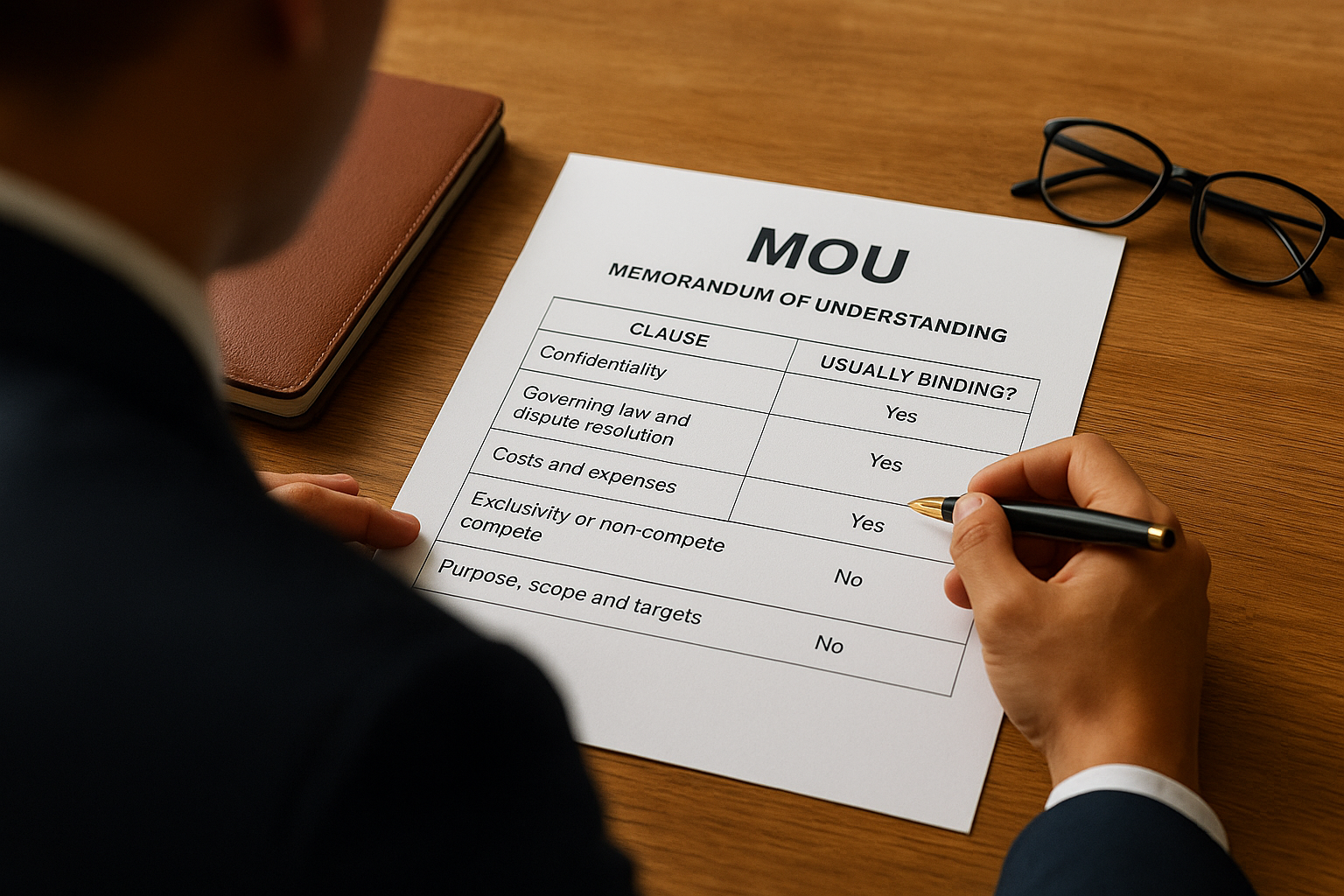
| Clause | Usually binding? | Reason |
|---|---|---|
| Confidentiality | Yes | Protects information shared during talks |
| Governing law and dispute resolution | Yes | Must work even if the deal collapses |
| Costs and expenses | Yes | Avoids disputes over who pays for due diligence |
| Exclusivity or non-compete | Only if stated clearly | Restraints must be reasonable under Section 27 |
| Purpose, scope and targets | No | Records intent, not a promise to perform |
| Future payment obligations | Only with fixed amount and terms | Uncertain sums fail under Section 29 |
Stamp duty also affects enforceability. Under Section 35 of the Indian Stamp Act, 1899, an unstamped instrument is not admissible in evidence until the duty and penalty are paid. Rates vary by state, so confirm the duty applicable in your state before signing.
Step 1. Identify the parties and state the purpose
Who should be named as the parties?
Begin with the full legal name of each party, exactly as it appears in its certificate of incorporation or registration. Add the entity type, the registered address, and the CIN or registration number. This opening block works for most MoU formats.
MEMORANDUM OF UNDERSTANDING

This MoU is made on [date] at [city] between:

(1) [Party A], a company incorporated under the Companies Act, 2013, CIN [number], having its registered office at [address] ("Party A"); and

(2) [Party B], a [society/trust/university] registered under [Act], registration no. [number], having its office at [address] ("Party B").
Check who signs for each side. A director needs a board resolution and an agent needs a power of attorney under the Powers of Attorney Act, 1882. Without proof of authority to sign, the other party may later say the MoU never bound it.
A wrong party name or an unauthorized signatory can leave you holding an MoU against nobody.
How do you state the purpose of the MoU?
Next, add a short background and a purpose clause. The background, also called recitals, explains who the parties are and why they are working together. The purpose clause states one clear objective in a sentence or two, and it should be specific enough that a stranger can measure whether it was met.
Compare "to collaborate on training" with the sample below. The second version names the activity, the place, and the period. Also remember that a court reads this clause to judge intent, so use words like "intend to" for goals you do not want to be enforceable.
Purpose: The parties intend to jointly set up a skill training program for engineering students in Pune, for twelve months from the Effective Date, on the terms set out in this MoU.
Step 2. Define scope, roles and responsibilities
Scope is where most MoU disputes begin. Once the parties and purpose are fixed, you must say what each side will actually do and by when. A vague scope clause can ruin an otherwise sound MoU format.

How do you define the scope of work?
List the activities in numbered points, and name what is excluded as well. Exclusions stop either party from assuming that the other will handle extra work. Section 29 of the Indian Contract Act, 1872 treats uncertain terms as void, so use figures, places, and dates wherever you can.
Scope: (a) Party A will provide the curriculum, trainers and certification for 120 students in two batches. (b) Party B will provide classrooms, lab access and student enrollment. (c) Placement assistance is excluded from this MoU.
If you cannot measure a task, you cannot hold anyone to it.
How do you assign roles and responsibilities?
Give each party its own list of duties. Add a named contact person and a deadline for every task. Avoid shared duties without an owner, because a task that belongs to both parties is usually done by neither.
| Task | Responsible party | Deadline |
|---|---|---|
| Curriculum and trainers | Party A | 30 days from the Effective Date |
| Classrooms and lab access | Party B | Before the first batch |
| Progress report | Both parties | Every quarter |
Also set up a joint steering committee with one representative from each side, meeting quarterly to review progress. Then fix the term in the same place. For example, state twelve months, with renewal only by written agreement, so the MoU does not drift on with no end date.
Step 3. Add standard clauses and legal terms
Once scope and roles are fixed, the legal clauses turn a plain statement of intent into a usable MoU format. Keep each clause short, and say clearly whether it is binding or non-binding.
Which standard clauses should every MoU include?
Add these after the roles section. Together they cover the risks that appear when a deal stalls, and they usually take about one page.
- Confidentiality: defines protected information and how long the duty lasts.
- Term and termination: states the end date and allows exit on 30 days' written notice.
- Costs: each party bears its own expenses.
- Amendment: changes are valid only if made in writing and signed by both parties.
- Governing law and disputes: names the law, the seat, and the forum.
How do you word the binding and non-binding clauses?
Draft the binding clauses in firm language, using "shall". Use "intend to" for everything else. Then add a binding effect clause that lists the enforceable clauses by number, so no one has to guess.
Say which clauses bind, or a court will decide for you.
Binding effect: Clauses 5 (Confidentiality), 7 (Governing Law and Disputes) and 8 (Costs) are legally binding. All other clauses record the present intention of the parties and do not create legal obligations.

Disputes: Any dispute arising out of this MoU shall first be referred to the senior management of both parties. If it is not resolved within 30 days, it shall be referred to a sole arbitrator under the Arbitration and Conciliation Act, 1996. The seat of arbitration shall be [city]. Courts at [city] shall have exclusive jurisdiction.
Under Section 7 of the Arbitration and Conciliation Act, 1996, an arbitration agreement must be in writing, and signatures on the MoU satisfy that. Name the seat of arbitration and the number of arbitrators. A clause that leaves these open invites a court fight before the real dispute even begins.
Step 4. Review, stamp and sign the MoU
What should you check before signing?
Read the full draft once as the other party would. Inconsistencies between clauses cause many disputes, so test your final MoU format against this checklist:
- Party names, addresses, and CIN match the registration documents.
- Defined terms, clause numbers, and cross-references are consistent.
- The binding effect clause lists the correct clause numbers.
- Dates, amounts, and deadlines read the same everywhere.
- Each party has approved the text, with a board resolution where needed.
An AI review in LeXi Desk can catch mismatched clause references and risky wording before the final copy is printed.
How do you stamp an MoU in India?
Stamp duty depends on your state and on what the MoU says. Check the schedule of your state stamp law, such as the Maharashtra Stamp Act, 1958, or the Indian Stamp Act, 1899, where it applies. Buy the stamp paper or complete e-stamping before anyone signs, and confirm the amount with a local advocate if the MoU carries payment terms.
Stamp the MoU before anyone signs it.
Late stamping costs more. Under Section 35 of the 1899 Act, an unstamped instrument cannot be used in evidence until the duty and a penalty that can reach ten times the duty are paid. In 2023, a seven-judge Bench of the Supreme Court held that a missing stamp is a curable defect and does not make an arbitration clause void. Still, do not plan around that ruling when paying on time is simple.
How do you sign and finish the MoU?
Each authorized signatory should initial every page and sign the last page with name, designation, and date. Add one witness per party. Notarization is not required for an MoU, but some institutions ask for it. Sign two originals so each party keeps one. Electronic signatures are valid under Section 5 of the Information Technology Act, 2000, though the stamp duty still applies.
Signed for and on behalf of [Party A]      Signed for and on behalf of [Party B]
Name:                                       Name:
Designation:                                Designation:
Date:                                       Date:
Witness 1:                                  Witness 1:
Putting your MoU together
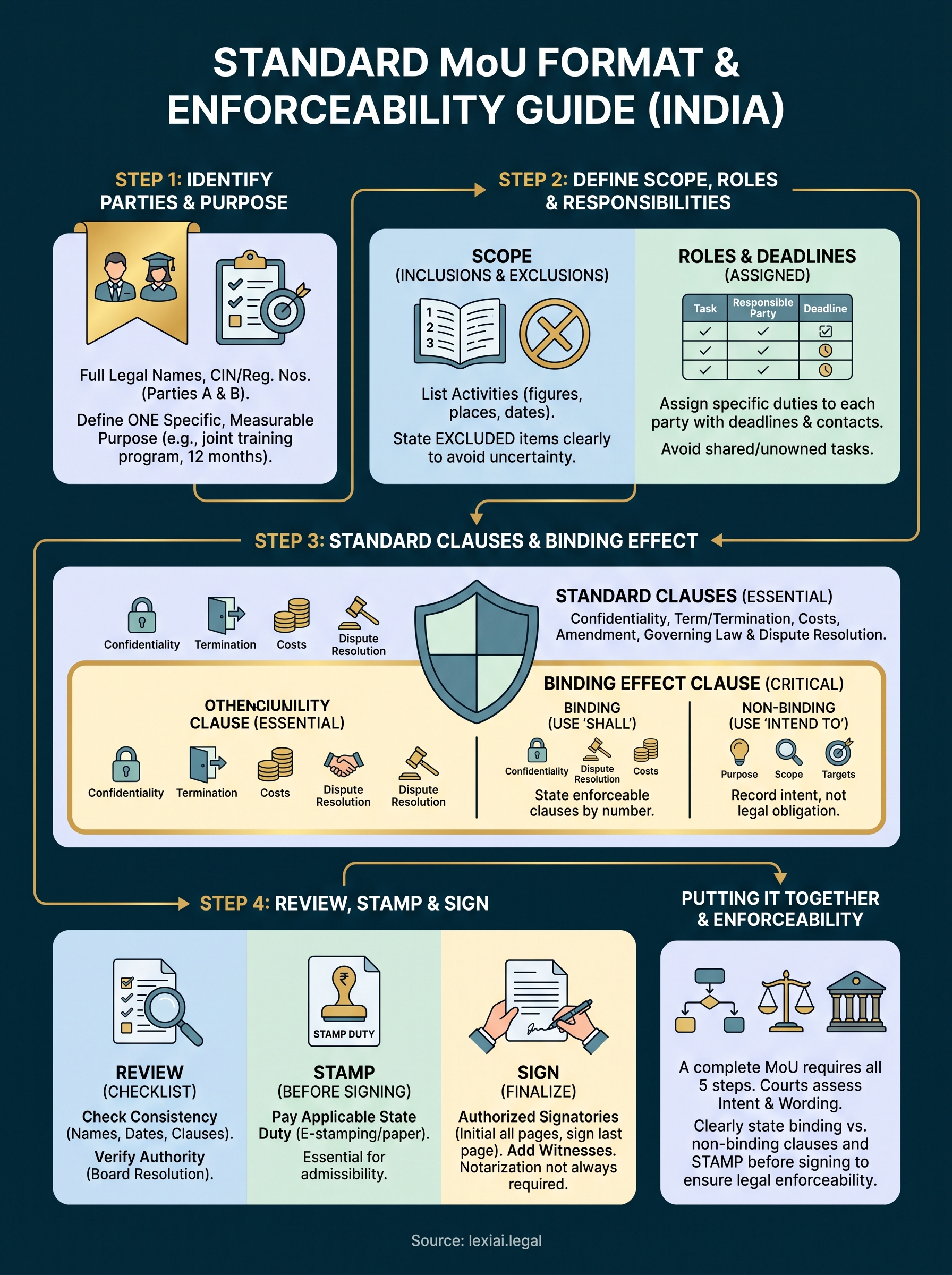
Drafting a good MoU comes down to five moves. Name the parties, state a measurable purpose, define scope and roles, add the standard clauses, then review, stamp, and sign. Skip none of them, because each step supports the next, and the MoU format only holds together when all five are done.
Two points matter more than the rest. State clearly which clauses are binding, and stamp the document before anyone signs it. These two habits prevent most of the disputes that reach a courtroom.
If you want a faster first draft, you can get a free LeXi AI trial and use LeXi Desk to generate clauses, flag risky wording, and check your MoU before it goes out for signature. Then have a local advocate confirm the stamp duty for your state.