

Income Tax Act 2025: What It Is and What Changes
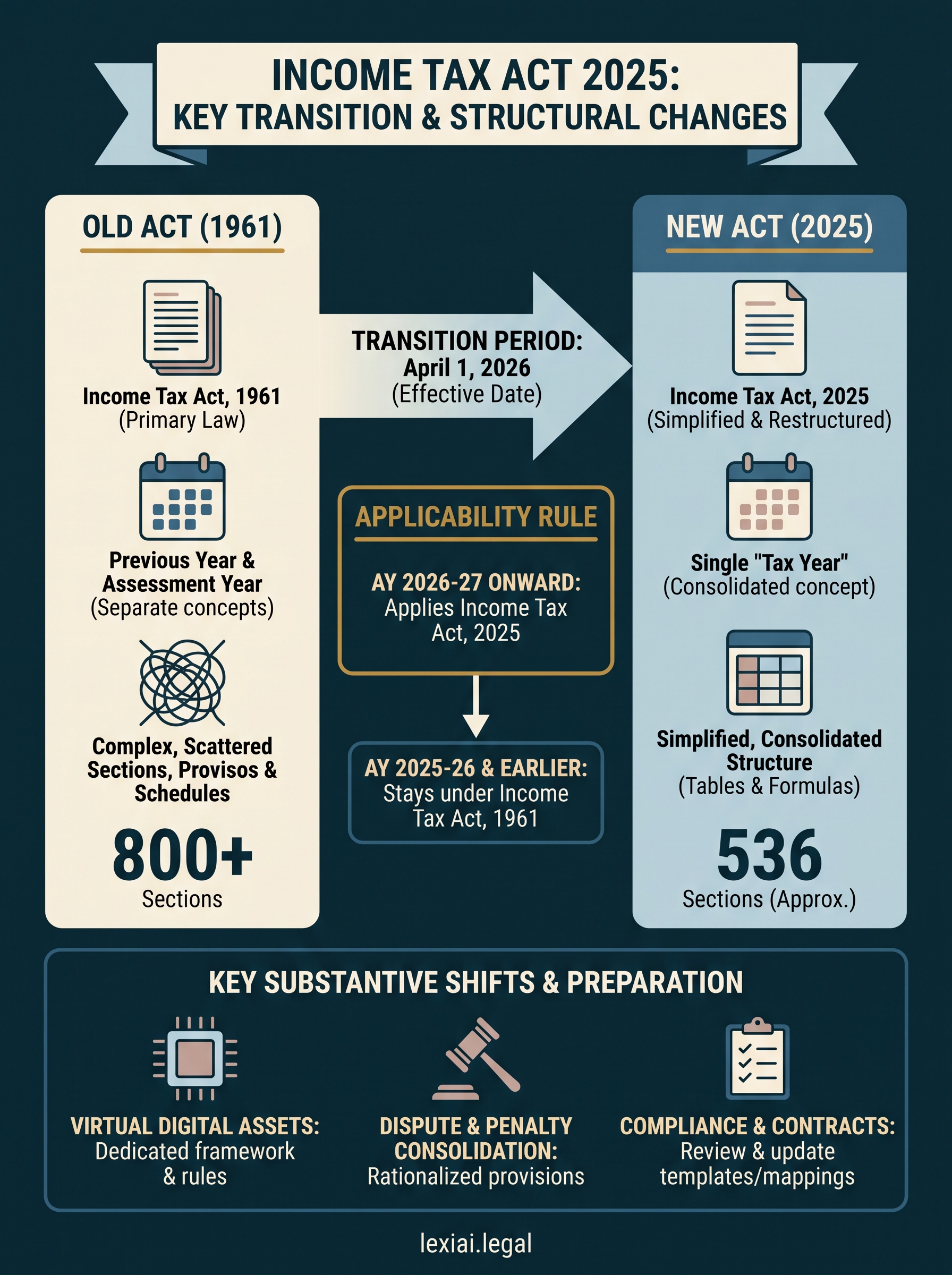
The Income Tax Act 2025 replaces the Income Tax Act, 1961, as the primary law governing income tax in India. Parliament passed it to simplify a statute that had grown unwieldy after more than six decades of amendments, and it takes effect from April 1, 2026, applicable to assessment year 2026-27 onward. If you are searching for what changed, why, and where to find the actual text, this article answers that directly.
The new Act does not rewrite tax policy from scratch. It restructures the law itself, cutting down the section count, removing redundant provisions, replacing confusing terms like "previous year" and "assessment year" with a single "tax year," and reorganizing schedules for easier reading. Rates and most substantive tax positions carry over, but the numbering, drafting language, and several compliance provisions differ enough that lawyers and taxpayers need a clear side-by-side understanding before the old Act stops applying.
This piece walks through what the Income Tax Act 2025 actually is, how to access its official text and sections, its effective date and transition rules, and the key structural and substantive changes from the 1961 Act. For lawyers and in-house teams tracking these changes across client files, tools like LeXi AI can help pull the relevant sections and compare provisions faster during this transition period.
Why the Income Tax Act 2025 matters for lawyers and taxpayers
Any time a country replaces its primary tax statute, the transition itself becomes a source of disputes, not just the new rules. The Income Tax Act 2025 touches every pending assessment, ongoing litigation, and contract clause that references the 1961 Act by section number. Lawyers who treat this as a simple renumbering exercise will miss real substantive shifts buried inside the restructuring, and taxpayers who assume nothing has changed risk missing new compliance timelines that carry penalties.

Interpretive risk during the changeover
Courts and tribunals will spend the next several years deciding how precedents built under the old Act apply to the new one. When a section is renumbered but its language changes even slightly, judges have to decide whether Parliament intended a substantive change or just a drafting cleanup. This has happened before in Indian tax law: minor wording shifts in amendments have triggered years of litigation over legislative intent. The new income tax law compresses roughly 800 sections into about 536 and cuts the chapter count nearly in half, which means many provisions were consolidated, split, or reworded even where the underlying policy stayed the same, much like the criminal code rewrite that renumbered IPC offences did in 2024.
The biggest risk during this transition is not the new rules themselves, it is assuming old case law transfers over unchanged.
That single sentence should guide how any lawyer approaches a file that straddles both statutes. Do not cite a 1961-era judgment on a renumbered provision without checking whether the new drafting actually preserved the same legal test.
Litigators need to track this now, not later
Assessment proceedings, appeals, and revision petitions that were initiated under the 1961 Act do not simply vanish. The transition rules built into the new Act generally preserve actions taken, notices issued, and proceedings pending as of the switchover date, so a case filed in 2025 under the old numbering will still reference old section numbers throughout its life in the courts. Litigators need to keep both statutes open side by side for years, not months, because appellate timelines in Indian tax matters routinely run past the assessment year in which they originated.
This matters practically in a few concrete ways:
- Cross-referencing in pleadings: Petitions and written submissions filed after April 1, 2026 for pre-2026-27 assessment years still need accurate 1961 Act citations, while any new cause of action uses the 2025 numbering.
- Precedent research: Search tools and databases need time to tag judgments correctly against both statutes, so manual verification of section correspondence remains necessary for now.
- Limitation periods: Some limitation and reassessment timelines carried over from the 1961 Act use specific section references that a lawyer must map to their 2025 equivalents to calculate deadlines correctly.
Contract and compliance teams face real rework
Corporate legal teams draft contracts, board resolutions, and compliance policies that cite specific sections of the Income Tax Act, whether for TDS obligations, withholding certificates, or tax indemnity clauses, and each of those documents depends on drafting precise legal documents with accurate statutory references. Every template built around 1961 Act section numbers now needs review, because a clause referencing
How to check which act applies to your assessment year
The rule is simpler than most people assume: assessment year 2026-27 and onward falls under the Income Tax Act 2025, while assessment year 2025-26 and earlier stays governed by the Income Tax Act, 1961. Since the new Act takes effect from April 1, 2026, any return, notice, or proceeding tied to income earned during financial year 2025-26 (assessment year 2026-27) uses the new numbering and provisions. Anything for financial year 2024-25 or before continues under the old Act, even if you file or litigate it after April 2026.
If the assessment year is 2026-27 or later, use the new Act. If it is 2025-26 or earlier, the 1961 Act still governs, regardless of when you actually file.
Match your assessment year to the correct act
When you are unsure which statute applies to a client file, check the assessment year first, not the calendar date on which you are working. The table below covers the most common scenarios lawyers and tax professionals run into during this transition.
| Assessment Year | Financial Year | Governing Act |
|---|---|---|
| AY 2024-25 and earlier | FY 2023-24 and earlier | Income Tax Act, 1961 |
| AY 2025-26 | FY 2024-25 | Income Tax Act, 1961 |
| AY 2026-27 | FY 2025-26 | Income Tax Act, 2025 |
| AY 2027-28 and later | FY 2026-27 and later | Income Tax Act, 2025 |
Refunds, rectifications, and revised returns tied to an older assessment year do not switch statutes just because you file them after the new Act comes into force. A revised return for AY 2025-26 filed in 2027 still runs on 1961 Act provisions for that assessment year.
What if your case spans both assessment years
Many files will not fall neatly on one side of the line. A search and seizure case, a transfer pricing dispute, or a multi-year assessment can touch both AY 2025-26 and AY 2026-27 in the same proceeding. In these situations, apply the 1961 Act to the portion of income and compliance tied to the earlier year, and the 2025 Act to the portion tied to the later year, treating each assessment year as a separate compliance unit even within one case file.
Appeals and revisions filed against orders passed under the 1961 Act stay under the 1961 Act framework for procedural purposes, even after the switchover date, because the transition provisions preserve the law under which the original proceeding began. Do not assume a fresh appeal automatically pulls the matter into the new Act just because you file it in 2026 or later.
Practical steps to confirm the correct act
Before drafting a notice, opinion, or pleading, run through this quick sequence:
- Identify the exact assessment year involved, not the filing date or today's date.
- Check whether that assessment year is 2026-27 or later.
- If the proceeding started before the switchover, confirm the transition clause that keeps it under the original Act.
- Cross-check section numbers against both statutes if the file references older correspondence or notices.
- Flag any ambiguity to a senior colleague before finalizing citations, since courts are still settling several interpretive questions on this point.
Tools built for searching Indian statutes and case law in seconds, including LeXi AI's research assistant, can help you pull both versions of a provision side by side, which saves time when a file straddles the two statutes.
What actually changed under the Income Tax Act 2025
Three changes stand out above everything else: the sheer reduction in section count, the shift to a single "tax year" concept, and the consolidation of exemptions and deductions into schedules rather than scattered provisos. Structural simplification drives most of what you will notice first when you open the bare text, but several substantive shifts sit underneath that simpler drafting, and those are the ones that actually affect tax positions.
Structural simplification you will notice immediately
Gone are the endless explanations, provisos, and cross-references that made the 1961 Act notoriously hard to read in one sitting. The new Act groups related provisions into tables and formulas wherever possible, so a section on depreciation now reads more like a schedule than a paragraph of legal prose. Many exemptions previously buried inside Section 10 subsections now sit in a dedicated schedule, which makes them easier to locate but also means old sub-clause references no longer map one to one.
Substantive shifts beyond the drafting cleanup
Several provisions changed in substance, not just numbering, and these deserve close attention before you rely on old precedent.
- Tax year replaces previous year and assessment year: instead of tracking income for one year and assessing it in the next, the Act now taxes income in the same year it is earned, collapsing a distinction that confused generations of taxpayers.
- Virtual digital assets get a dedicated framework: provisions that were added piecemeal to the 1961 Act through amendments are now integrated into the main structure with clearer computation rules.
- TDS and TCS provisions are consolidated: rather than dozens of scattered sections, deduction and collection obligations sit closer together, reducing the risk of missing an applicable rate.
- Faceless assessment and appeal mechanisms are built into the core Act: earlier these ran on separate schemes and notifications; now they form part of the primary statute itself.
- Penalty provisions are rationalized: overlapping penalty sections from the old Act have been merged, though the underlying amounts and triggers largely track the 1961 framework.
The drafting looks simpler, but do not mistake simpler language for identical law, several provisions genuinely changed in scope.
That distinction matters most for practitioners relying on settled interpretations built up over decades under the 1961 Act.
What this means for day-to-day practice
Corporate counsel reviewing compliance calendars need to check whether a TDS obligation that used to sit under one section now carries a different threshold or timeline under its consolidated home. Litigators arguing exemption claims should confirm whether a schedule reference preserved the exact conditions from the old subsection or tightened them during consolidation. Independent practitioners drafting opinions for clients on straddling transactions should flag, in writing, which provisions changed in substance versus which simply moved. Given the volume of renumbered and reworded sections, running a side-by-side comparison through a research tool built for this kind of mapping, rather than relying on memory of the old Act, reduces the chance of citing a provision that no longer says what you think it says.
How to map old 1961 sections to the new numbering
Mapping old sections to their new equivalents is not a one-line lookup, and treating it that way is where most drafting mistakes happen. The Income Tax Act 2025 did not simply renumber provisions in sequence; it merged some sections, split others across multiple new provisions, and moved several into schedules entirely. A single old section can now correspond to two or three new ones, or vice versa, so a search-and-replace approach to updating templates and pleadings will produce errors.

Why section mapping is not a simple lookup
Consolidation is the main reason a direct one-to-one table does not always work. Sections that dealt with related exemptions under the 1961 Act, scattered across different chapters, now sit together under a single schedule entry in the new Act, which means one old section reference might map to a schedule item plus a cross-referenced formula rather than a single clean section number. Splitting works the other way too: a long, dense section covering multiple compliance obligations under the old Act sometimes breaks into separate, narrower provisions under the new numbering.
Never assume a renumbered section carries the exact same text just because the topic sounds the same.
Common section correspondences to know
CBDT has published official equivalence tables alongside the Act, and these should be your primary reference rather than any informal chart circulating among practitioners. The table below illustrates the kind of correspondence you will find, using widely cited 1961 Act provisions as examples of the pattern rather than a complete reference.
| Old Act (1961) Provision | Typical Subject | New Act (2025) Treatment |
|---|---|---|
| Section 10 exemptions | Exempt categories of income | Moved into a dedicated schedule of exemptions |
| Section 80C and related deductions | Investment-linked deductions | Consolidated into a single deductions schedule |
| Section 139 | Return filing obligations | Restructured with tax year terminology, largely same filing logic |
| Section 194 series | TDS on specified payments | Grouped together under a consolidated TDS chapter |
| Section 271 series | Penalties | Merged into fewer, broader penalty provisions |
Building a reliable mapping workflow
Once you accept that mapping takes verification rather than memorization, build a repeatable process for your practice or in-house team:
- Pull the official CBDT correspondence table for the specific chapter you are working on, not just the section number.
- Read the new provision in full, rather than assuming the heading matches the old section's scope.
- Note any change in conditions, thresholds, or timelines, even when the general subject matter looks identical.
- Update templates, opinions, and precedent notes with both the old and new citations during the transition period, so anyone reviewing the file later understands which Act governs which portion.
- Keep a running log of provisions where the mapping felt unclear, and flag those for a second review before you rely on them in a filing.
Questions about a specific chapter's correspondence do come up constantly among lawyers handling straddling files right now. Running a query through one of the best AI tools for legal research in India, such as LeXi AI's research assistant, can speed up that verification step by pulling both provisions together instead of searching two separate statute texts by hand.
What stays the same under the new law
Despite the rewrite, the Income Tax Act 2025 keeps most of the substance that lawyers and taxpayers already know. Tax rates, slab structures, and the basic charge of tax on income under the five heads (salary, house property, business or profession, capital gains, and other sources) remain unchanged in principle. If you built your practice around understanding how income gets classified and taxed, that foundation still applies, only the section numbers and some drafting choices around it have moved.
Tax rates and slab structure carry over
Parliament did not use this rewrite to change how much tax anyone pays. The existing tax slabs and rates announced in recent Finance Acts continue to apply under the new numbering, and the concessional regime versus the old regime choice that taxpayers have gotten used to in recent years stays intact as a structural feature. Corporate tax rates, surcharge slabs, and cess calculations also carry forward without substantive change, so any rate table you already use for client advice does not need a rebuild, only a citation update once you reference the governing section.
Rates and slabs did not move, only the numbering around them did, so do not assume a client's tax liability changed just because the Act did.
Core exemptions and deduction logic remain intact
The underlying policy behind common exemptions and deductions, house rent allowance, standard deduction, deductions for investments and insurance premiums, and capital gains exemptions on reinvestment, has not been scrapped. These provisions moved into consolidated schedules for easier reading, but the qualifying conditions largely track what existed under the 1961 Act. A few examples worth flagging for client files:
- Standard deduction for salaried taxpayers continues at the same structure, now referenced within the tax year framework.
- Capital gains exemptions on reinvestment in property or specified bonds retain their holding period and reinvestment window requirements.
- Deduction limits for common investment categories stay at familiar caps, consolidated into a single schedule rather than scattered sections.
Procedural rights and appeal structure remain familiar
Taxpayers have not lost any procedural protections in this transition. The right to appeal an assessment order, the structure of appellate authorities from Commissioner (Appeals) through the Income Tax Appellate Tribunal and onward to the High Courts and Supreme Court, and the general framework for seeking rectification or revision all continue under the new Act with the same logic, even where section numbers differ. Search, seizure, and survey powers retain their underlying scope and safeguards, and the burden of proof standards courts have developed over decades under the 1961 Act remain relevant reference points for arguing similar questions under the new numbering.
This continuity matters practically because it tells you where you do not need to rebuild your working knowledge from scratch. A lawyer who has argued exemption claims or appeal procedure under the 1961 Act for years can transfer most of that reasoning directly, provided they verify the specific section reference and confirm the schedule did not quietly tighten a condition during consolidation. Treat continuity as the default assumption for policy and rates, and treat structure and numbering as the area demanding actual verification.
Key dates and deadlines to track during the transition
Getting the effective date wrong is the single most avoidable mistake during this changeover. The Income Tax Act 2025 applies from April 1, 2026, but several related deadlines fall before and after that date, and missing any one of them creates real exposure for a client or a firm. Treat this transition window as its own compliance calendar, separate from the routine filing dates you already track every year.

Dates already fixed by the transition
Parliament and CBDT have locked in a handful of dates that every tax and legal team should mark now, not closer to the deadline.
| Date | What happens |
|---|---|
| April 1, 2026 | Income Tax Act 2025 comes into force; 1961 Act stops applying to new assessment years |
| AY 2026-27 onward | First assessment year governed entirely by the new Act |
| Ongoing through 2026-27 | CBDT continues issuing rules, forms, and clarificatory circulars under the new Act |
| AY 2025-26 and earlier | Returns, appeals, and refunds continue under 1961 Act provisions indefinitely |
Notice how the table separates the statute's effective date from the assessment year it first governs. That gap trips up people who assume the new Act applies the moment the calendar turns April 1, 2026, when in fact the trigger is the assessment year, not the filing date.
Filing deadlines that shift during the switch
Once AY 2026-27 begins, several routine dates move onto the new Act's terminology even though the underlying due dates stay close to what practitioners already expect.
- Return filing due dates for AY 2026-27 follow the tax year framework, but the actual calendar dates for individuals, firms, and companies largely mirror the old due date structure.
- TDS and TCS deposit and return timelines carry over in substance, though you should confirm the consolidated section reference before citing it in a compliance note.
- Advance tax installment dates remain on the same quarterly pattern taxpayers already follow.
- Tax audit and transfer pricing report deadlines stay linked to the return filing date, now expressed under the new Act's numbering.
Do not let the new terminology distract you from the fact that most calendar due dates for AY 2026-27 stayed close to what you already track.
Deadlines for pending proceedings and refunds
Proceedings that began under the 1961 Act keep their original limitation periods, and those periods do not restart or pause because the governing statute changed. A reassessment notice issued under the old Act, for instance, still runs against the old limitation clock even if the actual order gets passed after April 2026. Refund claims and rectification applications tied to AY 2025-26 or earlier follow the same rule, so check the original section under which a notice or order was issued before calculating any deadline.
Corporate legal teams juggling multiple client files across both assessment years benefit from building a single tracker that flags which statute governs each deadline, rather than relying on memory once the transition period stretches into its second or third year. A tool built for legal research can help pull the correct limitation provision quickly when a file straddles both Acts, which matters most when a deadline sits only weeks away.
How legal and tax teams can prepare for the switch
Waiting for a deadline to force action is the most common mistake firms make during a statutory transition like this one. The Income Tax Act 2025 gives you a runway of several months before AY 2026-27 filings begin, and using that time now to build a transition plan saves far more hours later than scrambling once notices start referencing the new numbering. Treat this the way you would treat onboarding a new associate: assume nothing is automatically understood, and verify everything against the primary text.
Build an internal transition playbook
Every firm and in-house team handling tax matters needs a written playbook, not just a mental note that "the Act changed." Put together a short internal document that lists the assessment year rule, the key section correspondences your practice relies on most, and a point person for escalating unclear mappings. A workable playbook usually covers:
- Which client files straddle AY 2025-26 and AY 2026-27, flagged individually
- A running list of section mappings your team has already verified against CBDT's correspondence tables
- A naming convention for citing both old and new section numbers during the overlap period
- A designated reviewer for any pleading or opinion that cites a renumbered provision for the first time
A written transition playbook beats institutional memory every time a section gets renumbered.
Train associates and staff on the new numbering
Junior associates trained entirely under the 1961 Act need direct guidance before they start drafting under the new one. Run a short internal session that walks through the assessment year rule, the tax year terminology, and two or three high-frequency section mappings your practice uses daily, such as TDS provisions or exemption schedules. Give staff a copy of the CBDT equivalence tables rather than expecting them to memorize correspondences, and pair newer team members with someone reviewing their citations until the new numbering becomes second nature.
Update client-facing documents and templates
Standard engagement letters, TDS certificates, board resolution drafts, and compliance checklists that cite specific 1961 Act sections all need a review pass. Rather than updating every template in one rushed sweep, prioritize the documents your team uses most often, then work outward. A simple internal note attached to updated templates helps everyone track what changed:
Template: TDS Compliance Checklist (Vendor Payments)
Old reference: Section 194C, Income Tax Act 1961
New reference: [Consolidated TDS Chapter], Income Tax Act 2025
Verified against CBDT correspondence table: Yes / Pending
Last reviewed: [date]
Keeping a log like this across your firm's key templates prevents the same section getting re-verified by three different people over the coming year.
Set a review cadence for the transition period
CBDT will keep issuing rules, forms, and circulars under the new Act well into AY 2026-27 and beyond, so a one-time review will not be enough. Schedule a recurring review, monthly at first and quarterly once things settle, where your team checks for new clarifications and updates the playbook accordingly. Firms that build this cadence into their calendar now, rather than treating the Act as a one-time reading assignment, spend noticeably less time firefighting citation errors later. For teams handling a high volume of straddling files, an AI platform trained on Indian statutes that compares both Acts side by side can shorten this review cycle considerably.
Staying prepared as the new act takes effect
The Income Tax Act 2025 does not demand a complete rebuild of what you already know about Indian tax law. Rates, exemptions, and appeal structures carry forward largely intact, but the numbering, drafting, and a handful of substantive provisions genuinely changed, and treating this as a cosmetic renumbering will cost you a citation error sooner or later. Assessment year 2026-27 marks the real dividing line, so anchor every mapping decision to that fact rather than the calendar date on your desk.
Getting comfortable with the new structure now, while AY 2025-26 filings still run under the old Act, puts you ahead of the crowd scrambling once notices start citing the 2025 numbering exclusively. Build your playbook, verify your section mappings against CBDT's tables, and keep both statutes open until the transition settles.
If your team wants a faster way to compare provisions across both Acts, see what LeXi AI does for tax and litigation teams.