

How to File for Divorce in India: Steps and Documents
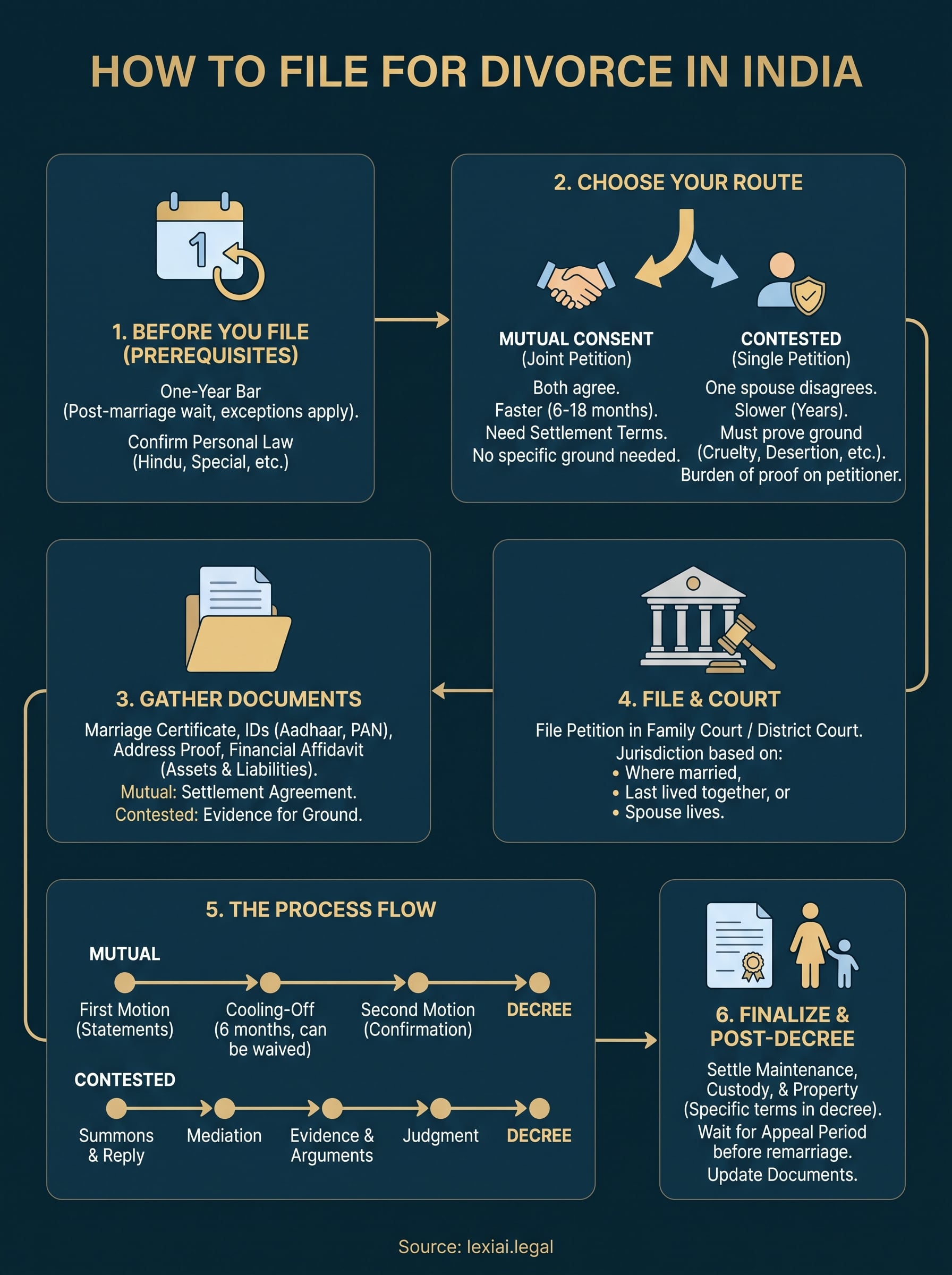
To file for divorce in India, you submit a petition before the Family Court or District Court that has jurisdiction, under the personal law that governs your marriage. For Hindus, that is the Hindu Marriage Act, 1955. Other communities follow the Special Marriage Act, 1954, the Indian Divorce Act, 1869, or their own personal laws. The route you take depends on whether both spouses agree.
If you both agree, you file a mutual consent petition under Section 13B of the Hindu Marriage Act. Courts usually expect a six month waiting period between the first and second motions, though the Supreme Court held in Amardeep Singh v. Harveen Kaur (2017) that this period can be waived. If one spouse disagrees, you file a contested petition under Section 13 on a specific ground, such as cruelty or desertion.
This guide covers the court filing steps in order, the documents you need to prepare, the differences between mutual and contested cases, and realistic timelines. Where drafting or research is involved, tools like LeXi AI can help lawyers prepare petitions and find relevant judgments faster.
What to know before you file for divorce in India
Check whether you can file yet
Start with the calendar. Under Section 14 of the Hindu Marriage Act and Section 29 of the Special Marriage Act, no petition can be presented within one year of marriage. The only exception is leave of the court for exceptional hardship or exceptional depravity. Your date of marriage on the certificate or registration decides this, so check it first.
The waiting rules differ by personal law. Confirm which law applies to you before you plan a timeline.
| Personal law | Mutual consent section | Rule before you file |
|---|---|---|
| Hindu Marriage Act, 1955 | Section 13B | One year since marriage (Section 14) |
| Special Marriage Act, 1954 | Section 28 | One year since marriage (Section 29) |
| Indian Divorce Act, 1869 | Section 10A | Two years of living separately |
Confirm your personal law and the one-year bar before you spend anything on drafting, because both decide which petition you can file.
Know what the process asks of you
Expect a long road. Mutual consent cases often close in six to eighteen months, depending on the court and its docket. Contested cases commonly run for several years, especially if either side appeals. These are practical ranges, not promises.

Family courts also push for settlement. Section 9 of the Family Courts Act, 1984 directs the court to assist parties in reaching an agreement, and Section 23(2) of the Hindu Marriage Act requires an effort at reconciliation. In practice, mediation is a standard step in most cases, so plan for at least one or two sessions.
Irretrievable breakdown of marriage is not a statutory ground under the Hindu Marriage Act. In Shilpa Sailesh v. Varun Sreenivasan (2023), the Supreme Court dissolved a marriage on that basis using Article 142 of the Constitution. That is an exceptional power, and a family court cannot grant divorce on this basis alone. Do not build your filing around it.
Settle these points before you file
A few decisions made early save months later. Work through this list before you meet a lawyer:
- Residence proof: Note where each spouse lives now and where you last lived together. This decides which court can hear your case.
- Marriage proof: Locate the marriage certificate, wedding invitation, and photographs.
- Your position on money and children: Decide what you want on maintenance, child custody, and property, since the court will ask.
- Evidence: If you plan a contested petition, collect messages, medical records, police complaints, and witness names now.
- Safety: If you face violence, speak to a lawyer about protection orders under the Protection of Women from Domestic Violence Act, 2005 before you serve any notice.
Finally, speak to a family law advocate early. A lawyer can tell you whether your facts fit a ground under Section 13 and which court to approach. If you are researching on your own, an AI research tool such as LeXi AI can pull verified judgments on your ground, so you arrive at that meeting with specific questions.
Step 1. Identify your personal law and grounds
The first task in how to file for divorce in India is to confirm which law governs your marriage. That one answer decides your grounds, your petition format, and the court you approach.
Find the law that governs your marriage
Personal law follows your religion, unless you married under the civil law. Use this table to match your marriage to its statute.
| Your marriage | Governing law |
|---|---|
| Hindu, Buddhist, Jain, or Sikh | Hindu Marriage Act, 1955 |
| Christian | Indian Divorce Act, 1869 |
| Parsi | Parsi Marriage and Divorce Act, 1936 |
| Muslim | Dissolution of Muslim Marriages Act, 1939 and Muslim personal law |
| Interfaith, or registered under the civil law | Special Marriage Act, 1954 |
A marriage registered under the Special Marriage Act stays under that Act, even if both spouses are Hindu. Check your marriage certificate to see which Act it cites.
Your personal law fixes your grounds, so confirm it before you draft a single page.
Match your facts to a ground
A contested petition must rest on a statutory ground, and you must prove that ground with evidence. Section 13(1) of the Hindu Marriage Act lists these grounds for either spouse:
- Adultery (Section 13(1)(i))
- Cruelty (Section 13(1)(ia))
- Desertion for a continuous period of at least two years before the petition (Section 13(1)(ib))
- Conversion to another religion (Section 13(1)(ii))
- Unsound mind of a kind that makes living together unreasonable (Section 13(1)(iii))
- Venereal disease in a communicable form (Section 13(1)(v))
- Renunciation of the world (Section 13(1)(vi))
- Not heard of as alive for seven years (Section 13(1)(vii))
Section 13(2) gives a wife additional grounds. These include the husband being guilty of rape, sodomy, or bestiality, and a marriage solemnized before she turned fifteen and repudiated before she turned eighteen. The Special Marriage Act (Section 27) and the Indian Divorce Act (Section 10) carry their own lists, which are similar but not identical.
Most filings rely on cruelty or desertion. Write down dates, incidents, and witnesses for each fact now, because vague allegations weaken a petition. If both of you agree to separate, you need no ground at all. Section 13B only requires that you have lived apart for one year or more and cannot live together. Step 2 explains how to choose between the two routes.
Step 2. Choose mutual consent or contested divorce
This choice sets your timeline, your cost, and how much of your private life ends up on the court record. Decide it before you draft anything.
When mutual consent fits
Choose this route if both of you agree to part. Section 13B of the Hindu Marriage Act requires that you have lived separately for one year or more and have mutually agreed that the marriage should be dissolved. You file one joint petition, and no ground such as cruelty is needed.
The court takes your statements on the first motion. The second motion follows after six months and within eighteen months. In Amardeep Singh v. Harveen Kaur (2017), the Supreme Court held that the six month period is directory and can be waived if reconciliation is impossible and the settlement terms are final.
Consent must last until the decree is passed. Either spouse can withdraw before then, as Sureshta Devi v. Om Prakash (1991) confirmed. So put your settlement terms in writing before you file.
When you must contest
File a contested petition if your spouse refuses to cooperate or you cannot agree on terms. You file under Section 13 on a specific ground, and the burden of proof is on you. Expect written statements, evidence, and cross-examination of witnesses.
This route is slower and more expensive. It also lets the other side contest every allegation. Rely on it only when your facts clearly fit a ground listed in Step 1.
How to decide between the two
Use this comparison to match your situation to a route.
| Factor | Mutual consent | Contested |
|---|---|---|
| Section (Hindu Marriage Act) | 13B | 13 |
| Ground needed | No | Yes |
| Who files | Both spouses jointly | One spouse |
| Typical duration | Six to eighteen months | Several years |
| Main risk | Withdrawal of consent | Failure to prove the ground |
Do not treat the two routes as fixed. Some couples start contested and later convert to mutual consent once they settle on maintenance and custody. Under Section 23(2), the court encourages that outcome.
Choose mutual consent only if both of you agree on the divorce and its terms, because one withdrawal before the decree ends the case.
Step 3. Gather the documents you need
A registry will not accept a petition without proof of the marriage and the identity of both spouses. Collect originals and keep two photocopies of each document, because the court, your advocate, and the other side each need a set. Start early, since a certified copy from the marriage registrar can take several weeks.
Documents every petitioner needs
This core set is the same whether you file by mutual consent or on a contested ground. It also answers most of the questions a family court asks at the first hearing about documents required for divorce in India.

| Document | Why the court needs it |
|---|---|
| Marriage certificate | Proves a valid marriage and the date for the one year bar |
| Wedding photographs and invitation card | Backup proof if registration is missing |
| Aadhaar, PAN, or passport of both spouses | Identity and current address |
| Proof of the last place you lived together | Fixes territorial jurisdiction (see Step 4) |
| Birth certificates of children | Needed for custody and maintenance |
| Income tax returns for three years, salary slips, bank statements | Basis for maintenance |
| Passport size photographs and signed vakalatnama | Appoints your advocate |
Financial disclosure now matters as much as proof of marriage. In Rajnesh v. Neha (2021), the Supreme Court directed both parties to file an affidavit of assets and liabilities in maintenance matters. List property, loans, investments, and monthly expenses, and keep every figure verifiable against your bank records.
Complete paperwork at the time of filing saves more time than any argument you make later.
Extra papers for a mutual consent petition
A joint petition needs both signatures, so agree on the paperwork together. Add these to the core set:
- A signed settlement agreement covering alimony, custody, visitation, and property
- Proof that you have lived separately for one year, such as rent agreements or utility bills in separate addresses
- Separate consent affidavits from each spouse
Put every term in writing now. Vague settlement terms are the most common reason a second motion stalls.
Extra papers for a contested petition
Here you must prove your ground, so match your evidence to the ground you chose in Step 1. For cruelty, gather messages, emails, medical records, and police complaints. For desertion, collect notices you sent and proof of the date your spouse left.
Print electronic evidence with care. Section 63 of the Bharatiya Sakshya Adhiniyam, 2023 requires a signed certificate for any phone message, email, or recording you rely on. Without it, the court may refuse to read your strongest material.
Step 4. Decide the right family court
Match your facts to Section 19
The court must have territorial jurisdiction, or the registry can return your petition. Section 19 of the Hindu Marriage Act lets you file in the district where any one of these facts is true:
- The marriage was solemnized there
- Your spouse lives there when you file
- You and your spouse last lived together there
- You are the wife and you live there now (added by the 2003 amendment)
- You live there, and your spouse is abroad or has not been heard of as alive for seven years
Jurisdiction rests on where you married, where your spouse lives, or where you last lived together, so check your proof for that place before you file.
Section 31 of the Special Marriage Act follows a similar pattern. Keep the address proofs from Step 3 ready, because the court may ask you to show why it can hear the case.
Choose between the family court and the district court
Family courts under the Family Courts Act, 1984 hear matrimonial suits through Section 7. Section 3 requires state governments to set them up in cities with a population above ten lakh. Where no family court exists, the district court hears the petition instead.
When you file for divorce in India, the venue also affects your daily routine. Compare the courts that qualify on distance, cause list length, and e-filing facilities. Your advocate can tell you how long first hearings take at each court. Choose the one where you can attend every date without trouble, since a missed date can delay the case by months.
Know what happens if your spouse files first elsewhere
Sometimes both spouses file in different districts. Section 21A of the Hindu Marriage Act provides for transfer to the court where the earlier petition was presented, so the race to file can matter. Do not rush a poorly prepared petition because of it, though.
If the other court is far away, you can seek a transfer. Section 25 of the Code of Civil Procedure lets the Supreme Court transfer a case between states when justice requires. It considers hardship, such as distance and the care of young children. Attach proof of your travel burden and your caregiving duties to the application.
Step 5. Draft and file the divorce petition
A clear petition is the core of how to file for divorce in India. Everything you collected in Steps 1 to 4 now goes into one document.
What the petition must contain
Section 20 of the Hindu Marriage Act requires you to state your facts clearly and to verify the petition like a plaint. Section 21 applies the Code of Civil Procedure, so its pleading rules shape the format. Keep each allegation in a separate numbered paragraph with a date.
Include these points:
- Court name, case title, and full details of both spouses
- Date and place of marriage, and where you last lived together
- Names and birth dates of any children
- A jurisdiction paragraph citing Section 19
- Facts for your ground, with dates, incidents, and witnesses (contested petitions only)
- A statement that there is no collusion and no unexplained delay, as Section 23(1) requires
- The prayer for a decree of divorce, plus maintenance and custody if you seek them
- Verification and a supporting affidavit
For a mutual consent petition under Section 13B, both spouses sign every page. State the settlement terms in the body.
Plead facts, not accusations, because the court decides only on what you state and can prove.
Have your advocate review it
Drafting errors cost time. Unsupported or exaggerated allegations can hurt your credibility, and you cannot easily take them back later. An AI drafting tool such as LeXi AI can produce a first draft and pull judgments on your ground, but your advocate must check every fact and citation before you sign.
File it at the registry
Follow these steps to file:
- Sign the petition and affidavit, and attach your Step 3 documents with an index.
- Pay the court fee. It is small and varies by state, so ask the registry for the amount.
- Submit the set at the filing counter, or through your High Court e-filing portal if it accepts matrimonial cases.
- Collect the case number and the first hearing date.
In a contested case, the court then issues summons to your spouse with a copy of the petition. Your spouse has to file a written statement in reply. A mutual consent petition skips this stage because both of you appear together.
Step 6. Go through the hearings and waiting period
How a contested case moves from summons to judgment
Hearings begin once your spouse is served. This stage of how to file for divorce in India tests your patience more than your paperwork, so know the sequence in advance. Each stage below follows the one before it.

- Appearance and written statement: Your spouse appears and files a reply, normally within 30 days. Courts often allow extra time.
- Mediation or counseling: The court refers you to a mediator under Section 9 of the Family Courts Act, 1984, and Section 23(2) of the Hindu Marriage Act.
- Framing of issues: The judge fixes the points in dispute, such as whether cruelty is proved.
- Evidence: Each side files an affidavit and faces cross-examination. Your witnesses and Step 3 documents are exhibited here.
- Final arguments and judgment: Advocates argue, and the court decides.
Missing a date carries a real cost. If you stay absent, the court can proceed ex parte under Order IX of the Code of Civil Procedure. Setting that order aside takes another application, and it adds months.
How the mutual consent waiting period works
Mutual consent cases move faster, but they have a built-in pause. Under Section 13B, the court records both statements on the first motion and passes an order. The second motion can be made only after six months, and it must come within eighteen months.
- Both spouses appear on the first motion, and the court records their statements.
- You wait six months, unless the court waives the period.
- Both of you appear again and confirm that consent still stands.
- The court passes the decree after an inquiry.
Since Amardeep Singh v. Harveen Kaur (2017), you can apply for a waiver. The court looks for at least one year of separation, failed mediation efforts, and final settlement terms.
The six month period is a cooling off window, so ask for a waiver only when your settlement is complete and cannot be reversed.
What to do between hearings
Attend every date with your advocate, even when you expect only a short adjournment. Carry your originals and the affidavit of assets from Step 3. Keep a running file of every order sheet, because dates and directions often change.
Also watch the limitation period for any appeal. Section 28 of the Hindu Marriage Act allows an appeal against a decree within 30 days of the order. If the other side appeals, the decree may not take final effect until the appeal ends, so ask your advocate to explain how that affects remarriage.
Step 7. Settle maintenance, custody and the final decree
The last stage of how to file for divorce in India decides money, children, and the date your marriage legally ends. Courts treat these points as part of the divorce itself. Raise them in your petition, not after the decree.
Maintenance and alimony
Section 24 of the Hindu Marriage Act lets the court award interim maintenance while the case runs, if a spouse lacks sufficient income. Section 25 allows permanent alimony when the court passes the decree or later. The Special Marriage Act has equivalent provisions in Sections 36 and 37.
There is no fixed formula. Courts weigh these factors:
- Income and earning capacity of both spouses
- Property and liabilities
- Age, health, and the standard of living during the marriage
- Duration of the marriage and care of children
Rajnesh v. Neha (2021) requires both sides to file the affidavit of assets and liabilities from Step 3. A wife can also seek maintenance under Section 144 of the Bharatiya Nagarik Suraksha Sanhita, 2023, which replaced Section 125 of the Code of Criminal Procedure.
Child custody and visitation
Section 26 of the Hindu Marriage Act empowers the court to pass orders on the custody, education, and maintenance of minor children. The welfare of the child is the controlling test, as Gaurav Nagpal v. Sumedha Nagpal (2009) held. Neither parent has an automatic right.

Courts commonly give one parent custody and the other fixed visitation. In Yashita Sahu v. Sangita Sahu (2020), the Supreme Court stressed that a child benefits from contact with both parents. Propose a concrete schedule with weekends, holidays, and video calls, because a specific plan is easier for the court to approve.
The final decree and what to do after
Once the court is satisfied, it passes the decree. In a mutual consent case, the settlement terms become part of the decree, and you can enforce them through the court under Section 28A.
A divorce decree ends the marriage, but only written and specific terms settle the money and the children.
Do not remarry yet. Section 15 permits remarriage only after the time for appeal has expired or any appeal has been dismissed. Then complete these tasks:
- Obtain a certified copy of the decree.
- Update your name and marital status on your Aadhaar, PAN, and passport.
- Change nominees on bank accounts, insurance, and provident fund.
- Record the maintenance payment dates and keep proof of each payment.
Where to go from here
Knowing how to file for divorce in India comes down to a short sequence. Confirm your personal law and grounds, choose between mutual consent and a contested petition, gather your documents, file in the right court, and attend every hearing. Then settle maintenance, custody, and the decree in writing. Specific, documented terms protect you far more than any argument made late in the case.
Most delays come from avoidable gaps, such as a missing certificate, a vague petition, or an unsigned settlement. Work through the seven steps in order, and ask a family law advocate to check your facts before you sign. Keep every order and receipt in one file.
If you want help with drafting and research, you can run a free trial of LeXi AI to prepare a first draft of your petition and find verified judgments on your ground. Your advocate should still review every citation before you file.