

How to File a Consumer Complaint Online in India
If you have a defective product, a service provider who took your money and vanished, or an insurance claim that got rejected without reason, you do not need to hire a lawyer just to get justice. How to file a consumer complaint online in India is a question with a clear, practical answer, and the process now takes minutes through government portals built for exactly this purpose.
The short answer is this: use the e-Daakhil portal run by the Department of Consumer Affairs, or call the National Consumer Helpline at 1915 first if you want mediation before litigation. Both routes fall under the Consumer Protection Act, 2019, and both let you file, track, and argue your case without stepping into a physical courtroom.
This guide walks through registration on e-Daakhil, the documents you need, how to calculate your claim value and pick the right consumer commission, and what happens after you submit. Where research or drafting gets tedious, a legal AI platform like LeXi AI can help you check precedent and prepare your complaint faster.
What you need before filing a consumer complaint online
Before you open a browser tab and start typing, spend fifteen minutes getting your paperwork in order. Filing a consumer complaint online goes faster when you already know who qualifies as a complainant, what documents the portal asks for, and which commission has jurisdiction over your claim amount. Skip this prep and you will end up re-uploading files or re-filing an application after a defect memo from the registry.
Who counts as a consumer under the law
Section 2(7) of the Consumer Protection Act, 2019 defines a consumer as anyone who buys goods or hires services for consideration, as long as it is not for resale or commercial use. This includes you if you bought a phone that stopped working, hired a contractor who abandoned the job, or paid an insurer whose claim got rejected without a valid reason. Legal heirs of a deceased consumer, registered voluntary consumer associations, and even the central or state government can file on behalf of one or more consumers under Section 35(1).
Documents and information you need on hand
Gather these before you start the online form, because the portal times out sessions and losing your progress halfway through is frustrating:
- Proof of purchase: invoice, receipt, or order confirmation
- Warranty card or service agreement, if applicable
- Written correspondence with the seller or service provider, including emails and screenshots of chat support
- Your Aadhaar or PAN card for identity verification
- A recent utility bill or bank statement as address proof, since this determines which district forum has territorial jurisdiction
- A signed affidavit stating the facts of your complaint are true, usually drafted on plain paper and uploaded as a scanned PDF
- Bank details for refund processing, if you are claiming a monetary refund
Missing even one of these means your complaint sits in a queue for clarification instead of moving toward a hearing date.
Know your claim value before you register
The pecuniary jurisdiction of the commission depends on the value of goods or services paid plus the compensation you are claiming, not just the price of the item. Get this number wrong and your case gets transferred, costing you weeks.

Pick the wrong forum and you lose time to a transfer order, not to a verdict.
| Commission | Claim Value (Consideration Paid) |
|---|---|
| District Consumer Disputes Redressal Commission | Up to Rs. 50 lakh |
| State Consumer Disputes Redressal Commission | Above Rs. 50 lakh up to Rs. 2 crore |
| National Consumer Disputes Redressal Commission (NCDRC) | Above Rs. 2 crore |
These thresholds come from Sections 34, 47, and 58 of the Consumer Protection Act, 2019, and they replaced the older, lower limits from the 1986 Act. Calculate your total honestly, because inflating the claim to reach a higher forum, or deflating it to stay in a lower one, invites objections from the opposing party.
Create your e-Daakhil account
Head to edaakhil.nic.in and click "Register" if you are a first-time user. You will need a valid email address and mobile number for OTP verification, after which the portal asks you to set up a login ID and password. Once registered, you land on a dashboard where you can file a new case, check the status of a filed case, or respond to a notice if you are on the receiving end of one. Keep your login credentials saved somewhere secure, because you will return to this same account to track hearing dates and upload rejoinders later in the process.
Step 1. Gather evidence and attempt direct resolution
Courts and commissions expect you to try resolving the dispute directly before you drag anyone into litigation. Section 2(1)(a) of the Consumer Protection Act, 2019 defines a complaint as a grievance where the consumer has already sought redressal, and most commissions look favorably on complainants who documented an honest attempt at settlement. Skipping this step does not bar your case, but it weakens your position and gives the opposing party an easy argument that you rushed to court without cause.
Send a written notice to the seller or service provider
Start by sending a formal notice in the standard structure a legal notice follows in India, either by email or registered post, explaining the defect or deficiency and what remedy you want, whether that is a refund, replacement, or repair. Give the business a reasonable window, usually 15 to 30 days, to respond before you escalate. If you prefer to send the notice online rather than by post, keep a copy of everything you send, along with delivery receipts or read acknowledgments, because this notice becomes Exhibit A in your complaint if the matter proceeds to a hearing.
A written notice costs you a day but proves you gave the other side a fair chance before litigation.
Build your evidence file as you go
Treat this stage like assembling a case file, not just venting frustration in an email. Organize everything chronologically so the commission can follow the sequence of events without asking you to explain gaps.
- Original invoice, order confirmation, or payment receipt
- Photographs or videos showing the defect, damage, or non-delivery
- All correspondence with the seller, including WhatsApp messages and call logs with dates
- Any expert opinion or repair estimate, if the defect involves technical goods
- A copy of the warranty terms if the business is refusing service under warranty
Deficient service claims, such as an insurance rejection or a builder delay, need the underlying agreement or policy document attached as well, since the commission will compare the promised terms against what actually happened.
Note the response, or the silence
Record the date the seller responded, or the date the notice period lapsed without any reply, because this timeline matters for your limitation period. Section 69 of the Act gives you two years from the date the cause of action arose to file, so mark your calendar rather than letting months slip by while you wait for a reply that never comes. Once you have this evidence file complete and the direct resolution window has closed, you are ready to pick the filing route that suits your situation, either e-Daakhil for a formal complaint or the National Consumer Helpline for mediation first.
Step 2. Choose e-daakhil or the National Consumer Helpline
Once your evidence file is ready and the notice period has lapsed, you face a fork in the road. National Consumer Helpline mediation works well when the business is still willing to talk, while the e-Daakhil portal is built for cases where negotiation has already failed or the amount at stake justifies a formal order. Picking the right route at this stage saves you from restarting the process later.
When to call 1915 first
Dial 1915 or use the INGRAM portal at consumerhelpline.gov.in when you want a government-backed mediator to nudge the company toward a settlement before you file a formal case. Convenient for smaller disputes, this route works especially well against large companies that respond faster to a helpline flag than to your individual email. Helpline staff log your complaint, forward it to the company's nodal officer, and follow up over roughly 60 days, though there is no guarantee of resolution within that window.
When to file directly on e-Daakhil
Direct filing makes sense when the seller has already ignored your notice, when you are past the point of wanting to negotiate, or when your claim value is high enough that you want a binding order rather than a voluntary settlement. Registered users on edaakhil.nic.in can file a consumer complaint online against sellers, manufacturers, service providers, insurers, or builders, and the portal generates a case number the moment you submit, which you can cite immediately if the other side keeps stalling.
Mediation buys you a settlement offer; e-Daakhil buys you an enforceable order.
Comparing the two routes
| Factor | National Consumer Helpline (1915) | e-Daakhil |
|---|---|---|
| Purpose | Mediation and grievance forwarding | Formal legal complaint |
| Typical timeline | Weeks to a few months | Months, depending on commission backlog |
| Outcome | Voluntary settlement, no binding order | Binding order enforceable under the Act |
| Cost | Free | Nominal court fee based on claim value |
| Best suited for | First attempt, cooperative businesses | Unresponsive parties, higher claim amounts |
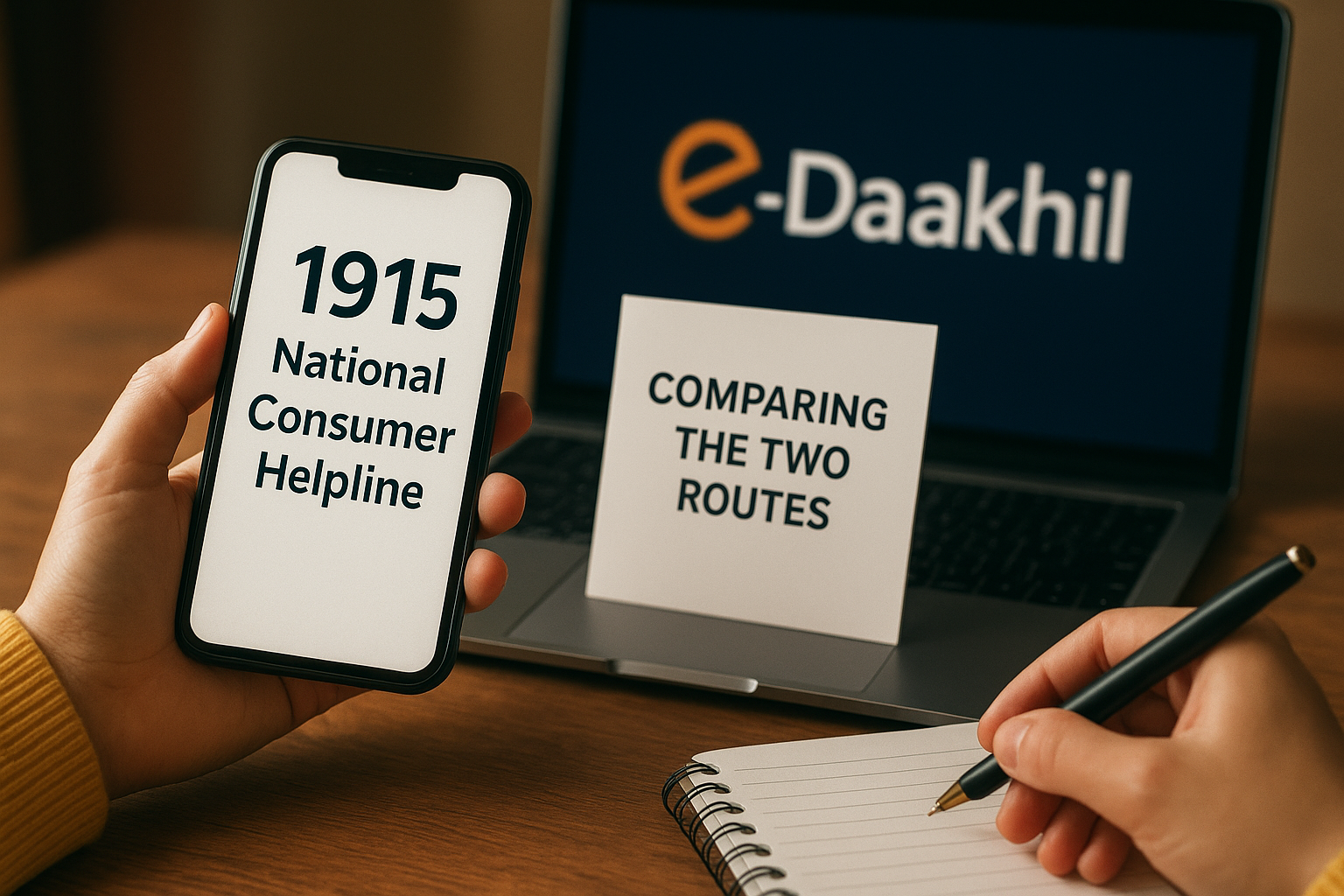
Many consumers run both in sequence, starting with the helpline and moving to e-Daakhil only if the company does not respond within the follow-up window. Nothing in the Consumer Protection Act, 2019 stops you from filing on e-Daakhil directly, so skip the helpline entirely if you already know the business has no intention of settling. Whichever path you pick, the next step is the same: confirming which commission has jurisdiction and getting your complaint drafted correctly the first time.
Step 3. Determine jurisdiction and draft your complaint
Jurisdiction decides whether a commission even looks at your case, so nail this before you touch the drafting fields. Filing a consumer complaint online in the wrong commission means a defect memo, a re-filing, and weeks added to your timeline for no reason.
Confirm territorial jurisdiction first
Section 34(2) of the Consumer Protection Act, 2019 gives you three valid locations to file: where the opposite party resides or carries on business, where the cause of action arose, or where you, the complainant, reside or work for gain. That last option is new compared to the 1986 Act, and it matters if you bought a product online from a seller based in another state. Verify the pecuniary jurisdiction table from earlier against your total claim, since combining the wrong forum with the wrong location gives the opposing party two separate grounds to object.
Match your commission on both money and location, or the registry sends your file back before anyone reads the facts.
Structure your complaint the way the commission expects
Draft your complaint in plain language, using the same drafting discipline courts expect from pleadings, but include every section a judge looks for on the first read. e-Daakhil provides fillable fields for most of this, though a clean draft prepared beforehand saves you from losing text if the session times out. Cover these elements in order:
- Cause title: names and addresses of complainant and opposite party
- Facts of the case: a chronological account of the purchase, defect, and your attempts at direct resolution
- Cause of action: the date the deficiency or defect occurred, tied to your two-year limitation window under Section 69
- Relief sought: refund, replacement, compensation for mental agony, or litigation costs, stated as specific amounts
- Verification: a signed statement affirming the facts are true to your knowledge
Keep the facts section factual, not emotional. Commissions respond to a clear sequence of dates and documents far better than to grievance written in frustration.
Use AI tools to tighten the draft
Research tools like LeXi AI's LiTT module can pull relevant consumer protection precedents with citations and flag weak phrasing in your relief section before you submit, which matters since a poorly worded prayer clause often gets challenged even when the underlying facts are solid. Once your draft reads clean and cites the correct sections, you are ready to attach documents and pay the fee.
Step 4. Upload documents and pay the filing fee
With your draft complaint finalized, the e-Daakhil portal moves you to the document upload screen, where format restrictions trip up more filers than the drafting itself does. Scanned copies must be clear, correctly oriented, and under the size limit the portal specifies, usually 10 MB per file in PDF format. Rejecting a blurry scan or a photo taken sideways costs you a resubmission cycle, so check every file before you click upload rather than after the registry flags it.
Format your documents before you upload
Convert every document to PDF and name each file so the registry can identify it without opening it first, such as "Invoice_Complainant_Name.pdf" or "Affidavit_Signed.pdf". Bundle related evidence, like a string of email correspondence, into a single PDF instead of uploading ten separate screenshots, since the portal caps the number of attachments per complaint. Your signed affidavit and the verification statement go in as separate files from your evidence, because the system treats them as distinct document types during scrutiny.
A rejected upload costs you a resubmission cycle, so check format and file size before you click submit, not after.
Pay the filing fee based on your claim value
The filing fee scales with your claim amount, and e-Daakhil accepts payment through net banking, credit card, or debit card directly on the portal, generating a receipt you should download immediately.
| Claim Value (Consideration Paid) | Filing Fee |
|---|---|
| Up to Rs. 5 lakh | Nil (no fee) |
| Above Rs. 5 lakh up to Rs. 10 lakh | Rs. 200 |
| Above Rs. 10 lakh up to Rs. 20 lakh | Rs. 400 |
| Above Rs. 20 lakh up to Rs. 50 lakh | Rs. 500 |
| Above Rs. 50 lakh up to Rs. 1 crore | Rs. 2,000 |
| Above Rs. 1 crore up to Rs. 2 crore | Rs. 4,000 |
These slabs come from the Consumer Protection (Consumer Disputes Redressal Commissions) Rules, 2020, and claims above Rs. 2 crore fall under the National Commission's separate fee schedule. Payment failures happen occasionally due to gateway timeouts, so keep your transaction reference number handy in case you need to prove payment was attempted even if the receipt did not generate immediately.
Double-check before final submission
Review every uploaded document and the fee receipt one more time before you hit submit, because e-Daakhil does not let you edit attachments after the case number generates. Once satisfied, proceed to the confirmation screen, where the portal locks your complaint and assigns it to the appropriate commission bench for scrutiny.
Step 5. Submit, track, and attend hearings
Click submit and e-Daakhil generates a case number immediately, which becomes your reference for every interaction with the commission from this point forward. Write this number down somewhere safe, because you will need it to track status, respond to notices, and eventually check the final order. The portal also emails a confirmation to your registered address, so check your spam folder if it does not arrive within a few minutes.
Track scrutiny and admission
Registry staff review your filing within a few weeks to confirm it meets basic requirements before listing it for admission hearing. Your case status on the e-Daakhil dashboard will show as pending scrutiny, then as listed for admission, or as returned with a defect memo if something is missing or improperly formatted. A defect memo is not a rejection, it is a request to fix a specific problem, usually a missing signature or an unclear document, and you typically get a set window to refile the correction.
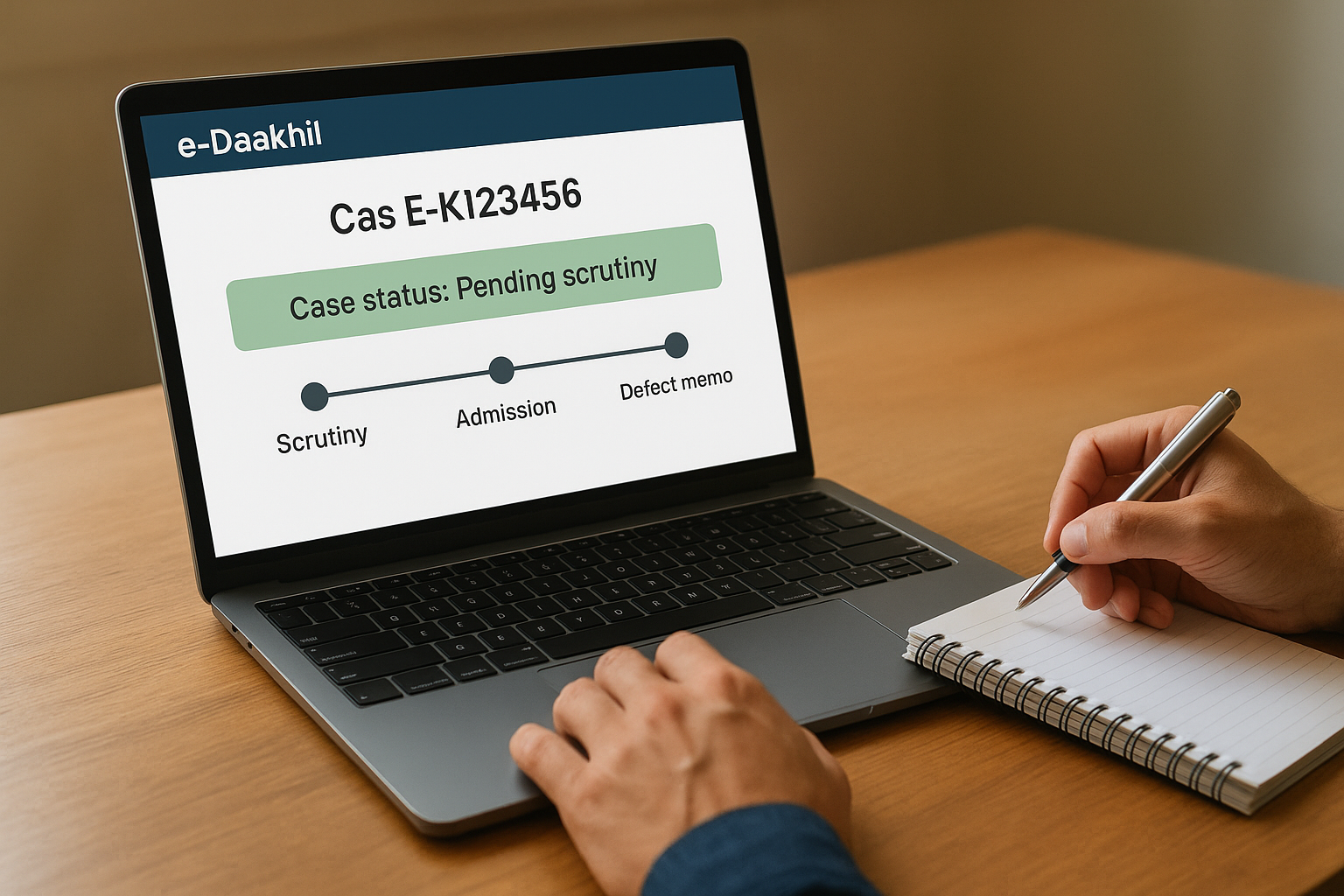
A defect memo asks you to fix one problem, not to start over, so respond within the window instead of panicking.
What happens after the notice goes out
Once the commission admits your complaint, it issues notice to the opposite party, who typically gets 30 days to file a written response, extendable to 45 days in limited circumstances under Section 38(3). Silence from the other side does not stall your case; if they fail to respond within the deadline, the commission can proceed ex parte and decide based on your evidence alone. Watch your dashboard closely during this window, since the other party's response, once filed, appears there and you may need to file a rejoinder addressing their arguments.
Attending hearings
Many district and state commissions now conduct hearings over video conferencing, and e-Daakhil sends hearing notifications with the date, time, and link directly to your registered email. Prepare a short oral summary of your case beforehand, referencing your written complaint by paragraph number so the bench can follow along without flipping through the entire file. Bring your original documents even for a virtual hearing, since the commission occasionally asks to verify a scanned copy against the original.
Getting your order and enforcing it
Once arguments close, the commission passes its order, which appears on your dashboard along with a downloadable copy. If the opposite party does not comply voluntarily, Section 71 lets you file an execution application before the same commission to enforce the order, including attachment of property if necessary.
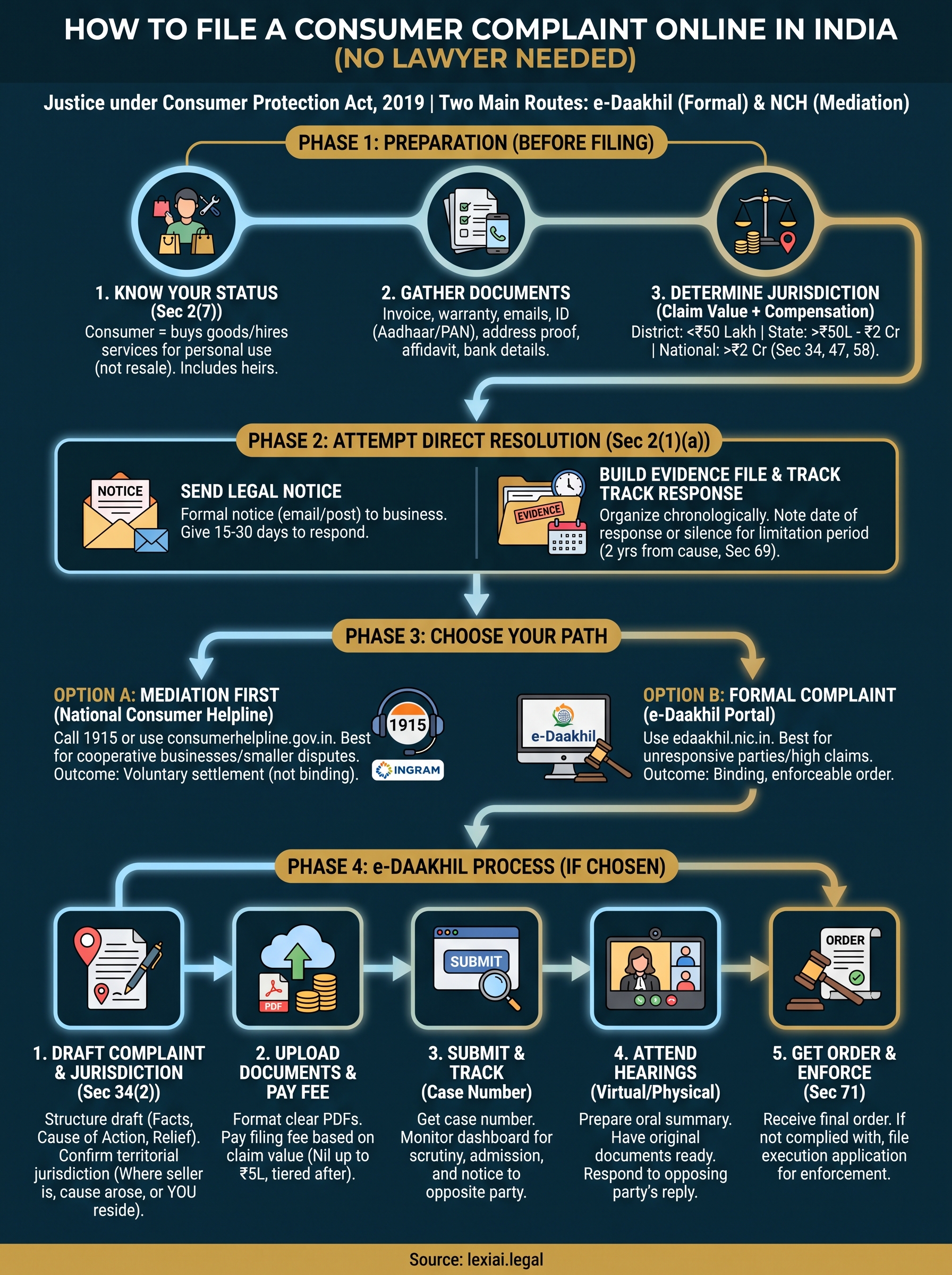
Getting Your Grievance Heard
Filing a consumer complaint online no longer requires a lawyer, a filing clerk, or a trip to a district courthouse. Preparation decides whether your case moves smoothly or stalls at scrutiny: know your claim value, gather your documents, attempt direct resolution, and pick the right forum before you touch the e-Daakhil form. Every step after that, from uploading PDFs to attending a video hearing, is mechanical once the groundwork is solid.
What separates a strong complaint from a weak one is not the portal, it is the drafting. A clear cause of action, precise relief sought, and evidence organized by date carries more weight with a bench than any amount of grievance in your tone. If you want help sharpening that draft, checking precedent, or calculating your claim correctly before you submit, run your consumer complaint through LeXi AI at no cost and see how much faster the process moves when the paperwork writes itself.