

DPDP Rules 2025: What They Are and Compliance Steps
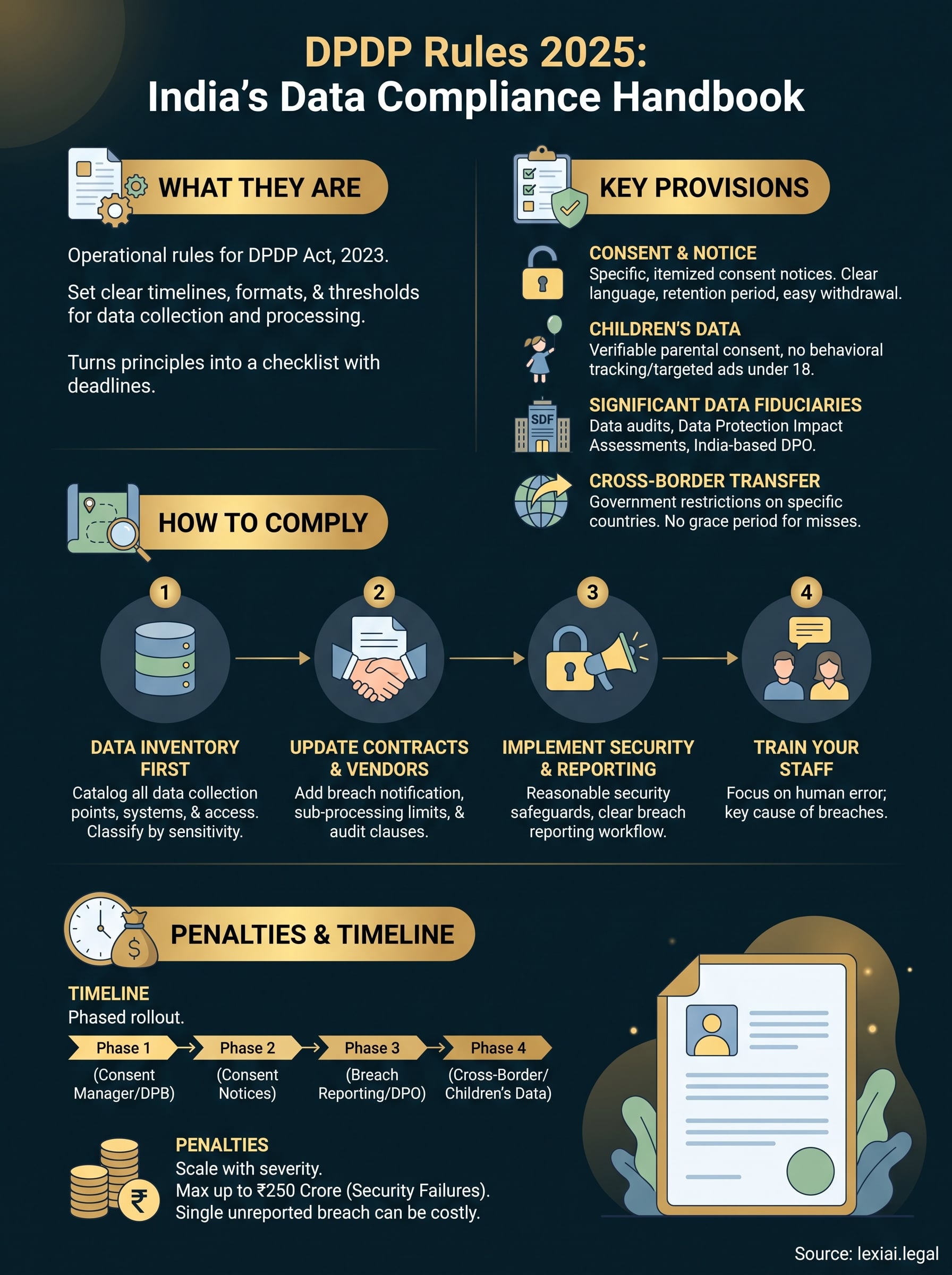
The DPDP Rules 2025 are the operational rulebook that tells you exactly how to comply with the Digital Personal Data Protection Act, 2023. The Act laid down the principles. The Rules, notified under the DPDP Act, spell out the mechanics: consent notices, breach reporting timelines, data fiduciary obligations, and how the Data Protection Board actually functions. If you are a business processing personal data of Indian users, these Rules decide what your compliance calendar looks like starting now.
Most readers searching for this topic want two things: a clear explanation of what changed, and a practical list of what to do next. This article gives you both. We break down the key provisions of the Rules, including consent manager registration, children's data safeguards, and cross border transfer conditions, then walk through the compliance steps your legal or privacy team needs to complete.
We also flag where the Rules leave room for interpretation, since litigation over ambiguous provisions is already shaping up. For lawyers advising clients on this, AI drafting tools built for Indian legal work like LeXi AI can speed up drafting compliant privacy notices and flagging clause level risk, though the judgment calls remain yours to make.
Why the DPDP Rules 2025 matter for your organization
The DPDP Act, 2023 gave India its first comprehensive data protection law, but it read more like a policy statement than an operating manual. The DPDP Rules 2025 fill that gap with actual timelines, formats, and thresholds. If your organization collects names, phone numbers, emails, or any other personal data from Indian users, whether through a website, an app, or a physical form, you are now a data fiduciary under a framework that has teeth.
What makes these Rules significant is the scope they cover. They apply to every entity that processes personal data of individuals in India, regardless of where that entity is headquartered. A SaaS company in California serving Indian customers, a fintech in Mumbai, and a hospital chain in Bengaluru all fall under the same compliance net. Cross-border data flows are addressed too, with the government retaining power to restrict transfers to specific countries through official notification, something the earlier Act only hinted at.
The DPDP Rules 2025 turn a principles-based law into a checklist with deadlines, and missing that checklist now carries a real financial cost.
Consent and notice requirements get specific
Significant portions of the Rules deal with how you obtain and record consent. Vague checkbox consent buried in a 40-page terms document will not hold up. The Rules require itemized consent notices that state, in clear language, what data you are collecting, why, and for how long you intend to retain it.
For law firms and in-house counsel, this changes how privacy notices get drafted. You need version control on consent language, timestamps on when consent was obtained, and a mechanism for users to withdraw consent as easily as they gave it. Teams using drafting tools such as LeXi Desk can generate and update these notices faster when regulatory language shifts, since manual redrafting across dozens of contracts is where most compliance timelines slip.
Children's data and Significant Data Fiduciaries face extra scrutiny
Organizations processing data of anyone under 18 face additional obligations, including verifiable parental consent and a ban on behavioral tracking or targeted advertising directed at minors. This hits edtech platforms, gaming apps, and social media services particularly hard.
Separately, entities classified as Significant Data Fiduciaries, a category based on volume and sensitivity of data processed, face heavier duties: mandatory Data Protection Impact Assessments, independent data audits, and appointment of a Data Protection Officer based in India. If your organization processes data at scale, assume you will eventually land in this category and plan your governance structure accordingly, rather than waiting for a government notification to confirm it.
How to comply with the DPDP Rules 2025
Compliance under the DPDP Rules 2025 starts with an honest audit, not a policy rewrite. Before you touch a single consent notice, you need to know exactly what personal data your organization holds, where it sits, and who has access to it. Skipping this step is the single biggest reason compliance programs stall halfway through implementation.
You cannot protect data you have not mapped, so the data inventory comes before the paperwork, not after.
Build your data inventory first
Start by cataloging every system, vendor, and department that touches personal data, from your HR software to your customer support tickets. Once that map exists, the rest of the work becomes sequential rather than chaotic.
- Identify all data collection points across websites, apps, and offline forms
- Classify data by sensitivity, including any data belonging to minors
- Determine whether you qualify as a Significant Data Fiduciary based on volume
- Draft or revise consent notices in the itemized format the Rules require
- Set up a breach detection and reporting workflow with clear internal ownership
- Appoint a Data Protection Officer if your classification requires one
Update contracts and vendor agreements
Terms hidden in old vendor contracts rarely meet the grievance redressal timelines the Rules now mandate, so those agreements need fresh clauses covering breach notification, sub-processing limits, and audit rights, and tracking contracts from drafting through renewal is what keeps those clauses from going stale again. Every third party that touches your users' data becomes an extension of your own compliance exposure, including any AI tool your team feeds documents into, where keeping client data safe inside AI tools deserves its own review, which means your procurement team needs a checklist as much as your legal team does.
Finally, train the people who actually handle data day to day, since most breaches trace back to human error rather than technical failure. Lawyers reviewing these contracts at volume often use tools that cut contract review and drafting hours such as LeXi Desk to flag indemnity and liability clauses that fall short of the new standard, cutting review time without skipping the judgment calls that still need a qualified eye.
Key deadlines in the DPDP Rules 2025 timeline
Understanding when each obligation kicks in matters as much as understanding what the obligation says. The Ministry of Electronics and Information Technology has structured the DPDP Rules 2025 as a phased rollout rather than a single effective date, which means different provisions become enforceable at different points. Missing a phase does not give you a grace period once the next one arrives.
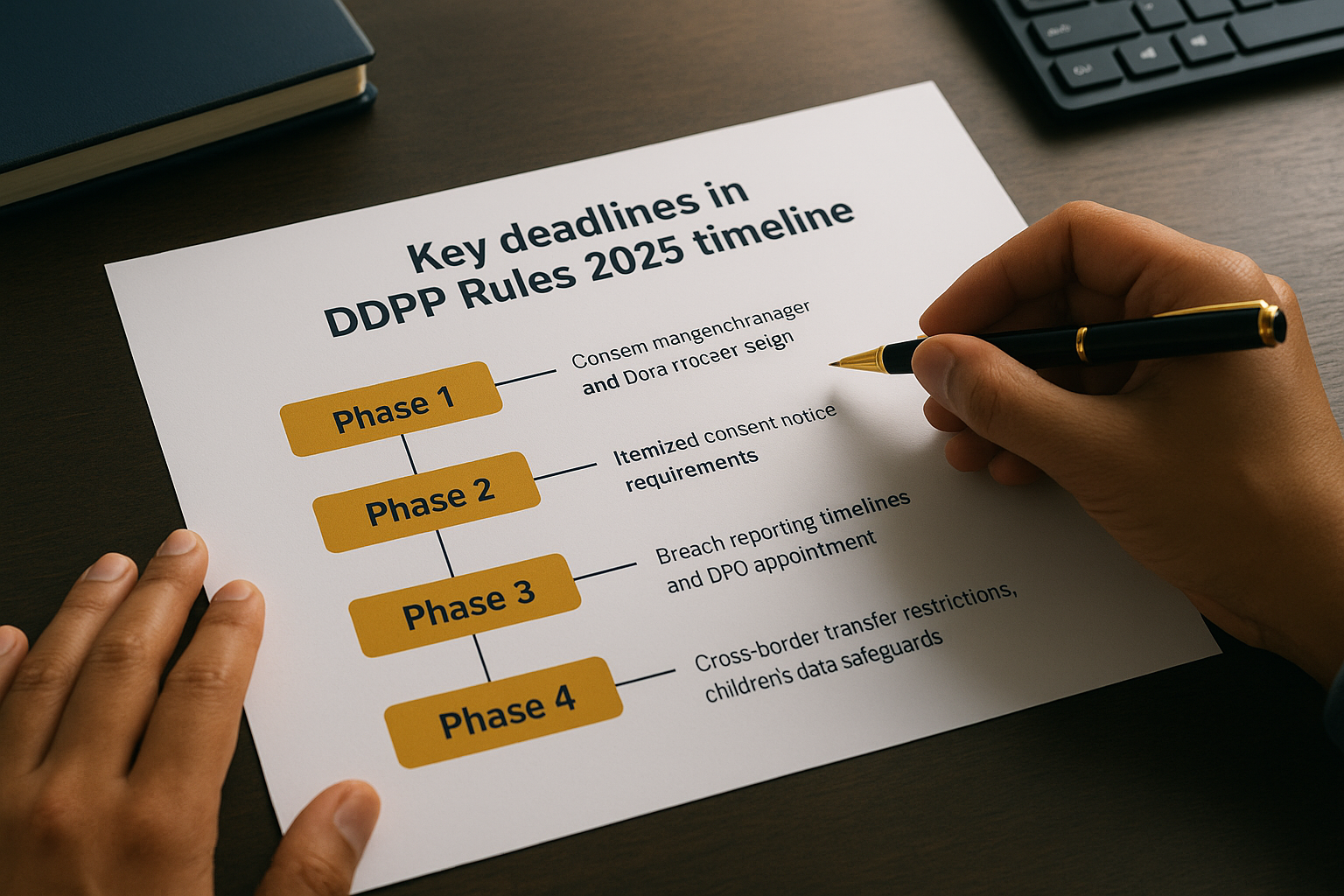
A phased timeline is not a delay, it is a series of separate deadlines, and each one carries its own exposure if you miss it.
Registration and consent manager provisions came into force first, since the government needed the infrastructure for consent management operational before enforcement could begin elsewhere. Verifiable consent, breach notification timelines, and Significant Data Fiduciary obligations follow on a staggered schedule tied to official notification dates rather than the date the Rules were first published.
| Phase | What activates | Who it affects most |
|---|---|---|
| Phase 1 | Consent Manager registration and Data Protection Board setup | Consent Manager applicants, government bodies |
| Phase 2 | Itemized consent notice requirements | All data fiduciaries facing Indian users |
| Phase 3 | Breach reporting timelines and DPO appointment | Significant Data Fiduciaries |
| Phase 4 | Cross-border transfer restrictions, children's data safeguards | Edtech, gaming, social platforms, fintechs |
Expect the government to issue further notifications specifying exact dates for later phases, since some thresholds depend on rules still being finalized for sector-specific data. Firms advising clients on litigation preparation around these deadlines should track official gazette notifications directly rather than relying on secondary summaries, because the compliance clock starts running from the notification date, not from any announcement or press briefing. Given how frequently these dates shift, building a simple internal tracker with owner names against each phase saves you from discovering a missed deadline only after a regulator's notice arrives.
Penalties for failing to comply with the DPDP Rules
Money talks under the DPDP Act, and the DPDP Rules 2025 give the Data Protection Board of India the procedural teeth to collect it. Penalties are not fixed fines pulled from a single line item. They scale based on the nature of the breach, the volume of data exposed, and whether the fiduciary took reasonable security safeguards before the incident occurred. A minor consent notice defect draws a smaller penalty than a full-blown data breach affecting millions of users.
Schedule 1 of the Act sets the outer limits, and the Rules describe how the Board investigates and adjudicates before any amount gets imposed.
| Violation type | Maximum penalty |
|---|---|
| Failure to implement reasonable security safeguards | Up to Rs 250 crore |
| Failure to notify a personal data breach | Up to Rs 200 crore |
| Non-compliance with children's data obligations | Up to Rs 200 crore |
| Failure to fulfill additional Significant Data Fiduciary duties | Up to Rs 150 crore |
| Breach of any other provision or rule | Up to Rs 50 crore |
A single unreported breach can cost more than years of compliance spending, which is exactly the incentive the Rules are designed to create.
Before any penalty lands, the Board issues a show-cause notice and gives the fiduciary a chance to respond, so the process resembles adjudication rather than a summary fine. Complainants also get a formal grievance route, meaning individuals whose data gets mishandled do not need to file a separate civil suit to trigger scrutiny. Enforcement here runs alongside, not instead of, existing consumer protection and IT Act remedies, so a single incident can expose an organization to multiple proceedings at once.
Governance failures compound the exposure further, since repeated violations or a pattern of non-compliance can influence how the Board calculates the next penalty. Organizations that treat their first notice as a wake-up call rather than a cost of doing business tend to fare far better when the Board reviews their remediation record.
Getting your compliance program ready
The DPDP Rules 2025 reward organizations that treat compliance as an ongoing discipline, not a one-time filing exercise. Data inventories go stale, vendor contracts get renewed without updated clauses, and staff turnover erodes training gains within months. Building a program that survives all three means assigning clear ownership now, before a regulator's notice forces the question.
Getting the drafting and research work done efficiently matters just as much as getting it done correctly, since legal teams rarely get extra headcount to handle new regulatory obligations. Reviewing consent notices, flagging clause-level risk in vendor agreements, and tracking phased deadlines all compete for the same limited hours your team already has.
Start by mapping your current gaps against the checklist above, then bring in tools built for the volume of work ahead. If you want to see how LeXi AI handles contract review and compliance drafting at scale, test LeXi AI free on your own compliance documents before your next deadline arrives.