

What Is BNS Section 85? Cruelty, Punishment and 498A
BNS Section 85 makes it a criminal offense for a husband, or a relative of the husband, to subject a woman to cruelty. The punishment is imprisonment for up to three years and a fine. It is the successor of Section 498A of the Indian Penal Code and applies to acts committed on or after 1 July 2024, when the Bharatiya Nyaya Sanhita, 2023 came into force.
The section has to be read with Section 86, which defines cruelty, and with the case law that grew around 498A. That case law still shapes how courts treat these complaints, so the old judgments remain useful under the new numbers.
This article covers the text and punishment, how Section 85 replaces IPC 498A, how to apply it to a set of facts, and what the Supreme Court has said recently. LeXi AI builds legal research tools around Indian statutes and judgments, so the guide is written for lawyers and students who need the correct citation and the current position in one place.
What does BNS Section 85 say, and why does it matter?
BNS Section 85 punishes a husband or a husband's relative who subjects a woman to cruelty, with imprisonment of up to three years and a fine. It matters because it is the main criminal remedy for cruelty inside a marriage, and it works alongside dowry laws and the Protection of Women from Domestic Violence Act, 2005.
The text and the punishment
The operative text says that whoever, being the husband or the relative of the husband of a woman, subjects such woman to cruelty shall be punished with imprisonment for a term which may extend to three years and shall also be liable to fine. The section sits in Chapter V of the Sanhita, which deals with offenses against women and children. The word cruelty is defined separately in Section 86.
| Feature | Position under Section 85 |
|---|---|
| Offense | Cruelty to a woman by her husband or his relative |
| Punishment | Imprisonment up to three years, and fine |
| Cognizable | Yes |
| Bailable | No |
| Triable by | Magistrate of the first class |
Section 85 creates the offense, and Section 86 tells you what counts as cruelty.
Who can be charged and who is protected
Only a woman can be the victim, and only a husband or a husband's relative can be the accused. The Sanhita does not define "relative". In U. Suvetha v. State by Inspector of Police (2009), the Supreme Court held that a woman with whom the husband had a relationship is not a relative for this offense. That reading carries over because the wording has not changed.
Complaints under this section usually travel with other charges. Dowry demands can attract Sections 3 and 4 of the Dowry Prohibition Act, 1961. A death within seven years of marriage may engage Section 80 BNS (dowry death), and a suicide may engage Section 108 (abetment of suicide).
How does BNS Section 85 replace IPC 498A?
BNS Section 85 carries forward IPC 498A with the same offender, the same victim, and the same punishment. The real change is structural. The Explanation that once defined cruelty under 498A is now a separate provision, Section 86.
What stayed the same and what moved
The table below gives a section-wise IPC and BNS comparison of the two provisions.
| Point | IPC 498A | BNS Sections 85 and 86 |
|---|---|---|
| Accused | Husband or relative of husband | Same |
| Victim | Woman | Same |
| Punishment | Up to three years and fine | Same |
| Classification | Cognizable, non-bailable | Same |
| Definition of cruelty | Explanation to 498A | Section 86 |
| Acts covered | Before 1 July 2024 | On or after 1 July 2024 |
Because the wording is the same, precedent on 498A remains the working guide to Section 85. A judgment that interprets "cruelty" or "relative" under the old section is still a safe authority, as long as you cite the new provision for post-July 2024 conduct.
The substance of 498A survives intact, so the old case law still carries over under the new numbers.
Which provision applies to your matter
The deciding factor is the date of the act. For conduct before 1 July 2024, IPC 498A applies, and the repeal and savings clause in Section 358 of the BNS preserves the old position. For conduct on or after that date, cite Sections 85 and 86.
Procedure follows a different clock. Proceedings that begin on or after 1 July 2024 run under the BNSS, not the CrPC. Where cruelty continued across the cut-off date, plead each act separately and cite the provision that matches its date.
How to apply BNS Section 85 to a real case
To apply BNS Section 85, test the facts against Section 86, confirm the relationship, and then check procedure. A complaint stands or falls on specific, dated acts, not on the label of cruelty.
Test the facts against Section 86
Section 86 recognizes two kinds of cruelty. Match every alleged act to one of them.
- Section 86(a): willful conduct likely to drive the woman to commit suicide, or to cause grave injury or danger to her life, limb, or health, whether mental or physical.
- Section 86(b): harassment meant to coerce her or anyone related to her into meeting an unlawful demand for property or valuable security, or harassment because that demand was not met.
A sound pleading names the act, the date, the place, and the person who did it. Vague claims against every in-law invite quashing. In Dara Lakshmi Narayana v. State of Telangana (2024), the Supreme Court cautioned against general and omnibus allegations that pull the husband's whole family into a case.
A Section 85 complaint stands or falls on specific, dated acts that fit Section 86.
Handle jurisdiction, limitation, and arrest
Jurisdiction can lie where the wife took shelter after leaving the matrimonial home. Rupali Devi v. State of Uttar Pradesh (2019) so held, because mental cruelty continues to affect her there. Limitation is three years for an offense punishable by up to three years, under Section 514 of the BNSS. Cruelty can be a continuing offense, so the pleaded dates matter.
Arrest is not automatic. Arnesh Kumar v. State of Bihar (2014) directed police to be satisfied that arrest is necessary and to issue a notice of appearance where it is not. That notice is now governed by Section 35 of the BNSS, earlier Section 41A of the CrPC.
Researching these points across judgments is where verified judgment search saves time. A tool such as LeXi AI can pull the cases quickly, but you must still read the final order before citing it.
What are the recent legal developments on Section 85?
The recent developments center on misuse concerns, the Supreme Court's 2025 order on family welfare committees, and a 2026 ruling that brings some live-in relationships within Section 85. The table traces how the position moved.

Family welfare committees and misuse concerns
| Year | Decision or event | Effect |
|---|---|---|
| 2017 | Rajesh Sharma v. State of UP | Supreme Court directed family welfare committees for 498A complaints |
| 2018 | Social Action Forum for Manav Adhikar v. Union of India | Supreme Court set aside the committee directions |
| 2022 | Mukesh Bansal v. State of UP | Allahabad High Court issued guidelines with a two-month cooling period |
| 2024 | BNS comes into force | Sections 85 and 86 replace 498A |
| 2024 | Dara Lakshmi Narayana v. State of Telangana | Court warned against omnibus allegations |
| 2025 | Shivangi Bansal v. Sahib Bansal | Allahabad guidelines left in effect |
| 2026 | X v. State of Karnataka | Section 85 extended to certain live-in relationships |
In Shivangi Bansal (July 2025), a bench of Chief Justice B.R. Gavai and Justice A.G. Masih said the Allahabad guidelines shall remain in effect. Those guidelines bar arrest or police action for two months after the complaint, while a Family Welfare Committee tries to settle the matter. They apply to 498A cases with other offenses punishable by less than ten years, and they exclude Section 307 cases involving injury.
These guidelines come from one High Court. Check what the court in your own state actually follows before you advise a client.
Live-in relationships and the 2026 ruling
In X v. State of Karnataka (2026), the Supreme Court held that Section 85 can extend to a woman in a live-in relationship in the nature of marriage. It adopted a purposive reading. A man cannot escape liability by arguing that the marriage was void, voidable, or never solemnized.
The protection is not open to every live-in couple. The relationship must show intent to marry, long-term cohabitation, and a shared domestic life. The Domestic Violence Act, 2005 still gives civil relief, but the ruling confirms that it does not replace criminal prosecution.
The court looks at the substance of the relationship, not only at the marriage certificate.
What to remember about Section 85
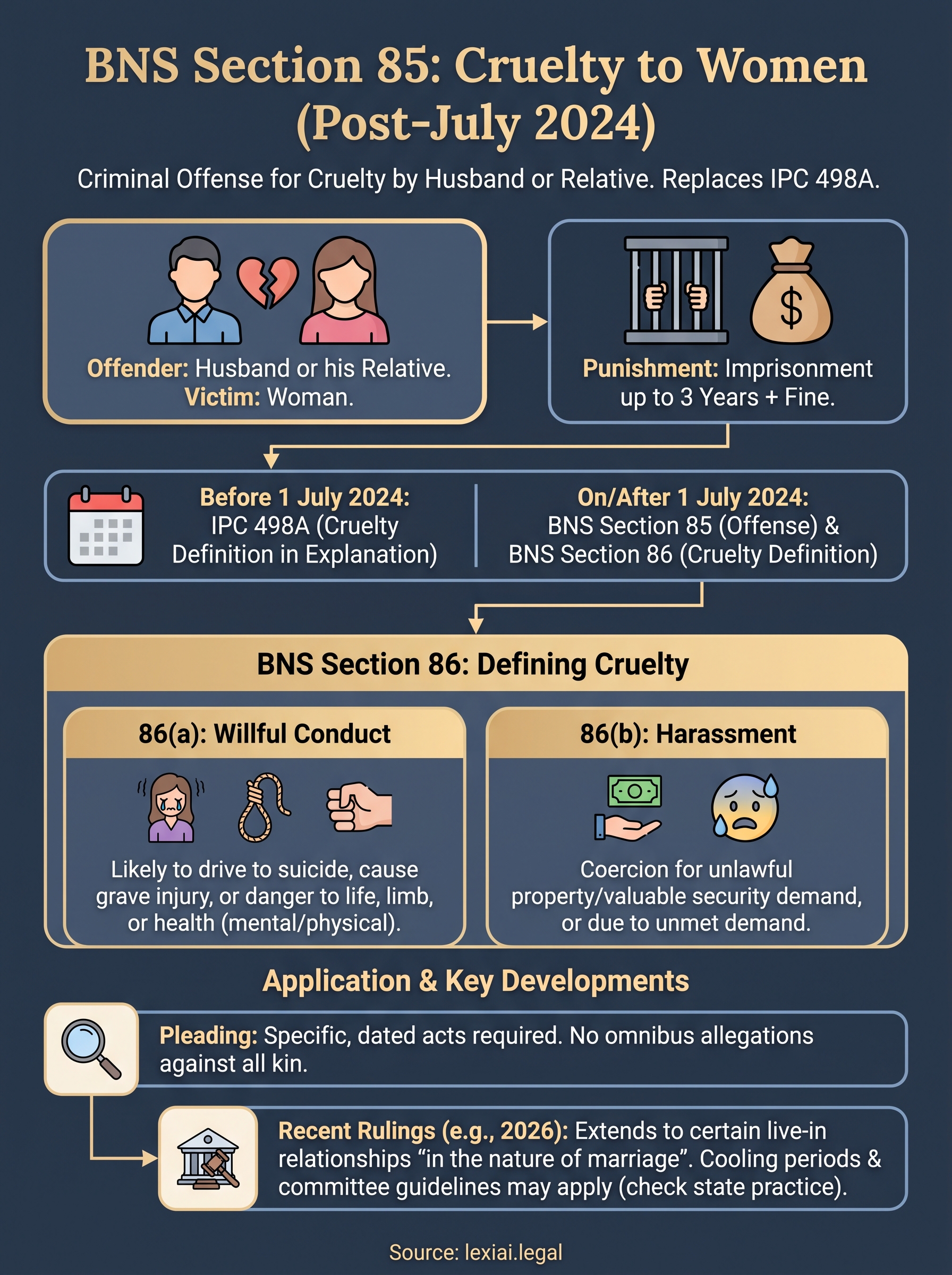
BNS Section 85 punishes cruelty to a woman by her husband or his relatives with up to three years of imprisonment and a fine. It repeats IPC 498A in substance, while Section 86 now holds the definition of cruelty. The date of the act decides which provision you cite.
Strong pleadings name specific acts that fit Section 86. Recent rulings stress caution on omnibus allegations, while also widening protection to genuine marriage-like relationships.
If you draft, research, or study these provisions regularly, you can try a free LeXi AI trial to search judgments with verified sources and prepare your next matter faster.