

How to Draft a Bail Application Format for Indian Courts
A bail application format has seven parts: the court heading and cause title, the applicant details, the provision under which you apply, the brief facts, the grounds, the undertakings, and the prayer. Choose the right section for your bail type, fill each part from the FIR and the remand papers, annex the supporting documents, and file before the court that has jurisdiction. The template in this guide follows that order.
The problem is that most formats online are old. They cite the Code of Criminal Procedure, 1973, which the Bharatiya Nagarik Suraksha Sanhita, 2023 replaced on 1 July 2024. They also repeat the same line about the applicant being innocent and falsely implicated, which tells the court nothing about this particular accused.
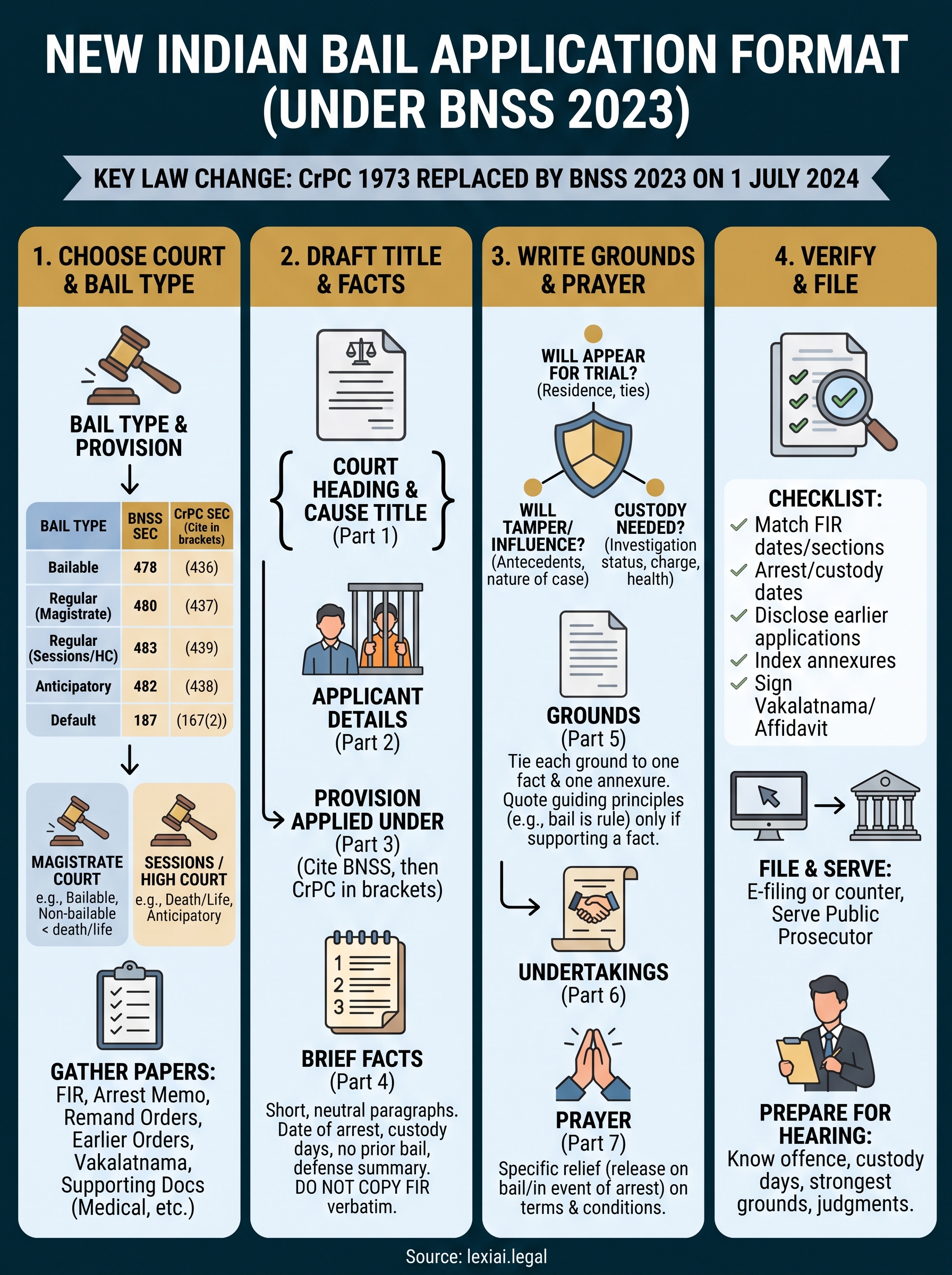
This guide takes you through four steps: choosing the court and gathering papers, drafting the cause title and facts, writing the grounds and prayer, and verifying and filing. It is written for advocates and law students by the team at LeXi AI, which builds drafting tools for Indian litigation. Use the template as a starting point and adapt every line to your record.
Which bail application format fits your case?
The format depends on the bail type, because each type has its own section, heading and prayer. Regular bail follows an arrest. Anticipatory bail is sought before arrest. Default bail arises when the police do not complete the investigation within the statutory period. Pick the type first, and the rest of the draft follows.
Match the bail type to the section
The table maps each bail type to its provision under the BNSS and the CrPC provision it replaced. Use it to fix the heading of your application.
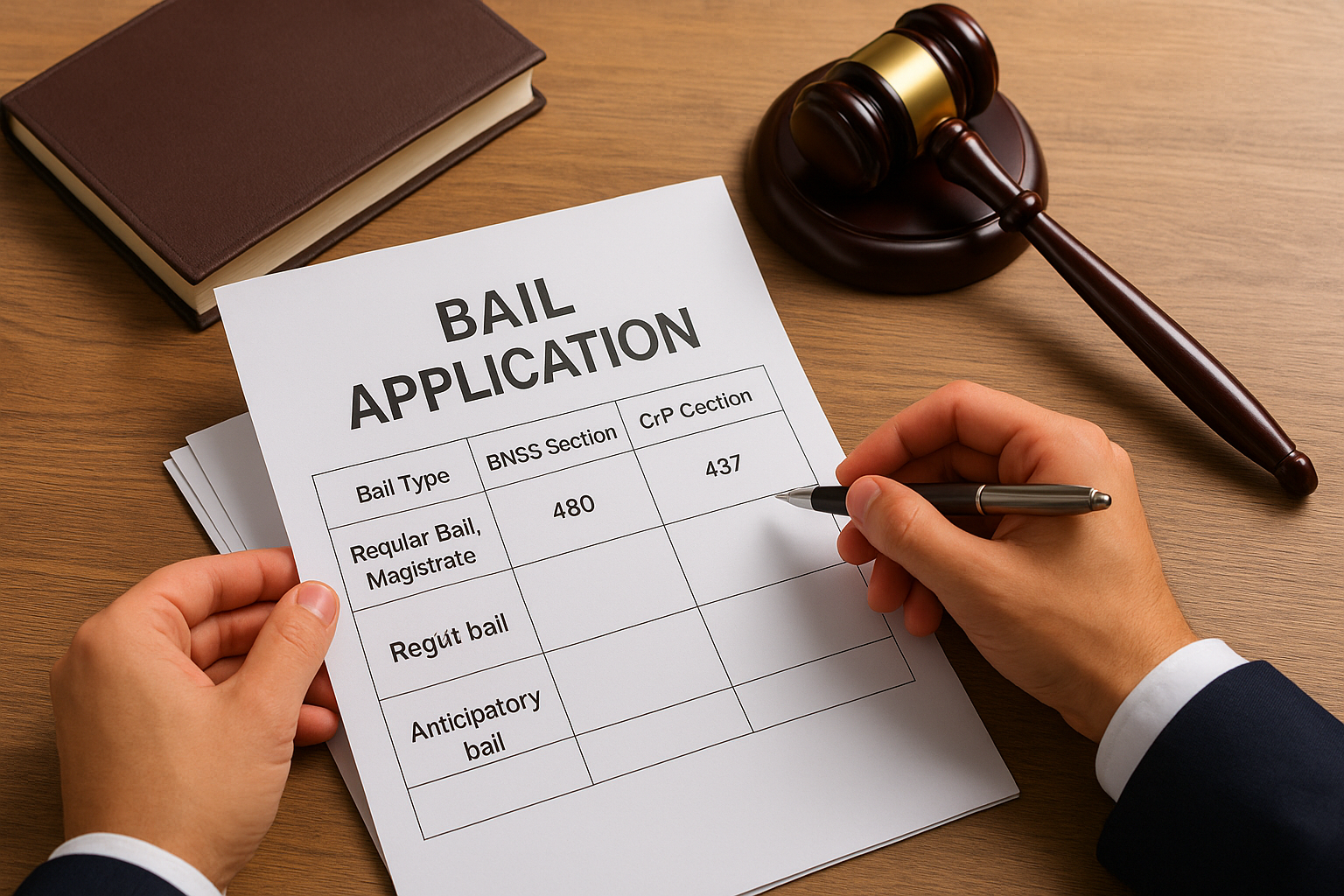
| Bail type | BNSS section | CrPC section | When it applies |
|---|---|---|---|
| Bail in a bailable offence | 478 | 436 | Arrest for a bailable offence, bail is a matter of right |
| Regular bail, Magistrate | 480 | 437 | Arrest for a non-bailable offence, Magistrate has power |
| Regular bail, Sessions Court or High Court | 483 | 439 | Arrest, and the Magistrate refused or has no power |
| Anticipatory bail | 482 | 438 | Apprehended arrest for a non-bailable offence |
| Default bail | 187 | 167(2) | No chargesheet within 60 or 90 days of remand |
| Bail after long detention | 479 | 436A | Undertrial has served half the maximum sentence, one-third for a first-time offender |
Most readers need one of the first four rows. The anticipatory bail format differs mainly in the facts section, and the default bail format differs mainly in its grounds. Step 3 shows exactly which lines to change.
Fix the bail type first, because the heading, the grounds and the prayer all depend on it.
Cite the BNSS section and keep the CrPC equivalent in brackets
The Bharatiya Nagarik Suraksha Sanhita, 2023 replaced the Code of Criminal Procedure, 1973 on 1 July 2024. For an FIR registered on or after that date, cite the BNSS for procedure and the Bharatiya Nyaya Sanhita, 2023 for the offences. A format that cites only Section 437 or 439 CrPC will look outdated to the court.
Where the FIR is older, Section 531 of the BNSS saves pending investigations and proceedings under the earlier law. Check which Act the court is applying in your matter. The safe practice is to cite the BNSS section and add the CrPC section in brackets, as in "Section 483 BNSS (Section 439 CrPC)". Do the same for offences, for example Section 318 BNS (Section 420 IPC).
Step 1. Choose the court and gather the case papers
File before the court that can grant the bail you need, and collect the case papers before you start drafting. A Magistrate can hear most bail matters, but the Sessions Court is the forum when the offence carries death or life imprisonment.
Choose the court by bail type
Section 480 BNSS (Section 437 CrPC) limits the Magistrate. In an offence punishable with death or life imprisonment, a Magistrate cannot grant bail where there are reasonable grounds to believe the accused is guilty, except for a person under sixteen, a woman, or a sick or infirm person. The Sessions Court and the High Court have wider powers under Section 483 BNSS (Section 439 CrPC).
- Bailable offence: the officer in charge of the police station or the Magistrate, under Section 478.
- Non-bailable offence not punishable with death or life imprisonment: the Magistrate under Section 480, or the Sessions Court under Section 483.
- Offence punishable with death or life imprisonment: the Sessions Court under Section 483.
- Anticipatory bail: the Sessions Court or the High Court under Section 482.
- After the Sessions Court refuses bail: the High Court under Section 483.
Both superior courts have concurrent powers, but the usual practice is to approach the Sessions Court first. A High Court may ask why you skipped the lower court.
Gather these papers before drafting
- The FIR, and the chargesheet if it has been filed
- The arrest memo and the grounds of arrest
- Remand orders that show the custody dates
- Earlier bail orders, including any rejection
- A vakalatnama and the applicant's identity and address proof
- Documents behind your grounds, such as medical records, employment proof and proof of family dependence
- For default bail, the first remand date and proof that no chargesheet is on record
Collect these first because the facts section and the grounds can only state what the record supports. A date that you cannot back with a paper should stay out of the draft. Gaps in the papers also tell you what to ask the family or the investigating officer for.
A fact you cannot annex is a fact you should not plead.
Step 2. Draft the cause title and brief facts
Begin with the court heading, the case particulars and the applicant's details, then state the brief facts in numbered paragraphs. The template below covers this opening part of any bail application format. Replace each bracket with details from the FIR and the remand papers.
Start with the heading and parties
IN THE COURT OF [Name of Magistrate / Sessions Judge], [District, State]

Bail Application No. [____] of [Year]

IN THE MATTER OF:

[Name of accused], [S/o, D/o or W/o Name], aged [__] years,
R/o [Full address]                                  ...APPLICANT / ACCUSED

VERSUS

State of [State], through [Public Prosecutor / Station House Officer]
                                                    ...RESPONDENT

FIR No. [____] dated [DD/MM/YYYY]
Police Station: [Name]
Offences: Sections [___] of the Bharatiya Nyaya Sanhita, 2023
([Corresponding IPC sections, if the FIR is older])

APPLICATION UNDER SECTION [483 / 480 / 478 / 482] OF THE BHARATIYA NAGARIK
SURAKSHA SANHITA, 2023 ([Section 439 / 437 / 436 / 438] OF THE CODE OF
CRIMINAL PROCEDURE, 1973) FOR GRANT OF [REGULAR / ANTICIPATORY] BAIL
ON BEHALF OF THE APPLICANT

MOST RESPECTFULLY SHOWETH:

1. That the applicant was arrested on [date] in FIR No. [____] registered at
   Police Station [Name] on the allegation that [two-line neutral summary].
2. That the applicant has been in [police / judicial] custody since [date],
   that is, for [__] days. [The chargesheet was filed on [date] / The
   chargesheet has not been filed.]
3. That the applicant has [not filed any earlier bail application / filed an
   earlier application, which was rejected by [court] on [date]]. No other
   bail application is pending before any court in this case.
4. That the case of the prosecution, in brief, is [short summary of the
   allegation and the role attributed to the applicant].
5. That the applicant's position is [short statement of the defence, delay in
   the FIR, civil dispute, or absence of role, with dates].
Delete the bracketed alternatives that do not apply. Number every paragraph from the start, because the grounds in Step 3 continue the same numbering and the court can then refer to paragraph 9 without confusion.
State the brief facts without copying the FIR
Keep the facts paragraphs short and neutral. Give the date of the alleged incident, the allegation in two lines, the date of arrest and the days in custody. Do not copy the FIR page after page.
Use this part to frame the case. If the FIR was lodged after a delay, the complaint is vague, or a civil dispute sits behind it, say so with dates. Also disclose any earlier bail application and its result. Concealing an earlier rejection damages your credibility and can lead the court to dismiss the new application.
Disclose every earlier bail application, because concealment costs more than the rejection itself.
Step 3. Write the grounds and the prayer
The grounds should answer the three questions a court asks before granting bail: will the accused appear for trial, will the accused tamper with evidence or influence witnesses, and is further detention needed for the investigation. Tie each ground to one fact and one annexure. Then close with a short prayer.
Build the grounds around the court's concerns
The Supreme Court stated the guiding principle in State of Rajasthan v. Balchand, (1977) 4 SCC 308, that bail is the rule and jail the exception. In Sanjay Chandra v. CBI, (2012) 1 SCC 40, it held that pre-trial detention must not become punishment. Quote these only where they support a fact in your case. Continue the numbering from the facts section.
GROUNDS

6. That the applicant is a permanent resident of [place], residing at the
   given address since [year], and there is no likelihood of absconding.
   Proof of residence is annexed as Annexure A-[__].
7. That the applicant has no criminal antecedents. [Or: The only other case,
   [details], ended in acquittal / is unrelated in nature.]
8. That the investigation is complete as regards the applicant. [Recovery, if
   any, has been made / The chargesheet was filed on [date] / Custodial
   interrogation is not required.] No purpose is served by further detention.
9. That the offence alleged is punishable with imprisonment of up to [__]
   years, and the applicant has been in custody for [__] days.
10. That the applicant is the [sole earning member / primary caregiver] of
    [family details], as shown in Annexure A-[__].
11. That the applicant undertakes to attend every hearing, to cooperate with
    the investigation, not to tamper with evidence or influence any witness,
    and not to leave India without the permission of the Court.
12. That the applicant is ready to furnish a personal bond and sureties to
    the satisfaction of the Court.

PRAYER

It is therefore most respectfully prayed that this Hon'ble Court may be
pleased to:
(a) release the applicant on bail in FIR No. [____], Police Station [Name],
    on such terms and conditions as the Court deems fit; and
(b) pass any other order that the Court deems fit in the interest of justice.

Place: [____]                                           APPLICANT
Date: [____]
                                                        Through
                                                        [Advocate name,
                                                        enrollment number,
                                                        address, phone, email]
For offences punishable with up to seven years, add a ground citing Arnesh Kumar v. State of Bihar, (2014) 8 SCC 273, and Satender Kumar Antil v. CBI, (2022) 10 SCC 51. Both discourage arrest and continued detention as a routine step.
Replace generic denials with record-based grounds
A line such as "the applicant is innocent and has been falsely implicated" adds nothing at the bail stage, because the court does not weigh the evidence in detail. State what is on record instead: the delay in the FIR, the absence of any recovery from the applicant, or the medical condition shown in a certificate. Each point should connect to an annexure.
Keep the grounds to what the court needs. Ten specific paragraphs persuade more than thirty boilerplate ones, and a judge reading a long list of repeated assertions tends to skim past the one fact that matters.
Every ground should point to one fact and one annexure.
Adjust the format for other bail types
- Anticipatory bail, Section 482 BNSS (Section 438 CrPC): Replace the custody paragraphs with the apprehension of arrest. State the FIR or complaint, why arrest for a non-bailable offence is feared, and any notice received under Section 35 BNSS (Section 41A CrPC). Add an undertaking to join the investigation. Word the prayer as release on bail "in the event of arrest" on a personal bond and sureties. A fixed time limit is not required as a rule, as held in Sushila Aggarwal v. State (NCT of Delhi), (2020) 5 SCC 1.
- Default bail, Section 187 BNSS (Section 167(2) CrPC): State the first remand date and that the period of 60 days, or 90 days where the offence is punishable with death, life imprisonment or imprisonment of ten years or more, ended on [date] without a chargesheet. State that the applicant is ready to furnish bail. The right is treated as indefeasible in Uday Mohanlal Acharya v. State of Maharashtra, (2001) 5 SCC 453, and Rakesh Kumar Paul v. State of Assam, (2017) 15 SCC 67. It must be claimed before the chargesheet is filed, so apply on the day the period ends.
- Bailable offence, Section 478 BNSS (Section 436 CrPC): Keep it short. State that the offence is bailable, give the date of arrest and offer to furnish a bond. Bail is a matter of right.
Step 4. Verify, annex and file the application
Check every date, section and name against the FIR, annex the documents in order, and file with an affidavit if the court requires one. Most rejections on technical grounds come from mismatches that a ten-minute check would have caught.
Run this checklist before filing
- The FIR number, date and police station match the FIR exactly.
- The BNS and IPC sections match the FIR, and the bail section matches the court and bail type.
- The arrest and custody dates match the arrest memo and remand orders.
- Every earlier bail application and its result is disclosed.
- Each annexure is marked, indexed and referred to in the grounds.
- The vakalatnama is signed, and the affidavit is attached where local rules require it.
- The name of the court and the case number are correct on every page.
Treat the checklist as a final read-through of the cause title and the dates, which are the two places where errors cost the most. A wrong FIR number can delay listing, and a wrong custody date can weaken a ground that depends on the length of detention.
Read the draft once against the FIR, line by line, before it reaches the filing counter.
File, serve the prosecutor and prepare for the hearing
File through the filing counter or the e-filing portal of the court, following its local rules, and give a copy to the Public Prosecutor so the application can be listed with notice. Courts commonly seek a status report or the case diary from the investigating officer before deciding. Be ready for that, and keep your own papers in the same order as the annexures.
Prepare a one-page note for the hearing with the offence, the days in custody, the three strongest grounds and the judgments you rely on. If you use a drafting tool such as LeXi LiTT, which is built around the BNSS, or LeXi Agent for judgment search across the Supreme Court and the High Courts, treat its output as a first draft. Verify every citation against the reported judgment before you cite it. This guide is general information, and each application must be adapted to its record and the rules of the court where it is filed.
Draft with the facts, then file
A good bail application is short, accurate and tied to the record. Choose the bail type and section first, cite the BNSS with the CrPC equivalent in brackets, state the facts neutrally, and write grounds that answer the court's concerns about appearance, tampering and need for custody. Then check every date and annexure before filing.
The templates above give you the structure. The facts and the annexures must come from your case file. If you want to test a first draft against your own case facts, you can test LeXi AI free on your next bail application and compare the output with your own drafting.