

Writ Petition Format: How to Draft Under Article 226 or 32
The standard writ petition format runs in a fixed order: cause title, index, synopsis and list of dates, memo of parties, the petition with facts, grounds, and prayer, a supporting affidavit, annexures, and a vakalatnama. The same structure works for a petition under Article 226 before a High Court and under Article 32 before the Supreme Court. Only the court heading, the jurisdiction line, and a few filing rules change.
Most drafts fail on structure, not on law. Facts get mixed with arguments, the prayer asks for relief that a writ court cannot grant, or the petition lands in the wrong forum. The registry then returns it with objections. Delay of even a few weeks can hurt, because courts expect a writ to be filed within a reasonable time.
This guide takes you through the drafting in five steps, with copy-ready templates for the cause title, grounds, prayer, and affidavit. At LeXi AI, we build drafting and research tools for Indian lawyers, so the steps follow the way a working advocate prepares a petition. Read the first section before you open a blank document, because the forum you choose decides everything that follows.
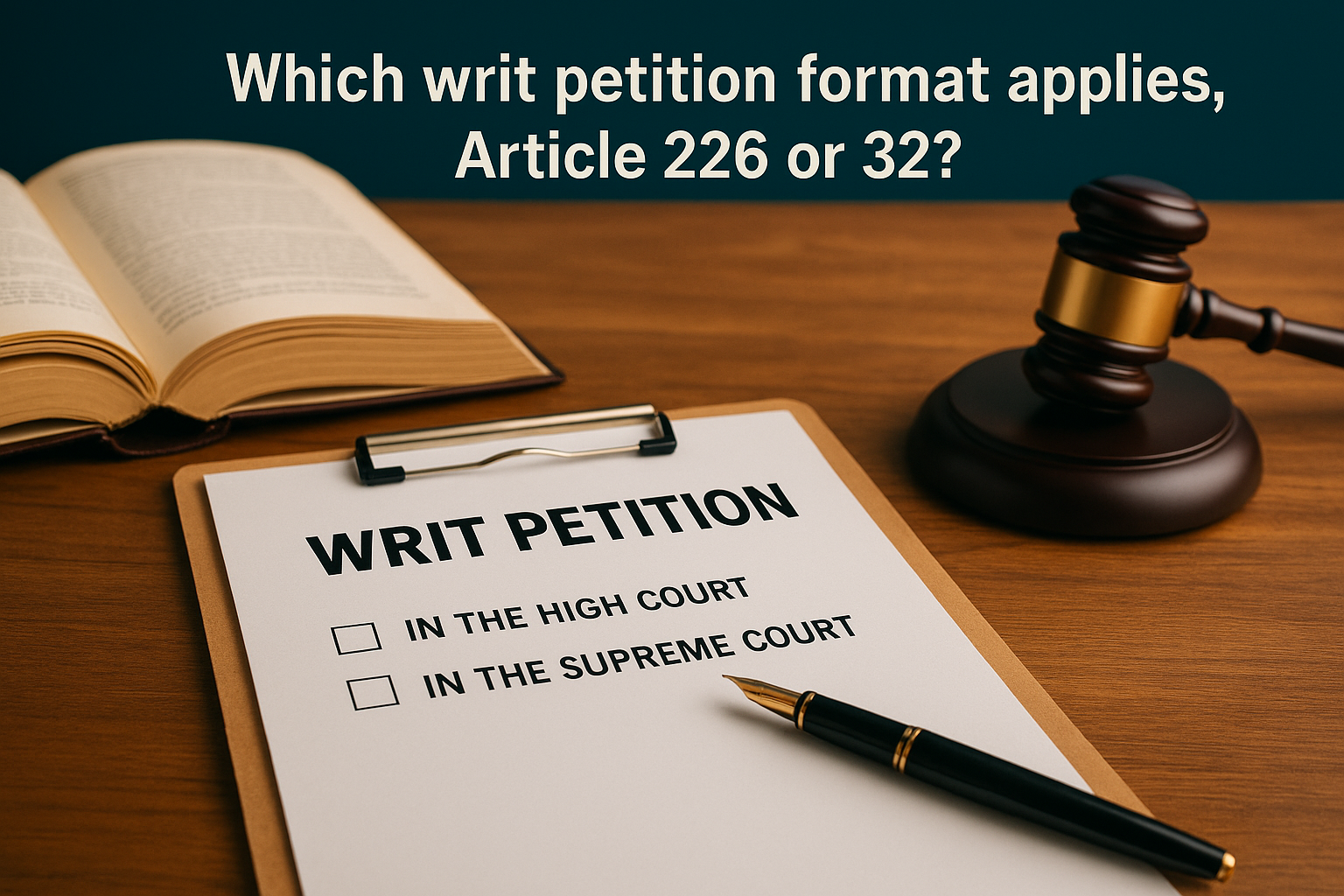
Which writ petition format applies, Article 226 or 32?
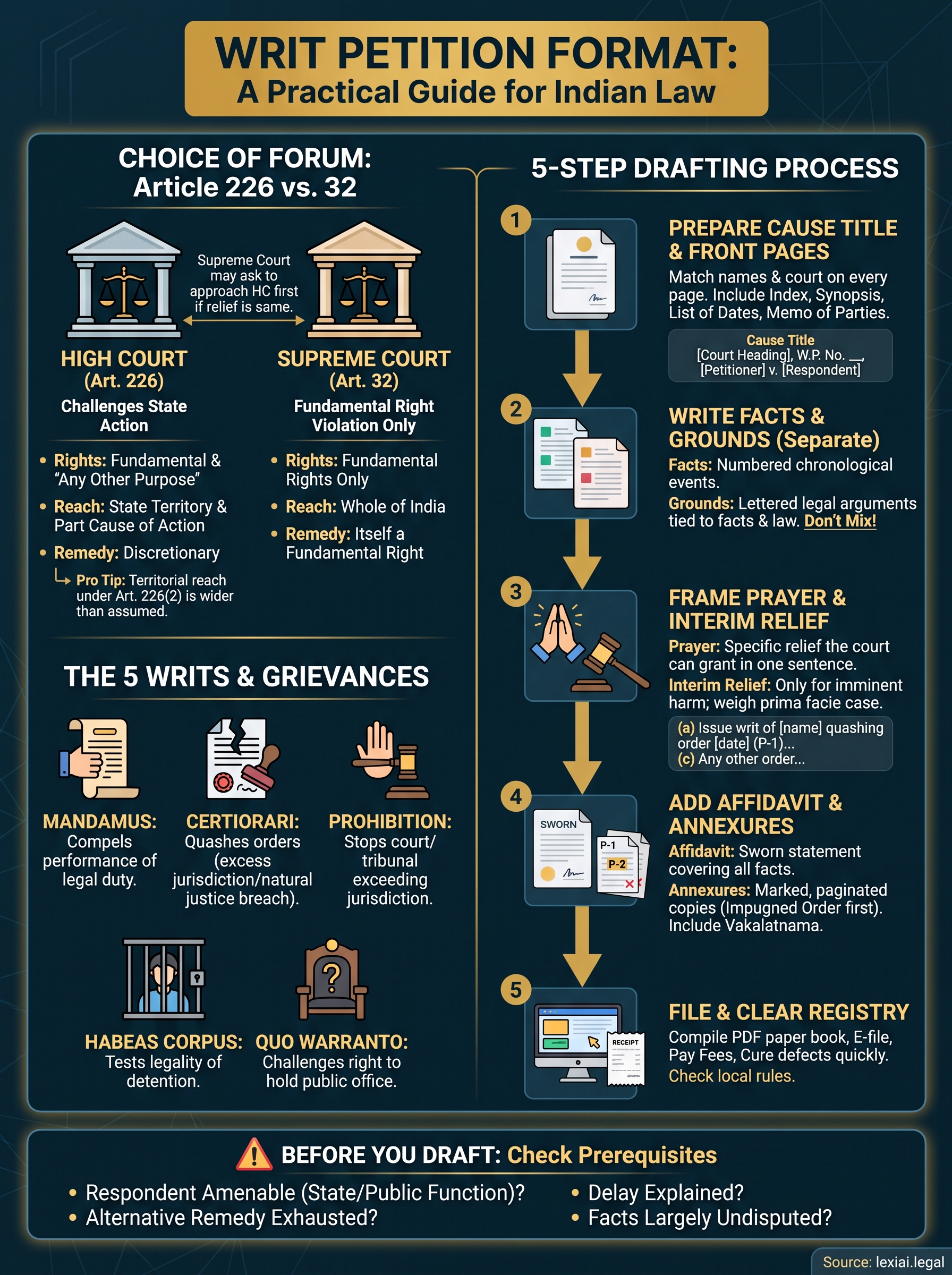
Use Article 226 and file in the High Court when you challenge state action on any legal ground. Use Article 32 and approach the Supreme Court only when a fundamental right is violated. The writ petition format is almost the same for both. What changes is the court heading, the case number series, and the filing rules.
How the two articles compare
The table below sets the two routes side by side, so you can pick the forum before you draft.
| Point | Article 226 (High Court) | Article 32 (Supreme Court) |
|---|---|---|
| Rights covered | Fundamental rights and "any other purpose" | Fundamental rights only |
| Territorial reach | Territory of the High Court, plus places where part of the cause of action arises under Article 226(2) | Whole of India |
| Nature of the remedy | Discretionary | Itself a fundamental right, yet the Court may send you to the High Court |
| Who files | Any advocate holding your vakalatnama | Ordinarily an Advocate-on-Record |
| Case number | W.P.(C) or W.P.(Crl.) | Writ Petition (Civil) or (Criminal) |
Territorial reach under Article 226(2) is wider than many drafters assume. In Kusum Ingots & Alloys Ltd. v. Union of India (2004) 6 SCC 254, the Supreme Court held that even a part of the cause of action can give a High Court jurisdiction, though the court may still decline as an inconvenient forum. Where a High Court can grant the same relief, the Supreme Court often asks you to go there first.
Choose the forum before you draft, because the cause title and the jurisdiction paragraph both depend on it.
Which writ fits your grievance
Article 32(2) and Article 226(1) name the same five writs. Match your grievance to one of them.
- Mandamus: compels a public authority to perform a legal duty.
- Certiorari: quashes an order of a tribunal or authority that acted without jurisdiction or in breach of natural justice.
- Prohibition: stops a court or tribunal from exceeding its jurisdiction.
- Habeas corpus: brings a detained person before the court to test the legality of detention.
- Quo warranto: challenges the right of a person to hold a public office.
Many petitions combine certiorari with mandamus, for example to quash a rejection and direct fresh consideration. The court can issue an "appropriate writ, order or direction," so a wrong label rarely sinks a petition. For quashing an FIR, the usual route is Section 528 of the BNSS, which replaced Section 482 of the CrPC, though High Courts also hear such matters under Article 226.
Check these prerequisites before drafting
A petition that skips these checks invites dismissal at the first hearing.
- The respondent must be amenable to writs. The State and "other authorities" under Article 12 qualify. A private body qualifies when it performs a public function, as in Andi Mukta Sadguru Shree Muktajee Vandas Swami Suvarna Jayanti Mahotsav Smarak Trust v. V.R. Rudani (1989) 2 SCC 691.
- An alternative remedy must be exhausted, or an exception must apply. Whirlpool Corporation v. Registrar of Trade Marks (1998) 8 SCC 1 recognizes exceptions for enforcement of fundamental rights, breach of natural justice, orders wholly without jurisdiction, and challenges to the vires of legislation.
- Delay must be explained. No fixed limitation period applies, but unexplained delay is a common ground for refusing relief.
- The facts must be largely undisputed. Writ courts do not ordinarily try disputed questions of fact.
- Your documents must be in hand. Collect the impugned order, your representation, and any reply.
An AI legal research tool such as LeXi AI can pull verified authorities for each point above. Read each judgment yourself before you cite it.
Step 1. Prepare the cause title and front pages
Start with the pages that sit in front of the petition: the cause title, index, synopsis, list of dates, and memo of parties. The registry and the bench see these first. A clean writ petition format begins here, and the party names and court heading must match on every page of the paper book.
Write the cause title
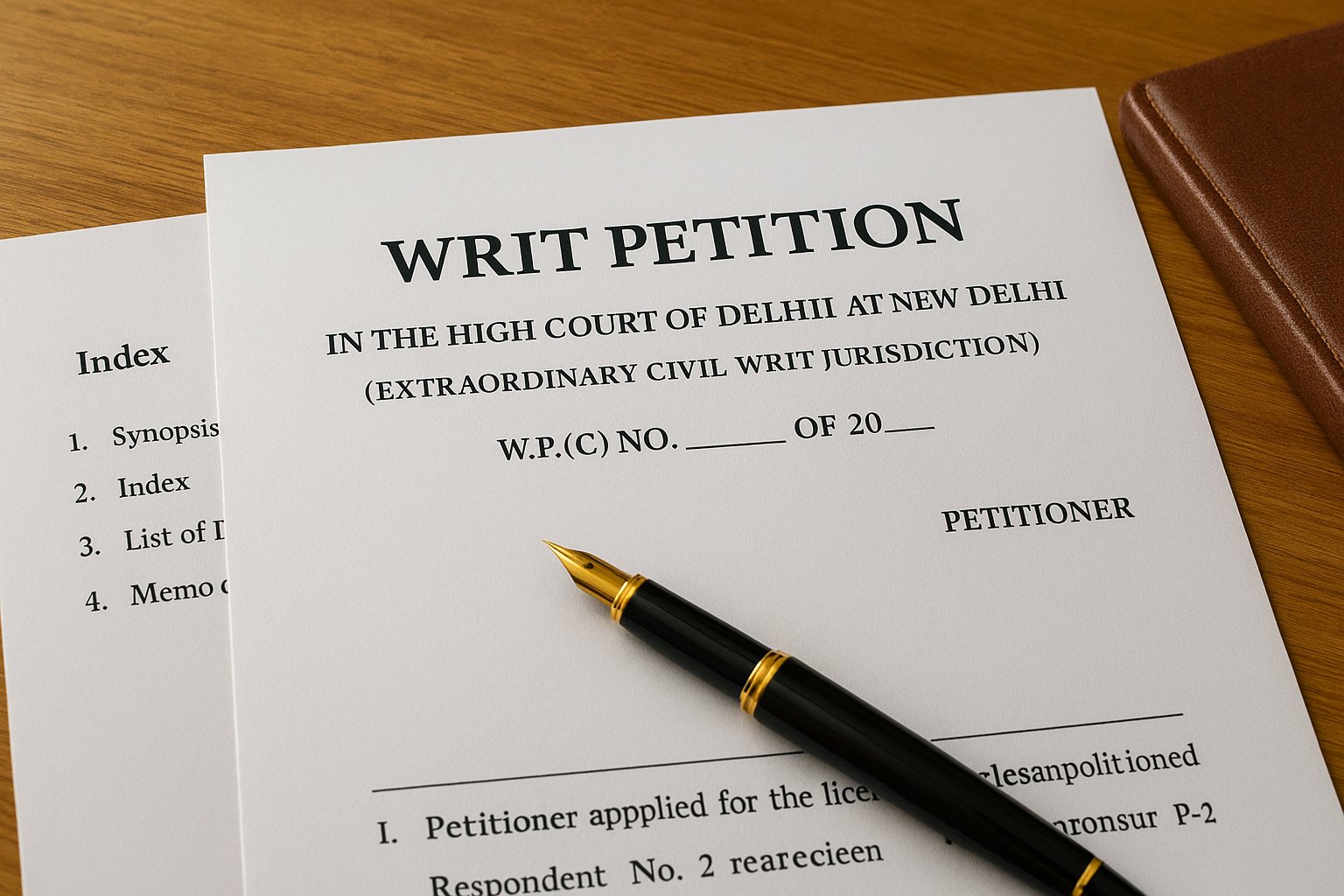
The cause title names the court, the jurisdiction, the case number, and the parties. Leave the number blank, because the registry assigns it. Use the templates below and adjust the jurisdiction line to your court.
High Court template under Article 226:
IN THE HIGH COURT OF DELHI AT NEW DELHI
(EXTRAORDINARY CIVIL WRIT JURISDICTION)
W.P.(C) NO. ______ OF 20__

IN THE MATTER OF:

[Name of petitioner], [age, occupation]
R/o [full address] ...PETITIONER

VERSUS

1. Union of India, through its Secretary, [Ministry], [address] ...RESPONDENT NO. 1
2. [Name of authority], through its [officer], [address] ...RESPONDENT NO. 2

WRIT PETITION UNDER ARTICLE 226 OF THE CONSTITUTION OF INDIA SEEKING A WRIT OF [CERTIORARI / MANDAMUS] AND OTHER APPROPRIATE RELIEF
Supreme Court template under Article 32:
IN THE SUPREME COURT OF INDIA
CIVIL ORIGINAL JURISDICTION
WRIT PETITION (CIVIL) NO. ______ OF 20__
(Under Article 32 of the Constitution of India)

[Name of petitioner] ...PETITIONER
VERSUS
[Name of respondent] ...RESPONDENT
Jurisdiction wording differs between High Courts. Some use "Civil Writ Jurisdiction" and others "Writ Jurisdiction." Copy the heading from a recent order of the same court.
Prepare the index, synopsis, list of dates, and memo of parties
The index lists every document with its page number. The synopsis runs one to two pages and says, in plain words, who you are, what action you challenge, why it is illegal, and what relief you seek. The list of dates is a table of events, each tied to an annexure. The memo of parties gives the full name, designation, and address of every party, with your own address for service.
| Date | Event |
|---|---|
| [dd.mm.yyyy] | Petitioner applied for the license (Annexure P-1) |
| [dd.mm.yyyy] | Respondent No. 2 rejected the application without a hearing (Annexure P-2) |
| [dd.mm.yyyy] | Petitioner sent a representation (Annexure P-3) |
| [dd.mm.yyyy] | No reply received; present petition filed |
Write the synopsis last and keep it tight, because it is the first page the judge reads.
Step 2. Write the facts and grounds
Facts and grounds are separate parts of the writ petition format, and mixing them is the most common drafting error. Facts say what happened, in date order. Grounds say why that conduct is illegal. Keep the argument out of the facts and the narrative out of the grounds.
Draft the facts in numbered paragraphs
Each paragraph should carry one factual proposition and point to its annexure. Add short paragraphs on jurisdiction, alternative remedy, delay, and the absence of any other petition. Courts expect these statements, and an affidavit will later swear to them.
FACTS OF THE CASE
1. That the petitioner is [a citizen of India / a company incorporated under the Companies Act, 2013] engaged in [activity]. The petitioner is aggrieved by the order dated [date] passed by Respondent No. 2, annexed as ANNEXURE P-1.
2. That on [date], the petitioner applied for [relief or permission]. A copy is annexed as ANNEXURE P-2.
3. That on [date], Respondent No. 2 rejected the application without giving the petitioner a hearing.
4. That the petitioner sent a representation on [date] (ANNEXURE P-3). No reply has been received.

JURISDICTION AND MAINTAINABILITY
5. That the cause of action arose within the territorial jurisdiction of this Hon'ble Court because [reason]. This Hon'ble Court has jurisdiction under Article 226 of the Constitution.
6. That the petitioner has no other alternative and efficacious remedy. [OR: Although an appeal lies under Section __ of the __ Act, this petition is maintainable because (state the exception).]
7. That the petition is filed without delay. [Explain any delay here.]
8. That the petitioner has not filed any other petition on the same cause of action before this Hon'ble Court, the Supreme Court, or any other court.
Plead grounds that tie law to fact
Write each ground as a lettered paragraph that states one legal proposition and links it to a fact above. Name the article, section, or binding precedent it rests on. Where you allege arbitrariness, E.P. Royappa v. State of Tamil Nadu (1974) 4 SCC 3 is the usual starting point. For a procedure that affects life or liberty, rely on Maneka Gandhi v. Union of India (1978) 1 SCC 248.
GROUNDS
A. Because the impugned order dated [date] was passed without notice or hearing, in breach of the principles of natural justice.
B. Because the impugned order is arbitrary and violates Article 14 of the Constitution.
C. Because the order affects the petitioner's right under Article [19(1)(g) / 21] and the procedure followed is not fair, just, and reasonable.
D. Because Respondent No. 2 acted beyond the power conferred by Section __ of the __ Act, and the order is ultra vires.
A ground that cites no fact and no provision is a slogan, and the bench will treat it as one.
Step 3. Frame the prayer and interim relief
The prayer must list exact reliefs, each tied to a writ and to the order you challenge. Courts read this section closely, because it defines what they can grant. A prayer that sprawls or asks for something outside writ jurisdiction weakens an otherwise sound writ petition format.
Write a prayer the court can grant
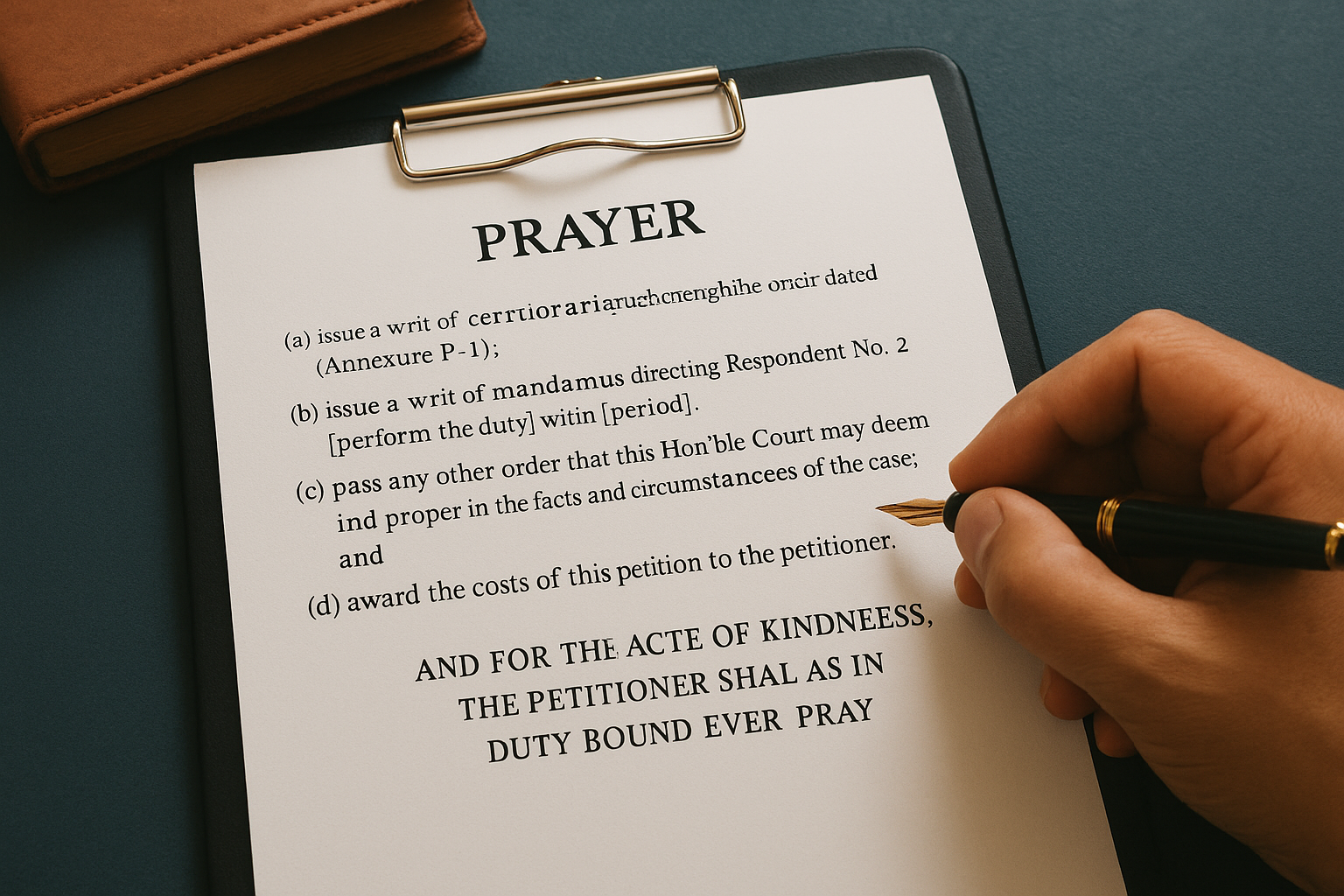
Name the writ, identify the order by date and annexure, and state the direction in one sentence. Add a general residuary clause at the end. Ask for costs only where they are justified.
PRAYER
In view of the facts and grounds stated above, it is most respectfully prayed that this Hon'ble Court may be pleased to:
(a) issue a writ of certiorari or any other appropriate writ, order, or direction quashing the order dated [date] passed by Respondent No. 2 (Annexure P-1);
(b) issue a writ of mandamus directing Respondent No. 2 to [perform the duty] within [period];
(c) pass any other order that this Hon'ble Court may deem fit and proper in the facts and circumstances of the case; and
(d) award the costs of this petition to the petitioner.

AND FOR THIS ACT OF KINDNESS, THE PETITIONER SHALL AS IN DUTY BOUND EVER PRAY.

Place: [city]
Date: [date]
[Name of petitioner], Petitioner
Through [Name of advocate], Counsel for the Petitioner
Use the wording below when you need a different writ.
| Writ | Sample prayer wording |
|---|---|
| Mandamus | Issue a writ of mandamus directing Respondent No. 2 to [perform the duty] within [period] |
| Certiorari | Issue a writ of certiorari quashing the order dated [date] (Annexure P-1) |
| Prohibition | Issue a writ of prohibition restraining Respondent No. 2 from proceeding with [proceeding] |
| Habeas corpus | Issue a writ of habeas corpus directing the respondents to produce [name] before this Hon'ble Court |
| Quo warranto | Issue a writ of quo warranto calling upon Respondent No. 3 to show by what authority he holds the office of [office] |
Add interim relief only where harm is imminent
Interim relief must be asked for in the petition or in a separate application. Courts weigh a prima facie case, the balance of convenience, and irreparable injury. Keep the request narrow, such as a stay of one order or a bar on coercive action.
INTERIM RELIEF
Pending the hearing and final disposal of this petition, this Hon'ble Court may be pleased to stay the operation of the order dated [date] (Annexure P-1) and restrain the respondents from taking any coercive action against the petitioner.
Never disguise final relief as interim relief. If the matter is urgent, add an affidavit of urgency that states the date of the threatened action and why the ordinary listing is too late.
A prayer that the court cannot grant in one clear line needs redrafting before you file.
Step 4. Add the affidavit and annexures
A writ petition is not complete without a sworn affidavit, numbered annexures, and a vakalatnama. This part of the writ petition format is mechanical, yet it causes most registry objections. Prepare it while the petition is fresh, not on the day of filing.
Draft the supporting affidavit and verification
The affidavit confirms the facts on oath. The petitioner, or an authorized signatory for a company, signs it before an Oath Commissioner or notary. Cover every paragraph of the facts and keep the affidavit consistent with the petition.
AFFIDAVIT
I, [name], [son/daughter/wife] of [name], aged about [age] years, resident of [address], do hereby solemnly affirm and state on oath as follows:
1. That I am the petitioner [or authorized signatory of the petitioner] in the above matter and am conversant with the facts of the case. I am competent to swear this affidavit.
2. That I have read the accompanying writ petition, including the synopsis and list of dates. The facts stated in paragraphs 1 to [__] are true to my knowledge. The submissions of law are based on legal advice, which I believe to be true.
3. That the annexures are true copies of their originals.

DEPONENT

VERIFICATION
Verified at [place] on this [__] day of [month], 20__ that the contents of the above affidavit are true and correct to my knowledge, no part of it is false, and nothing material has been concealed.

DEPONENT
Assemble annexures, vakalatnama, and applications
Mark each annexure as P-1, P-2, and so on, and match the numbers to the index and the list of dates. Paginate the whole paper book continuously. Include these items:
- Certified or true copy of the impugned order. Attach it as the first annexure.
- Supporting documents. These include the application, representation, notices, and replies.
- Translations. Documents in a regional language usually need a translation, with an exemption application where the court's rules allow one.
- Vakalatnama. Add a memo of appearance where the court requires it.
- Authority for a company. Attach a board resolution authorizing the signatory.
- Applications. File interim relief, urgency, or condonation of delay as separate applications.
Public interest petitions need one more disclosure. State who you are, what your interest is, and that you have no personal or oblique motive. The Supreme Court laid down these expectations in State of Uttaranchal v. Balwant Singh Chaufal (2010) 3 SCC 402.
The affidavit must match the petition paragraph for paragraph, because a mismatch is the cheapest objection for the registry to raise.
Step 5. File the petition and clear the registry
File the paper book through the court's e-filing system, pay the court fee, and cure any defects the registry lists. Rules differ between courts, so check the current rules of your High Court or the Supreme Court Rules, 2013 before you file. This final step is where a well-built writ petition format either proceeds or comes back.
Follow the filing sequence
The sequence below applies in most courts. Local practice may add a physical copy or an advance copy to the opposite counsel.
- Compile one PDF paper book in the order of the index, with bookmarks and legible annexures.
- Sign every page through counsel and complete the affidavit and vakalatnama.
- E-file on the court's portal, such as the Supreme Court e-filing system or the High Court's own portal, and pay the court fee prescribed by that court. In the Supreme Court, filing is ordinarily done through an Advocate-on-Record.
- Note the diary or filing number the system generates.
- Cure registry defects within the time the registry gives.
- Receive the registration number, which appears as W.P.(C), W.P.(Crl.), or Writ Petition (Civil) with a number.
- Seek listing. For urgent matters, follow the court's mentioning procedure with your affidavit of urgency.
Avoid the common registry objections
Most defects are avoidable with a short pre-filing review. The table lists the usual ones.
| Registry objection | Fix |
|---|---|
| Verification or affidavit missing or unsigned | Complete both before filing and check every signature |
| Annexures not marked or paginated | Mark P-1 onward and match the index |
| Illegible or uncertified copies | Attach a clear copy, and a certified copy of the impugned order |
| Vernacular document without translation | Attach a translation or file an exemption application |
| Wrong or short court fee | Compute the fee under that court's rules and keep proof |
| Necessary party not impleaded | Add the authority that passed the order |
Prepare for listing, notice, and reply
After listing, the court may issue notice, and the respondents file a counter affidavit. You then file a rejoinder that answers only the new points. Keep one clean set of the petition and annexures ready for the first hearing, with the two or three key authorities flagged.
AI legal drafting tools can shorten the work before filing. LeXi AI can generate a first draft of the cause title, grounds, and prayer, and summarize a long file into a chronology. You remain responsible for the final text, so check every citation against the full judgment and every fact against your documents. This guide gives general information, and it does not replace advice on your specific matter.
Before you file
A writ petition succeeds on structure as much as on law. Pick the right forum, write the cause title, keep facts and grounds apart, frame a prayer the court can grant in one line, and support everything with a verified affidavit and numbered annexures. Then clear the registry on the first attempt.
Run the final checklist against your paper book: court heading, parties, synopsis, dates, facts, grounds, prayer, affidavit, annexures, vakalatnama, fee. When you are ready to draft, test LeXi AI free on your next writ petition and build your first draft with LeXi LiTT, then verify each authority before you sign.