

Section 34 IPC in BNS: Now Section 3(5), Meaning and Text
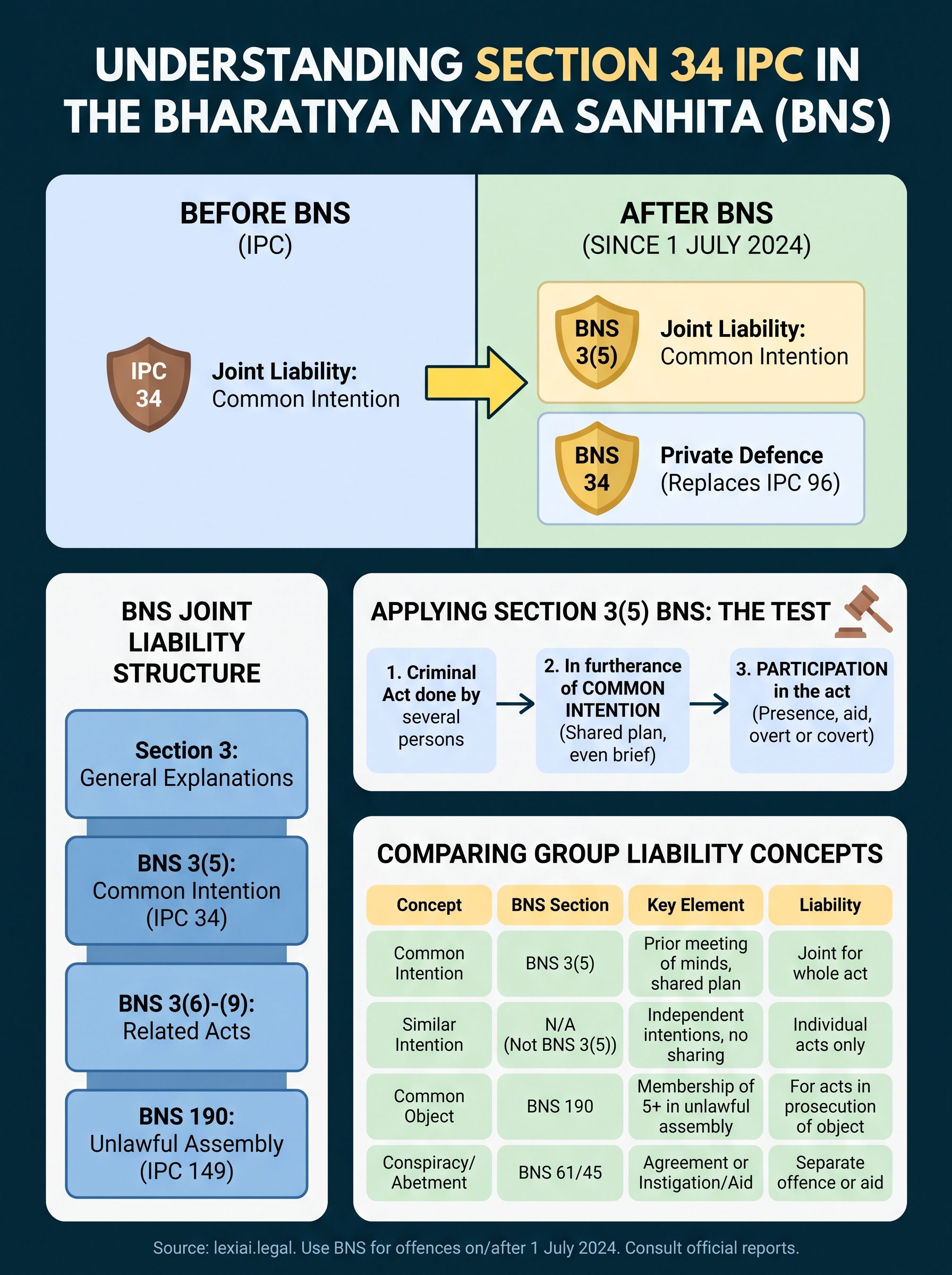
Section 34 IPC in BNS is Section 3(5) of the Bharatiya Nyaya Sanhita, 2023. The wording is the same as before. When a criminal act is done by several persons in furtherance of the common intention of all, each of them is liable for that act in the same manner as if it were done by him alone. BNS Section 34 is a different provision. It deals with things done in private defence and replaces Section 96 IPC.
In simple terms, the rule says that people who plan and carry out a crime together answer for the result together. The prosecution does not have to prove which accused struck the fatal blow. It has to prove a shared intention and some participation by each accused in furthering that intention.
This article explains why the renumbering matters and how to apply Section 3(5) to a set of facts. It then covers what common intention means, how the provision differs from Section 190 BNS and other group-liability rules, how courts weigh the evidence, and how to cite it correctly. Every case decided under Section 34 IPC still guides courts today, and a research platform such as LeXi AI can help you pull those judgments quickly.
Why does the BNS renumbering of Section 34 IPC matter?
The renumbering matters because the old number now points to a different law. If you cite "Section 34 BNS" for common intention, you cite the private defence provision, not the joint liability rule. A wrong number in a charge sheet, a bail application, or an exam answer shows that the drafter has not checked the new Code.
Where is Section 34 IPC in the BNS?
Section 34 IPC now sits in Section 3(5) BNS. Section 3 is titled General Explanations. It gathers into one section several provisions that stood separately in the IPC, and the marginal heading was dropped while the text was carried over without change.

The provision reads as follows: when a criminal act is done by several persons in furtherance of the common intention of all, each of such persons is liable for that act in the same manner as if it were done by him alone. The companion provisions on joint acts moved into Section 3 along with it.
| IPC section | Subject | BNS provision |
|---|---|---|
| 34 | Acts done by several persons in furtherance of common intention | 3(5) |
| 35 | Criminal act done with criminal knowledge or intention by several persons | 3(6) |
| 36 | Effect caused partly by act and partly by omission | 3(7) |
| 37 | Co-operation by doing one of several acts constituting an offence | 3(8) |
| 38 | Persons concerned in a criminal act may be guilty of different offences | 3(9) |
| 149 | Member of unlawful assembly guilty of offence committed in prosecution of common object | 190 |
Some study notes cite the provision as Section 2(5) BNS. That is wrong. Section 2 contains definitions, and the joint liability rule sits in Section 3.
Section 34 IPC is Section 3(5) BNS, with the same words and the same body of case law.
Why is BNS Section 34 a different provision?
BNS Section 34 is the opening provision on the right of private defence. It says that nothing is an offence which is done in the exercise of that right, and it replaces Section 96 IPC. The Sanhita then sets out the scope and limits of the right in the sections that follow, up to Section 44, which replace Sections 97 to 106 IPC.
The two provisions work in opposite directions. Section 3(5) is used by the prosecution to spread liability across participants. BNS Section 34 is used by the accused to say that the act was not an offence at all.
| Point | Section 3(5) BNS | Section 34 BNS |
|---|---|---|
| Old IPC number | Section 34 | Section 96 |
| Subject | Joint liability for acts done in furtherance of common intention | Acts done in exercise of private defence are not offences |
| Creates an offence | No, it only attributes liability | No, it removes criminality |
| Usually invoked by | Prosecution | Accused |
| Related provisions | 3(6) to 3(9), 190 | Sections 35 to 44 |
Search engines and legal databases make the confusion worse. A search for "BNS Section 34" returns private defence first, because that is what the number now means.
Which Code applies to your case?
The BNS came into force on 1 July 2024. An offence committed before that date is still governed by the IPC, so Section 34 IPC continues to appear in pending trials, appeals, and revisions. Article 20(1) of the Constitution also bars conviction under a law that was not in force when the offence was committed.
For offences committed on or after 1 July 2024, cite Section 3(5) BNS. For older offences, cite Section 34 IPC and, if you want to help the reader, add the BNS equivalent in brackets. Using the right Code from the first line of a pleading keeps the court focused on your argument and not on your citation.
How to apply Section 3(5) BNS to a set of facts
To apply Section 3(5) BNS, ask two questions in order. Did more than one person do the criminal act, and was each person's part done in furtherance of the common intention of all? If both answers are yes, each participant is liable for the whole act, as if he had done it alone.
What are the two ingredients of Section 3(5)?
The first ingredient is a criminal act done by several persons. The acts need not be identical. In Barendra Kumar Ghosh v. King Emperor (1925), the Privy Council explained that the section deals with separate acts, similar or diverse, by several persons. If all are done in furtherance of a common intention, each person is liable for the result of them all.
The second ingredient is that the act must be in furtherance of the common intention of all. Courts read "furtherance" as advancement or promotion. An act qualifies if it is a step intentionally taken to bring about the planned offence, and the Supreme Court has held in Suresh v. State of Uttar Pradesh (2001) that both ingredients must be proved before the section applies.
Participation is the bridge between the two. The accused must have taken part in the criminal act in some way, and the prosecution must link that part to the shared plan.
A five-step test for any fact pattern
A fixed sequence stops you from jumping to the conclusion. You can use it for a bail application, a trial brief, or an exam problem.
- Name the substantive offence, for example murder under Section 103 BNS or robbery under Section 309 BNS.
- List every accused and what each did before, during, and after the incident.
- Look for evidence of a shared plan, even one formed moments earlier.
- Check whether each accused's act helped carry out that plan.
- Decide whether the final result was within the plan or a natural consequence of it. If not, the accused who went beyond the plan is liable alone for the excess.
The output of this test is a charge of the form "Section 103(1) read with Section 3(5)". Section 3(5) never stands alone, because it creates no offence of its own.
Section 3(5) never creates a crime. It only decides who answers for a crime that another section defines.
A worked example
Three people, A, B, and C, plan to rob a jeweler. A holds the shopkeeper at gunpoint, B collects the jewelry, and C waits outside on a motorcycle. The shopkeeper resists, and A shoots and kills him.

All three are jointly liable for robbery under Section 309 BNS. C waiting outside is participation, in the same way that Barendra Kumar Ghosh stood guard outside the post office. The harder question is murder. If the plan included carrying a loaded firearm and using it against resistance, murder follows for all three under Section 103 read with Section 3(5). If C did not know that A was armed, the defense will argue that the killing went beyond the common intention, and C's liability may stop at robbery.
What does common intention mean under Section 3(5) BNS?
Common intention means a pre-arranged plan or prior meeting of minds to commit a criminal act, shared by every participant. The BNS does not define the term, just as the IPC did not. Its meaning comes from decisions of the Privy Council and the Supreme Court.
Is common intention the same as a pre-arranged plan?
Yes, for practical purposes. In Mahbub Shah v. Emperor (1945), the Privy Council held that common intention implies a pre-arranged plan and that there must be proof of a prior meeting of minds. The Supreme Court repeated this in Pandurang v. State of Hyderabad (1955), and it remains the standard formulation.
The intention of each accused must be known to the others and shared by them. A private intention that no one else knows about is not a common intention, even if several people at the scene happen to hold something similar.
Can common intention form on the spot?
Yes. The plan must come before the act, but it can form moments before. A long interval or a formal agreement is not required, and a few seconds of shared understanding can be enough.

Take a street quarrel. A slaps C, and B, who is standing nearby, immediately joins in and beats C alongside A. There was no earlier plan, but the moment B joined A with the same aim, a common intention arose. In Virendra Singh v. State of Madhya Pradesh (2010), the Supreme Court described the essence of the section as a simultaneous consensus of minds, which can form immediately before or during the act.
Courts still insist on material that supports this finding. A bare assertion that the accused "must have" agreed is not enough.
How is common intention different from similar intention?
Several people can hold the same intention without sharing it. The Privy Council in Mahbub Shah cautioned that the dividing line is thin but real, and that ignoring it leads to a miscarriage of justice. The Supreme Court endorsed that warning in Pandurang.
| Feature | Common intention | Same or similar intention |
|---|---|---|
| Prior meeting of minds | Present, even if brief | Absent |
| Communication between accused | Intention known to and shared by all | Held independently |
| Section 3(5) BNS | Applies | Does not apply |
| Liability | Joint, for the whole act | Individual, for own acts only |
Consider three strangers who walk down separate lanes, see the same enemy of each, and attack him with different weapons. Each wants him dead, but nobody planned anything with anybody. Each is liable for his own act under the substantive section, and Section 3(5) does not apply.
Having the same intention is not the same as sharing an intention, and Section 3(5) needs the second.
How does Section 3(5) BNS differ from Section 190 and other rules?
Section 3(5) needs a shared intention among two or more persons who take part in a criminal act. Section 190 needs membership of an unlawful assembly of five or more persons and a common object. Conspiracy needs an agreement, and abetment needs instigation, conspiracy, or intentional aid. Each rule fits a different fact pattern.
Section 3(5) versus Section 190
Section 34 IPC and Section 149 IPC are the two classic provisions on group liability, and both survive in the BNS as Section 3(5) and Section 190. They are often pleaded together in riot and murder cases. Courts have accepted that they can overlap on the same facts, and the question is decided case by case.
| Basis | Section 3(5) BNS (IPC 34) | Section 190 BNS (IPC 149) |
|---|---|---|
| Persons needed | Two or more | Five or more, forming an unlawful assembly under Section 189 |
| Prior meeting of minds | Required | Not required in the same way |
| Core concept | Common intention | Common object |
| What attracts liability | Participation in the criminal act | Membership of the assembly with that object |
| Scope of purpose | Any criminal act | Limited to the objects listed in the definition of unlawful assembly |
A practical rule follows from the table. If only three or four people are involved, Section 190 cannot apply, and the prosecution must rely on Section 3(5). If a large crowd is involved and the evidence on who planned what is thin, Section 190 is often the easier route.
How does it compare with conspiracy, abetment, and Section 3(9)?
Criminal conspiracy under Section 61 BNS is a separate offence. It is complete on agreement, and it can be punished even if the planned crime never takes place. Section 3(5) comes into play only after a criminal act has actually been done, and it only decides who is liable for it.
Abetment under Section 45 BNS targets the person who instigates, conspires, or intentionally aids. It overlaps with Section 3(5) at the edges, because a person who stands guard can be an abettor or a participant. Prosecutors often plead both.
Section 3(9), formerly Section 38 IPC, adds a useful point. Persons concerned in a criminal act may be guilty of different offences. If two accused share only an intention to cause grievous hurt and one of them kills, the one who caused death may face murder, while the other may be liable for a lesser offence, such as culpable homicide under Section 105 BNS.
Joint liability is calibrated to what each accused actually shared and did, not simply to the worst result.
How do courts prove common intention and participation?
Courts prove common intention mostly by inference from conduct, because direct evidence of a plan is rare. Participation is proved through the acts, presence, or role of each accused. In both cases the inference must be the only reasonable one.
Can common intention be proved by circumstances?
Yes, and it usually is. The Supreme Court has said that common intention is a state of mind that may be inferred objectively from conduct during the crime and from circumstances before and after it. In Dukhmochan Pandey v. State of Bihar, it also stressed that the inference must show a meeting of minds beyond reasonable doubt.
Courts commonly look at these circumstances:
- The weapons each accused carried and how they were used.
- The manner and number of injuries.
- How the accused arrived at the scene and whether they arrived together.
- Their words just before the attack.
- Their conduct afterward, such as fleeing together.
Where the facts can be explained on another reasonable basis, the inference fails. The accused are then liable only for their own acts.
Is physical presence or an overt act required?
Participation in action is the leading attribute of the section, as the Supreme Court held in Jaikrishnadas Manohardas Desai v. State of Bombay (1960). For crimes of violence, the courts have generally required that the accused be present at the scene to facilitate or promote the offence, as in Ramaswami Ayyangar v. State of Tamil Nadu (1976). Standing guard or blocking an escape route counts as participation.
An overt act is not always needed. In Suresh v. State of Uttar Pradesh, the Court accepted that covert acts, and in some cases even an illegal omission, can fasten liability. Mere presence, however, is not enough. In Vithal Tukaram More v. State of Maharashtra (2002), the Court refused to infer common intention from the fact that some accused were in the house during an assault by another.
What happens if the co-accused are acquitted?
The answer depends on what the court finds about the other participants. If the court holds that nobody else shared the intention, a lone accused cannot be convicted with the help of Section 3(5). In Krishna Govind Patil v. State of Maharashtra (1963), the Supreme Court held that where all but one accused are acquitted, the conviction of the remaining one under this rule cannot stand unless there is evidence of other unnamed participants.
The acquittal of some accused does not automatically free the others. If the evidence shows that unidentified persons took part in the same crime, a conviction using Section 3(5) can still stand. Also, a charge that does not mention the section is not defective in itself, so long as the accused suffered no prejudice.
The question is never how many accused remain. It is whether the evidence shows that more than one person shared the intention.
How to cite Section 3(5) BNS in pleadings and research
Cite Section 3(5) BNS with the substantive section, in the form "read with". Never write "Section 34 BNS" for common intention. Both rules keep your pleadings accurate and your research complete.
How should you write the charge or citation?
Use the full name of the Code on first mention, and match the Code to the date of the offence. You can copy these forms and adjust the section numbers.
Section 103(1) read with Section 3(5) of the Bharatiya Nyaya Sanhita, 2023

Section 302 read with Section 34 of the Indian Penal Code, 1860
(offence committed before 1 July 2024)
In a bail application or a defense brief, plead the weak points of the prosecution case by name. These are the absence of a prior meeting of minds, the absence of any overt act by your client, mere presence at the scene, and an act that went beyond any shared plan. For a prosecution brief, plead the circumstances from which the plan can be inferred.
How can you research the old case law faster?
Almost all authority on this rule was written under Section 34 IPC. Those decisions apply to Section 3(5) BNS because the text did not change, so your research should run on both numbers. Search the old section, the new section, and the doctrine, for example "common intention" and "similar intention".
An AI research tool can shorten this work. LeXi AI lets you search judgments with sources you can check, summarize long case files, and draft from the results. Always confirm every citation against the official report before you file.
Using Section 3(5) with confidence
Section 34 IPC in the BNS is Section 3(5), with the same words and the same case law. It makes each participant liable for a criminal act done in furtherance of the common intention of all, but it creates no offence of its own. BNS Section 34 is the private defence provision and has nothing to do with it.
When you apply the rule, look for a shared plan, even a brief one, and for each accused's part in carrying it out. Keep it apart from similar intention, common object, conspiracy, and abetment. If you want to test your analysis against the judgments that shaped this rule, run LeXi AI on the case law behind Section 3(5) BNS at no cost.