

CrPC vs BNSS: Key Changes and a Section Conversion Table
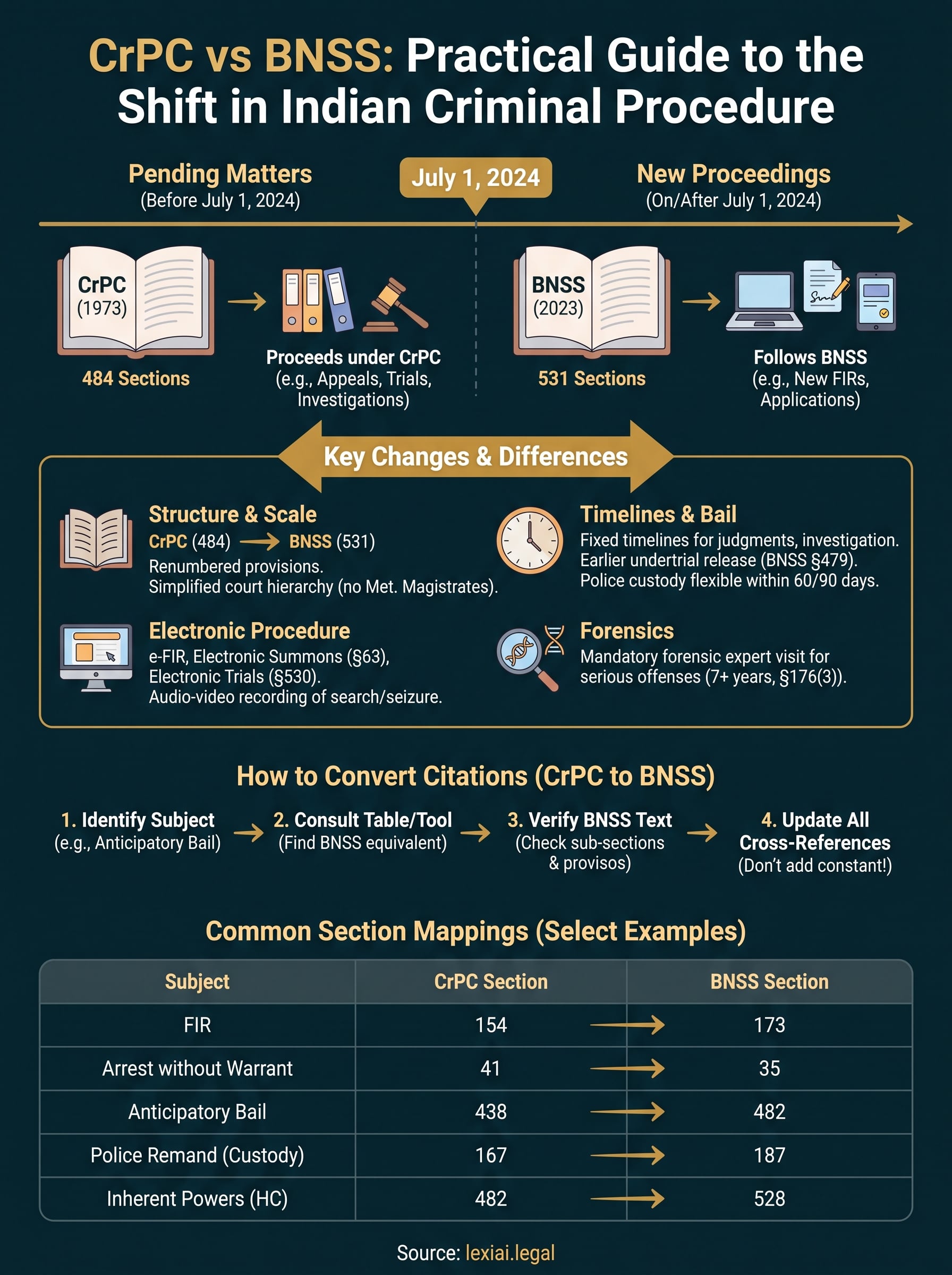
CrPC vs BNSS is the comparison between the Code of Criminal Procedure, 1973 and the Bharatiya Nagarik Suraksha Sanhita, 2023, which replaced it on July 1, 2024. The BNSS keeps the basic design of criminal procedure but renumbers most provisions and grows from 484 to 531 sections. It also adds electronic procedure and forensic requirements, and it sets fixed timelines. The conversion table below maps the sections you cite most often.
Both codes answer the same practical questions. How does the police register an FIR, how long can an accused be held, when does bail arise, and how does a trial end? The BNSS answers each in its own numbering. The Bharatiya Nyaya Sanhita (BNS) now supplies the offenses that the Indian Penal Code once did.
This article explains why the change matters for your filings, how to convert old references step by step, and what changed in substance. It comes from LeXi AI, a legal intelligence platform for Indian lawyers and law students. Treat the table as a working aid and confirm each citation against the official text before you file.
Why does the CrPC vs BNSS difference matter in practice?
It matters because both codes are still in use, and citing the wrong one in a petition, application, or answer paper is an avoidable error. The BNSS governs new proceedings, while the CrPC continues for matters that were already pending.
Which code governs your matter
Section 531 of the BNSS repeals the CrPC, but its savings clause keeps pending appeals, applications, trials, inquiries, and investigations under the CrPC. A proceeding that begins on or after July 1, 2024 follows the BNSS. For an FIR registered after that date, the BNSS governs procedure. The offense itself is defined by the IPC if the act took place before July 1, 2024, and by the BNS if it took place later.
| Situation | Procedural code | Offense code |
|---|---|---|
| Trial pending on July 1, 2024 | CrPC | IPC or the relevant special law |
| FIR registered after July 1, 2024 for an act before that date | BNSS | IPC |
| FIR registered for an act on or after July 1, 2024 | BNSS | BNS |
Match the code to the date the proceeding began, then match the section to the subject.
What a wrong citation costs you
A petition that invokes Section 438 CrPC for anticipatory bail should now cite Section 482 BNSS. Courts usually treat a wrong section number as a curable defect. It still invites avoidable objections and wastes time at the hearing.
Students face the same problem in another form. Judicial service and law school papers now test BNSS numbering, while older commentaries and case reports still use CrPC numbers. You need to read a 2019 judgment on Section 161 CrPC and recognize the same power in Section 180 BNSS.
How do you convert CrPC sections to BNSS sections?
Match by subject first, then check the sub-section in the BNSS text. The new numbers do not follow a fixed offset, so you cannot add a constant to the old number.
A four step method for converting a citation
Start from what the old section does, not from its number. Then follow these steps.
- Name the subject of the old section, such as arrest without warrant or remand.
- Find the BNSS provision for that subject in the table below or in the official correspondence table.
- Read the BNSS provision itself, because provisos and sub-sections may have been rewritten or added.
- Update every cross reference, because a section that cited another CrPC section now needs the matching BNSS number.
The shift is small at the start of the code and large at the end. Section 41 became Section 35, which moves six numbers down. Section 154 became Section 173, a move of 19 up. Section 438 became Section 482, a move of 44, and Section 482 became Section 528, a move of 46.
Never convert by arithmetic. Convert by subject and confirm in the text.
CrPC to BNSS conversion table for common sections
The table covers 24 provisions that appear most often in FIRs, bail applications, charge sheets, and petitions. It is a selection, not the full correspondence table.
| CrPC section | BNSS section | Subject |
|---|---|---|
| 41 | 35 | Arrest by police without warrant |
| 41A | 35(3) to 35(6) | Notice of appearance |
| 82 | 84 | Proclamation for a person absconding |
| 91 | 94 | Summons to produce a document or thing |
| 125 | 144 | Maintenance of wives, children, and parents |
| 154 | 173 | Information in cognizable cases (FIR) |
| 156 | 175 | Police power to investigate cognizable cases |
| 161 | 180 | Examination of witnesses by police |
| 164 | 183 | Recording of confessions and statements |
| 167 | 187 | Remand when investigation cannot finish in 24 hours |
| 173 | 193 | Police report on completion of investigation |
| 197 | 218 | Prosecution of judges and public servants |
| 200 | 223 | Examination of the complainant |
| 205 | 228 | Dispensing with personal attendance of the accused |
| 227 | 250 | Discharge |
| 228 | 251 | Framing of charge |
| 235 | 258 | Judgment of acquittal or conviction |
| 313 | 351 | Power to examine the accused |
| 320 | 359 | Compounding of offenses |
| 436A | 479 | Maximum detention of an undertrial |
| 437 | 480 | Bail in non-bailable offenses |
| 438 | 482 | Anticipatory bail |
| 439 | 483 | Special bail powers of High Court and Sessions Court |
| 482 | 528 | Inherent powers of the High Court |
Some old sections now spread across several provisions, as with Section 41A. Others carry over almost word for word, with "Code" replaced by "Sanhita".
Checking mappings with a research tool
A research tool can shorten the lookup. LeXi LiTT is built around Indian procedural and substantive laws including BNSS, BSA, and CPC.
Whatever tool you use, verify each section against the official Gazette text. A table or an AI answer points you to the provision. The statute itself decides the wording you cite.
What are the key changes in BNSS compared with CrPC?
The BNSS expands the code from 484 to 531 sections and changes it mainly in four areas: structure, FIR and investigation, custody and trial timelines, and electronic procedure. Most core powers survive, only renumbered or tightened.
Structure and scale
Government figures widely reported at the time of enactment put the changes at 177 provisions changed, 9 new sections, 39 new sub-sections, and 14 repealed sections. Metropolitan areas and Metropolitan Magistrates no longer appear, and the post of Judicial Magistrate of the third class is gone. The hierarchy of criminal courts is simpler as a result.
Section 2 also adds definitions that the CrPC lacked. These include "audio-video electronic means," "bail," "bail bond," "bond," and "electronic communication." Courts no longer have to read the meaning of bail from practice alone.
FIR and investigation
Section 173 lets a person give information electronically, and an e-FIR must be signed within three days. It also provides for a Zero FIR, which the police register irrespective of where the offense occurred and then transfer. For offenses punishable with three years or more but less than seven, a preliminary enquiry may be held within 14 days, with the permission of an officer not below the rank of Deputy Superintendent of Police.
Other duties apply during investigation. Section 176(3) requires a forensic expert to visit the scene for offenses punishable with seven years or more. Section 105 requires audio-video recording of search and seizure. Under Section 193, the police must inform the victim of the progress of the investigation within 90 days.
Custody, bail, and trial timelines
The timeline changes are where a CrPC vs BNSS comparison shows its practical value. The table sets the main ones side by side.
| Subject | CrPC | BNSS |
|---|---|---|
| Police custody | Section 167, read by the Supreme Court in CBI v. Anupam J. Kulkarni (1992) as available only in the first 15 days of detention | Section 187(3): up to 15 days, in whole or in parts, within the first 40 of 60 days or the first 60 of 90 days of detention |
| Undertrial release | Section 436A: after half of the maximum sentence | Section 479: one third for a first-time offender, half for others, not for offenses punishable with death or life imprisonment |
| Judgment in a Sessions trial | Section 235: no fixed period | Section 258: within 30 days of the end of arguments, extendable to 45 days for recorded reasons |
| Cognizance of a complaint | Section 200 | Section 223: the accused must be given a hearing before cognizance |
Two further additions deserve a note. Section 356 allows an inquiry, trial, and judgment in the absence of a proclaimed offender. Section 107 provides for attachment and forfeiture of proceeds of crime.
Electronic procedure
Section 63 allows summons to be served in electronic form, authenticated by a digital signature or the image of the court seal. Section 530 allows trials, inquiries, and proceedings to be held in electronic mode. This turns what used to be a matter of practice into a statutory power.
Section 398 requires every state government to notify a witness protection scheme. How far each of these provisions is working on the ground depends on the court and the state, so check the relevant practice directions before you rely on them.
The BNSS changes timelines and records more than it changes the core powers of the police and the courts.
Using the CrPC vs BNSS comparison in your next filing
The two codes share one purpose and most of their powers. What changed is the numbering, the deadlines, and the move toward electronic records. Cite the BNSS for proceedings that began on or after July 1, 2024, keep the CrPC for matters already pending, and convert every section by subject before you check its sub-sections.
If you want to cross-check sections while you draft or research, you can test LeXi AI free on your own BNSS citations.