

Contract Lifecycle Management Software: Stages and Features
Contract lifecycle management software is a system that manages a contract from the first request to final renewal or expiry, in one place. It replaces scattered Word files, email chains, and spreadsheets with a single record that shows who drafted what, who approved it, and what happens next.
Most Indian legal teams still track obligations by hand. That is where missed renewal dates, unnoticed indemnity risk, and slow approvals begin. A good CLM tool covers the contract management lifecycle end to end: request, drafting, review, negotiation, approval, signing, obligation tracking, and renewal. The features that matter most are clause libraries, risk flagging, version control, translation, and search.
This article explains each stage of the workflow in plain terms, then lists the features you should expect and how to judge vendors against your own needs. At LeXi AI, we build LeXi Desk for this work, so we refer to it briefly where it helps make a point concrete. You can then compare tools using criteria that apply to your organization, not a vendor's brochure.
Why contract lifecycle management software matters
Contracts hold the obligations a business runs on, yet most teams manage them with the least structure. Contract lifecycle management software matters because it turns a pile of documents into a system with owners, dates, and an audit trail.
What breaks when contracts live in email
Consider a company with 300 active vendor and customer contracts. Each one sits in a different folder, and three people hold three different drafts. When a notice arrives, nobody can say which version was signed. Version confusion is the most common failure, and it usually surfaces only during a dispute.
Renewals cause the second kind of loss. An auto-renewal clause with a 60-day notice window passes quietly, and the company is bound for another year. Missed notice periods cost real money, and a manual tracker works only as long as one person remembers to open the sheet.
A contract you cannot find, or a date you cannot see, is a risk you have already accepted.
Why the legal exposure is specific in India
Indian law adds its own pressure points. Under Section 73 of the Indian Contract Act, 1872, a party can claim compensation for breach, and Article 55 of the Limitation Act, 1963 generally gives three years to sue. Short limitation periods and state-specific formalities make loose tracking expensive. These are the points a good contract management lifecycle must account for:
- Stamping: an unstamped instrument cannot be admitted in evidence under Section 35 of the Indian Stamp Act, 1899, until duty and penalty are paid. Duty differs by state.
- Electronic execution: Section 10A of the Information Technology Act, 2000 recognizes contracts formed by electronic means, so signature records must be kept and retrievable.
- Indemnity: Section 124 of the Indian Contract Act defines a contract of indemnity. Uncapped indemnity clauses should be flagged before signing, not after a claim.
- Language: agreements and court filings in regional languages need accurate translation, with the original preserved.
Each of these is easy to handle for one contract. It becomes hard across hundreds, which is where a system earns its place.
What a CLM tool changes in practice
The gain is mostly in everyday tasks that currently eat hours. The table below shows where a contract lifecycle management tool changes the work.
| Task | Without CLM | With CLM software |
|---|---|---|
| Finding a clause across contracts | Open files one by one | Search the repository in seconds |
| Tracking renewals | Spreadsheet and memory | Automatic alerts before notice dates |
| Reviewing a counterparty draft | Manual read against a checklist | Clause-level risk flags against your standards |
| Checking approval status | Email follow-ups | Visible approval trail with timestamps |
Treat vendor numbers with care and test them on your own documents. LeXi AI reports a 60% or greater reduction in drafting time for LeXi Desk users, but the real figure for your team depends on how standardized your templates already are. A short pilot on ten live contracts will tell you more than any benchmark.
What are the stages of the contract lifecycle?
The contract lifecycle has eight stages, and they fall into two halves: before signature and after it. Most teams handle the first half reasonably well. These contract lifecycle management stages are the same whether you sign five agreements a year or five hundred, and the second half is where money leaks.
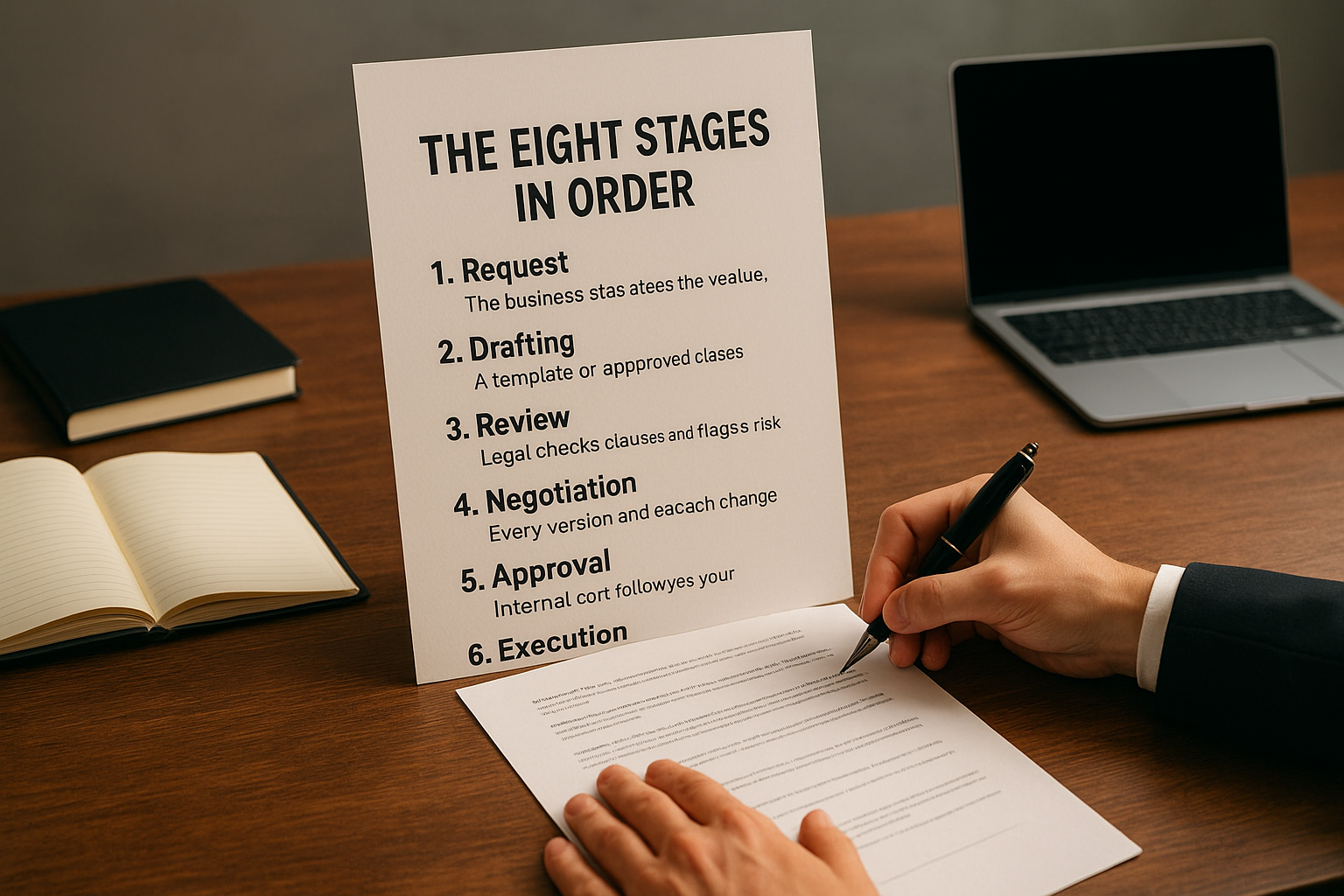
The eight stages in order
Each stage should produce one clear output. When a stage has no output, the handoff becomes a hidden delay. Good contract lifecycle management software records these outputs automatically, so nobody has to ask for them by email.
| Stage | What happens | What should be recorded |
|---|---|---|
| 1. Request | The business team states the need, value, and counterparty | Requester, deal value, deadline |
| 2. Drafting | A template or approved clauses produce the first draft | Template version used |
| 3. Review | Legal checks clauses and flags risk | Flagged items, such as uncapped indemnity |
| 4. Negotiation | Redlines move between both sides | Every version and each change |
| 5. Approval | Internal sign-off follows your authority matrix | Approver and timestamp |
| 6. Execution | Parties sign and stamp the document | Signature record, stamp duty paid |
| 7. Obligation tracking | Deliverables, payments, and notice dates are monitored | Owner and due date for each obligation |
| 8. Renewal or expiry | The team renews, renegotiates, or terminates | Notice deadline and final decision |
Where the stages usually go wrong
Negotiation and obligation tracking cause the most damage. Negotiation produces many versions in a short time, so version control matters most there. Tracking depends on someone reading the signed text and converting it into dates.
Post-signature work is easy to ignore because nothing feels urgent. Take a 12-month services contract with a 30-day termination notice. The reminder must fire by day 335, and a missed date means another year of fees.
Drafting gets the attention, but most contract value is won or lost after signature.
So map your own process against the eight stages first. Mark the stage where files stall or dates slip, and judge any contract lifecycle management tool on how well it fixes that stage.
How does a contract lifecycle management workflow run?
A contract lifecycle management workflow is the set of rules that moves a contract from one stage to the next without anyone chasing it. The stages describe what happens. The workflow decides who acts, in what order, and what triggers the next step. Good contract lifecycle management software lets you set these rules once and apply them to every agreement.
How triggers, conditions, and actions fit together
Every workflow rests on a trigger, a condition, and an action. Rules are plain if-then logic, and you should build them from your own authority matrix. Here are three examples:
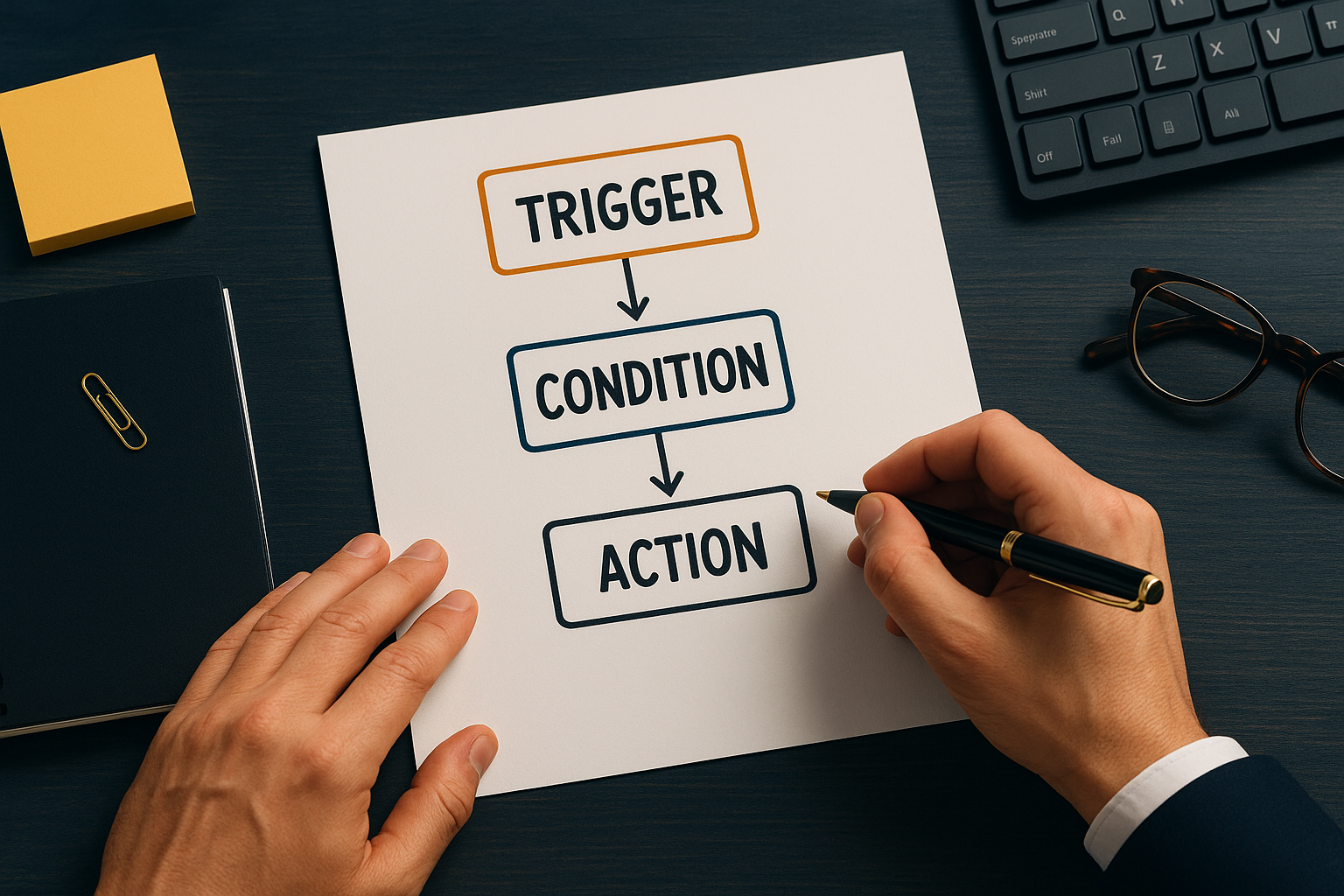
IF contract_type = "Vendor services" AND value > INR 50 lakh
THEN route approval to Legal Head, then CFO

IF indemnity_cap = missing
THEN flag clause and hold the draft for legal review

IF today = notice_deadline - 60 days
THEN alert contract owner and legal
A vendor services agreement from request to renewal
Take a vendor services agreement worth INR 80 lakh. Procurement submits a request, and the system selects the approved template. The review step finds no liability cap, so the draft routes to the legal head before it reaches the counterparty.
Negotiation then runs in one tracked document, so every redline stays on record. After the CFO approves, the contract goes for e-signature and stamping, and the signed copy enters the repository. Obligation dates are extracted and assigned to named owners, with a renewal alert set 60 days before the notice window closes.
A workflow works when every handoff has an owner and every date has an alert.
Where human judgment still decides
Automation moves documents and fires reminders. It does not decide how much risk your organization will accept. Legal judgment stays with your lawyers, and a rule that routes a clause for review is only as good as the standard behind it.
In LeXi Desk, for example, clause risk analysis flags items such as indemnity exposure, and a lawyer then decides whether to accept, amend, or reject. Review the rules every quarter. Outdated routing rules send contracts to people who no longer hold the authority to approve them.
What features should CLM software have?
Strong contract lifecycle management software features map directly to the eight stages you just read about. If a feature does not fix a stage where your files stall, it is an optional extra, not a requirement.
Judge every feature by the stage gap it closes, not by how long the vendor's list is.
Which core features does every CLM tool need?
Start with the basics. A contract lifecycle management tool without these is a storage folder with a login, and it will not change how your team works. The table links each feature to the stage it supports.
| Feature | What it does | Stage supported |
|---|---|---|
| Searchable repository | Stores every contract with metadata and full-text search | All stages |
| Template and clause library | Builds drafts from approved language | Drafting |
| Clause risk flagging | Marks issues such as uncapped indemnity | Review |
| Version control and redlining | Keeps every change in one tracked document | Negotiation |
| Approval routing | Applies your authority matrix | Approval |
| E-signature and stamp records | Stores signature evidence and duty paid | Execution |
| Obligation and renewal alerts | Assigns owners and fires reminders | Tracking, renewal |
Which features matter most for Indian legal teams?
Global comparison sheets often miss the points that cause trouble here. Translation with the original preserved is one, because contracts and filings in Hindi, Marathi, or Tamil need accurate English versions. State-wise stamp duty tracking is another, since an unstamped instrument faces the bar in Section 35 of the Indian Stamp Act, 1899.
Audit trails deserve equal attention. Electronic records are proved under Section 63 of the Bharatiya Sakshya Adhiniyam, 2023, so you need time-stamped logs of who changed what. Without them, a signed PDF is harder to defend.
Security also needs a direct question. Ask about role-based access and encryption, and about how the vendor handles personal data inside contracts under the Digital Personal Data Protection Act, 2023.
Finally, test the AI layer on your own documents. Check whether case law suggestions carry verified sources, and whether APIs exist if you plan to connect the tool to your ERP or procurement system. LeXi Desk, for example, combines drafting, clause generation, risk analysis, translation, and document summarization in one workspace, so you can test all five on a single live contract.
How to choose a CLM tool for your organization
Choosing among CLM vendors is simpler when you fix your criteria before the first demo. Otherwise the vendor's strongest feature quietly becomes your requirement.
What criteria should you score a CLM tool on?
Score every contract lifecycle management tool on one sheet, using a five-point scale per row. Give extra weight to the stage where your own files stall.
| Criterion | Question to ask |
|---|---|
| Stage fit | Does it fix our weakest stage? |
| Indian legal fit | Does it handle stamp duty records, translation, and Indian judgments? |
| AI accuracy | Are sources verified, and is there a published benchmark? |
| Security | Where is data stored, and who can open each contract? |
| Integration | Do APIs connect to our ERP or procurement system? |
| Cost | What is the three-year total, including setup and extra users? |
How do you run a fair vendor comparison?
Shortlist no more than three vendors. A longer list produces demo fatigue, and the scores stop meaning anything. Then run the same test for each one:
- Name the stage where your contracts stall.
- Give every vendor the same ten live contracts, with party names redacted.
- Time three tasks: drafting, clause review, and finding one clause across the repository.
- Ask two lawyers to score the output separately.
- Request a reference from a team of similar size.
A demo shows what a tool can do. Your own contracts show what it will do.
Benchmarks help, but only as a starting point. LeXi AI, for example, reports 98.95% correct on the AIBE 20 legal reasoning dataset. Still, a score on a public dataset does not replace your own indemnity clauses run through the tool.
Which red flags should end an evaluation?
Some answers should stop the process. A vendor that cannot show where case law suggestions come from is asking you to trust output you cannot check. The same applies to any vendor that is vague about data storage.
Watch for these warning signs:
- No audit trail: the system cannot show who changed what, and when.
- Translation that overwrites: the original text is not preserved.
- Pilot refused: the vendor will not test on your documents.
- Hidden pricing: costs for extra users, storage, or APIs appear only after signing.
Any one of these is enough reason to drop a vendor, however good the demo looked.
How to implement CLM software in an Indian legal team
Implementation works best as a staged rollout, not a company-wide switch. Start contract lifecycle management software with one team and one contract type, then widen it once the results hold. This keeps risk small and gives you real numbers to show the business.
What does a 90-day rollout look like?
Ninety days is enough for a pilot in most teams. Pick the contract type you sign most often, such as NDAs or vendor agreements, because repeat volume shows results quickly.
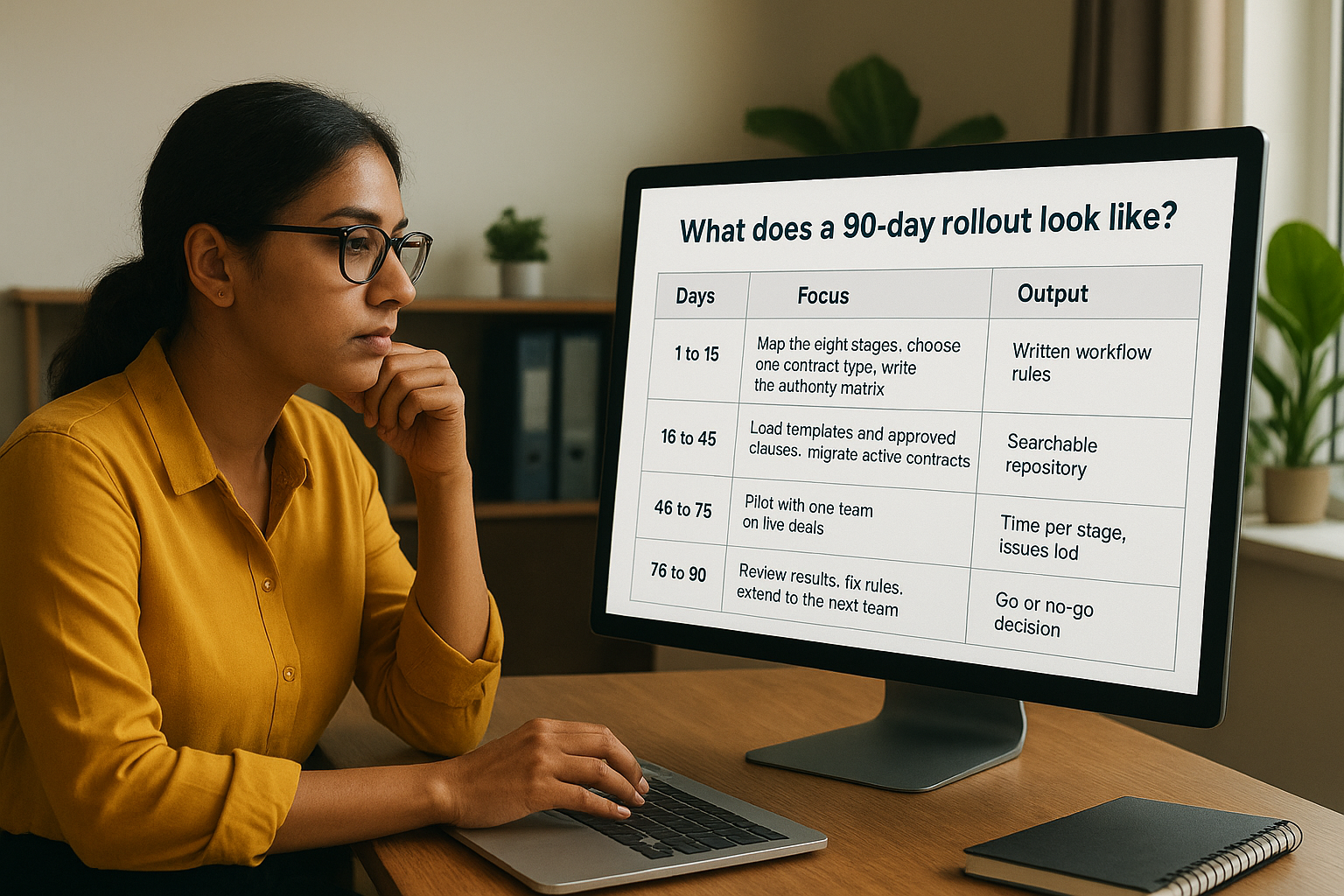
| Days | Focus | Output |
|---|---|---|
| 1 to 15 | Map the eight stages, choose one contract type, write the authority matrix | Written workflow rules |
| 16 to 45 | Load templates and approved clauses, migrate active contracts | Searchable repository |
| 46 to 75 | Pilot with one team on live deals | Time per stage, issues log |
| 76 to 90 | Review results, fix rules, extend to the next team | Go or no-go decision |
How do you migrate existing contracts?
Do not upload everything at once. Begin with active contracts that carry dates, such as auto-renewals, termination notices, and payment milestones. Record the same fields for each one: party, value, governing law, notice date, stamp duty paid, and owner.
Migrate the contracts with deadlines first, and let the archive wait.
Check stamping while you migrate. An unstamped instrument cannot be admitted in evidence under Section 35 of the Indian Stamp Act, 1899, so migration is the cheapest moment to find gaps. Expired agreements can follow in a later batch, once the live contracts are clean.
How do you get your team to use it?
Adoption fails when lawyers see the tool as extra data entry. In training, show one saved task, such as finding a clause across 200 contracts in seconds. Then make the system the only route for approvals, so email stops being an option.
Settle data questions before launch. Confirm who can open each contract, and how personal data inside agreements is handled under the Digital Personal Data Protection Act, 2023. Then track three numbers every month: days to first draft, days to approval, and renewals caught before the notice date. If a platform such as LeXi Desk is on your shortlist, run ten real contracts through the pilot and measure those same three numbers against your current process.
Common CLM mistakes and how to avoid them
Most failed rollouts of contract lifecycle management software share a few causes, and none of them is technical. They come from skipping decisions that belong before launch, not from a weak product.
Which setup mistakes slow a rollout?
Setup errors show up in the first month, and they are cheap to fix if you catch them early. The table lists the four that appear most often.
| Mistake | Why it hurts | Fix |
|---|---|---|
| Buying on feature count | You pay for modules that fix no stalled stage | Score tools against your weakest stage |
| Uploading the whole archive | Poor metadata makes search unreliable | Migrate contracts with dates first |
| Copying old approval habits | Drafts reach people without authority | Write the authority matrix before building rules |
| Skipping stamp duty fields | Gaps surface in a dispute, under Section 35 of the Indian Stamp Act, 1899 | Record duty paid for every executed contract |
What goes wrong after launch?
Neglect is the biggest post-launch mistake. Teams build the contract lifecycle management workflow once and never look at it again. Staff change and approval limits change, yet the rules keep routing drafts to the old approver. Review the rules every quarter, and name one owner for the system.
Second, many teams stop at signature. They file the signed PDF but never enter notice dates, so no alert ever fires. A 60-day renewal window passes, and the contract renews for another year.
A CLM tool that stops tracking at signature is only an expensive filing cabinet.
Fix this by making date entry part of the execution stage. No contract counts as complete until each obligation has an owner and a due date.
How do you avoid trusting AI output too much?
Over-trust is the newer mistake, and it is just as costly. A flagged clause is a prompt for review, not a verdict. Check every cited judgment against its original source, and keep a lawyer's sign-off on high-value agreements. LeXi Desk, for example, surfaces clause risk such as indemnity exposure, but whether to accept that risk stays with you.
Finally, audit the system itself. Pull five signed contracts each quarter and compare the extracted dates with the signed text. Wrong dates are worse than missing dates, because people trust an alert and stop checking. Record each error you find, and use the log to tighten your rules.
Choosing the right CLM approach
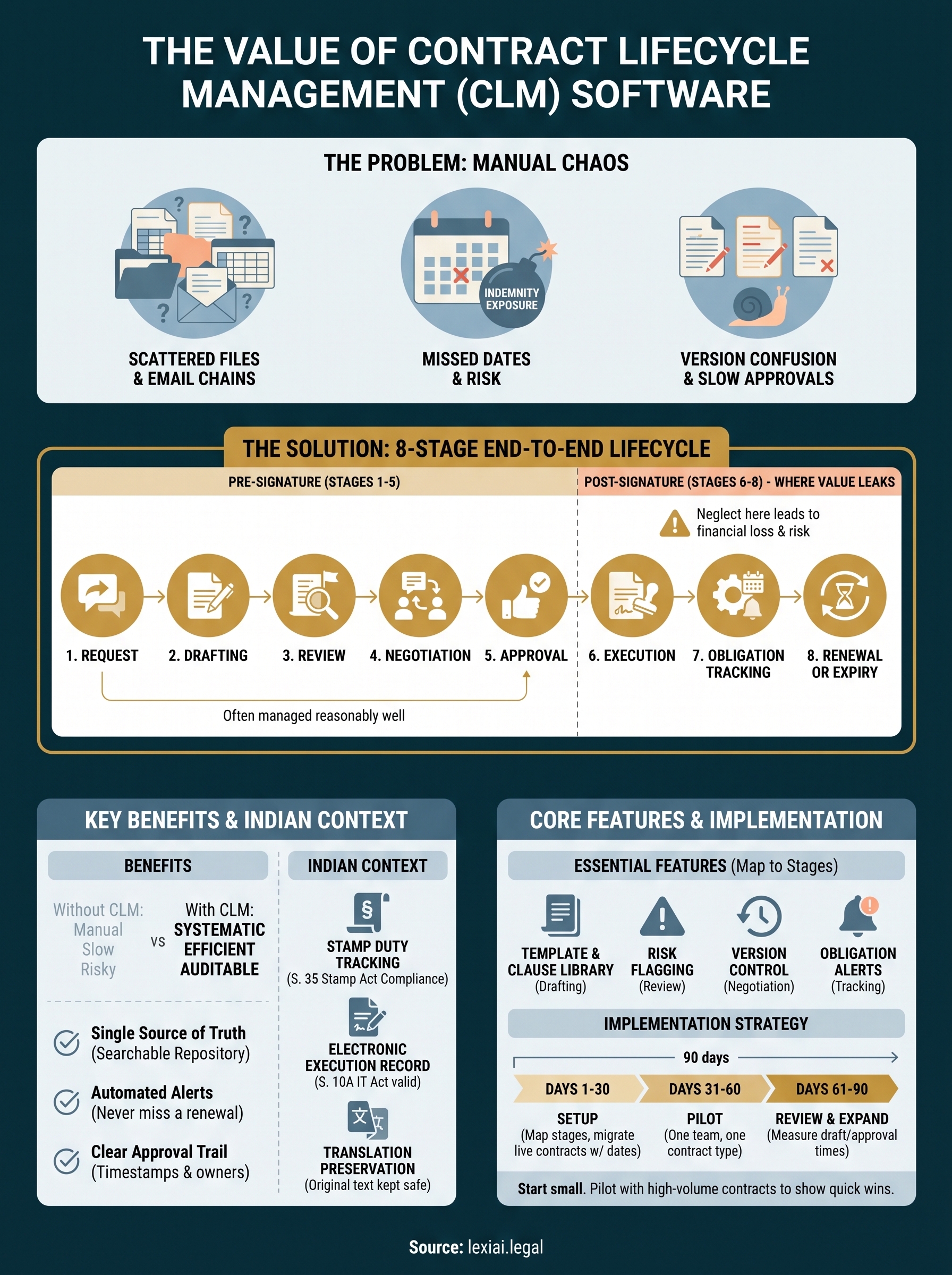
The right contract lifecycle management software is the one that fixes the stage where your contracts stall. Feature lists and benchmark scores come second. Map your eight stages, find the weak point, and score every vendor against that gap.
Indian teams have extra checks to make. Confirm that the tool records stamp duty and signature evidence, preserves the original text in translation, and keeps a full audit trail. Test it on ten live contracts, and keep a lawyer in charge of every risk decision.
Begin small. Run one contract type through a 90-day pilot, and measure days to first draft, days to approval, and renewals caught on time. To test this on your own documents, start a free LeXi AI trial and run a live contract through LeXi Desk.