

9 Best Contract Lifecycle Management Software Picks for 2026
Most law firms and legal teams still track contracts across email threads, shared drives, and sticky notes. That is exactly why contract management lifecycle software has become a real priority, not a nice-to-have, for anyone handling drafting, negotiation, renewals, and risk review at scale. A missed renewal date or an unflagged indemnity clause can cost far more than the price of a proper system.
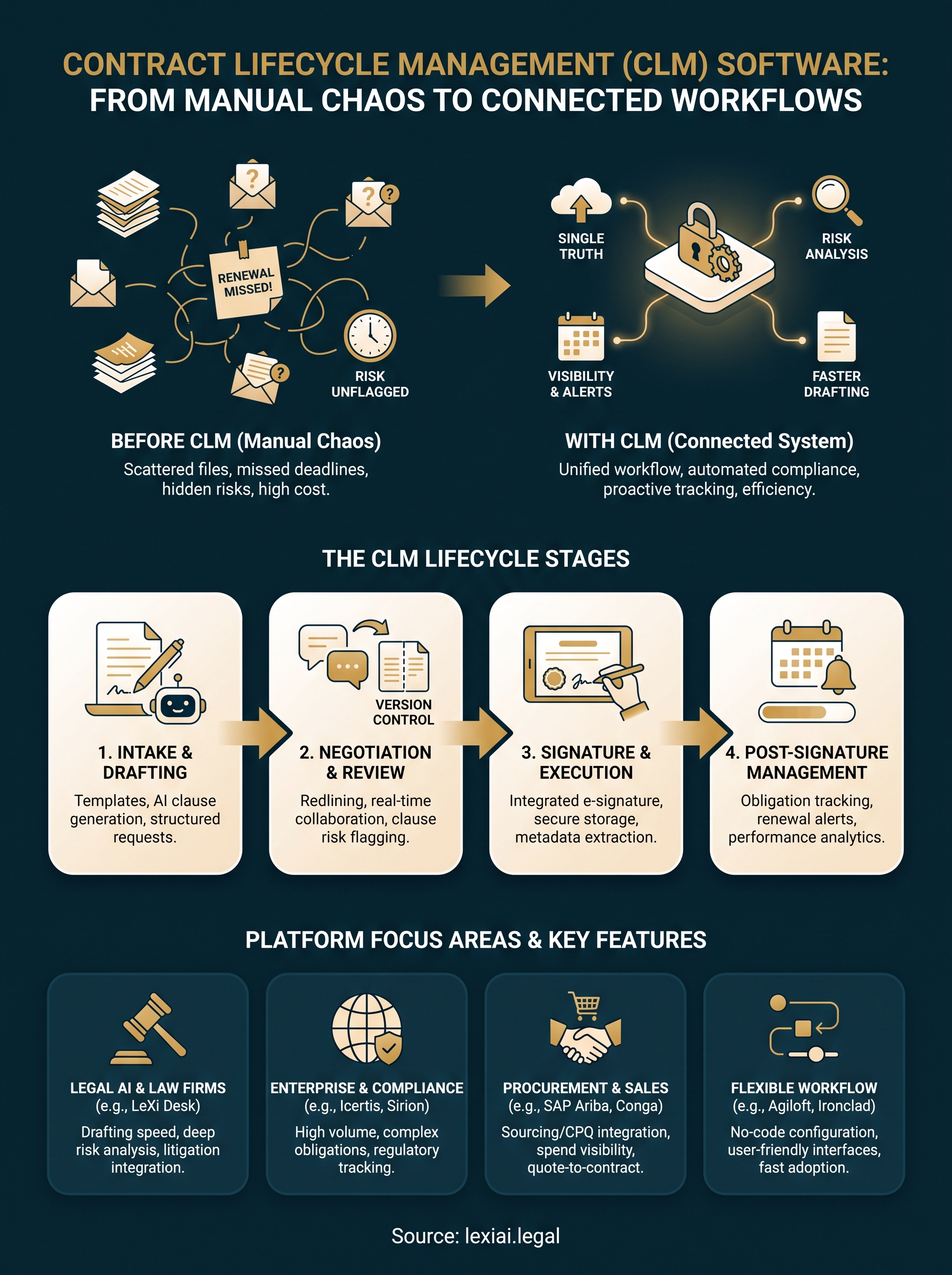
Contract lifecycle management, or CLM, refers to software that manages a contract from request and drafting through negotiation, signature, execution, and renewal, all in one connected workflow. A good contract lifecycle management system replaces scattered folders with a single source of truth, adds clause risk analysis, and gives legal teams visibility into obligations before they become disputes.
This list covers nine platforms worth evaluating in 2026, including tools built for Indian law firms using legal AI, corporate legal departments, and procurement teams. We look at drafting speed, clause risk flagging, integrations, and pricing, and where relevant, note how a platform like LeXi Desk handles full lifecycle management alongside litigation and research tools.
1. LeXi Desk by LeXi AI
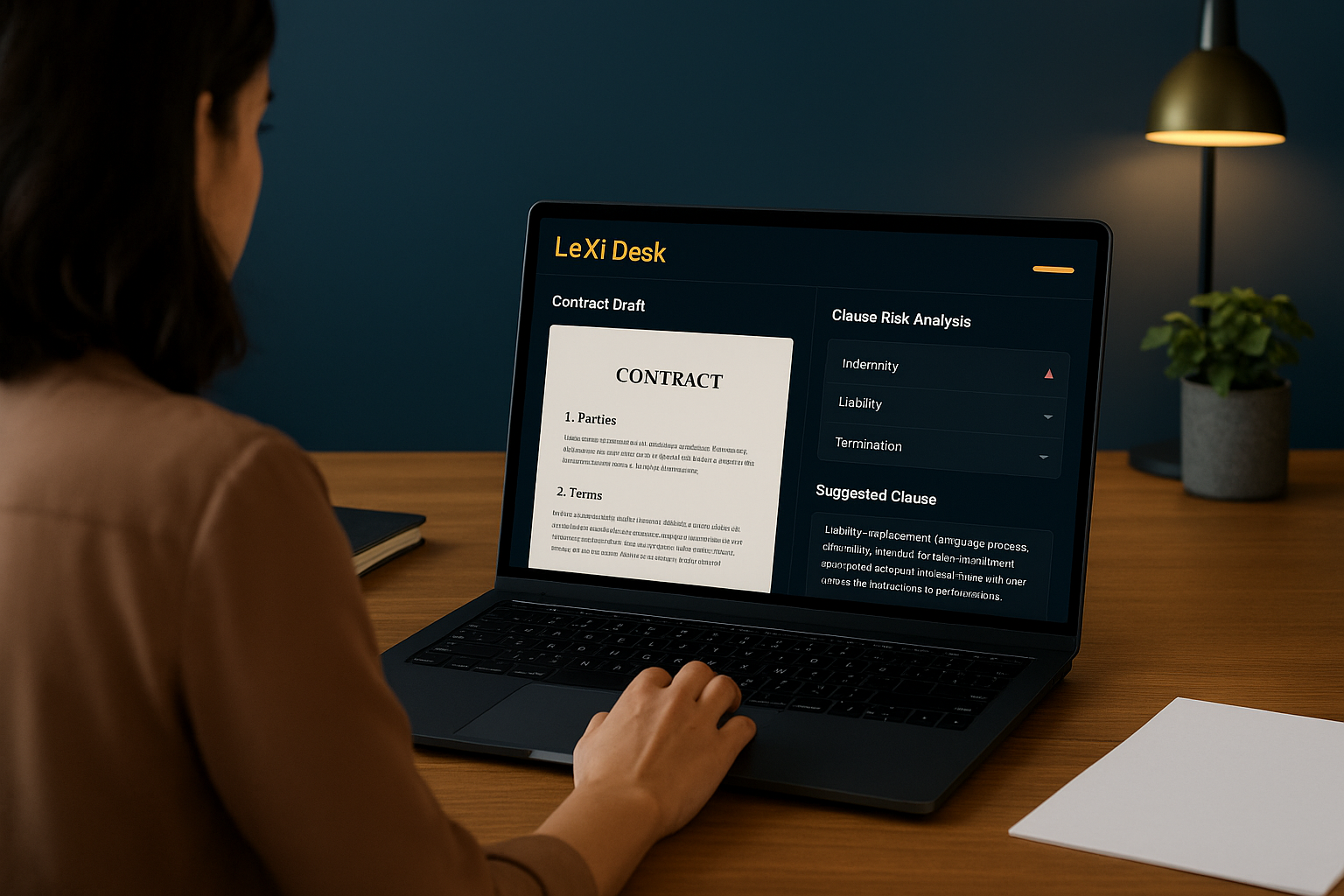
LeXi Desk is the contract lifecycle management module inside the LeXi AI platform, built specifically for Indian law firms, corporate legal teams, and enterprises that want drafting, clause risk analysis, and contract tracking under one roof instead of stitched-together tools. It answers the what is contract lifecycle management software question in the most practical way possible: it manages a contract from the first draft to renewal, with AI doing the heavy lifting at every stage.
How it works
You start a contract inside LeXi Desk using a template or an uploaded draft, and the AI reads the document line by line to flag risky clauses, missing terms, and unusual obligations before you send it out for review. Negotiation happens with version tracking built in, so you always know which clause changed and who changed it. Once a contract is signed, LeXi Desk keeps monitoring it, tracking renewal dates, obligation deadlines, and clause performance so nothing slips through email threads again.
A contract lifecycle management system only earns its keep when it catches the clause you would have missed at 11 p.m. before a filing deadline.
Key features
LeXi Desk covers the full contract lifecycle management process rather than just storage and e-signature, which is where many CLM tools stop short, and it maps closely to the practices that keep contracts moving from intake to renewal.
- Clause risk analysis that flags indemnity, liability, and termination clauses that deviate from your standard playbook
- AI clause generation that drafts replacement language matching your firm's risk tolerance, using the same AI drafting engine built for Indian legal documents
- Document summarization that condenses long agreements into a one-page brief for partners and clients
- Legal translation for contracts and filings that need to move between English and regional languages
- Full lifecycle tracking from intake and drafting through execution, renewal, and archival
- Integration with LeXi Agent for judgment search across Indian case law and LeXi LiTT for disputes that escalate to litigation
Best for
LeXi Desk suits Indian law firms, in-house legal teams, and enterprises that draft or review a high volume of contracts and want risk flagging from an AI legal assistant instead of hiring extra associates to redline every clause manually. It is also a strong fit for procurement teams doing procurement contract lifecycle management, since vendor agreements and purchase contracts benefit from the same clause risk checks as litigation-adjacent contracts. Teams already using LeXi Agent or LeXi LiTT get the most value, since contracts, research, and case prep sit in one connected system instead of three separate logins.
Pricing
LeXi Desk pricing depends on team size and whether you need the full LeXi AI suite or the contract module alone. Astute Lex Servicado Private Limited, the company behind LeXi AI, offers tiered plans for solo practitioners, chambers, and enterprise legal departments, with API access available for organizations that want to build custom contract workflows. You can review the LeXi AI plan tiers and request a demo directly on the LeXi Desk page.
2. DocuSign CLM
DocuSign CLM extends the e-signature product most Indian lawyers already know into a full contract lifecycle management solution, covering intake, drafting, negotiation, and post-signature obligation tracking. Firms that already run DocuSign for signatures often add CLM as the next logical step rather than adopting a completely new vendor.
How it works
Contracts start from a clause library or an uploaded template, and DocuSign CLM routes the draft through configurable approval workflows before it reaches the signature stage. Redlining happens inside Word or the browser, with side-by-side comparison so reviewers see exactly what changed between versions. After execution, the platform stores the signed document alongside metadata like renewal date and contract value, and it can trigger alerts before key deadlines pass.
The value of any CLM contract lifecycle management tool comes down to whether it catches a renewal date before your client does.
Key features
- Automated workflows that route contracts to the right approver based on value or clause type
- Clause and template library shared across teams to keep drafting consistent
- AI-assisted review that flags nonstandard language against a baseline playbook
- Reporting dashboards covering cycle time, bottlenecks, and renewal pipelines
- Native integration with the DocuSign e-signature product most firms already use
Best for
DocuSign CLM suits corporate legal departments and large firms with existing DocuSign accounts who want signature and lifecycle management under one vendor relationship. It works less well for solo practitioners or small chambers, since the platform is built around enterprise procurement cycles and multi-department approval chains rather than single-lawyer workflows.
Pricing
DocuSign does not publish flat CLM pricing; contracts are quoted per organization based on user count, document volume, and add-on modules like AI review, which is common across how CLM vendors structure their quotes. Expect a sales-led buying process with annual contracts rather than a self-serve monthly plan, which is worth factoring in if your firm needs to move fast.
3. Icertis Contract Intelligence
Icertis Contract Intelligence, often shortened to ICI, is an enterprise-grade contract lifecycle management system built for large organizations with global contract volumes and complex compliance needs. Multinational companies with an India presence often pick Icertis when procurement, sales, and legal all need to work off the same contract data.

How it works
Icertis centers its platform around what it calls a contract intelligence graph, which pulls structured data out of every clause, term, and obligation across your entire contract portfolio. Drafting happens through pre-approved templates and clause libraries, with the AI layer comparing new language against thousands of existing contracts to spot deviations. Once signed, the system tracks obligations, pricing terms, and compliance deadlines, and it can push alerts into Salesforce, SAP, or Microsoft Dynamics if those are already part of your stack.
A contract lifecycle management solution is only as useful as the data it can pull out of your contracts, not just the storage it offers.
Key features
- Contract intelligence graph that extracts obligations, dates, and pricing terms automatically
- Pre-built templates for procurement, sales, and licensing contracts across industries
- Compliance tracking for regulatory clauses across multiple jurisdictions
- Deep integrations with SAP, Salesforce, and Microsoft Dynamics
- Configurable approval workflows for multi-department sign-off
Best for
Icertis suits large enterprises and multinational legal departments running thousands of contracts a year across procurement, sales, and vendor management. Smaller firms and independent lawyers will find the platform heavier than they need, since the setup and configuration effort assumes a dedicated legal operations team rather than a handful of associates.
Pricing
Icertis does not publish pricing publicly and sells through enterprise contracts negotiated per organization. Expect a multi-month implementation timeline and annual licensing tied to contract volume and the number of integrated systems, which places it firmly in enterprise budget territory rather than mid-market reach.
4. Sirion
Sirion positions itself as an AI-first contract lifecycle management system built for legal and procurement teams managing high-value, high-risk agreements. It leans heavily on obligation tracking and risk scoring, which makes it a common pick for organizations that already treat contracts as a compliance asset rather than just signed paperwork.
How it works
Teams upload existing contracts or draft new ones from templates, and Sirion's AI extracts clauses, obligations, and key dates into a structured repository. Negotiation runs through redlining tools with version comparison, and the platform scores risk on each clause against a configurable playbook before approval. Post-signature, Sirion tracks obligation deadlines, payment milestones, and compliance triggers, sending alerts to the responsible owner rather than leaving it to someone's calendar reminder.
Lifecycle contract management only works when obligation tracking survives past the signature date, not just up to it.
Key features
- AI clause extraction that converts unstructured contract text into searchable, structured data
- Risk scoring applied to each clause against your organization's playbook
- Obligation management that assigns and tracks post-signature deliverables and payments
- Third-party paper support for redlining contracts drafted by the other side
- Analytics dashboards covering contract value, risk exposure, and renewal timelines
Best for
Sirion suits corporate legal and procurement teams handling supplier agreements, vendor contracts, and other paper where obligation tracking after signature matters as much as drafting speed. It is a reasonable fit for Indian subsidiaries of global companies that already use Sirion at the parent level, though standalone Indian firms may find the platform priced and scoped for larger contract volumes than they run.
Pricing
Sirion sells through annual enterprise contracts with pricing based on contract volume, user seats, and the number of modules activated, such as obligation management or third-party paper review. Public pricing is not listed, so budgeting requires a sales conversation, and smaller legal teams should ask directly whether a scaled-down tier exists before assuming enterprise-only pricing applies.
5. Agiloft
Agiloft markets itself as a no-code contract lifecycle management system, built so legal operations teams can configure workflows, fields, and approval chains without waiting on a developer queue. That flexibility makes it a common pick for legal departments that want to shape the platform around their own process rather than adapt their process to fit rigid software.
How it works
Teams build contract workflows using a drag-and-drop configuration layer, defining approval steps, clause libraries, and data fields specific to their organization. Drafting pulls from templates with conditional logic, so a vendor agreement and an NDA can follow entirely different approval paths inside the same system. Once signed, Agiloft tracks renewal dates, obligations, and custom milestones, and its AI layer can extract key terms from contracts uploaded from outside the platform.
A contract lifecycle management process built around your workflow works better than one that forces your workflow to match the software.
Key features
- No-code workflow builder for configuring approval chains and clause libraries without vendor help
- AI-based metadata extraction from legacy contracts uploaded in bulk
- Custom fields and record types tailored to procurement, sales, or legal-specific contracts
- Reporting and analytics covering cycle time, renewal pipelines, and bottleneck stages
- Integration options with Salesforce, Microsoft 365, and NetSuite
Best for
Agiloft suits legal operations teams and mid-size corporate legal departments that want to configure their own contract workflows rather than accept a vendor's fixed template. Firms without a dedicated legal ops resource may find the configuration burden heavier than expected, since the flexibility that makes Agiloft powerful also means someone has to build and maintain it.
Pricing
Agiloft offers tiered plans, including a starting tier aimed at smaller teams, though enterprise-grade AI extraction and unlimited workflow customization sit behind higher tiers with custom quotes. Expect pricing to scale with user count and contract volume, and confirm which AI features are included before assuming the entry tier covers your needs.
6. Ironclad
Ironclad built its name on contract workflow automation for fast-moving legal teams, and it remains a popular contract lifecycle management solution among startups and mid-size companies that want a clean interface over deep configuration options. Legal teams pick Ironclad when speed of adoption matters more than heavy customization.
How it works
Workflows start with Ironclad's visual workflow designer, where legal ops teams map out intake forms, approval steps, and clause libraries without writing code. Business teams submit contract requests through a simple form, and the system routes each request to the right approver based on contract type or value. Redlining happens inside a browser-based editor with version history, and once signed, Ironclad stores the document with searchable metadata and renewal alerts.
A contract lifecycle management solution that business teams actually want to use beats one that only legal understands.
Key features
- Workflow designer for building intake forms and approval chains without developer support
- Ironclad AI that reviews clauses against a playbook and suggests redlines
- Repository search that finds any clause or term across the entire contract portfolio
- Reporting dashboards tracking cycle time, approval bottlenecks, and renewal pipelines
- Integrations with Salesforce, Slack, and Microsoft Teams for request intake
Best for
Ironclad suits startups, mid-size companies, and legal teams that want business users outside legal to submit and track contract requests without confusion. It fits organizations prioritizing a smooth contract lifecycle management process for sales and procurement contracts over deep compliance tracking, which makes it a lighter option than Icertis or Sirion for teams without complex multi-jurisdiction requirements.
Pricing
Ironclad does not publish flat pricing and sells through annual contracts scoped to user seats and workflow volume. Expect a demo-led sales process, and confirm whether Ironclad AI features are bundled or sold as a separate add-on before signing, since this changes the effective cost significantly for smaller legal teams.
7. Conga CLM
Conga CLM sits inside the larger Conga revenue lifecycle suite, built for companies that want contract management tied directly to their CPQ and billing systems rather than running as a standalone tool. Sales-heavy organizations often pick Conga when contracts, quotes, and revenue data need to stay in sync across departments.
How it works
Contracts generate directly from approved quotes inside Conga, pulling pricing, terms, and product data so sales does not redraft what CPQ already calculated. Approval workflows route the draft through legal and finance based on discount level or contract value, and redlining happens through Conga's document generation engine with version tracking. After signature, the platform stores executed contracts alongside the original quote and billing record, which keeps renewal and revenue data connected instead of living in separate systems.
A contract lifecycle management solution built on top of your sales stack saves the most time when contracts start from a quote instead of a blank template.
Key features
- Quote-to-contract generation that pulls pricing and terms straight from CPQ
- Approval workflows configured around discount thresholds and contract value
- Clause library shared across sales, legal, and finance teams
- Document generation engine producing consistent contracts from structured data
- Integration with Salesforce and the broader Conga revenue suite
Best for
Conga CLM suits sales-driven organizations already running Conga CPQ or Salesforce, where contracts need to inherit pricing and product data automatically rather than being retyped by legal. It is a weaker fit for law firms and litigation-heavy legal teams, since the platform assumes a sales pipeline feeding contract creation rather than legal drafting contracts from scratch.
Pricing
Conga sells CLM through annual contracts bundled with its broader revenue suite, and pricing depends on which modules you activate alongside user count. Standalone CLM pricing is not published separately, so expect a sales conversation that scopes CPQ, billing, and CLM together rather than a simple per-seat quote.
8. SAP Ariba Contracts
SAP Ariba Contracts is the contract module inside SAP's procurement suite, built for organizations that already run SAP for purchasing, invoicing, and supplier management. Procurement teams pick it because contract data flows straight into the same system that handles purchase orders and vendor payments, rather than sitting in a separate silo.

How it works
Contract requests start from a sourcing event or a procurement need already logged inside Ariba, and the platform generates a draft using clause libraries tied to category, spend threshold, and supplier risk profile. Approval routing follows your procurement hierarchy, so a high-value supplier agreement moves through more sign-off layers than a routine purchase contract. Once executed, Ariba links the contract back to purchase orders and invoices, which means compliance teams can check whether actual spending matches the agreed terms without cross-referencing three systems.
A contract lifecycle management system tied to your procurement stack earns its cost when spend and compliance checks stop requiring three separate logins.
Key features
- Clause libraries organized by spend category and supplier risk tier
- Approval workflows mapped to procurement hierarchy and contract value
- Spend visibility linking executed contracts to purchase orders and invoices
- Supplier risk scoring integrated with SAP's broader vendor management data
- Native connection to SAP S/4HANA and Ariba sourcing modules
Best for
SAP Ariba Contracts suits procurement teams and enterprises already running SAP for purchasing and finance, where procurement contract lifecycle management needs to tie directly into spend data. It is a poor fit for law firms or litigation practices, since the platform assumes a procurement-driven contract flow rather than legal teams drafting agreements independently of a purchasing event.
Pricing
SAP does not publish standalone pricing for Ariba Contracts, and it typically sells as part of a broader Ariba or S/4HANA procurement bundle. Expect enterprise licensing negotiated per organization, with cost scaling based on transaction volume and which Ariba modules you activate alongside contracts.
9. Zycus Contract Management
Zycus Contract Management is part of the larger Zycus procurement suite, built for organizations that want contracts, sourcing, and supplier data managed inside one platform rather than bolted together from separate vendors. Indian enterprises already running Zycus for sourcing often extend into contracts as the next module rather than shopping for a standalone contract lifecycle management solution.
How it works
Contracts typically originate from a completed sourcing event or supplier negotiation already logged inside Zycus, and the platform drafts using clause libraries tied to category and risk profile. Approval workflows route the draft through legal and procurement based on contract value and supplier risk score, with AI flagging clauses that deviate from the approved playbook. After execution, Zycus tracks obligations, renewal dates, and compliance milestones, and it links the signed contract back to the original sourcing event so procurement teams can audit whether final terms match what was negotiated.
A contract lifecycle management process tied to sourcing data saves the most rework when the signed contract never drifts from what procurement actually negotiated.
Key features
- AI clause risk scoring that checks drafts against a configurable playbook
- Sourcing-to-contract linkage connecting negotiated terms directly to the final agreement
- Supplier risk profiles feeding into approval routing and clause selection
- Obligation and renewal tracking with alerts sent to the responsible owner
- Integration with the broader Zycus procurement and sourcing suite
Best for
Zycus suits procurement-heavy organizations and enterprises already using Zycus for sourcing, where procurement contract lifecycle management benefits from sitting alongside supplier negotiation data. Law firms and litigation teams will find little use for it, since the platform is built around procurement events rather than legal drafting from scratch.
Pricing
Zycus does not publish standalone pricing and sells through enterprise contracts scoped to transaction volume and which procurement modules you activate alongside contracts. Budgeting requires a direct sales conversation, and smaller legal teams outside procurement should confirm the module even fits their use case before requesting a quote.
Picking the CLM platform that fits your practice
The nine platforms above cover very different priorities, from SAP Ariba's procurement focus to Icertis's enterprise compliance graph. Your choice should depend on who drafts contracts day to day. Procurement-heavy organizations gain from tools tied to sourcing data, while law firms and corporate legal teams need drafting speed and clause risk analysis built for legal work, not purchasing workflows.
Most platforms on this list solve one piece of the puzzle well but leave you juggling separate tools for research, drafting, and litigation prep. That is the gap LeXi Desk closes for Indian legal practice, connecting contract lifecycle management with judgment search, case strategy, and courtroom preparation inside one system instead of three logins.
If your firm is still tracking renewal dates in a spreadsheet, do not wait for the next missed deadline to make the switch. Try LeXi Desk free on your own contracts and see how drafting, risk flagging, and renewal tracking work when they finally sit in one place.